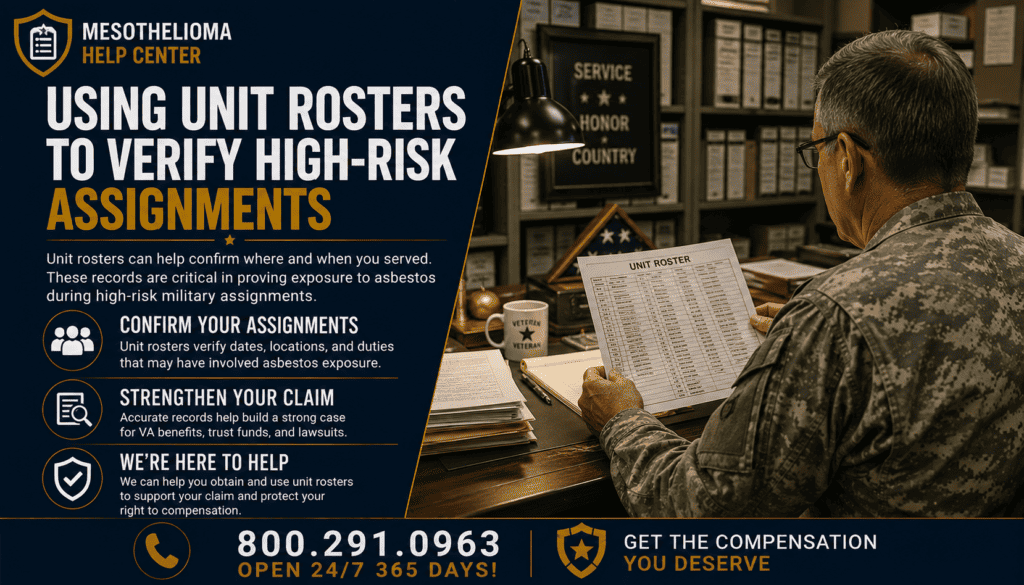
🪖 Using Unit Rosters to Verify High-Risk Assignments
Confirming Asbestos Exposure by Duty Station and Role
Unit rosters (muster rolls, morning reports, personnel accountability lists) place you at a specific unit, location, and timeframe—the missing link many mesothelioma claims need to prove you were there when asbestos exposure occurred. Paired with ship logs, base records, and MOS evidence, rosters help validate duty stations, shop assignments, and TDY details that strengthen VA, trust-fund, and civil claims.
📞 Need help locating unit rosters or morning reports? Call 800.291.0963 for free records support.
🧭 What Unit Rosters Prove
Rosters establish who served, where, and when.
They can show:
-
🧾 Your name assigned to a unit at a specific base/ship.
-
📅 Date ranges that overlap with asbestos-related repairs or operations.
-
💬 Temporary duty (TDY) or detachment to high-risk shops.
-
🧱 Proximity to boiler rooms, hangars, motor pools, or shipyards.
Goal: Tie your presence to known asbestos locations and windows of exposure.
📁 Types of Rosters by Branch
Different branches used different formats.
-
⚓ Navy/USMC: Muster rolls, watch/berthing lists, ship station bills.
-
🪖 Army: Morning reports, unit personnel rosters, DA strength reports.
-
✈️ Air Force: Unit personnel rosters, duty section lists, flightline shop rosters.
-
🛥️ Coast Guard: Muster lists, cutter station bills, duty section cards.
Goal: Identify the roster type your branch kept during your service period.
🏛️ Where to Request Unit Rosters
Start with federal archives and command history offices.
-
🏛️ National Archives (NARA) – unit rosters, morning reports, muster rolls.
-
⚙️ Naval History & Heritage Command – ship muster and station records.
-
🗂️ Unit/wing/base historians – command chronologies, shop lists.
-
🧾 State archives & veteran organizations – copies of locally stored rosters.
Goal: Retrieve the official lists that document your assignment dates and locations.
🧱 Using Rosters to Corroborate Exposure
Combine roster dates with high-risk events.
-
⚓ Match to dry-dock/overhaul periods in deck logs.
-
🧰 Align with work orders for insulation, boilers, gaskets.
-
🧭 Cross-check with blueprints showing asbestos in your shop/building.
-
💬 Link to buddy statements confirming your daily duties.
Goal: Build a synchronized timeline: person + place + asbestos activity.
🧾 Proving TDY and Shop-Level Exposure
Rosters often note sections/shops (e.g., Eng Dept, Boiler Shop, Airframes).
-
🧰 Shop lists show you worked around insulation, brakes, gaskets.
-
🧱 Section assignments place you in engine rooms, motor pools, hangars.
-
📜 Duty rosters (watch bills) can show engine-room watches and confined spaces.
Goal: Elevate exposure probability from “possible” to documented.
💼 What If Your Name Isn’t on a Monthly Roster?
Gaps happen—use adjacent proof.
-
🧭 Previous/next month rosters to bracket presence.
-
💬 Orders, pay stubs, leave records to confirm the same location.
-
🧾 Command chronologies and shop schedules naming you/your billet.
-
👥 Buddy statements from coworkers on the same watch/team.
Goal: Fill roster gaps with credible, time-stamped substitutes.
🩺 Linking Rosters to Medical Nexus Letters
Give doctors concrete dates and places.
-
🧾 Provide roster copies with highlighted months of exposure.
-
💬 Ask your physician to reference unit/location in the nexus letter.
-
⚙️ Include MOS + roster + maintenance logs in the medical file.
Goal: Enable a clear medical opinion: service exposure → mesothelioma.
⚖️ Using Rosters in Trust-Fund & Civil Claims
Rosters help meet product/site proof standards.
-
🏦 Trusts require presence at site + timeframe—rosters satisfy the site element.
-
🧱 Tie roster months to manufacturer records (Garlock, JM, etc.).
-
🧾 Provide certified/archival copies to accelerate review.
Goal: Unlock multiple claims by satisfying each fund’s exposure criteria.
🧠 Organizing Roster Evidence
Make it easy for raters and reviewers.
-
🗂️ File chronologically; label unit, base/ship, month/year.
-
✏️ Highlight your name and billet/section.
-
🔗 Cross-reference to deck logs, work orders, blueprints.
-
📎 Include a one-page timeline summarizing overlaps with asbestos work.
Goal: Present a clean, audit-ready package that speeds approvals.
🕊️ When to Get Professional Help
Archivists and experienced attorneys know where to look.
-
🧭 Locate hard-to-find rosters, shop lists, and watch bills.
-
🧾 Authenticate copies for VA/trust submissions.
-
⚙️ Integrate rosters with FOIA, BuShips, and maintenance evidence.
Goal: Ensure no assignment, shop, or exposure window is missed.
🤝 Where to Get Help
Our advocates obtain, organize, and cross-reference unit rosters with your other exposure records to build an airtight claim.
📞 Call 800.291.0963 for free roster retrieval and evidence building.
🧭 Summary
Unit rosters prove you were at the right place and time to be exposed. When combined with MOS codes, deck logs, work orders, and blueprints, they transform an exposure story into verifiable, time-stamped proof—the foundation of successful VA, trust-fund, and civil claims.
Your name on the roster is your name on the record—and on the path to justice.
800.291.0963