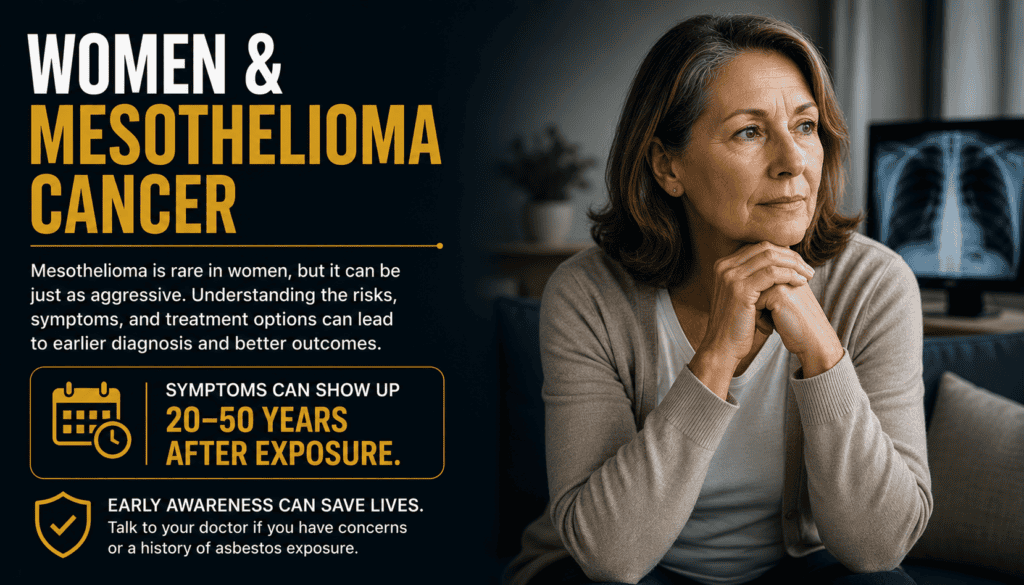
Women and Mesothelioma
Women and mesothelioma are linked through several possible asbestos exposure histories, including workplace materials, dust brought home by family members, and certain contaminated products. A diagnosis may follow exposure by many years, making dated work, household, and medical records important when investigating where contact occurred and whether an asbestos-related claim has a factual basis.
Women do not need to have worked in construction or shipbuilding for asbestos exposure to warrant investigation. This guide explains household, occupational, building, and product pathways; identifies records that can help confirm or rule out each source; and outlines why diagnosis, responsible parties, legal eligibility, and filing deadlines must be evaluated separately for each person.
👩⚕️ Women, Mesothelioma and Exposure History
Women can develop mesothelioma after asbestos exposure at work, at home or in the wider environment. A woman’s history should be reviewed on its own facts rather than assuming that only industrial employees encountered asbestos. The National Cancer Institute identifies asbestos as a major mesothelioma risk factor and recognizes household contact with asbestos-exposed workers as a possible risk.
Begin with the women’s mesothelioma lawsuits hub and the women’s asbestos exposure guide. Record workplaces, residences, family occupations, renovation dates and products separately. A possible exposure setting is a lead to investigate, not proof that asbestos was present or that a particular company is responsible.
| Possible exposure settings | What to establish | Evidence to request |
|---|---|---|
| Employment | Tasks, materials, nearby repairs | Personnel records, job tickets, building surveys |
| Household | Worker, dusty items, laundering routine | Family work records, dated statements |
| Consumer product | Exact product, period, lot or packaging | Receipts, photographs, testing tied to product |
| Building or community | Address, renovation or environmental event | Survey, abatement and site records |
🏠 Household and Take-Home Asbestos Exposure
Asbestos fibers can be carried home on work clothing, shoes, skin and hair. The National Cancer Institute describes evidence of increased mesothelioma risk among some family members of heavily exposed workers. A household claim still requires investigation of the worker’s tasks, the material involved and the contact experienced by the person diagnosed.
The secondhand exposure guide and laundry-related exposure page address distinct ways fibers may have entered a home. Preserve descriptions of where clothes were stored, who shook them out, how often they were washed and which family member worked at the source job.
| Question | Useful detail | Potential record |
|---|---|---|
| Who brought materials home? | Name, employer, job and dates | Employment or union records |
| How did contact occur? | Laundry, shared vehicle or living space | Household recollections |
| What was the material? | Insulation, brake or other specific product | Supplier invoices or jobsite files |
| When did contact happen? | Home address and overlapping years | Lease, tax or school records |
🏢 Workplace and Building Exposure
Women have worked in manufacturing, healthcare, schools, offices, military settings and other places where asbestos-containing materials may historically have been used. Employment at an older site alone does not establish exposure. Identify the specific material, whether it was disturbed and how the person encountered it.
For focused investigations, see women’s workplace exposure, healthcare work and teaching and school buildings. Construction records and contemporaneous maintenance logs may be more useful than assumptions based on a job title.
| Setting | Question | Record |
|---|---|---|
| School or hospital | Were materials repaired or removed? | Facilities and abatement files |
| Factory | Which line and task? | Production logs and product records |
| Office | What renovations occurred nearby? | Building permits and surveys |
| Military facility | Where and when was service performed? | Service and installation records |
🧴 Talc, Cosmetics and Other Product Questions
Talc is used in some cosmetics and personal-care products, and the FDA explains that talc deposits can be contaminated with asbestos. This does not mean every talc-containing product contains asbestos. Product-specific testing, manufacturing records, dates and batch information matter when evaluating an alleged exposure.
The asbestos-contaminated talc page and cosmetics exposure page can help organize a product history. Keep original packaging and purchase details when available; do not disturb or sample suspected asbestos yourself.
| Evidence | What it may show | What it cannot establish alone |
|---|---|---|
| Product photograph | Brand and package design | Asbestos content |
| Receipt or diary | Purchase or use period | Contamination of the batch |
| Laboratory report | Findings for a tested sample | Composition of every version or lot |
| Manufacturer record | Supply chain or formula | Individual use and exposure |
🩺 Diagnosis and Medical Documentation
Mesothelioma can affect the lining of the chest or abdomen. Symptoms and imaging may raise concern, but diagnosis and tumor type require medical evaluation. Ask the treating team which pathology and other records document the diagnosis, and keep medical questions separate from legal conclusions about exposure.
The mesothelioma in women guide provides a related overview. A clinician should review symptoms and treatment options; an exposure investigation separately evaluates whether identifiable asbestos sources and responsible parties can be supported.
| Medical record | Purpose | Follow-up |
|---|---|---|
| Pathology report | Documents diagnosis and type | Ask clinician about unclear terminology |
| Imaging report | Documents clinical findings | Keep dates and facility names |
| Treatment records | Documents care and expenses | Retain complete records |
| Exposure history given to clinician | Preserves reported background | Correct errors through clinical channels |
🗂️ Building an Individual Exposure Timeline
An exposure timeline links a person to places, tasks, products and dates. It should include confirmed facts, possible leads and unresolved questions in separate columns. A missing product name is a reason to seek records, not to substitute an unsupported identification.
The exposure timeline guide and historical photo documentation guide explain how to connect recollections with dated records. Save original files and note who supplied each statement.
| Timeline field | Example | Corroboration |
|---|---|---|
| Years and address | Home or workplace period | Lease, payroll, tax record |
| Task or contact | Laundry or maintenance work | Witness and work order |
| Material or product | Specific item under review | Invoice, label, survey or test |
| Confidence level | Confirmed, reported or unknown | Source citation and follow-up |
⚖️ Claims, Deadlines and Possible Compensation
Legal options depend on the diagnosis, evidence, responsible parties and governing law—not on gender alone. Depending on the circumstances, a person may explore a personal-injury lawsuit, a qualifying asbestos bankruptcy trust claim or another applicable benefit. These processes have different eligibility requirements and deadlines.
Review legal options for women, asbestos trust claims and filing deadlines. No payment amount or outcome can be assumed from a diagnosis or exposure history alone.
| Potential route | Core issue | Important limit |
|---|---|---|
| Personal-injury lawsuit | Claimant, defendants and evidence | State law and filing rules vary |
| Asbestos trust | Trust-specific product and exposure criteria | No automatic qualification |
| Veterans benefits | Service and eligibility requirements | Separate from a civil lawsuit |
| Wrongful-death claim | Authorized claimant and governing statute | Different from a living person’s claim |
📋 Practical Next Steps
Start with the medical records and a simple chronology. Ask family members for specific memories without coaching them toward a product or company name. Preserve photos, packaging and work records in their original form, then have a qualified professional review possible exposure sources and legal deadlines.
For a confidential inquiry, use Submit Your Case. An initial review does not establish eligibility or guarantee a claim.
| Priority | Action | Reason |
|---|---|---|
| First | Collect diagnosis and treatment records | Establishes the medical record |
| Second | List every possible exposure setting | Prevents overlooked pathways |
| Third | Request supporting work and product documents | Tests recollections against records |
| Fourth | Check deadlines for each potential claim | Protects time-sensitive options |
❓ Frequently Asked Questions
Can a woman develop mesothelioma without working in construction?
Yes. Asbestos exposure may occur in other jobs, households or environmental settings. The source in an individual case still needs investigation.
Does washing a family member’s work clothes prove exposure?
No. It may identify a potential take-home pathway; the worker’s job, asbestos-containing material and actual contact need supporting evidence.
Does every talc product contain asbestos?
No. The FDA describes contamination as a potential concern, not a characteristic of every product. Product-specific evidence is important.
Is a building’s age enough to prove exposure?
No. Investigators need information about the material, its condition, any disturbance and the person’s location.
What if the asbestos product name is unknown?
Preserve dates, sites and tasks first. Records and witnesses may help identify a product, but a claim still needs an adequate factual basis.
Can a family file after a woman dies?
Possibly. State law determines who may bring a wrongful-death or survival claim and the applicable deadlines.
Do all women with mesothelioma qualify for compensation?
No. Eligibility depends on the applicable program or legal claim, exposure evidence and other requirements.
What records should be gathered first?
Diagnosis and pathology records, employment and household histories, dated photos, relevant product information and witness contact details.
📝 Summary
Women may encounter asbestos through several different pathways. A useful review separates each possible source, documents the person’s actual contact, confirms the medical diagnosis and checks the rules for any proposed claim. Neither gender nor a possible exposure setting alone establishes legal responsibility.
🔗 Confirmed Sources
- National Cancer Institute — Asbestos Exposure and Cancer Risk
- National Cancer Institute — Mesothelioma Causes and Risk Factors
- National Cancer Institute — Mesothelioma
- U.S. Food and Drug Administration — Talc
📞 Submit Your Case
If you or a family member has a mesothelioma diagnosis, collect medical records and the dates and places of possible asbestos contact for an individual review. An inquiry does not establish exposure, eligibility or a guaranteed result.
Call 800.291.0963
Live chat is available 24/7, 365 days a year.
Submit Your Case
This page provides general information, not medical or legal advice. Diagnosis, exposure, legal responsibility and eligibility depend on individual evidence and applicable law.