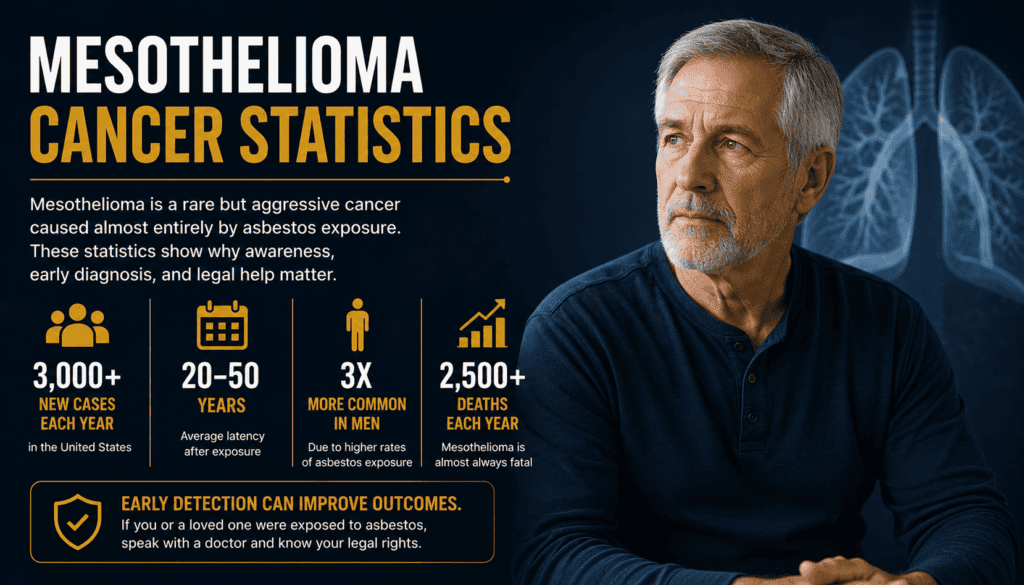
Mesothelioma Cancer Statistics
U.S. incidence, demographics, trends and what population survival data can—and cannot—tell an individual patient.
Mesothelioma is an uncommon cancer most often associated with asbestos exposure. Statistics can show how frequently it is diagnosed and how patterns change over time, but figures from different years, populations and cancer sites must not be combined as though they describe the same patients. This guide identifies the population and time period behind each key number and links to original public-health data.
Mesothelioma statistics at a glance
The Centers for Disease Control and Prevention (CDC) reported 2,669 new U.S. mesothelioma cases in 2022. The American Cancer Society (ACS), in a page revised February 3, 2026, describes approximately 3,000 diagnoses per year. The first is a reported count for a specific year; the second is a rounded annual description, not a 2026 case count.
| Measure | Reported figure | Population / period / source |
|---|---|---|
| New cases | 2,669 | United States, 2022; CDC U.S. Cancer Statistics |
| Approximate annual diagnoses | About 3,000 | United States; ACS overview revised February 2026 |
| Typical pleural diagnosis age | About 70 years | ACS description of people diagnosed with pleural mesothelioma |
| Typical peritoneal diagnosis age | Most diagnosed in their 50s | ACS description of peritoneal mesothelioma |
These are different statistical measures; they should not be added together or used to calculate an individual patient’s prognosis.
How many new cases occur?
Incidence means newly diagnosed cases in a defined population over a defined time. CDC’s September 10, 2025 report states that 2,669 cases were reported nationwide in 2022. That is a historical observation, not an estimate of cases diagnosed today. Cancer registry reports typically lag behind the current calendar year while records are collected and checked.
| Term | What it means | Reader caution |
|---|---|---|
| Case count | Number of diagnoses | Always identify calendar year and geography |
| Incidence rate | New cases relative to population | Check whether rate is age-adjusted |
| Estimated cases | Statistical projection | Do not describe as an observed count |
| Prevalence | People living with a diagnosis | Not interchangeable with annual incidence |
Source: CDC, Incidence of Malignant Mesothelioma (September 2025).
Are mesothelioma rates increasing or decreasing?
The CDC reports that the U.S. rate of new mesothelioma cases is declining, associated with reduced asbestos exposure. The ACS explains that U.S. rates increased from the 1970s into the 1990s, then leveled off and decreased slightly. A long delay between exposure and diagnosis means older exposures can still result in cases decades later.
| Period or observation | Documented interpretation |
|---|---|
| 1970s–1990s | ACS reports an increase in U.S. mesothelioma rates |
| After the 1990s | ACS reports leveling off followed by a slight decrease |
| CDC report issued 2025 | CDC describes a declining U.S. incidence rate |
| Current-year numbers | Require a dated dataset or explicitly labeled projection |
For updated analyses, the National Cancer Institute’s SEER program released incidence data through 2023 in April 2026 and preliminary estimates through 2024 in June 2026. Those releases do not turn the CDC’s 2022 case count into a current-year count.
Who is most often diagnosed?
Mesothelioma occurs more often in men than women in U.S. data. The ACS attributes this pattern in part to historical differences in occupational asbestos exposure. Mesothelioma is more common among older adults because disease can develop decades after exposure. The ACS places average age at diagnosis for pleural mesothelioma at about 70 and says most people diagnosed with peritoneal mesothelioma are in their 50s.
| Group | What ACS reports | Important limitation |
|---|---|---|
| Men | Mesothelioma is more common than among women | Not a statement that women cannot develop disease |
| Older adults | Mesothelioma is more common | Not exclusive to older adults |
| Pleural mesothelioma | Average diagnosis age about 70 | Does not apply automatically to peritoneal disease |
| Peritoneal mesothelioma | Most diagnoses in people in their 50s | Not a prediction for any individual |
Age, sex and workplace history can help researchers describe patterns, but none of these characteristics can diagnose cancer.
Asbestos exposure and latency
Exposure to asbestos causes most mesothelioma cases, according to CDC. Historically, exposure could occur in shipyards, construction, industrial facilities, maintenance work and other settings involving asbestos-containing materials. Household exposure from fibers brought home on work clothing has also been recognized. An exposure history is important to discuss with a clinician, but exposure alone does not establish that cancer is present.
| Concept | Meaning |
|---|---|
| Occupational exposure | Contact with asbestos during work |
| Secondary exposure | Fibers carried from a work environment to another setting |
| Latency | Long interval between exposure and diagnosis |
| Exposure history | A record of workplaces, products, dates and possible sources |
People with known exposure and new persistent symptoms should seek medical assessment rather than relying on statistics or self-diagnosis. See the site’s mesothelioma prognosis overview for discussion of individual clinical factors.
Understanding survival statistics
Survival rates describe groups of people diagnosed in earlier years. They do not tell any individual how long they will live. Outcomes differ by pleural versus peritoneal disease, cancer cell type, extent of disease, general health, treatment options and response. Survival figures also vary by whether a study reports overall survival, relative survival or a median.
| Statistic | What it describes | What it does not mean |
|---|---|---|
| Median overall survival | Time by which half a study group has died | A personal deadline |
| Five-year relative survival | Survival compared with expected survival in a comparable population | An individual probability or cure rate |
| Overall survival | Time from a defined starting point until death from any cause | A direct measure of treatment benefit without comparison |
| Study survival estimate | Result in a specific enrolled population | A result for every patient or disease site |
Do not apply a pleural-only survival percentage to peritoneal mesothelioma or combine statistics from different diagnosis periods. For a dedicated explanation, read mesothelioma life expectancy.
How to interpret cancer data accurately
Reliable interpretation starts by checking the source, calendar years, case definition and geography. An age-adjusted incidence rate and a raw number of cases answer different questions. A newer publication may still report diagnoses from several years earlier because cancer surveillance takes time. Differences between studies can reflect changing treatments, disease sites, selection criteria and follow-up duration.
| Before sharing a statistic | Ask this question |
|---|---|
| Date | What years were cases diagnosed or deaths recorded? |
| Population | United States, a state, a registry region or selected hospital patients? |
| Disease definition | All mesothelioma or pleural disease only? |
| Measure | Observed count, estimated count, rate or survival? |
| Comparison | Are populations and methods comparable? |
The National Cancer Institute’s SEER*Explorer lets researchers examine cancer measures by demographic group and time period; results must still be checked for the precise disease classification selected.
What patients and families can do
If you or a family member has received a diagnosis, ask the treating team which statistics, if any, apply to the specific cancer site and clinical situation. An oncologist can explain pathology, imaging, treatment goals and how new information changes an individualized outlook. A second opinion at a center experienced with mesothelioma may help clarify options.
| Practical step | Why it helps |
|---|---|
| Confirm pathology and disease site | Avoids applying figures for the wrong diagnosis |
| Ask about stage and cell type | Places group statistics in clinical context |
| Review treatment choices | Clarifies benefits, risks and goals |
| Keep exposure and work records | Helps organize medical and potential legal questions |
| Discuss symptoms and quality of life | Supports timely symptom management |
Explore mesothelioma treatments, surgery and chemotherapy for treatment-specific information.
Frequently asked questions
How many people are diagnosed with mesothelioma in the United States each year?
The ACS describes about 3,000 new U.S. diagnoses annually. CDC reported an observed count of 2,669 for 2022; the figures refer to different statistical descriptions.
Is mesothelioma becoming more common?
CDC describes a declining U.S. incidence rate. Trends vary by country and period, so a claim about a particular place should cite its own data.
What is the average age at diagnosis?
The ACS reports an average of about 70 for pleural mesothelioma and says most people diagnosed with peritoneal disease are in their 50s.
Are men diagnosed more often than women?
Yes, according to ACS descriptions of U.S. cases. Historical differences in asbestos exposure likely contribute; women can also develop mesothelioma.
Does asbestos exposure mean I will develop mesothelioma?
No. Exposure increases risk but does not establish a diagnosis. Discuss exposure history and persistent symptoms with a qualified clinician.
Can a five-year survival rate predict my life expectancy?
No. It describes outcomes for a past group and cannot predict an individual’s course.
Why do mesothelioma case numbers differ between websites?
Sources may use different years, geography, case definitions, observed counts, projections or reporting methods.
Where can I find official mesothelioma statistics?
Start with CDC U.S. Cancer Statistics, the National Cancer Institute SEER program and the American Cancer Society; always check the reporting period.
Confirmed Sources and Reporting Dates
- CDC — Incidence of Malignant Mesothelioma; published September 10, 2025; U.S. cases in 2022.
- American Cancer Society — Key Statistics About Mesothelioma; revised February 3, 2026.
- National Cancer Institute — SEER 1975–2023 Data; updated April 22, 2026.
- NCI SEER*Explorer; incidence, mortality and survival data with defined time periods.
Statistics review date: September 18, 2026. Figures are labeled by their original reporting periods, not represented as new diagnoses in 2026.
Questions About Mesothelioma or Asbestos Exposure?
Call 800.291.0963. Live chat is available 24/7, 365 days a year. Submit Your Case to ask about next steps. No compensation or outcome is guaranteed.
⚕️ Legal & Medical Information Disclaimer
This article is general educational information, not individualized medical or legal advice. Ask a qualified clinician about diagnosis, prognosis and treatment, and a licensed attorney about legal questions.