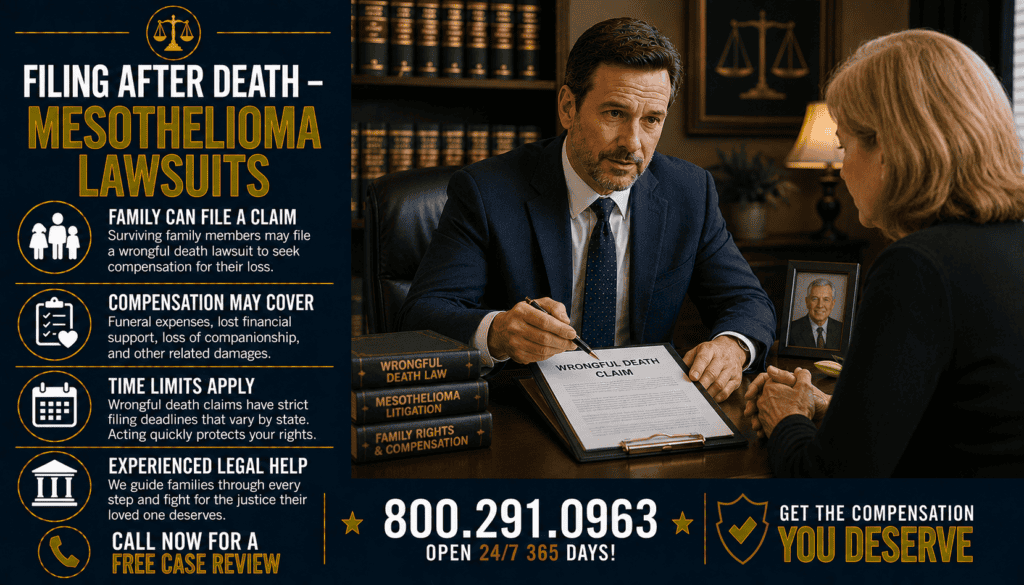
Filing After Death: Mesothelioma Lawsuits
Filing a mesothelioma lawsuit after death may allow eligible family members or an estate representative to pursue asbestos-related claims, depending on state law. The first steps are identifying the proper claimant, checking filing deadlines, and preserving the deceased person’s medical, employment, military, and asbestos exposure records before they become harder to locate.
Families may be able to pursue a wrongful-death claim, a survival claim, or both, but these are different legal rights with different rules for who files and what losses may be recovered. This guide explains the evidence to gather, how probate can affect an estate claim, and why an existing lawsuit needs a prompt procedural review.
⚖️ Which Mesothelioma Claims May Be Filed After Death?
A death does not automatically extinguish every asbestos-related legal claim. State statutes determine whether a deceased person’s personal-injury claim survives and whether specified survivors have a separate wrongful-death claim. The person entitled to bring each claim, available damages, and filing deadline must be checked independently.
The wrongful-death lawsuits hub provides related information; filing a wrongful-death claim for asbestos exposure addresses a related but distinct topic.
| Question | Survival claim | Wrongful-death claim |
|---|---|---|
| Whose loss? | The deceased person’s legally surviving claim | Losses identified by the governing wrongful-death statute |
| Who files? | Usually an authorized estate representative or other permitted successor | The representative or eligible survivors specified by state law |
| When does it arise? | From the person’s underlying injury claim | Generally arises from the death, subject to state law |
| What must be shown? | Surviving claim and its required elements | Statutory standing, liability and death-related elements |
👥 Who Can File and Why Authority Matters
A spouse, child, executor, administrator, or other relative may have a role, but family relationship alone does not establish legal authority for every claim. Review the applicable statute, will, probate appointment, and any court order before filing or signing a release. An executor named in a will may still need formal appointment for a particular action.
Read what executors should know about asbestos claims and how probate affects mesothelioma lawsuits for related documentation questions.
| Document | What it may establish | What it does not establish |
|---|---|---|
| Death certificate | Identity and recorded death details | Who has authority to sue |
| Will | Named executor and stated wishes | That a court has appointed the executor |
| Letters testamentary or administration | Court-appointed representative, where required | Standing for every separate wrongful-death claim |
| Family relationship records | Potential statutory beneficiary relationship | That every relative can file individually |
⏰ Filing Deadlines After a Mesothelioma Death
There is no single nationwide deadline for mesothelioma claims after death. States may use different accrual rules, limitation periods, tolling provisions, and requirements for wrongful-death and survival actions. A prior diagnosis, an earlier lawsuit, and the date of death can each matter differently. Do not assume a death restarts an expired personal-injury deadline.
For related context, see the deadlines and statute of limitations hub and claims filing process hub.
| Date or event | Why it matters |
|---|---|
| First diagnosis and notice | May be relevant to accrual under governing law |
| Date of death | May trigger a distinct wrongful-death period |
| Earlier complaint or trust filing | May affect the procedural posture, not necessarily other deadlines |
| Court service of a statement noting death | May trigger a federal substitution deadline in an existing case |
📂 What Happens to a Lawsuit Already Filed?
If the person filed a lawsuit before death, the case may require substitution of a proper party rather than a completely new filing. Under Federal Rule of Civil Procedure 25(a), when a claim survives, the 90-day substitution period is tied to proper service of a statement noting death—not simply the date of death. State-court rules and case-specific orders can differ.
Ask the existing lawyer for the docket, filed complaint, pending deadlines, settlement status, and any notices or motions concerning death. A surviving personal-injury claim and a new wrongful-death claim may require different procedural steps.
| Check | Why |
|---|---|
| Court and case number | Identifies the applicable procedural rules |
| Statement noting death and service | Determines whether a substitution clock may have started |
| Representative appointment | Helps identify the proper party |
| Pending discovery or trial dates | Prevents avoidable missed court obligations |
🏭 Reconstructing Asbestos Exposure After Death
The person who knew the most about a worksite may no longer be available to explain it. Gather job dates, employers, unions, military assignments, facility names, coworkers, photographs, product labels, invoices and past testimony. Record what each item actually proves; an old job title or photograph does not, by itself, establish a specific asbestos-containing product or defendant.
Start with documenting an asbestos exposure history, using historical photos, and linking products to defendants.
| Record | Possible contribution | Follow-up needed |
|---|---|---|
| Payroll, union or tax records | Employer and employment period | Actual worksite and task |
| Military service records | Unit, duty and assignment dates | Specific location and material |
| Coworker statement | Work conditions and observed products | Basis of knowledge and dates |
| Photo or product invoice | Location or manufacturer lead | Authenticity and connection to the worker |
🩺 Medical and Death Records
Preserve pathology reports, imaging, treating-clinician records, treatment expenses, and the death certificate. A diagnosis documents illness but does not by itself identify an asbestos product or legally responsible party. A death certificate may also need to be read alongside the complete clinical record when cause of death is disputed.
The medical evidence guide explains why clinical proof and exposure proof serve different purposes.
| Record | Use |
|---|---|
| Pathology and diagnostic reports | Documents the diagnosis and its basis |
| Treatment and billing records | Documents care and potential economic losses |
| Death certificate | Records death information; may not resolve every causation question |
| Prior recorded exposure history | Provides leads that require independent verification |
📜 Probate and Estate Administration
Probate can be relevant when an estate must appoint a representative or receive proceeds from a survival claim. It does not follow that every wrongful-death recovery is an estate asset: state law determines the claimant, beneficiaries, distribution and possible creditor treatment. Keep estate administration separate from the question of who owns a particular claim.
For a focused review, see probate and mesothelioma lawsuits and executor responsibilities in asbestos claims.
| Issue | Question |
|---|---|
| Appointment | Is a court-appointed representative required? |
| Claim ownership | Does this claim belong to the estate or statutory beneficiaries? |
| Distribution | Who receives any recovery under governing law? |
| Existing case | Is substitution or another court filing required? |
💼 Damages and Possible Payment Sources
Potential damages depend on the claim and jurisdiction. A survival action may concern losses the person sustained before death; a wrongful-death action may concern legally recognized survivor losses. Medical bills, lost financial support, funeral expenses, and other categories should not be presented as automatically recoverable in every state.
Lawsuits, asbestos bankruptcy trusts, and benefits programs are different possible payment routes with separate eligibility rules. The wrongful-death damages guide and damages calculation guide offer related questions to review.
| Potential issue | Records to gather | Important limit |
|---|---|---|
| Treatment costs | Bills, statements and insurance records | Recoverability and offsets vary |
| Lost support | Income, benefits and household financial records | Depends on claim and beneficiaries |
| Funeral expenses | Invoices and proof of payment | Not recoverable under every theory |
| Other claimed losses | Contemporaneous records and witness accounts | Availability differs by jurisdiction |
🗂️ Practical Steps for Families
First, identify whether a lawsuit or trust claim was already filed and preserve its case number and correspondence. Next, obtain the death certificate and medical records, gather the deceased person’s work history, and identify who may have authority to act. Then have the applicable state’s deadlines and filing requirements reviewed before any complaint, trust submission or settlement release is signed.
If a possible exposure source is uncertain, the guide to filing without knowing the exposure source explains how to distinguish investigation leads from substantiated allegations.
| Priority | Action | Purpose |
|---|---|---|
| Immediate | Identify open cases and deadline notices | Protect existing procedural rights |
| Next | Confirm claimant and estate authority | Avoid filing in the wrong name |
| Next | Preserve medical and worksite records | Reduce loss of evidence |
| Before signing | Review releases, fees and possible liens | Understand what an agreement resolves |
❓ Frequently Asked Questions
Can a mesothelioma lawsuit be filed after someone dies?
Potentially. State law determines which claims survive or arise from death, who can bring them, and the applicable deadlines.
Is a wrongful-death lawsuit the same as a survival action?
No. They generally address different rights and losses; the precise distinction depends on the jurisdiction.
Does the spouse automatically have authority to file?
Not for every claim. A statute or court appointment may identify a different proper claimant.
Does death restart the filing deadline?
Do not assume so. A wrongful-death claim may have its own period, while an underlying injury claim can have different rules.
What if a lawsuit was already pending?
The court may require a substitution or other filing. Review the docket and applicable court rules promptly.
Is probate always required?
No universal rule applies. The type of claim and state law determine whether an estate representative or probate proceeding is needed.
What if the family does not know the asbestos product?
Preserve jobsite, employment, military and witness records, then investigate the product and responsible party before making factual allegations.
Are asbestos trust claims the same as lawsuits?
No. Each trust has its own published eligibility and filing requirements, which must be checked separately.
📝 Summary
Filing after a mesothelioma death starts with identifying the correct claim and claimant, reviewing the applicable deadline, and protecting medical and asbestos exposure evidence. A pending lawsuit, estate appointment, and potential wrongful-death claim may each require a different step under the governing law.
| Question | Next step |
|---|---|
| Which claim? | Distinguish survival from wrongful death |
| Who files? | Verify statutory standing or representative authority |
| When? | Check each claim’s deadline and any pending court clock |
| What proof? | Preserve diagnosis, death and source-specific exposure records |
🔗 Confirmed Sources
- Cornell Legal Information Institute — Survival Statute
- Cornell Legal Information Institute — Wrongful Death
- Federal Rules of Civil Procedure — Rule 25
- National Cancer Institute — Asbestos Exposure and Cancer Risk
- U.S. EPA — Learn About Asbestos
📞 Submit Your Case
If a loved one died after a mesothelioma diagnosis, gather any existing case papers, diagnosis and death records, work history, and documents showing who may act for the estate. A case review can help identify questions about the proper claimant, potential exposure sources and applicable deadlines.
Need help now? Call 800.291.0963.
Live chat is available 24/7, 365 days a year.
Submit Your Case
General information only; not legal or medical advice. Eligibility, deadlines, damages and authority depend on the facts and applicable law.