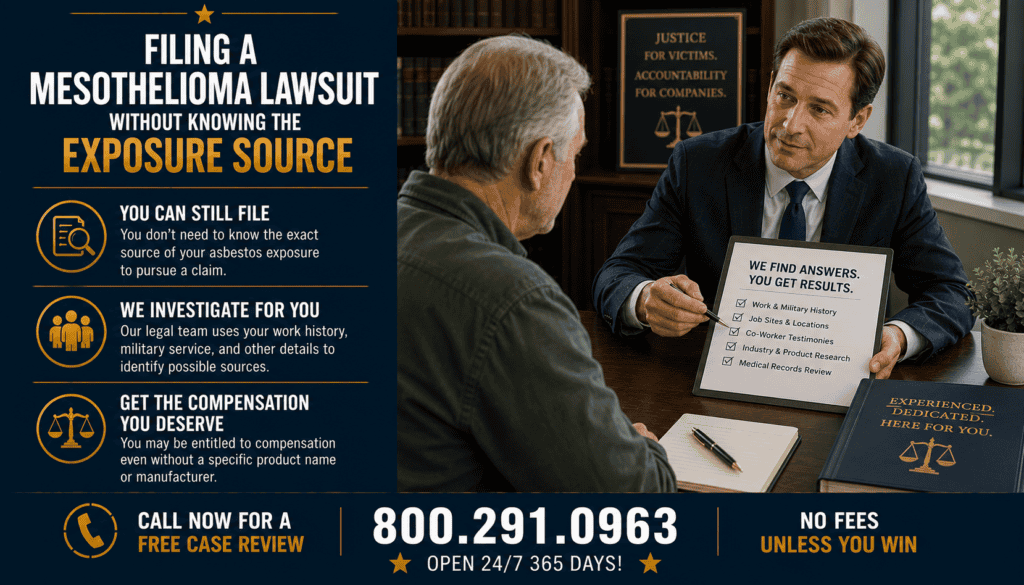
Filing a Mesothelioma Lawsuit Without Knowing the Exposure Source
Not remembering where asbestos exposure occurred—or which company made a material—does not necessarily end an investigation. It does mean the evidence must be reconstructed carefully. A mesothelioma diagnosis, workplace history, and a suspected asbestos product answer different questions, and none should be presented as proof of the others.
This guide explains how to start with confirmed facts, investigate missing sources, and discuss filing deadlines and potential claims without guessing at a defendant. Whether a lawsuit can actually be filed depends on the evidence and law governing the individual case.
🔎 What “Unknown Exposure Source” Means
Not knowing the exposure source can mean remembering a workplace but not a product name, knowing a product but not its manufacturer, or having no clear recollection of where exposure occurred. These are different evidence problems. A diagnosis alone does not identify a responsible company, and a suspected workplace alone does not prove asbestos was present.
Asbestos-related disease may appear decades after exposure, so old records and recollections can be incomplete. The National Cancer Institute explains that symptoms may arise many years after exposure and that exposure may also occur through fibers carried home from work. An investigation should consider occupational, household and other plausible histories without assuming any one route applies to a particular person.
The practical starting point is a list of what is known, what is suspected, and what remains unverified. A person can request a case evaluation without first supplying a complete manufacturer list; whether a lawsuit can be filed is a separate question governed by facts and applicable law.
| What is known | What remains unknown | Useful next inquiry |
|---|---|---|
| Workplace and years | Material or brand | Work orders and coworkers |
| Product description | Manufacturer | Labels, invoices and specifications |
| Diagnosis | Exposure setting | Work, residence and household history |
🗂️ Start With Facts You Can Confirm
Begin with the diagnosis and a chronological account of employment, military service, residences, and relevant household contacts. Preserve exact dates when available; use approximate ranges when not. Identify each employer, job site, department, task, and coworker who may recall the work.
Use how to document an asbestos exposure history and tracking work history to prove exposure to organize these details. The goal is to identify records worth obtaining, not to turn a possible lead into a proven fact.
| Record | What it may establish | What it does not establish |
|---|---|---|
| Pathology or diagnosis report | Medical diagnosis | Responsible product |
| Payroll or service record | Workplace and time | Asbestos content |
| Coworker account | Tasks and nearby activity | Every product manufacturer |
| Product invoice | Product supplied to site | Personal exposure by itself |
🏭 Reconstruct Workplaces and Missing Records
Old pay stubs, tax forms, union records, personnel files, job tickets, service records, building plans, and contractor rosters may place a person at a site during a relevant period. A document that establishes employment does not automatically identify an asbestos product. Match it with the task and material evidence whenever possible.
If records are scarce, see finding old pay stubs and leave records and building a case from limited records. Preserve original files and record where each copy came from.
| Record source | Possible detail | Cross-check |
|---|---|---|
| Union or employer archive | Job and assignment dates | Site and department |
| Tax or payroll file | Employer and period | Actual work tasks |
| Facility maintenance file | Repairs and materials | Room and dates |
| Photographs or logs | Site context | Authenticity and provenance |
⚙️ Move From Job Site to Product and Manufacturer
A workplace history can suggest where to look for product invoices, purchase orders, specifications, maintenance records, photographs, or coworkers with direct knowledge. An old product label may help identify a manufacturer; the presence of a manufacturer at a site does not establish that the claimant encountered its asbestos-containing product.
Compare each proposed product against dates, location, tasks, and available material evidence. The site guide to linking products to defendants addresses this distinct step. Do not list a company as responsible solely because it operated in the same industry or appeared on a historical supplier list.
| Question | Evidence to seek |
|---|---|
| Was the material asbestos-containing? | Reliable product documentation or material testing |
| Was it present at this site? | Invoice, specification or site record |
| Was it present during this job? | Dates and installation or removal records |
| Was the person exposed to it? | Tasks, proximity and witness evidence |
🏠 Consider Household and Other Exposure Routes
If no direct workplace source is apparent, ask whether someone in the household handled dusty work clothes or whether the person lived near a documented source. The National Cancer Institute describes household exposure as a recognized concern, but an individual claim still needs evidence of the actual source, contact, and applicable legal requirements.
For a separate discussion of household scenarios, see legal options after secondary household exposure. Do not assume that every mesothelioma diagnosis has a traceable occupational or household source.
| Setting | Useful question | Caution |
|---|---|---|
| Household | Who brought work clothing home? | Relationship alone is not exposure proof |
| Residential | Was a specific material disturbed? | Building age alone is insufficient |
| Community | Is there a documented source and pathway? | Proximity alone does not establish a claim |
🩺 Keep Medical Proof Separate From Source Identification
Pathology reports, clinical records, and a treating specialist’s documentation may establish the diagnosis and medical history. They generally do not, by themselves, establish which manufacturer supplied a material at a job site. Keep medical evidence and exposure evidence in separate folders, then connect them only where supported.
Review medical evidence in asbestos litigation for the role of clinical records. Do not delay medical care while researching old jobs or products.
| Medical documentation | Exposure documentation |
|---|---|
| Pathology and diagnosis | Employment and site history |
| Treatment records | Product and material records |
| Clinical chronology | Witnesses and work tasks |
⚖️ Can a Lawsuit Be Filed Before Every Source Is Identified?
Potentially, but not automatically. The answer depends on the governing jurisdiction, the factual basis available, the defendants that can properly be identified, and procedural rules. In federal civil litigation, Rule 11 requires a reasonable prefiling inquiry and evidentiary support for factual allegations, or a specifically identified basis to expect support after further investigation or discovery. State-court requirements may differ.
After a properly filed case, discovery can allow requests for relevant, nonprivileged documents and witness information within applicable limits. Discovery is not a substitute for having a reasonable factual basis to bring a claim, and it does not guarantee that a missing source will be found. The site’s mesothelioma case evaluation page explains the initial review.
| Stage | Typical question | Important limit |
|---|---|---|
| Initial consultation | What facts and records exist? | Not a filed lawsuit |
| Pre-filing review | Is there a reasonable basis for claims? | No speculative defendants |
| Discovery if a case proceeds | What relevant records can be requested? | Subject to rules and court limits |
| Further case review | Do new facts support or change claims? | Unsupported contentions must not persist |
⏳ Protect Filing Deadlines While Investigating
Legal deadlines differ by state, claim type, and individual circumstances. Waiting until every product is identified may create timing problems, but filing without an adequate factual basis can also create problems. A qualified attorney can evaluate both questions together.
Use state-by-state filing deadlines and identifying the right jurisdiction as starting points, not as a substitute for a case-specific deadline assessment.
| Issue | Why it matters |
|---|---|
| Diagnosis date | May be relevant to a limitations analysis |
| State and possible venue | Different laws and procedures may apply |
| Type of claim | Personal injury and wrongful death may differ |
| Earlier claims or settlements | May affect available routes |
📑 Are Asbestos Trust Funds an Alternative?
Trust claims are separate from lawsuits and have their own eligibility and exposure documentation requirements. A trust cannot be selected simply because the claimant does not remember a manufacturer. The relevant trust’s current criteria must connect the claimant to a covered product, site, or other qualifying exposure.
The site’s trust-fund evidence guide and trusts and lawsuits guide explain why these routes should be reviewed separately and coordinated where applicable.
| Route | What must be assessed |
|---|---|
| Civil lawsuit | Proper parties, factual basis and deadlines |
| Trust claim | Specific trust criteria and exposure evidence |
| Both routes | Disclosure and coordination requirements |
✅ A Practical First-Review Checklist
Collect the diagnosis documentation you already have, then make a list of employers, work sites, years, job tasks, residences, and possible household contacts. Mark each item as confirmed, remembered, or uncertain. Identify witnesses and the records that might confirm the next missing detail.
The claims filing process hub and lawsuit evidence and documentation hub provide related guides. Keep a copy of every original record, note its source, and avoid guessing at a manufacturer or exposure date to fill a blank.
| Include | Mark clearly |
|---|---|
| Diagnosis records | Date and record source |
| Work and residence timeline | Confirmed versus approximate dates |
| Witness contacts | What each person actually knows |
| Possible products | Verified versus suspected |
❓ Frequently Asked Questions
Can I request a case review without knowing the manufacturer?
Yes. A case review can begin with a diagnosis, job and residence history, and whatever records are available. That does not guarantee a lawsuit can be filed.
Does a mesothelioma diagnosis prove which product caused exposure?
No. Medical records and product or site identification address different questions.
Can coworkers help identify an old asbestos product?
They may help reconstruct tasks, locations and product names. Their recollections should be compared with dates and available documents.
Will discovery identify a missing manufacturer?
It may uncover relevant records in a properly filed case, but it is limited by procedural rules and does not guarantee identification.
Should I wait until I know every exposure source?
A case-specific deadline review should occur promptly. The decision to file also requires an adequate factual and legal basis.
Can I name every company that worked at the site?
No. A company should not be named merely because it worked at the same site; a reasonable factual and legal basis is required.
What if exposure happened at home?
Document the worker, source of dust, household contact, and dates. Whether a claim exists depends on evidence and applicable law.
Do trust funds require product identification?
Trusts have their own criteria and exposure proof requirements. An unknown manufacturer does not automatically qualify someone for a trust.
📝 Summary
When the asbestos source is unknown, a useful first step is to distinguish confirmed facts from leads: diagnosis, work and household history, site records, possible products, and witnesses. Product identification, filing requirements, and deadlines each need a separate review. An investigation may develop new evidence, but neither a diagnosis nor a general industry history automatically establishes a claim against a particular company.
🔗 Confirmed Sources
- National Cancer Institute — Asbestos Exposure and Cancer Risk
- National Cancer Institute — Mesothelioma Causes and Risk Factors
- Federal Rule of Civil Procedure 11 — Representations to the Court
- Federal Rule of Civil Procedure 26 — Discovery
📞 Submit Your Case
If you have a mesothelioma diagnosis but cannot identify the asbestos source, gather the records you have and describe what remains uncertain. A case review can consider possible exposure settings, evidence gaps, and time-sensitive questions without assuming a particular company is responsible.
Need help now? Call 800.291.0963
Live chat is available 24/7, 365 days a year.
Submit Your Case
This page provides general information, not legal or medical advice. Filing requirements, deadlines, liability, eligibility and compensation depend on individual facts and applicable law.