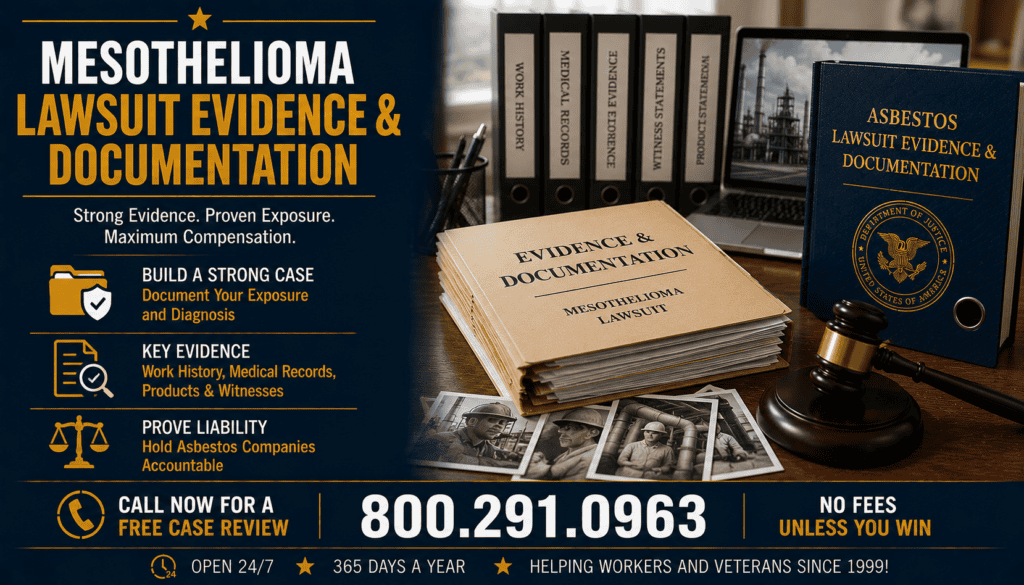
Mesothelioma Lawsuit Evidence & Documentation
Evidence is the foundation of a mesothelioma lawsuit, but no single document normally answers every question in a case. Medical records may establish a diagnosis, employment records may establish where someone worked, product records may show what was supplied to a facility, and witnesses may describe the work actually performed. The strongest documentation strategy connects these different sources into a supported exposure history without treating assumptions as facts.
Mesothelioma cases often involve exposures from decades earlier. Records can be incomplete and memories can fade, so preserving originals, documenting sources and distinguishing verified facts from estimates are especially important. Federal civil discovery can also require parties to exchange relevant information and identify witnesses and documents as a case develops. citeturn0search0turn0search2
📂 Understanding Mesothelioma Lawsuit Evidence
A case may require proof of several distinct issues: diagnosis, asbestos exposure, the identity of products or companies connected to that exposure, legal responsibility, causation and damages. Evidence useful for one issue should not automatically be treated as proof of another.
Build Evidence in Layers
A practical approach begins with the person’s life and work chronology, then connects jobsites to tasks, equipment, products, coworkers and surviving records. Medical evidence and damages documentation form additional layers.
Do Not Turn Possibilities Into Facts
If a worker remembers insulation but not a brand, record exactly that. If a date is approximate, label it as approximate. A credible timeline can include uncertainty rather than filling gaps with unsupported details.
Evidence Is Defendant-Specific
Showing that asbestos was used somewhere at a large industrial facility does not automatically connect every manufacturer or supplier to an individual worker. Each potential defendant should be evaluated using claimant-specific evidence and applicable law.
🩺 Medical & Diagnosis Evidence
Medical documentation can include pathology reports, imaging, physician records, treatment records, operative reports and other records associated with diagnosis and care.
Diagnosis Does Not Identify the Exposure Source
A mesothelioma diagnosis can establish an important medical fact, but it does not by itself identify where asbestos exposure occurred or which company is legally responsible.
Preserve Complete Records
Keep complete copies when available rather than isolated screenshots or excerpts. Note where records came from and the date they were obtained.
Secure Record Transfers
When sending medical information electronically, verify the intended recipient and use the secure method requested by the recipient. See How to Upload Medical Records Securely.
🏭 Exposure & Work-History Evidence
Exposure reconstruction often starts with a chronological work history. Useful sources can include employment records, Social Security earnings histories, union records, military service records, personnel files, pay stubs, leave records, tax documents and coworkers.
| Evidence source | What it may help establish |
|---|---|
| Employment records | Employer, occupation and work period |
| Pay stubs | Employer and approximate employment dates |
| Union records | Trade, local membership or assignments |
| Military records | Service, rating/MOS and duty locations |
| Coworkers | Tasks, products, equipment and workplace conditions |
| Photos and plans | Historical layout, equipment and work areas |
Create a Chronological Exposure Timeline
Organize employers, facilities, departments, dates, job titles, actual tasks, nearby trades, equipment, possible products and witnesses. A timeline can reveal gaps and identify records worth locating.
See How Exposure Timelines Strengthen Mesothelioma Claims and Tracking Your Work History to Prove Exposure.
Employment at a Site Is Not Exposure to Every Product
A personnel record can place someone at a facility, but additional evidence may be necessary to establish contact with a particular material or product.
🔧 Product, Equipment & Company Evidence
Historical product identification can involve invoices, purchase orders, catalogs, specifications, equipment manuals, maintenance records, photographs, packaging, corporate records and witness testimony.
Invoices Need a Claimant Connection
An invoice can show that a product was purchased or supplied, but it does not necessarily establish that the claimant encountered it. Dates, departments, locations, tasks and witnesses can provide the needed context.
Equipment Manufacturers and Component Manufacturers Can Differ
A pump, valve, turbine or boiler nameplate can identify the equipment manufacturer while saying nothing about who manufactured insulation, gaskets, packing or later replacement components. Avoid attributing every component to the equipment maker without supporting evidence.
Historical Photographs
Photographs can help identify equipment, work areas, labels or conditions, but visual appearance alone may not establish that a material contained asbestos. Preserve the original image and information about who took it, when, where and how it was obtained.
See How Attorneys Link Products to Defendants and Using Historical Photos to Document Asbestos Use.
👥 Witness Statements & Testimony
Coworkers, supervisors and family members can supply information unavailable in surviving documents. A useful witness identifies what they personally observed and explains the basis of that knowledge.
Coworkers
Coworkers may remember departments, tasks, brands, equipment, insulation work, maintenance practices and other trades working nearby.
Family Members
Family witnesses may know about employment, work clothing, household contact, illness, caregiving and damages. They should not be used as substitutes for workplace facts they did not personally observe.
Record Memory Before It Is Lost
Write down names, contact information and the subjects each witness may remember. Avoid coaching a witness toward a brand or date. Firsthand uncertainty is more useful than manufactured certainty.
📑 Authenticating & Preserving Records
Preservation and authentication are different concepts. Preservation protects evidence from loss or alteration. Authentication addresses whether an item can be shown to be what it is claimed to be. Federal Rule of Evidence 901 generally requires sufficient evidence to support that finding and gives examples including testimony from a witness with knowledge and characteristics of the item itself. citeturn0search1
Keep Originals When Possible
Preserve original paper documents, photographs and digital files. For digital material, retain available metadata and avoid repeatedly editing or resaving the original file.
Document Provenance
Record where an item came from, who supplied it and when it was obtained. For copied archives, note the repository, collection, box, folder or record identifier when available.
Chain of Custody
A chain-of-custody record can document possession and handling of physical or digital evidence. It does not itself prove asbestos exposure; it helps establish the integrity and history of the item being offered.
See Chain of Custody Best Practices for Exposure Evidence and How to Authenticate Old Photos, Ship Logs & Base Records.
🔍 Evidence Developed Through Discovery
Families do not need to possess every potentially relevant corporate document before a lawsuit begins. In federal litigation, Rule 26 generally permits discovery of nonprivileged matter relevant to a claim or defense and proportional to the needs of the case. Discovery can include witnesses, documents, electronically stored information and expert material subject to applicable rules and court orders. citeturn0search2
Documents From Defendants and Third Parties
Discovery may produce corporate records, historical product documents, sales records, safety materials, specifications, testimony and other evidence unavailable to the claimant beforehand.
Depositions
Depositions preserve sworn testimony. The U.S. Courts describes a deposition as questioning a witness under oath before trial, with a court reporter producing a transcript. citeturn0search0
Correcting Information
If reliable new evidence changes an earlier date, jobsite or product identification, document why the information changed. Do not silently rewrite earlier statements.
🧭 Explore Evidence & Documentation Topics
Use these focused evidence guides to build and preserve a more complete case record:
- Chain of Custody Best Practices for Exposure Evidence
- How to Authenticate Old Photos, Ship Logs & Base Records
- Using Historical Photos to Document Asbestos Use
- Finding Old Pay Stubs and Leave Records for Asbestos Exposure
- Tracking Your Work History to Prove Exposure
- How to Document Your Asbestos Exposure History
- How Lawyers Prove Asbestos Exposure in the Workplace
- What Evidence Law Firms Collect Before Filing
- Evidence You Need to Win an Asbestos Lawsuit
- How Attorneys Link Products to Defendants
- Understanding Medical Evidence in Asbestos Litigation
- Building a Strong Mesothelioma Case From Limited Records
- How Attorneys Build an Asbestos Exposure Timeline
- How to Upload Medical Records Securely
- How Exposure Timelines Strengthen Mesothelioma Claims
Evidence Organization Checklist
| Category | What to preserve |
|---|---|
| Medical | Pathology, diagnosis, imaging and treatment records |
| Employment | Employers, dates, jobsites, trades and departments |
| Military | Service records, ratings/MOS, units, ships and bases |
| Exposure | Tasks, materials, equipment, frequency and proximity |
| Products | Names, labels, invoices, catalogs, photos and specifications |
| Witnesses | Names, contact details and firsthand knowledge |
| Digital evidence | Original files and available metadata |
| Damages | Bills, income records, travel and supported losses |
| Prior claims | Trust submissions, lawsuits, releases and exposure statements |
| Source notes | Where each important document or fact came from |
❓ Frequently Asked Questions
What evidence is most important in a mesothelioma lawsuit?
No single category is always most important. Medical evidence, exposure history, product or company identification, witnesses and damages records can address different elements of a case.
Does a mesothelioma diagnosis prove which company caused the exposure?
No. Diagnosis and defendant identification are separate evidentiary questions.
What if employment records are missing?
Other sources may help reconstruct employment, including earnings histories, union records, military records, pay stubs, coworkers, directories and discovery.
Can old photographs be used as evidence?
Potentially. Their usefulness depends on what they depict and whether their identity, source and relevance can be established. A photo alone does not prove a pictured material contained asbestos.
Does an invoice prove that a worker used a product?
Not necessarily. It may establish a transaction or presence at a facility, but claimant-specific evidence may still be needed.
Should original documents be mailed away?
Preserve originals and follow the receiving professional’s instructions. Keep a complete copy and record what was transferred and when.
What if a witness does not remember the product brand?
The witness should say what they actually remember. Other records may help identify products without asking the witness to guess.
Can evidence be found after a lawsuit is filed?
Yes. Discovery can be used to obtain relevant documents and testimony within the scope allowed by applicable procedural rules.
What is chain of custody?
It is documentation of how evidence was possessed, transferred or handled. It can support integrity but does not independently prove exposure.
Should estimates be included in an exposure timeline?
Yes when useful, but they should be clearly labeled as estimates and kept distinct from dates supported by records.
📞 Request a Case Evaluation
Start with the records you already have. Organize medical documents, employers, jobsites, military history, tasks, equipment, possible products, coworkers and prior asbestos claims. Preserve originals and clearly distinguish verified facts from estimates.
Call 800.291.0963 for a no-obligation case evaluation and to talk to a real person 24/7, 365 days a year. Many mesothelioma law firms handle qualifying cases on a contingency-fee basis; confirm the fee agreement and terms directly with the firm you retain. Submit your case here.
📝 Summary
Mesothelioma lawsuit evidence is strongest when medical, employment, exposure, product, witness and damages records are organized into a consistent chronology. A diagnosis does not identify a defendant, employment at a facility does not establish exposure to every product, and an invoice does not automatically prove claimant contact. Preserve original records, document their sources, distinguish facts from estimates and use discovery to develop additional evidence when litigation permits.
🔗 Confirmed Sources
- United States Courts — Civil Cases
- Federal Rule of Civil Procedure 26 — Discovery
- Federal Rule of Evidence 901 — Authenticating or Identifying Evidence
Disclaimer: General information only—not legal or medical advice. This website is not a law firm. Evidence requirements, discovery procedures, admissibility standards, filing deadlines and liability rules vary by jurisdiction and case. No individual document, witness, diagnosis or exposure history guarantees liability, compensation or a particular outcome. Past results do not guarantee future outcomes.