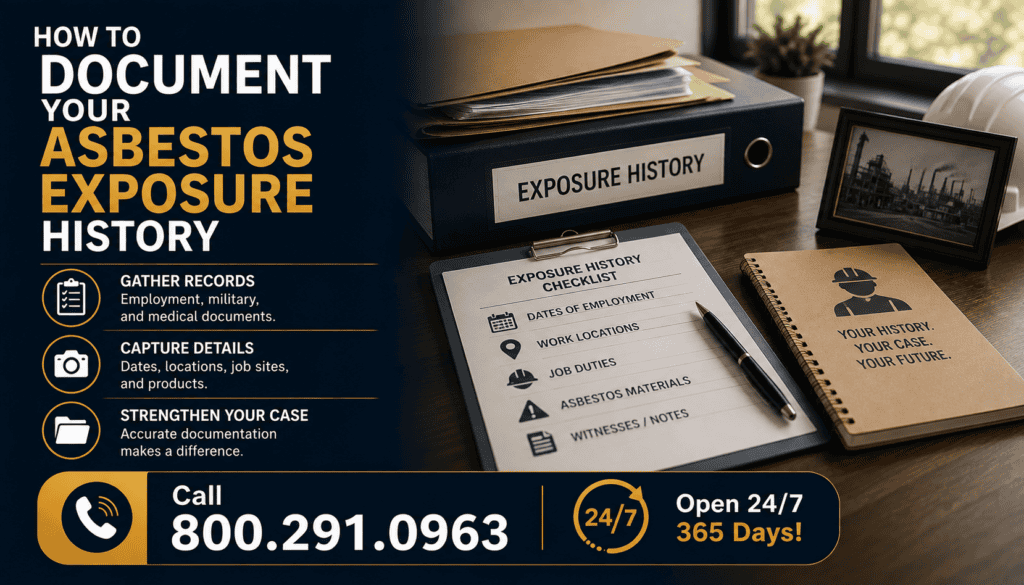
How to Document Your Asbestos Exposure History
Documenting an asbestos exposure history means reconstructing where, when and how contact with asbestos may have occurred. Because many occupational exposures happened decades before a mesothelioma diagnosis, the most useful history is usually built from a combination of personal recollection and independent records rather than memory alone.
Start with facts you know: employers, job sites, approximate dates, trades, departments, equipment, routine tasks and coworkers. Then add documents that can confirm or refine those memories. A well-organized exposure history should distinguish confirmed facts from reasonable leads and unresolved questions instead of filling missing periods with assumptions.
📝 Start With What You Remember
Do not begin by trying to remember every asbestos brand. Start with the structure of your life and work. List employers, facilities, trades, supervisors, coworkers, military assignments when relevant, residences associated with possible secondary exposure, and major job changes.
For each period, write down what you personally remember before reviewing old product lists or photographs. This helps preserve the distinction between firsthand memory and information learned later during research.
| Start with | Questions to answer |
|---|---|
| Employer | Who employed you and approximately when? |
| Job site | At which plant, shipyard, building, base or facility did you work? |
| Work area | Which department, shop, floor, unit, vessel or room? |
| Job duties | What did you actually do during a normal shift? |
| Materials | What insulation, gaskets, packing, cement, tile or other materials did you handle or work near? |
| Witnesses | Who worked with you and may remember the same conditions? |
Use the Mesothelioma Lawsuit Evidence & Documentation hub for the broader evidence framework.
🗓️ Build a Chronological Exposure Timeline
Create one timeline covering the earliest potentially relevant work through the latest. Approximate dates are acceptable as a starting point when exact dates are unknown, but label them as estimates. Later records can be used to narrow them.
| Period | Employer/site | Job/task | Possible source | Supporting record |
|---|---|---|---|---|
| Example: 1972–1976 | Industrial plant | Maintenance | Pipe insulation and gaskets | Pay records/coworker |
| Example: 1976–1981 | Shipyard | Repair work | Insulation and equipment work | Union/assignment records |
| Example: 1981–1988 | Commercial construction | Mechanical work | Building materials | Contractor records |
Related guides include How Attorneys Build an Asbestos Exposure Timeline and How Exposure Timelines Strengthen Mesothelioma Claims.
💼 Document Employers and Work Dates
Record the full employer name, division or contractor if known, job title and approximate start and end dates. Include temporary work, apprenticeships, union assignments and periods when you worked for a contractor at another company’s facility.
Potential corroborating documents include Social Security earnings records, pay stubs, personnel records, union dispatch records, pension records, tax documents and leave records. An employment record can place you with an employer but may not establish your exact work area or asbestos exposure.
See Tracking Your Work History to Prove Exposure and Finding Old Pay Stubs and Leave Records.
🏭 Record Every Relevant Job Site and Work Area
A company name alone may be too broad. Record the physical location and the part of the facility where you worked: boiler room, turbine area, machine shop, engine room, maintenance department, production line, construction floor or other identifiable area.
If the site had several names or owners, record every name you remember. Note major renovations, shutdowns, overhauls or demolition projects because those events may help locate historical work orders and witnesses.
🔧 Describe Tasks, Materials and Nearby Work
Describe the actual work rather than relying only on a job title. Note whether you cut, removed, installed, repaired, scraped, sanded, swept or replaced materials. Also record work performed nearby by other trades if you personally remember it.
Useful details include how often the activity occurred, how long it lasted, approximate distance, ventilation, protective equipment and visible dust. Do not assign an airborne fiber concentration unless reliable monitoring or expert analysis supports one.
📦 Record Product and Equipment Clues
If you remember a brand, write it down along with why you remember it—such as a label, package, color scheme, equipment plate or repeated use. If you do not remember a brand, record the product type and surrounding details instead of guessing.
Invoices, catalogs, purchase orders, specifications and maintenance records may later help identify products. Formulations and corporate ownership can change over time, so match product evidence to the correct exposure period.
👥 Identify Coworkers and Other Witnesses
Make a separate list of coworkers, supervisors, contractors and other people who may have firsthand knowledge. Record full names, nicknames, trade or department, approximate years worked together and current contact information if known.
Do not coordinate memories or tell another witness what to say. Their independent recollection can be more useful when it can later be compared with your timeline and documentary evidence.
📁 Find Employment, Union and Government Records
Documents can help turn approximate memories into a more precise timeline. Search personal files first, then identify records that may exist with former employers, unions, pension administrators, government agencies or archives.
| Record | Potential value | Important limitation |
|---|---|---|
| Pay stub | Employer and pay period | May not show work area. |
| Union record | Trade, employer or assignment | Detail varies. |
| Personnel file | Employment dates and title | Title may not describe actual tasks. |
| Work order | Task, location or equipment | May not identify material composition. |
| Purchase record | Product and destination | Does not prove personal contact. |
📷 Use Historical Photos and Facility Records
Old photographs may help identify equipment, work areas, packaging, labels or facility conditions. Construction plans, maintenance logs, ship records, specifications and equipment manuals may provide additional context.
Keep the original photograph or digital file and information about its source. A photograph should not be treated as proof that a visible material contained asbestos solely because of its appearance.
See Using Historical Photos to Document Asbestos Use and How to Authenticate Old Photos, Ship Logs and Base Records.
📊 Look for Exposure-Monitoring and Safety Records
Historical exposure-monitoring, industrial-hygiene and safety records may help document conditions when they correspond to the relevant operation, job classification, work area and period. OSHA’s general-industry asbestos standard requires covered exposure-monitoring records to identify information including the date, operation monitored, sampling method, sample results and employees whose exposures are represented.
Under that standard, asbestos exposure-monitoring records must be maintained for at least 30 years. OSHA’s construction and shipyard asbestos standards also require covered exposure-measurement records to be retained for at least 30 years. These requirements can make historical records worth investigating, although the existence and applicability of particular records depend on the employer, work and period involved. citeturn0search0turn0search1turn0search5
🏠 Document Possible Take-Home or Secondary Exposure
If the history includes possible exposure from another person’s work clothing, tools or belongings, document that separately. Record who worked with asbestos-associated materials, where and when they worked, how work clothes were handled, who laundered them and what firsthand memories support the account.
Do not combine occupational and secondary exposure into one undifferentiated timeline. Separate entries make the claimed route of exposure easier to understand and evaluate.
🩺 Keep Medical Evidence With a Separate Medical Timeline
Maintain a medical chronology that includes the diagnosis date, pathology, imaging, treating facilities and major treatment events. Keep it coordinated with the exposure history but do not treat a diagnosis as proof of a particular workplace or product.
🔗 Preserve Sources and Original Evidence
Keep original paper records and unedited digital files whenever possible. Make working copies rather than writing on originals. Record who supplied an important document, when it was received and where the original is stored.
For downloaded archival records, save the complete record and identifying information rather than only a cropped screenshot. See Chain-of-Custody Best Practices for Exposure Evidence.
🚫 Avoid Guessing or Overstating the Record
A useful exposure history identifies uncertainty instead of hiding it. Mark dates as approximate when they are approximate. Record “brand unknown” when the brand is unknown. Keep information learned from documents separate from personal memory.
| Evidence | May help establish | Does not automatically establish |
|---|---|---|
| Employment record | Employer and period | Specific asbestos exposure. |
| Invoice | Product delivered to a facility | Personal contact with that product. |
| Historical photograph | Equipment or location | Asbestos content from appearance alone. |
| Coworker recollection | Firsthand workplace facts | Facts outside the witness’s knowledge. |
| Air-monitoring record | Conditions represented by the sampling | Exact exposure of every employee. |
✅ Asbestos Exposure History Worksheet
Create one entry for each distinct employer, facility or exposure period and record:
- Employer and facility name
- City and state
- Approximate start and end dates
- Department, vessel, building or work area
- Job title and actual duties
- Equipment worked on or near
- Materials handled or disturbed
- Product or brand names actually remembered
- Nearby trades and dusty activities
- Frequency and duration of the activity
- Coworkers or witnesses
- Documents that support the entry
- Source of each document or photograph
- Questions that remain unresolved
After completing the worksheet, compare it with How Lawyers Prove Asbestos Exposure in the Workplace and What Evidence Law Firms Collect Before Filing.
❓ Frequently Asked Questions
What if I do not remember the exact dates I worked somewhere?
Use an approximate period and label it as an estimate. Pay records, Social Security earnings histories, union files or other documents may later help narrow the dates.
Do I need to know the asbestos product brand?
No. Record what you actually remember about the material, equipment, packaging, task and workplace. Product records and witnesses may provide additional information later.
Should I make one list of every job I ever had?
A complete work chronology can help reveal relevant periods and prevent gaps. Mark jobs with no known asbestos connection rather than deleting them if they help explain the timeline.
Can coworkers help document my history?
Yes. People with firsthand knowledge may remember job sites, tasks, equipment and products. Their memories should be recorded independently and accurately.
Can old photographs be useful?
Potentially. They may identify equipment, work areas, labels or time periods, especially when their date and source can be established.
Can OSHA exposure records help?
Potentially. Monitoring records can provide useful historical information when they represent the relevant operation, job, area and period. They should not automatically be treated as the exact exposure of every worker.
Should I collect a sample from an old building or product?
No. Do not disturb suspected asbestos-containing material to create evidence. Existing surveys, records or professionally collected samples should be evaluated instead.
What if my employer no longer exists?
Other records may survive through unions, archives, coworkers, suppliers, successor entities, public repositories or documents obtained during litigation.
Should I include possible secondhand exposure?
Yes, if relevant, but document it separately and identify the person, workplace, dates and specific circumstances supporting the possible exposure route.
Does a detailed exposure history prove a lawsuit?
No. It organizes potential evidence and investigative leads. Legal responsibility, causation, admissibility and damages depend on the evidence and law governing the individual case.
📞 Request a Case Evaluation
If you or a family member has been diagnosed with mesothelioma, you do not need a perfect exposure history before requesting a review. Start with employers, job sites, approximate dates, duties and coworkers. Preserve the original records you already have and avoid guessing at missing details.
Call 800.291.0963 for a no-obligation case evaluation. Talk to a real person 24/7, 365 days a year. There are no out-of-pocket legal fees for a contingency-fee claim unless compensation is recovered. Submit your case here.
📝 Summary
A useful asbestos exposure history connects people, places, tasks, products and dates without overstating what the evidence proves. Begin with your own recollection, build a chronological work and exposure timeline, then corroborate it with employment records, coworkers, product information, historical photographs, facility records and relevant exposure-monitoring information. Preserve originals, record the source of important evidence and clearly identify uncertainties. The result is a structured record that can guide further investigation.
🔗 Confirmed Sources
- OSHA — 29 CFR 1910.1001, Asbestos in General Industry
- OSHA — 29 CFR 1926.1101, Asbestos in Construction
- OSHA — 29 CFR 1915.1001, Asbestos in Shipyard Employment
Disclaimer: General information only—not legal or medical advice. This website is not a law firm. Exposure, causation, liability and evidence requirements vary by jurisdiction and individual case. Do not disturb suspected asbestos-containing material to create evidence. No particular evidence or prior result guarantees an outcome.