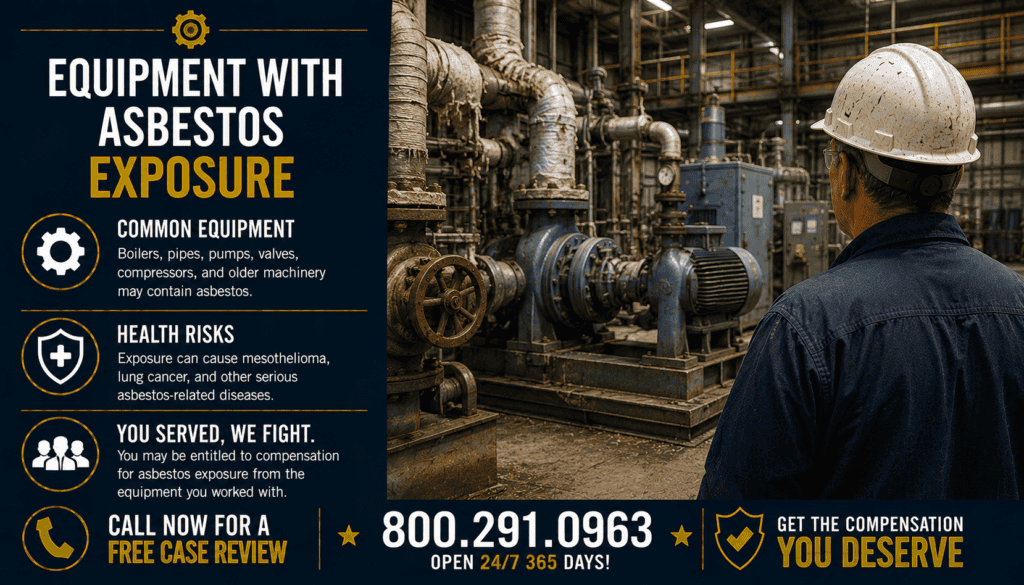
Equipment With Asbestos Exposure
For decades, asbestos was used in a wide range of industrial and military equipment to prevent heat damage, fire, and wear. Mechanics, technicians, and operators who worked on or near equipment containing asbestos were often exposed to dangerous fibers without protective gear. Over time, these invisible fibers could be inhaled or swallowed—leading to serious illnesses such as mesothelioma, asbestos-related lung cancer, and asbestosis. This guide explains how exposure occurred, what types of equipment were affected, and how victims can pursue legal and financial support.
⚙️ Equipment Asbestos Exposure – What You’ll Learn From This Page:
🧰 Industrial and commercial equipment made before the 1990s often contained asbestos insulation, especially in gaskets, brakes, seals, and packing.
🔧 Workers were exposed while servicing boilers, turbines, compressors, pumps, and other heavy machinery lined with asbestos materials.
🛠️ Repair tasks like gasket removal, valve adjustments, or insulation stripping disturbed aging asbestos, releasing fibers into the air.
🌬️ Confined mechanical rooms and poorly ventilated equipment bays allowed airborne asbestos to accumulate near workers’ breathing zones.
💰 Machinists, mechanics, millwrights, and maintenance crews diagnosed with mesothelioma may qualify for trust fund payouts or legal compensation.
Asbestos was widely used in equipment between the 1930s and 1980s for its heat resistance, durability, and affordability. Whether in military vehicles, factory machines, construction tools, or heavy-duty appliances, asbestos was commonly found in parts that endured high temperatures or friction. Unfortunately, workers who maintained, installed, or repaired this equipment were often exposed without warning.
Due to a 20–50 year latency period, many are only now being diagnosed.
Estimated Number of People Exposed to Asbestos-Containing Equipment in the U.S.
Asbestos-containing equipment—including boilers, pumps, valves, and HVAC systems—was extensively used across many industries. Workers involved in operating, maintaining, and repairing this equipment faced regular asbestos exposure.
| Equipment Type | Estimated Number of Workers Exposed |
|---|---|
| Boilers, Pumps, and Valves | Approximately 130,000 workers operated or maintained asbestos-insulated equipment. |
| HVAC and Industrial Systems | Around 90,000 personnel exposed to asbestos-containing heating and ventilation equipment during service and repair. |
Total Estimated Exposure: Over 220,000 U.S. workers were exposed to asbestos through asbestos-containing equipment.
Asbestos was used in both large machinery and everyday jobsite tools—putting countless workers at risk.
- Boilers & Pressure Vessels: Lined with asbestos insulation to retain heat and prevent fire.
- Industrial Pumps & Valves: Used asbestos gaskets and seals to handle high-pressure fluids.
- Generators & Turbines: Contained asbestos insulation and wiring to withstand extreme heat.
- Heavy Equipment (Cranes, Bulldozers): Brake pads, clutches, and engine insulation often contained asbestos.
- Military Vehicles & Aircraft: Asbestos was used in brake systems, heat shields, and pipe insulation.
- Ovens & Kilns: Firebrick and thermal insulation made with asbestos kept these machines safe—but hazardous.
- Machinery Gaskets: Asbestos was a standard material in high-temperature sealing components.
- Welding Equipment: Gloves, aprons, and blankets used during welding often contained asbestos fibers.
- Electrical Panels & Switches: Asbestos components resisted electrical fires and high voltage.
- Furnaces & HVAC Units: Insulation and duct materials often included asbestos for fire safety.
If you worked on or around equipment before the 1990s, you may have unknowingly been exposed to asbestos—even if you weren’t told at the time.
✅ Common Ways to Prove Exposure:
- Job history as a mechanic, technician, equipment operator, or engineer
- Records showing equipment type used during employment or military service
- Medical diagnosis of mesothelioma, asbestos-related lung cancer, or asbestosis
- Manufacturer documentation showing asbestos use in product parts
- Statements from coworkers or supervisors about repair work or asbestos dust
- Help from legal professionals who can match equipment brands to trust fund records
Workers and veterans diagnosed with asbestos-related diseases due to equipment exposure may qualify for compensation through asbestos trust funds, lawsuits, or VA benefits.
✅ You may be eligible if:
- You worked with or around equipment made before 1990
- You were exposed to gaskets, insulation, brakes, or seals made with asbestos
- You’ve been diagnosed with mesothelioma, lung cancer, or asbestosis
- You maintained or repaired boilers, vehicles, turbines, or industrial machinery
- A loved one passed away from asbestos illness connected to equipment exposure
Many claimants qualify for multiple asbestos trust fund settlements and lawsuit compensation.
Whether you’re a living patient or the family member of someone affected, financial and legal help is available.
✅ Workers and Families May Qualify For:
- Compensation from asbestos trust funds related to equipment manufacturers
- Personal injury or wrongful death lawsuits
- Funeral and medical expense reimbursement
- Secondhand exposure claims if asbestos dust was brought home on work clothes
- Free legal support to file claims or gather evidence
- Monthly income payments to support surviving spouses or dependents
📞 If you or a loved one worked on or near equipment containing asbestos, and now suffer from mesothelioma or another asbestos-related illness, you may be eligible for significant compensation. Contact us today for a free legal case review—no fees unless you win.
For much of the 20th century, asbestos was widely used in industrial, construction, automotive, and mechanical equipment because of its heat resistance, durability, and fire-retardant properties, exposing workers during installation, maintenance, repair, and removal activities.
🔥 Heating & Power Systems
-
Steam Boiler Equipment Asbestos Exposure
Steam boilers released asbestos fibers during insulation removal, repairs, and maintenance in schools, ships, and factories. -
Boiler Equipment Asbestos Exposure
Industrial and heating boilers exposed workers when asbestos linings and gaskets were disturbed. -
Furnace Equipment Asbestos Exposure
Furnace repairs released asbestos insulation fibers into confined mechanical rooms. -
Heat Exchanger Equipment Asbestos Exposure
Servicing heat exchangers disturbed asbestos insulation used for temperature control. -
Hot Water System Equipment Asbestos Exposure
Asbestos insulation around hot water systems released fibers during pipe and system repairs. -
Water Heater Equipment Asbestos Exposure
Older water heaters contained asbestos insulation disturbed during replacement or removal. -
Nuclear Equipment Asbestos Exposure
Nuclear facilities used asbestos insulation in reactors and auxiliary systems. -
Industrial Oven Equipment Asbestos Exposure
Industrial ovens exposed workers when asbestos linings deteriorated or were removed. - Generator Equipment Asbestos Exposure
Backup and industrial generators released asbestos fibers during insulation removal, gasket replacement, and electrical maintenance in hospitals, ships, and power facilities.
⚙️ Mechanical & Plant Equipment
-
Air Compressor Equipment Asbestos Exposure
Asbestos gaskets and insulation released fibers during compressor maintenance. - Airport Maintenance Equipment Asbestos Exposure
Ground support equipment released asbestos during servicing and repairs. -
Pump Equipment Asbestos Exposure
Pump repairs disturbed asbestos seals and packing materials. -
Electrical Equipment Asbestos Exposure
Electrical panels and wiring insulation released asbestos fibers during upgrades. -
Elevator Equipment Asbestos Exposure
Elevator machinery rooms exposed technicians to asbestos dust during servicing. -
Escalator Equipment Asbestos Exposure
Asbestos fibers were released from escalator motors and brake systems. -
Lift Equipment Asbestos Exposure
Lift systems exposed maintenance workers during mechanical repairs. -
Refrigeration Unit Equipment Asbestos Exposure
Older refrigeration units released asbestos insulation fibers during dismantling.
🚗 Vehicle & Automotive Equipment
-
Automotive Equipment Asbestos Exposure
Vehicle repairs exposed mechanics to asbestos brake, clutch, and gasket dust. -
Farm Equipment Asbestos Exposure
Agricultural machinery released asbestos during repairs and daily operation. -
Radiator Equipment Asbestos Exposure
Radiator maintenance disturbed asbestos insulation and seals.
🛑 Friction Components & Related Systems
-
Brake Equipment Asbestos Exposure
Brake servicing released asbestos fibers from linings and pads. -
Gasket Equipment Asbestos Exposure
Cutting and scraping gaskets exposed workers to airborne asbestos. -
Valve Equipment Asbestos Exposure
Valve repairs disturbed asbestos packing and insulation materials.
🏗️ Construction & Heavy Machinery
-
Cement Mixer Equipment Asbestos Exposure
Mixer repairs released asbestos insulation fibers on construction sites. -
Crane Equipment Asbestos Exposure
Crane brake and insulation repairs exposed operators and mechanics. -
Excavating Equipment Asbestos Exposure
Heavy excavation machinery released asbestos during component servicing. -
Road Construction Equipment Asbestos Exposure
Road machinery repairs exposed workers to asbestos brake and clutch dust. -
Fireproofing Equipment Asbestos Exposure
Fireproofing materials released asbestos fibers during installation and removal. - Concrete Mixer Equipment Asbestos Exposure
Mixer repairs released asbestos fibers from insulation and brake components.
🏭 Industrial Machinery & Tools
-
Machinery Equipment Asbestos Exposure
Industrial machines exposed workers when asbestos insulation deteriorated. -
Fabricating Equipment Asbestos Exposure
Fabrication equipment released asbestos fibers during high-heat operations. -
Grinder Equipment Asbestos Exposure
Grinding equipment disturbed asbestos components during operation. -
Lathe Equipment Asbestos Exposure
Machining lathes released asbestos dust during maintenance. -
Mill Equipment Asbestos Exposure
Mill machinery exposed workers to asbestos insulation fibers. -
Mining Equipment Asbestos Exposure
Mining machinery released asbestos in confined underground environments. -
Welding Equipment Asbestos Exposure
Welding tools exposed workers to asbestos heat-shield materials. -
Insulating Blanket Equipment Asbestos Exposure
Heat-resistant blankets released asbestos fibers during removal. - Agricultural Equipment Asbestos Exposure
Manufacturing machinery exposed workers to asbestos during equipment production.
🚢 Marine & Ship Equipment
-
Ship Engine Equipment Asbestos Exposure
Ship engines exposed sailors to asbestos insulation during repairs. -
Shipbuilding Tool Equipment Asbestos Exposure
Shipyard tools disturbed asbestos materials during vessel construction.
🧱 Building Materials & Systems
-
Floor Tile Equipment Asbestos Exposure
Tile cutting and removal released asbestos dust in buildings. -
Wall Insulation Equipment Asbestos Exposure
Wall insulation removal exposed workers to asbestos fibers. -
Insulation Equipment Asbestos Exposure
Installing or removing insulation released airborne asbestos. -
Tile & Countertop Equipment Asbestos Exposure
Surface cutting equipment released asbestos from older materials. -
Kitchen Appliance Equipment Asbestos Exposure
Repairing appliances released asbestos insulation fibers.
FAQs About Asbestos-Containing Equipment

Q. What types of equipment commonly contained asbestos?
Asbestos was widely used in equipment that required heat resistance or insulation. This includes boilers, turbines, pumps, generators, gaskets, brake pads, clutches, and electrical panels—especially in military, industrial, and shipyard settings.
Q. Who is at risk of asbestos exposure from equipment?
Anyone who installed, repaired, maintained, or worked near asbestos-containing equipment may have been exposed. This includes mechanics, electricians, machinists, shipyard workers, HVAC technicians, and military personnel.
Q. How does asbestos exposure from equipment happen?
Exposure typically occurs when asbestos-containing parts are disturbed—such as during repairs, sanding, cutting, or removal—releasing microscopic fibers into the air that can be inhaled.
Q. What health issues are linked to asbestos exposure?
Asbestos exposure can lead to serious illnesses including mesothelioma, lung cancer, asbestosis, and other respiratory conditions. These diseases may not appear until decades after exposure.
Q. How do I know if the equipment I worked with contained asbestos?
If you worked with or around older equipment made before the 1980s, especially in the military or industrial settings, there’s a strong chance asbestos was present. Maintenance manuals or product records may also identify asbestos use.
Q. Can I still file a legal claim if I was exposed years ago?
Yes. Many asbestos-related legal claims are filed decades after exposure. The clock typically starts from the date of diagnosis, not the date of exposure.
Q. What compensation is available for asbestos exposure?
You may be eligible for compensation from asbestos trust funds, personal injury lawsuits, or VA benefits (for veterans). These funds help cover medical costs, lost income, and pain and suffering.
Q. How can I get legal help for asbestos exposure from equipment?
If you or a loved one has been diagnosed with an asbestos-related illness, call us today to speak with an experienced asbestos attorney. We can help you determine if you qualify for financial compensation and guide you through every step—with no upfront costs.
The mesothelioma claims process can seem overwhelming, but understanding each step can make it easier to navigate. Here’s an easy-to-follow guide to help you understand the process, from filing your claim to receiving compensation.
Step 1: Consult with an Experienced Mesothelioma Lawyer
The first step in the mesothelioma claims process is to consult with an experienced mesothelioma lawyer. This lawyer specializes in asbestos-related cases and can guide you through the legal process. They will evaluate your case, explain your legal options, and help you determine whether you are eligible for compensation. Choosing a lawyer with experience in mesothelioma cases increases your chances of success.
Step 2: Gather Medical and Work History
Once you’ve chosen your lawyer, the next step is to gather your medical and work history. You’ll need to provide your medical records that confirm your mesothelioma diagnosis and documents showing where and when you were exposed to asbestos. Your lawyer will help you collect employment records and any other relevant documents that establish the connection between your exposure and your illness. This step is essential to building a strong case.
Step 3: Investigate the Asbestos Exposure
In this step, your lawyer will work to identify the specific companies and products responsible for your asbestos exposure. This is done by investigating your work history, where you lived, and which asbestos-containing materials you were in contact with. Your lawyer will research which manufacturers or employers were involved and whether they can be held legally accountable. This investigation is crucial for determining who will be the target of your claim.
Step 4: Filing the Mesothelioma Claim
After gathering all necessary information, your lawyer will file the mesothelioma claim on your behalf. This may involve filing a lawsuit against the companies responsible for your exposure, or it could involve filing a claim with an asbestos trust fund, which is a compensation fund set up by companies that have gone bankrupt due to asbestos liabilities. Your lawyer will ensure that all necessary documentation is submitted to support your claim and increase the chances of success.
Step 5: Discovery and Negotiation
Once the claim is filed, the discovery process begins. During this phase, both parties (you and the defendants) will exchange information and evidence related to the case. This process may involve depositions, document requests, and expert witness testimony. After discovery, your lawyer will enter into settlement negotiations with the defendant(s). Many mesothelioma cases are settled out of court to avoid lengthy trials. Your lawyer will negotiate on your behalf to secure the best possible settlement.
Step 6: Settlement or Trial
Most mesothelioma claims are settled out of court, which means you will receive compensation without a trial. If a fair settlement can’t be reached, the case will proceed to trial. During a trial, both sides present evidence and arguments to a judge or jury, who will then make a decision. While a trial can take longer, a favorable verdict can result in a larger settlement. However, many mesothelioma cases are settled before reaching trial, providing quicker compensation.
Step 7: Receiving Compensation
After settlement or trial, you will receive compensation for your mesothelioma diagnosis. Compensation may cover medical expenses, lost wages, pain and suffering, and other damages resulting from your illness. If your claim is successful, you will receive a financial payout. This compensation is essential for managing the costs of treatment, and it provides some financial relief for you and your family. Your lawyer will help you understand how much you are entitled to and ensure that the funds are distributed appropriately.
Step 8: Post-Settlement Support
After you receive compensation, your lawyer will continue to support you by ensuring that all aspects of your claim are completed, and they will address any additional legal concerns that may arise. If you are receiving compensation from an asbestos trust fund, your lawyer will help you navigate the disbursement process. Post-settlement support ensures that all final steps are handled efficiently and that you can focus on your health and well-being.
Final Thoughts
The mesothelioma claims process can be lengthy, but with the help of a skilled attorney, you can secure the compensation you deserve. Whether your claim involves filing a lawsuit or a trust fund claim, following each step carefully will ensure that your legal rights are protected and that you get the support you need during this challenging time.
If you or someone you love has been diagnosed with mesothelioma, you may be entitled to compensation. Call 800.291.0963 for a free, no-obligation case evaluation with a dedicated mesothelioma lawyer who can help guide you through the legal process and get the support you deserve.