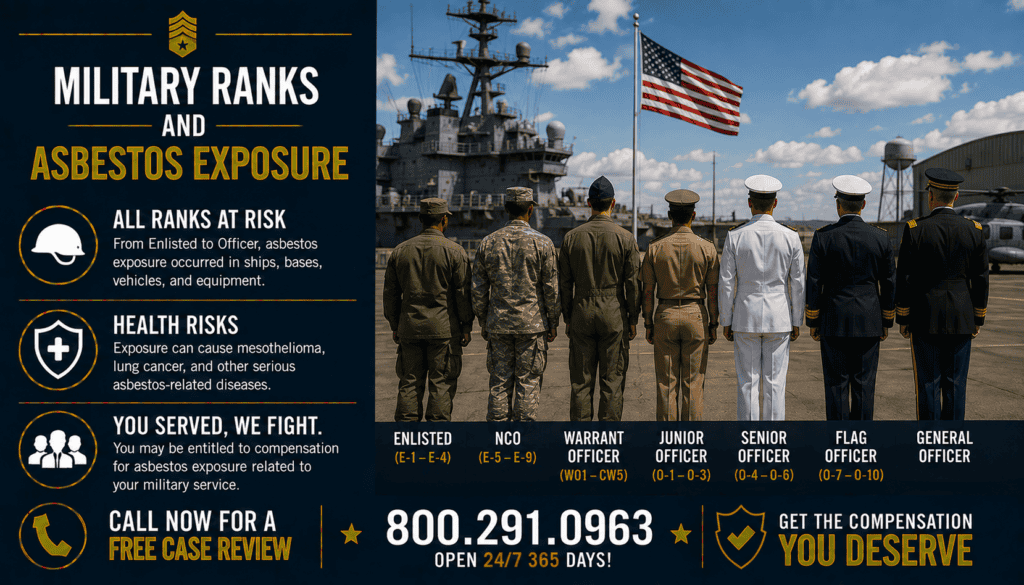
Military Ranks and Asbestos Exposure
For decades, all branches of the U.S. military relied on asbestos in ships, vehicles, aircraft, barracks, equipment, and base infrastructure. Because asbestos was used for insulation, fireproofing, brake linings, gaskets, engine heat shields, wiring, flooring, and roofing, service members across all ranks—from E-1 enlisted to senior officers—were repeatedly exposed during everyday duties.
Below is a complete guide explaining how asbestos affected each branch, with direct links to detailed rank-by-rank exposure breakdowns.
U.S. Army Ranks and Asbestos Exposure
Army personnel encountered asbestos in vehicles, barracks, motor pools, base housing, and heating systems. Soldiers in all ranks inhaled fibers during vehicle repair, construction tasks, and time spent in older military buildings built before 1980.
U.S. Air Force Ranks Asbestos Exposure
Air Force personnel were exposed to asbestos through aircraft brakes, wiring, insulation blankets, engine components, and hangar infrastructure. Airmen faced exposure during routine aircraft maintenance, flightline operations, and work inside pre-1980 Air Force facilities.
U.S. Navy Ranks and Asbestos Exposure
Navy service members experienced some of the highest military asbestos exposure due to heavy shipboard usage. Sailors working in boiler rooms, engine rooms, and machinery spaces routinely inhaled fibers from insulated piping, turbines, and fireproofing materials.
U.S. Marine Corps Ranks and Asbestos Exposure
Marine Corps personnel were exposed through vehicles, amphibious craft, portable heaters, barracks, and older base structures. Mechanics, engineers, and Marines deployed on Navy vessels frequently encountered asbestos during repairs and transport operations.
U.S. Coast Guard Ranks and Asbestos Exposure
Coast Guard members faced asbestos exposure aboard cutters, patrol craft, engine rooms, and shipboard boilers. Many older Coast Guard stations also contained asbestos in walls, ceilings, insulation, and heating systems.
U.S. National Guard Ranks and Asbestos Exposure
National Guard service members were exposed during training, equipment maintenance, and work inside older armories. Many state-run facilities built before 1980 used asbestos in flooring, insulation, heating systems, and roofing materials.
U.S. Army Corps of Engineers Ranks and Asbestos Exposure
Army Corps of Engineers personnel encountered asbestos while constructing, renovating, and demolishing military structures. Steam pipes, boilers, insulation, and flooring materials released fibers during engineering, plumbing, and carpentry work.
Merchant Marines Ranks and Asbestos Exposure
Merchant Mariners regularly worked aboard ships laden with asbestos insulation. Engine rooms, boiler spaces, and cargo areas exposed mariners in all ranks to airborne asbestos fibers during voyages, repairs, and machinery operations.
Civilian Contractor Jobs with Asbestos Exposure
Civilian contractors working on military bases, shipyards, and aircraft depots were heavily exposed while performing plumbing, electrical, demolition, construction, and repair work. They often handled asbestos materials directly.
U.S. Seabees Ranks and Asbestos Exposure
U.S. Navy Seabees were exposed to asbestos through construction materials, cement boards, roofing, insulation, generators, piping systems, and vehicle components used on pre-1980 military installations. Seabees faced exposure during building projects, demolition work, heavy-equipment maintenance, and time spent in older Navy facilities and field structures.
U.S. Space Force Ranks and Asbestos Exposure
Space Force personnel were exposed to asbestos through legacy Air Force facility insulation, ceiling and floor tiles, HVAC systems, electrical components, and mission-building infrastructure. Guardians faced exposure during launch operations, facility inspections, and work inside pre-1980 Space Force and Air Force installations.
Military Aircraft Personnel Asbestos Exposure
Aircraft mechanics, crew chiefs, electricians, and support personnel inhaled asbestos from brakes, engines, wiring systems, insulation blankets, cockpit panels, and hangar structures—especially while maintaining pre-1990 military aircraft.
Military Ship Personnel Asbestos Exposure
Shipboard personnel—including machinist’s mates, boiler technicians, and hull maintenance crews—faced extreme exposure from pipe insulation, turbines, pumps, fireproofing, and other ACMs found throughout Navy and Coast Guard vessels.
Military Vehicle Personnel Asbestos Exposure
Vehicle mechanics and drivers encountered asbestos in brake pads, clutches, engine compartments, heater ducts, and insulation materials used in military wheeled and tracked vehicles from the 1940s through the 1980s.
Military Base Personnel Asbestos Exposure
Service members stationed at older bases were exposed through barracks, steam lines, boiler rooms, flooring, ceiling tiles, and maintenance shops. Renovations and routine building wear released asbestos fibers into the air.
Military Housing Personnel Asbestos Exposure
Families living in pre-1980 base housing were exposed through asbestos-containing drywall, pipe insulation, roofing materials, flooring, and popcorn ceilings. Even simple home repairs disturbed asbestos fibers.
High-Risk Military Occupations for Asbestos Exposure
Boiler operators, mechanics, electricians, shipyard crews, pipefitters, and construction workers experienced repeated exposure to asbestos during maintenance, repairs, demolition, and time spent in contaminated mechanical spaces.
Military Boiler Room Personnel Asbestos Exposure
Boiler rooms aboard ships and bases contained massive amounts of asbestos in insulation, refractory brick, gaskets, valves, and steam systems. Personnel frequently inhaled airborne fibers while performing routine maintenance.
Military Construction Personnel Asbestos Exposure
Construction crews—Seabees, engineers, carpenters, electricians, and plumbers—handled asbestos materials during building, renovation, roofing, flooring, and demolition work across military installations worldwide.
Military Shipyard Personnel Asbestos Exposure
Shipyard personnel were among the most heavily exposed workers due to cutting, grinding, welding, and removing asbestos insulation from ships, submarines, piping systems, and boiler components during repairs and overhauls.
Why Military Ranks Faced Widespread Asbestos Exposure
Key Reasons
-
Asbestos was used for heat resistance and fireproofing across all military systems
-
Confined spaces—especially in ships and aircraft—trapped fibers
-
Maintenance and repair work directly disturbed asbestos materials
-
Bases and barracks built before 1980 contained extensive ACM
-
Protective gear was minimal prior to the mid-1980s
Compensation Options for Exposed Service Members
VA Disability Benefits
Most veterans with mesothelioma qualify for 100% VA disability due to service-related asbestos exposure.
Asbestos Trust Fund Claims
Over $32 billion remains available for eligible veterans and families.
Legal Claims Against Manufacturers
Lawsuits target asbestos manufacturers—not the U.S. military or government.
Free Case Review for Veterans Exposed to Asbestos
📞 Call 800.291.0963 now for a free, confidential case review.
Our team can explain your rights, determine claim eligibility, and help your family secure compensation.