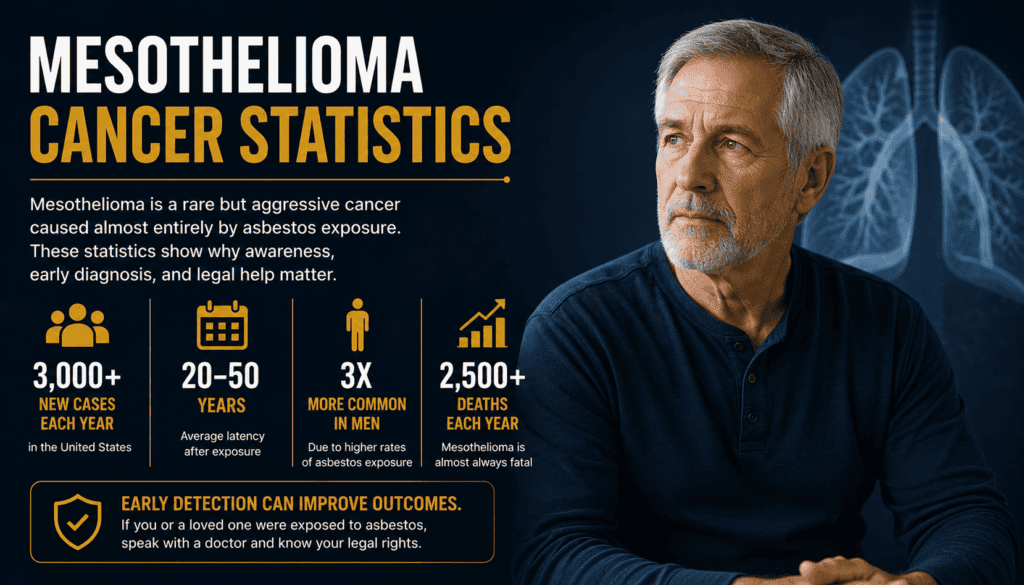
Mesothelioma Cancer Statistics: A 2026 Overview
For those newly diagnosed with mesothelioma, understanding the scope of the disease, treatment options, and expected outcomes can be overwhelming. The following key statistics and facts provide a snapshot of the current landscape in the U.S., giving patients and families a clearer picture of what to expect.
📊 What You’ll Learn From This Page:
-
In the U.S., around 3,000 new mesothelioma cases are diagnosed annually, primarily in older adults.
-
Pleural mesothelioma accounts for ~75–80% of cases, with peritoneal cases making up most of the rest.
-
Incidence is slowly declining due to asbestos regulations, but legacy exposure still drives new cases.
-
Survival statistics are improving, thanks to better treatments and earlier diagnoses, although prognosis remains serious.
-
Geographic and occupational patterns persist—mining, construction, military, shipbuilding, and industrial regions show higher rates.
General Statistics
- Approximately 3,000 new cases of mesothelioma are diagnosed each year in the United States.
- Pleural mesothelioma (affecting the lungs’ lining) accounts for about 81% of cases.
- Peritoneal mesothelioma (affecting the abdominal lining) makes up nearly 11%.
- Pericardial and testicular mesothelioma are extremely rare.
- From 1999 to 2020, 54,905 mesothelioma-related deaths were reported in the U.S.
Survival Rates and Life Expectancy
- Average life expectancy post-diagnosis is 4 to 18 months, according to Penn Medicine.
- Without treatment, life expectancy is typically 1 year or less.
- 5-year survival rate is around 12%, per the American Cancer Society.
- Patients receiving surgery and chemotherapy have better outcomes:
- Pleural mesothelioma: 32-month average survival
- Peritoneal mesothelioma with HIPEC: 53-month average survival
Treatment and Remission Insights
- Chemotherapy remains the most used treatment:
- 32% of patients received chemo.
- Most common drugs: Paraplatin (24%), Alimta (21%), Platinol (19%).
- Chemotherapy + surgery resulted in remission for 76% of successful cases.
- Surgery was used in 19% of cases; those who had surgery were 9% more likely to experience remission.
- Immunotherapy was used by 22% of patients, with Opdivo + Yervoy being the most common combination.
- Only 8% participated in clinical trials—a number that dropped from 2023.
Patient Care and Treatment Access
- Just 13% of remission cases involved a mesothelioma specialist.
- About 25% of all patients did not see a specialist, and 10% weren’t sure if they had.
- Only 34% of pleural and 40% of peritoneal patients received palliative care.
- 59% of patients or their loved ones never accessed hospice care.
Demographics and Diagnosis Trends
- Average diagnosis age: 72 (pleural mesothelioma).
- 1 in 4 patients are misdiagnosed at first.
- Diagnosis delays average 9 months from the onset of symptoms.
- A biopsy is the only definitive diagnostic method. Thoracoscopy was 90% effective in one major study.
Exposure Statistics and Risk Factors
- Over 27 million Americans were exposed to asbestos between 1940 and 1979.
- No level of asbestos exposure is safe, per Penn Medicine.
- About 33% of cases are linked to U.S. Navy or shipyard asbestos exposure.
- Up to 30% of cases stem from secondhand or non-occupational exposure.
- In 2024, the EPA officially banned the last form of asbestos used in the U.S.
- Over 62,000 talcum powder lawsuits have been filed for mesothelioma and ovarian cancer.
Alternative and Complementary Therapies
- Younger patients (<50) were 28% more likely to try integrative or alternative therapies.
- Medical marijuana was the most used alternative therapy.
- 7% of patients over 81 tried acupuncture or CBD oil.
Lung Cancer from Asbestos
- In addition to mesothelioma, asbestos exposure is a major cause of asbestos-related lung cancer, which is more common but harder to attribute directly to asbestos.
- Exact yearly diagnoses vary but are estimated in the tens of thousands.
Takeaway These statistics emphasize the importance of early diagnosis, seeing a specialist, and understanding your treatment options. Knowledge is power—especially for patients and families navigating the complex path of mesothelioma care. Ongoing research, legal options, and clinical trials continue to offer hope for improved outcomes in the years ahead.
Sources:
- American Cancer Society (ACS)
- Centers for Disease Control and Prevention (CDC)
- Penn Medicine
- Journal of Thoracic Disease
- Cancer Management and Research
- Open Epidemiology Journal
- U.S. Environmental Protection Agency (EPA)
- Agency for Toxic Substances and Disease Registry (ATSDR)
If you or someone you love has been diagnosed with mesothelioma, you may be entitled to compensation. Call 800.291.0963 for a free, no-obligation case evaluation with a dedicated mesothelioma lawyer who can help guide you through the legal process and get the support you deserve.