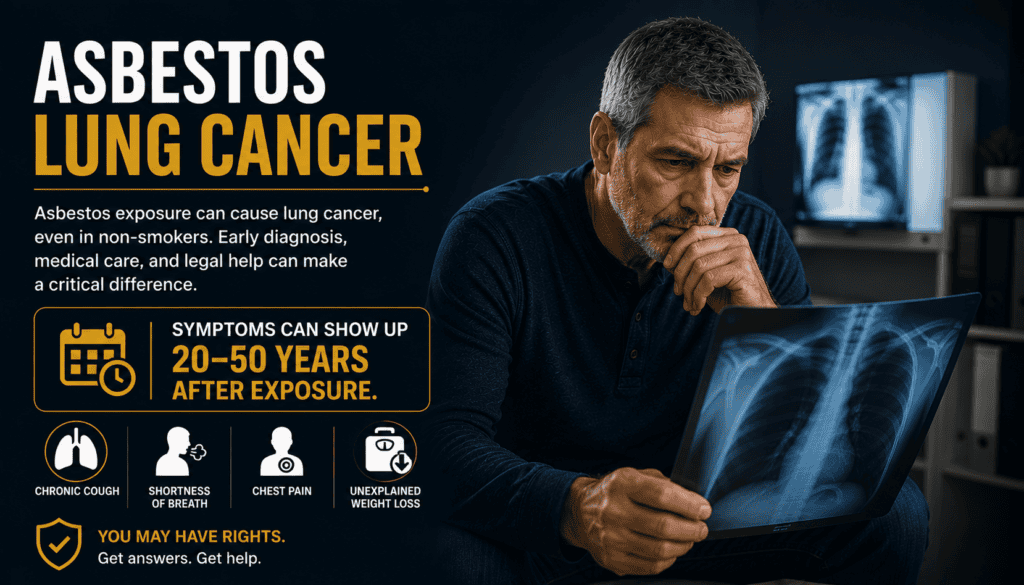
What Is Asbestos-Related Lung Cancer? Symptoms, Causes, Diagnosis and Treatment
Understand the distinction between lung cancer and mesothelioma, and learn when to seek evaluation.
What asbestos-related lung cancer means
Asbestos-related lung cancer is cancer that develops in the lung after asbestos exposure has contributed to a person’s risk. It is not the same disease as mesothelioma, which arises in the lining around the lungs or other organs. A clinician cannot determine from a scan alone whether asbestos caused an individual lung cancer; exposure history and other risk factors matter.
People with a past workplace, military or household exposure may have questions decades later. Exposure raises risk but does not mean cancer is inevitable. This guide explains what is known, what to discuss with a medical team, and where to find related information about asbestos-related diseases.
| Term | Plain-language meaning |
|---|---|
| Lung cancer | A malignancy that begins in lung tissue, often classified as non-small cell or small cell. |
| Mesothelioma | A different malignancy arising from the mesothelium, commonly the pleura. |
| Asbestos-related | A description of an exposure associated with increased risk; individual causation requires careful evaluation. |
How asbestos exposure increases risk
Asbestos is a group of naturally occurring mineral fibers. When asbestos-containing material is disturbed, airborne fibers may be inhaled. Occupational exposures have occurred in construction, shipyards, insulation work and other settings. Risk is affected by the amount and duration of exposure, among other factors. Disease can appear many years after exposure; there is no reliable way to predict whether a particular exposed person will develop cancer.
Bring a timeline of jobs, service, buildings, materials and possible secondhand exposure to your clinician. Do not disturb suspected asbestos materials to collect a sample; use qualified professionals for building assessment.
| Exposure detail | What to record |
|---|---|
| Where and when | Employer, worksite or military assignment and approximate years. |
| Tasks and materials | Insulation, pipe work, brakes, demolition or other plausible activities, without assuming asbestos was present. |
| Other exposures | Smoking history, household contact and other occupational hazards. |
Symptoms and when to seek care
Symptoms may include a persistent or worsening cough, coughing up blood, chest pain, shortness of breath, unexplained weight loss, fatigue or repeated chest infections. These symptoms have many possible causes and do not diagnose lung cancer. Contact a clinician promptly for new or persistent symptoms. Seek emergency care for severe breathing difficulty, significant coughing of blood, fainting or severe chest pain.
People who have no symptoms should not assume that a normal-feeling chest means there is no problem; discuss exposure history and individualized screening eligibility with a clinician.
| Finding | Action |
|---|---|
| Persistent cough or unexplained weight loss | Arrange a medical evaluation. |
| Small amount of blood in sputum | Contact a clinician urgently for advice. |
| Severe shortness of breath, major bleeding or severe chest pain | Seek emergency medical care. |
How doctors diagnose lung cancer
A clinician begins with symptoms, examination, medical history and exposure history. Imaging such as chest X-ray or CT can reveal an abnormality, but a tissue or cell sample is usually needed to establish the diagnosis and cancer type. Depending on the location, doctors may use bronchoscopy, image-guided biopsy or another procedure. Pathology and sometimes molecular testing help guide treatment.
Ask what each test can answer, whether a biopsy is needed, how results will be communicated and whether referral to a lung cancer specialist is appropriate. For diagnostic support, see information about seeking a second opinion, noting that lung cancer requires its own specialist assessment.
| Step | Purpose |
|---|---|
| History and examination | Identify symptoms, exposure and other risks. |
| Imaging | Locate and characterize a suspicious area. |
| Biopsy and pathology | Confirm cancer and determine the histologic type. |
| Staging and biomarker tests | Assess extent and, when appropriate, guide treatment. |
Types, stages and related conditions
The main lung cancer categories are non-small cell lung cancer (NSCLC) and small cell lung cancer (SCLC). NSCLC includes adenocarcinoma and squamous cell carcinoma. Stage describes how far cancer has spread; treatment options depend on type, stage, overall health and tumor characteristics. Asbestos exposure does not create a unique microscopic lung cancer subtype.
Asbestosis is scarring of lung tissue, and pleural plaques are changes in the lining around the lung; neither is itself lung cancer. Mesothelioma is another distinct malignancy. A person may have more than one asbestos-associated condition, so accurate pathology matters.
| Condition | How it differs |
|---|---|
| NSCLC / SCLC | Cancer beginning in lung tissue; requires type-specific staging and treatment. |
| Mesothelioma | Cancer of mesothelial lining, often pleura; different diagnosis and treatment. |
| Asbestosis | Noncancerous lung fibrosis associated with asbestos exposure. |
| Pleural plaques | Usually noncancerous pleural changes indicating prior exposure. |
Need help now? Call 800.291.0963 / Live chat 24/7, 365 days a year / Submit Your Case.
Treatment and supportive care
Depending on cancer type and stage, clinicians may consider surgery, radiation therapy, chemotherapy, immunotherapy, targeted therapy or combinations. Some treatments aim to remove or control cancer; others relieve symptoms. Biomarker testing can be important for selecting certain NSCLC treatments. The treatment plan for asbestos-associated lung cancer follows lung cancer evidence and is not automatically the same as a mesothelioma regimen.
Ask about goals, likely benefits, side effects, clinical trials and supportive or palliative care. Palliative care can accompany active cancer treatment and help manage symptoms and family needs. See our palliative care overview for general supportive-care concepts, while following a lung cancer team for disease-specific treatment.
| Option | Typical role to discuss |
|---|---|
| Surgery | Potentially appropriate for selected localized cases. |
| Radiation | May treat cancer or help relieve certain symptoms. |
| Systemic medicines | Chemotherapy, immunotherapy or targeted therapy as indicated by cancer type and testing. |
| Palliative care | Symptom relief and support at any disease stage. |
Smoking, screening and prevention
Smoking and asbestos exposure together increase lung cancer risk substantially more than either exposure alone. Stopping smoking benefits health even after past exposure; ask about counseling and evidence-based cessation medicines. Avoid new asbestos exposure and follow occupational safety rules. There is no supplement, detoxification program or home remedy proven to remove inhaled fibers or prevent asbestos-related lung cancer.
Low-dose CT screening is recommended for certain people at high risk based on age and smoking history under U.S. screening guidance. Asbestos exposure alone does not automatically meet standard screening eligibility criteria. A clinician can assess individual risk and explain potential benefits and harms, including false positives and follow-up procedures.
| Question | Discussion point |
|---|---|
| Do I qualify for low-dose CT? | Review age, smoking pack-years, quit date and other risk factors with a clinician. |
| Should I stop smoking now? | Yes; ask for cessation support regardless of exposure timing. |
| Can supplements prevent cancer? | No supplement is established to prevent asbestos-related lung cancer. |
Practical next steps after exposure or diagnosis
Start with medical evaluation rather than self-diagnosis. Prepare a dated exposure history, symptom list, medication list and copies of imaging or pathology reports. Ask the care team to explain the exact diagnosis, stage, recommended treatment, follow-up plan and warning signs. If caring for a relative, obtain permission before sharing their health details and coordinate appointments in a way that respects their preferences.
For people exploring legal or benefits questions, preserve employment and military records and consult a qualified professional about applicable deadlines and evidence. A diagnosis does not guarantee compensation, and rules vary by claim and jurisdiction. You can also read our prognosis overview for an explanation of why population statistics are not personal predictions; lung cancer survival estimates must be taken from lung cancer-specific sources.
| This week | Practical action |
|---|---|
| Medical | Book evaluation for symptoms or discuss screening eligibility if asymptomatic. |
| Records | Write down exposure locations, years and potential witnesses. |
| Support | Identify a trusted contact and questions for the next appointment. |
| Follow-up | Confirm when and how test results will be communicated. |
Frequently asked questions
These answers provide general information and cannot replace an individual medical or legal assessment.
Is asbestos-related lung cancer the same as mesothelioma?
No. Lung cancer starts in lung tissue; mesothelioma starts in the mesothelial lining, most often around the lungs.
Does everyone exposed to asbestos develop lung cancer?
No. Exposure increases risk but does not make cancer inevitable.
How long after exposure can lung cancer appear?
It may develop decades later. Timing varies, and an individual risk cannot be predicted from a single exposure date.
Can a CT scan prove asbestos caused my cancer?
No. Imaging can identify abnormalities, while diagnosis usually requires pathology; determining an exposure contribution requires broader clinical and exposure evaluation.
Does smoking matter if I was exposed to asbestos?
Yes. Smoking and asbestos exposure interact to raise lung cancer risk, and quitting smoking remains beneficial.
Should everyone with asbestos exposure get annual CT screening?
Not automatically. Discuss age, smoking history, exposure and potential screening benefits and harms with a clinician.
Can lung cancer be treated if asbestos was involved?
Yes. Treatment depends on cancer type, stage, biomarkers and health, not solely on the exposure history.
Can a family seek compensation after a diagnosis?
Potential options depend on the facts and applicable rules; a qualified legal professional can explain evidence, deadlines and eligibility without guaranteeing an outcome.
Medical sources and further reading
These primary public-health and cancer resources explain asbestos-associated disease, lung cancer diagnosis and screening. Check their current clinical guidance with your care team.
Questions About Asbestos Exposure or a Diagnosis?
Call 800.291.0963. Live chat is available 24/7, 365 days a year. Submit Your Case to ask about possible next steps. Contacting us does not establish eligibility or guarantee compensation.
⚕️ Legal & Medical Information Disclaimer
This page provides general education, not medical diagnosis, treatment advice or legal advice. Consult a qualified clinician for personal health decisions and a qualified attorney for legal questions.