🛁 Asbestos Exposure & Talc Powder
What You’ll Learn From This Page:
-
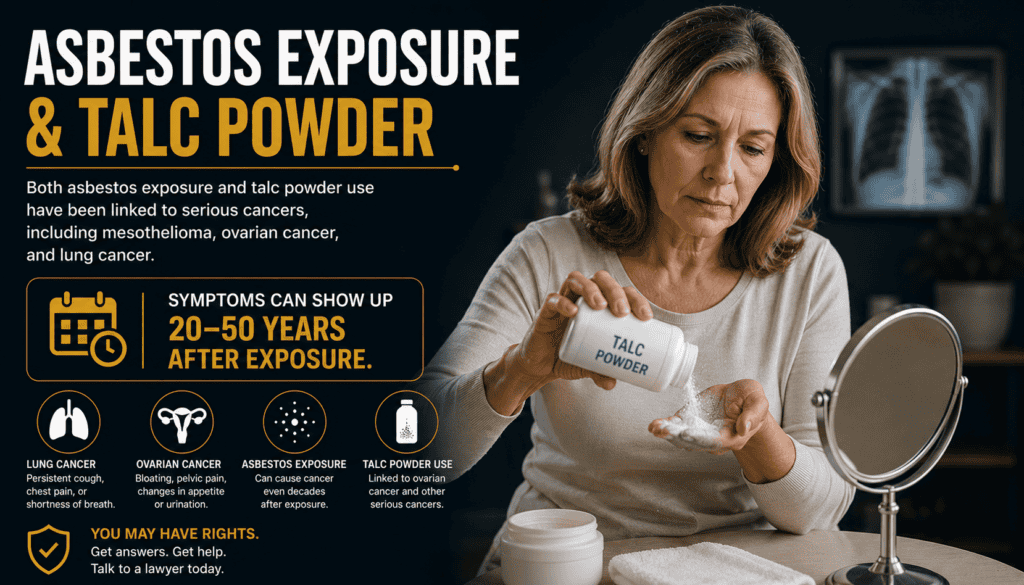
Some talc powders were contaminated with asbestos, a known carcinogen, before stricter regulations.
-
Using contaminated talc can increase mesothelioma or ovarian cancer risk, especially with long-term use.
-
Diagnosis involves determining talc brand, usage timeline, and exposure context.
-
Several major manufacturers face legal cases, and juries have awarded large compensations to users diagnosed with cancer.
Understanding Asbestos Exposure & Talc Powder
Talc powder, commonly used in personal care products, has been linked to asbestos exposure due to the natural presence of asbestos in talc deposits. Talc is a mineral that is often found in close proximity to asbestos, and mining processes can result in contamination. This exposure has raised concerns about the potential health risks associated with the use of talc-containing products, including an increased risk of mesothelioma, lung cancer, and other asbestos-related diseases.
How Asbestos Exposure Occurs Through Talc Powder
Talc is frequently used in baby powder, body powders, cosmetics, and industrial applications due to its moisture-absorbing properties. However, when talc is mined from deposits that also contain asbestos, tiny asbestos fibers can become trapped in the talc. Asbestos fibers are harmful when inhaled, as they can lodge in the lungs or other organs, leading to serious health conditions over time. Although not all talc is contaminated with asbestos, products that have been improperly sourced or inadequately purified may pose a significant risk to users.
Health Risks Associated with Talc Powder Containing Asbestos
- Mesothelioma: Mesothelioma, a rare and aggressive cancer of the lining of the lungs or abdomen, is strongly linked to asbestos exposure. Using talc powder contaminated with asbestos increases the risk of developing mesothelioma.
- Lung Cancer: Inhalation of asbestos fibers from contaminated talc powder may lead to lung cancer. Asbestos is a known carcinogen, and prolonged exposure increases the likelihood of developing this disease.
- Asbestosis: Prolonged exposure to asbestos, including through talc powder, can lead to asbestosis, a chronic lung disease characterized by scarring of lung tissue. This condition can cause breathing difficulties and long-term lung damage.
Individuals exposed to asbestos through contaminated talc powder may experience symptoms such as:
- Persistent Coughing: A chronic cough that does not go away, often worsening over time.
- Shortness of Breath: Difficulty breathing or feeling winded with minimal exertion.
- Chest Pain: Pain or tightness in the chest, which may worsen with coughing.
- Fatigue: Extreme tiredness that doesn’t improve with rest.
- Unexplained Weight Loss: Losing weight without changes in diet or physical activity.
If you have used talc powder products and are experiencing symptoms related to asbestos exposure, it is crucial to seek medical advice immediately. Early detection of asbestos-related diseases can improve treatment outcomes. Additionally, individuals diagnosed with mesothelioma or other asbestos-related diseases due to talc powder exposure may be entitled to compensation. Consulting an experienced attorney specializing in asbestos-related cases can provide valuable guidance and help secure the financial relief needed for treatment and recovery.

Asbestos exposure has long been recognized as a significant risk factor for various cancers, including ovarian cancer and mesothelioma, particularly for individuals who have used talcum powder containing asbestos. Mesothelioma is a rare but aggressive cancer primarily caused by asbestos exposure, often affecting the lining of the lungs (pleura), abdomen (peritoneum), or heart (pericardium). This document outlines the diagnostic methods and treatment options for both ovarian cancer and mesothelioma, emphasizing the risks associated with talc powder and asbestos exposure.
Pelvic Examination
A pelvic examination is an essential first step in diagnosing ovarian cancer. During this exam, a healthcare provider checks for abnormalities, such as enlarged ovaries or masses, by palpating the pelvic area. If an abnormality is detected, further diagnostic tests will be performed to confirm the presence of ovarian cancer or other related conditions.
Ultrasound (Sonography)
Ultrasound uses sound waves to create detailed images of the ovaries and surrounding tissues. A transvaginal ultrasound, in which the probe is inserted into the vagina, provides a closer view of the ovaries, helping to detect cysts, tumors, or other growths indicative of ovarian cancer. It is also helpful in evaluating fluid buildup that may suggest mesothelioma.
CT Scan (Computed Tomography)
CT scans are highly effective in diagnosing both ovarian cancer and mesothelioma. For ovarian cancer, a CT scan provides detailed images of the abdomen and pelvis, helping doctors assess tumor size, location, and whether the cancer has spread. For mesothelioma, CT scans can detect fluid accumulation around the lungs or abdomen and provide information about the spread of the disease.
MRI Scan (Magnetic Resonance Imaging)
MRI uses magnets and radio waves to create high-resolution images of the body’s organs and tissues. MRI scans are particularly useful for evaluating soft tissue changes in ovarian cancer and mesothelioma, providing clearer details than CT scans in some cases. They are used to assess the extent of tumor spread and to identify any metastasis.
Blood Tests (CA-125 Test for Ovarian Cancer and Mesothelin Test for Mesothelioma)
The CA-125 blood test measures the levels of cancer antigen 125, a protein that is often elevated in ovarian cancer. While not definitive on its own, it serves as a useful marker to monitor the presence and progression of ovarian cancer. For mesothelioma, the mesothelin test can help detect elevated levels of a specific protein associated with this type of cancer, though it is not used as a sole diagnostic tool.
Biopsy
A biopsy is the most definitive way to diagnose both ovarian cancer and mesothelioma. In ovarian cancer, tissue samples from the ovaries or abdominal lining are removed for analysis. In mesothelioma, biopsies are often performed on the pleura, peritoneum, or pericardium, depending on the location of the cancer. The tissue is examined under a microscope to confirm the presence of cancer cells.
Laparoscopy
Laparoscopy is a minimally invasive procedure that involves inserting a camera into the abdomen to inspect the ovaries or abdominal lining. This procedure is helpful for confirming the diagnosis of ovarian cancer and collecting tissue samples for biopsy. In mesothelioma, laparoscopy can be used to inspect the peritoneum and collect fluid or tissue for testing.
X-Ray
X-rays are often used in combination with other imaging methods to detect complications or metastasis of both ovarian cancer and mesothelioma. In mesothelioma, X-rays can reveal fluid accumulation in the lungs or abdomen, which is a common sign of the disease.
CT-guided Needle Biopsy
For both ovarian cancer and mesothelioma, a CT-guided needle biopsy can be used to obtain tissue samples from tumors that are difficult to reach. This technique uses CT imaging to guide the needle to the affected area, allowing for precise sample collection.
Surgery for Ovarian Cancer
Surgery is often the primary treatment for ovarian cancer. The goal is to remove as much of the tumor as possible. Depending on the stage of the cancer, surgery may involve removing one or both ovaries, the fallopian tubes, the uterus, and nearby lymph nodes. In some cases, chemotherapy or radiation therapy is administered after surgery to reduce the risk of recurrence.
Surgery for Mesothelioma
Surgery for mesothelioma is more complex and is generally considered when the disease is in the early stages. Procedures may involve removing the affected pleura or peritoneum, along with parts of the lung or abdominal lining. In some cases, doctors may perform a pleurectomy or peritonectomy, which removes the lining of the lungs or abdomen, respectively. However, surgery is not always possible, especially if the cancer has spread extensively.
Chemotherapy for Ovarian Cancer and Mesothelioma
Chemotherapy is a common treatment for both ovarian cancer and mesothelioma. For ovarian cancer, chemotherapy drugs are used to kill cancer cells or stop their growth, and it is typically administered after surgery to target any remaining cancer cells. For mesothelioma, chemotherapy helps manage symptoms and can shrink tumors, although it is often used to improve quality of life rather than cure the disease.
Targeted Therapy for Ovarian Cancer
Targeted therapy focuses on specific molecules involved in cancer cell growth. This treatment is used to block the growth of cancer cells while minimizing damage to healthy tissue. Targeted therapies for ovarian cancer may include drugs that target specific proteins or pathways in the cancer cells.
Immunotherapy for Ovarian Cancer and Mesothelioma
Immunotherapy uses the body’s immune system to fight cancer. For ovarian cancer, certain immunotherapies may be used in combination with chemotherapy to target cancer cells more effectively. Immunotherapy is also being studied for mesothelioma, with some promising results in stimulating the immune system to attack mesothelioma cells.
Hormone Therapy for Ovarian Cancer
Hormone therapy is sometimes used in cases of ovarian cancer that are sensitive to hormones like estrogen. It involves the use of medications that block or lower hormone levels to prevent cancer cells from growing.
Radiation Therapy for Mesothelioma
Radiation therapy is used for mesothelioma to shrink tumors and relieve symptoms, especially when surgery is not an option. It can be applied to specific areas of the body, such as the chest or abdomen, to target the cancer and reduce pain or swelling.
Ovarian cancer and mesothelioma are both serious cancers that can be linked to asbestos exposure, especially in individuals who have used talc powder contaminated with asbestos. Early diagnosis through imaging tests, blood tests, and biopsies is critical for improving treatment outcomes. Treatment options for both cancers include surgery, chemotherapy, radiation therapy, and emerging therapies like immunotherapy and targeted therapy. If you or a loved one has been exposed to talc powder or asbestos, it is important to seek medical attention as early detection and timely treatment significantly increase the chances of successful management of these cancers.
If you or someone you love has been diagnosed with mesothelioma, you may be entitled to compensation. Call 800.291.0963 for a free, no-obligation case evaluation with a dedicated mesothelioma lawyer who can help guide you through the legal process and get the support you deserve.