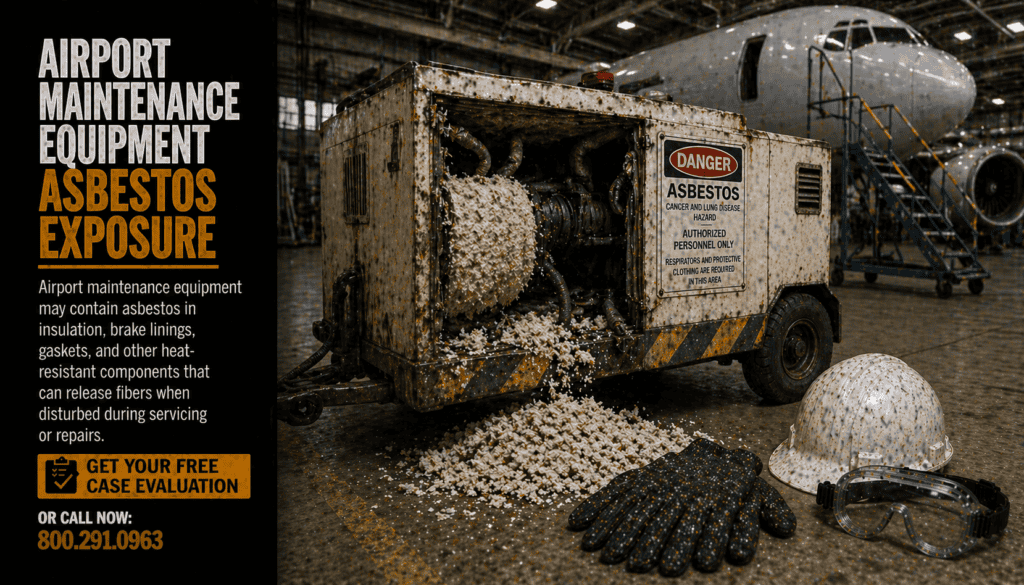
Airport Maintenance Equipment Asbestos Exposure Risks
Airport operations depend on vehicles and machines that tow aircraft, move baggage, supply power, start engines, handle cargo and maintain runways and buildings. Mechanics and civilian contractors who serviced older ground-support equipment may have encountered asbestos in friction parts, gaskets, insulation, electrical components or nearby facility materials.
An airport job or an old machine does not prove exposure. The most useful evidence identifies the equipment, component, manufacturer, maintenance activity, location and approximate year. This guide explains which airport tasks deserve investigation and how workers and families can organize an exposure history.
Airport Equipment and Work Locations
Ground-support equipment includes service and maintenance machines used at airports to support aviation operations. Depending on the airport and period, fleets may have included aircraft tugs, baggage tractors, belt loaders, cargo loaders, forklifts, service trucks, mobile stairs, ground-power units, air-start units, compressors, generators and runway-maintenance vehicles.
Possible exposure locations extend beyond the ramp. Mechanics may have worked in motor pools, equipment garages, airline maintenance bases, cargo terminals, hangars, parts rooms, boiler rooms, electrical shops and temporary field facilities. Some employees repaired airport-owned vehicles; others serviced airline, contractor or government equipment in the same building.
Job titles may not reveal the actual work. A ramp agent might help replace a tug brake, while a general mechanic could maintain generators, tractors and building systems during the same shift. Exposure histories should describe tasks and nearby work instead of relying only on payroll titles.
For the surrounding topic, visit the civilian aircraft asbestos-exposure hub and the main civilian contractor asbestos-exposure page.
How Airport Equipment Work May Release Asbestos Fibers
Older brakes and clutches are important areas to investigate because friction materials historically could contain asbestos. Dust may accumulate inside a brake drum or clutch housing as a lining wears. Removing the housing, dry brushing parts, sanding a lining or blowing residue with uncontained compressed air can move fine particles into a mechanic’s breathing zone and across the shop.
Heat-producing equipment may present different questions. Engine, compressor, generator, pump and exhaust work can involve old gaskets, packing, insulation or heat-resistant barriers. A worker could disturb material while separating a flange, scraping a sealing surface, opening an insulated cabinet or replacing a hot-system component.
Airport facilities may create another exposure pathway. Repair work near insulated pipes, boilers, floor tile, fire doors or older electrical systems should be documented separately from vehicle maintenance. Identifying the actual source matters because equipment manufacturers, product suppliers and premises owners can be different entities.
Jet fuel, hydraulic fluid, diesel exhaust, deicing chemicals, solvents and brake dust without asbestos are separate occupational hazards. Their presence does not establish asbestos exposure, and an accurate page should not combine them into one unsupported conclusion.
Equipment, Components and Records to Investigate
| Equipment or system | Potentially relevant work | Helpful identifying records |
|---|---|---|
| Aircraft tugs and baggage tractors | Brake, clutch, transmission and exhaust service | Fleet number, make, model, repair order and parts invoice |
| Belt loaders, cargo loaders and forklifts | Friction-part replacement and dusty component cleanup | Maintenance log, brake specification and supplier record |
| Ground-power and air-start units | Engine, generator, insulation, gasket and electrical repair | Serial plate, service manual and wiring diagram |
| Compressors, pumps and shop machinery | Removing seals, packing, gaskets or heat barriers | Equipment drawing, overhaul kit and product label |
| Airport boilers, HVAC and electrical systems | Repairing insulated pipes, ducts, panels or mechanical rooms | Facility survey, work order and asbestos-abatement report |
Material composition can vary by manufacturer and production year. A newer replacement lining or gasket may be asbestos-free even when an earlier version looked similar. The component’s name alone is not enough; part numbers, technical manuals, purchase documents or credible testimony help establish what was present.
Related resources include civilian contractor vehicles, mobile generators, pump equipment and electrical equipment.
Verified Asbestos and Equipment-Safety Facts
- A Federal Aviation Administration definition describes ground-support equipment as service and maintenance equipment used at an airport to support aviation operations and related activities.
- OSHA’s mandatory brake-and-clutch work-practice appendix describes enclosed HEPA-vacuum and low-pressure wet-cleaning methods for controlling asbestos-containing residue.
- OSHA’s general-industry asbestos standard restricts the use of compressed air on asbestos-containing material unless a ventilation system effectively captures the dust cloud.
- The Environmental Protection Agency reports that asbestos was used in friction products, gaskets, heat-resistant fabrics, insulation and other manufactured products.
- The National Cancer Institute identifies asbestos as a known human carcinogen associated with mesothelioma, lung cancer and additional diseases.
These sources explain why brake, clutch and heat-resistant materials merit investigation. They do not establish that every airport machine contained asbestos or that every equipment mechanic experienced a harmful exposure.
Health and Secondhand Exposure
When airborne asbestos fibers are inhaled, they can remain in the body and contribute to disease many years later. Mesothelioma, asbestos-related lung cancer and asbestosis are among the recognized conditions. The long interval between exposure and diagnosis makes a complete lifetime work history especially important.
Symptoms such as ongoing shortness of breath, chest pain, persistent cough, fatigue, unexplained weight loss or abdominal swelling require medical evaluation. These symptoms have many possible causes and cannot confirm asbestos exposure or disease on their own. Workers should tell their clinician about historical brake, clutch, gasket, insulation and airport-facility work.
Dust could also leave a repair shop on uniforms, shoes, hair, tools or a personal vehicle. A family member who handled or laundered dusty work clothing may have experienced take-home exposure. Read more about civilian contractor secondhand exposure and contractor asbestos health risks.
Documenting Airport Maintenance-Equipment Work
Create a timeline beginning with the airport, airline, contractor or government agency that employed the worker. Add the terminal, hangar, motor pool, cargo area or support-equipment shop where the work occurred. Approximate years are useful even when exact dates are unavailable.
Record the following details when possible:
- equipment type, manufacturer, model, fleet number and fuel type;
- brake, clutch, engine, generator, pump or electrical part numbers;
- tasks such as sanding, scraping, drilling, sweeping or compressed-air cleaning;
- names of coworkers, supervisors, vendors and outside repair contractors;
- maintenance manuals, work cards, inventory lists and purchase invoices;
- garage ventilation, respiratory protection and cleanup procedures;
- nearby boiler, HVAC, pipe or building-renovation work;
- uniform-laundry practices and household contact with work dust.
Photographs can identify an equipment model, shop layout or product container. Union records, airport badges, training certificates, tax records and Social Security employment histories may help establish where and when someone worked. Use the civilian contractor exposure-timeline guide to organize the evidence.
Legal and Compensation Options
Potential claims depend on the diagnosis, evidence, responsible companies, job location and applicable filing deadlines. An investigation may examine equipment manufacturers, friction-part or gasket suppliers, maintenance contractors, distributors and premises owners. The employer is not automatically the only relevant business.
A diagnosed worker may be able to pursue a personal-injury lawsuit against responsible defendants. Some families may qualify for a wrongful-death claim. Asbestos bankruptcy trusts use separate eligibility and exposure criteria, and more than one trust may be relevant when multiple products are identified. Workers’ compensation or other benefits may also apply in certain cases.
Outcomes and compensation cannot be promised. A case-specific review is necessary because statutes of limitation and evidence requirements vary. The civilian contractor claims and legal-options hub provides additional information.
Frequently Asked Questions
Did all older airport ground equipment contain asbestos?
No. Materials varied by equipment, manufacturer, component and year. A model name or age is not sufficient proof.
Why are brakes and clutches investigated?
Some historical friction materials contained asbestos, and dust could accumulate during use. The actual part and maintenance period must still be verified.
Could compressed-air cleaning increase dust?
Yes. Uncontrolled compressed air can disperse residue. OSHA restricts its use on asbestos-containing material unless effective ventilation captures the dust cloud.
Is facility exposure different from equipment exposure?
Yes. Pipe insulation, boilers or floor tile in an airport building may involve different products and responsible companies than a tug or generator.
What if the equipment model is unknown?
Begin with the airport, employer, department, years and tasks. Coworkers, photographs, fleet records and maintenance documents may identify the machine later.
Get Help Reviewing Airport Equipment Exposure
If you or a loved one developed mesothelioma or asbestos-related lung cancer after repairing airport tugs, tractors, generators or other support equipment, a case review can help identify the machines, parts, suppliers and work locations involved.
Call 800.291.0963 or use our contact form for a free, confidential review of your airport-maintenance history.
This page provides general educational information and does not offer medical advice or legal advice for a specific case.