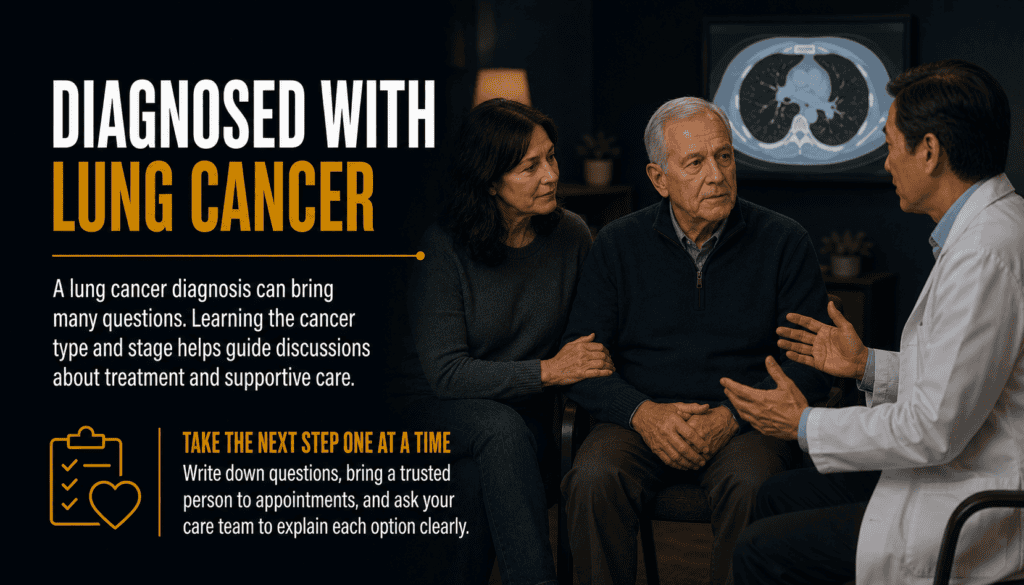
Diagnosed With Lung Cancer
Medical next steps, asbestos exposure questions, and records to gather
A lung cancer diagnosis can bring urgent medical decisions and many unanswered questions. The first priorities are confirming the exact cancer type, learning its stage, completing recommended biomarker testing, and discussing treatment with a qualified cancer team. A second opinion may help when the diagnosis, stage, or treatment options are uncertain.
If you worked with or around asbestos, served in the military, lived with an exposed worker, or encountered disturbed asbestos materials, tell your doctor. Asbestos can cause lung cancer as well as mesothelioma, but these are different diseases and require an accurate pathology diagnosis.
First Steps After a Lung Cancer Diagnosis
Ask for copies of the pathology report, imaging reports, laboratory results, procedure notes, and an updated medication list. Write down the specific diagnosis and stage, the tests still needed, and the name of the clinician coordinating care. Consider bringing a family member or friend to appointments to take notes.
| Priority | Questions to ask | Why it matters |
|---|---|---|
| Confirm the diagnosis | What exact type and subtype of lung cancer is this? | Small cell and non-small cell lung cancers are treated differently |
| Determine the stage | Where is the cancer, and has it spread? | Stage helps guide treatment choices and goals |
| Complete tumor testing | Does my tumor need molecular biomarker and PD-L1 testing? | Results may identify targeted therapy or immunotherapy options |
| Review overall health | How do lung function and other conditions affect treatment? | Fitness for surgery and other treatments varies by patient |
| Consider another review | Would a thoracic oncology or pathology second opinion help? | A specialist may confirm the diagnosis and identify additional options |
Understanding Cancer Type and Stage
The two main categories are non-small cell lung cancer (NSCLC) and small cell lung cancer (SCLC). NSCLC is more common and includes adenocarcinoma, squamous cell carcinoma, and other subtypes. SCLC usually grows and spreads differently and follows a separate treatment approach.
| Diagnosis detail | What it describes | How it affects care |
|---|---|---|
| Histology | How cancer cells look and behave under a microscope | Separates NSCLC, SCLC, and specific subtypes |
| Stage | Tumor size and spread to lymph nodes or distant organs | Helps determine whether local, systemic, or combined treatment is appropriate |
| Performance status | How well a patient performs daily activities | Helps clinicians weigh potential treatment benefits and side effects |
| Biomarkers | Tumor gene changes or proteins that may guide therapy | Can identify targeted treatments or help plan immunotherapy |
Ask the oncology team to explain the diagnosis in plain language and provide it in writing. Prognosis is individualized; population statistics cannot predict exactly what will happen to one person.
Lung Cancer and Mesothelioma Are Different Diseases
Lung cancer begins in lung tissue or the airways. Pleural mesothelioma begins in the pleura, the membrane covering the lungs and lining the chest wall. Both can cause cough, chest pain, shortness of breath, fluid around the lung, fatigue, and weight loss, and both can be associated with asbestos exposure.
| Feature | Primary lung cancer | Pleural mesothelioma |
|---|---|---|
| Where it starts | Lung tissue or bronchi | Pleural lining around the lung |
| Major categories | Non-small cell and small cell lung cancer | Epithelioid, sarcomatoid, and biphasic cell types |
| Main risk factors | Smoking is the leading risk; asbestos and other exposures also raise risk | Asbestos exposure causes most cases |
| Diagnosis | Imaging plus tissue biopsy and pathology | Imaging plus tissue biopsy, specialized pathology, and immunohistochemistry |
| Treatment planning | Based on type, stage, biomarkers, health, and preferences | Based on location, stage, cell type, health, and specialist evaluation |
If pathology is unclear—especially with a pleural tumor or known asbestos exposure—ask whether an expert pathology review is appropriate. See the mesothelioma diagnosis overview and pleural mesothelioma guide.
Pathology, Imaging, and Biomarker Testing
A biopsy is generally needed to confirm lung cancer. A pathologist examines the tissue to determine the cancer type. Imaging—such as CT, PET/CT, MRI, or bone imaging when indicated—helps define tumor location and spread. Bronchoscopy, endobronchial ultrasound, mediastinoscopy, or image-guided biopsy may be used to obtain tissue or assess lymph nodes.
For many patients with NSCLC, testing the tumor for actionable biomarkers and PD-L1 can affect first-line treatment. The exact panel depends on histology, stage, available tissue, and current treatment guidelines. Blood-based testing may sometimes supplement tissue testing but does not always replace it.
- Confirm whether the biopsy sample is adequate for diagnosis and recommended testing.
- Ask whether the pathology distinguishes primary lung cancer from cancer that spread from another organ.
- Ask when biomarker results will be available and whether treatment should wait for them.
- Request electronic or disc copies of imaging for a second opinion.
Related resources include imaging tests, pathology reviews, and getting a second opinion.
Building a Treatment Plan
Treatment can include surgery, radiation therapy, chemotherapy, immunotherapy, targeted therapy, or combinations of these approaches. The best plan depends on whether the diagnosis is NSCLC or SCLC, the stage, tumor biomarkers, overall health, lung function, symptoms, and personal goals.
| Approach | How it may be used | Questions for the care team |
|---|---|---|
| Surgery | May be considered for selected localized NSCLC | Is the cancer technically removable, and am I medically fit for surgery? |
| Radiation therapy | May treat localized disease, combine with chemotherapy, or relieve symptoms | What area will be treated, and what side effects are expected? |
| Chemotherapy | May be given before or after surgery, with radiation, or for advanced disease | What is the goal, schedule, and monitoring plan? |
| Targeted therapy | Treats cancers with certain actionable molecular changes | Which biomarkers were tested, and is a matched treatment available? |
| Immunotherapy | Helps the immune system recognize or attack cancer | Am I eligible, and what immune-related side effects require urgent attention? |
| Supportive and palliative care | Manages symptoms and supports quality of life at any stage | Can symptom support begin alongside cancer-directed treatment? |
Clinical trials may provide access to investigational approaches and can be considered at different stages of care. Ask whether a trial fits the cancer type, biomarkers, prior treatments, location, and health status.
Was Asbestos Part of Your Work or Military History?
We can help you organize possible exposure sources and understand available support and legal resources.
Call 800.291.0963 Submit Your CaseLive chat is available 24/7/365.
How Asbestos Exposure Relates to Lung Cancer
Asbestos is an established cause of lung cancer. Exposure may have occurred through construction, shipyards, industrial plants, power generation, automotive brake work, insulation trades, railroad work, military service, building renovation, or fibers carried home by an exposed worker.
Smoking is the largest risk factor for lung cancer, but an asbestos history still matters. Tobacco smoke and asbestos together are especially hazardous, and smoking does not erase a separate occupational or household exposure. Only qualified medical professionals can evaluate possible causes in an individual case.
Questions That Help Reconstruct Exposure
- Where did you work, serve, or live, and during which years?
- Did you handle insulation, boilers, pipes, gaskets, brakes, cement products, flooring, roofing, or fireproofing?
- Did nearby workers create dust during cutting, sanding, repair, demolition, or cleanup?
- Did a household member return home in dusty work clothes?
Learn more about the history of asbestos exposure, high-risk occupations, and military asbestos exposure.
Records, Appointments, and Practical Support
Create one folder—paper or digital—for medical and exposure records. Keeping documents organized can reduce repeated requests, make second opinions easier, and help family members understand the care plan.
| Medical records | Exposure records | Practical records |
|---|---|---|
| Pathology and biopsy reports | Employment and union history | Insurance correspondence |
| Imaging reports and image files | Military discharge and assignment records | Medication and symptom lists |
| Biomarker and laboratory results | Job sites, products, tasks, and coworkers | Appointment calendar and contact list |
| Treatment summaries and visit notes | Residences, renovations, and household exposure | Advance directives and caregiver notes |
Ask the cancer center about an oncology social worker, financial counselor, nutrition professional, smoking-cessation support, transportation assistance, symptom management, and caregiver services. Supportive care is appropriate from diagnosis onward—not only at the end of life.
Legal and Benefit Options After Asbestos Exposure
A person diagnosed with primary lung cancer may have legal or benefit options if asbestos exposure contributed to the disease; a mesothelioma diagnosis is not necessarily required. Potential avenues can include personal-injury claims, asbestos trust claims, workers’ compensation in some circumstances, or Department of Veterans Affairs benefits for eligible veterans.
Eligibility depends on medical evidence, exposure evidence, the responsible companies or products, jurisdiction, and filing deadlines. Laws vary, and no outcome or compensation amount is guaranteed. An attorney experienced in asbestos-related lung cancer can evaluate the facts and applicable deadlines.
Useful documents may include pathology records, a Social Security earnings history, union records, military records, job-site lists, product names, coworker contacts, and a written exposure timeline. Do not delay medical care while collecting legal records.
Review information about a lung cancer asbestos lawsuit, asbestos trust funds, and filing deadlines.
Authoritative Medical Sources
- National Cancer Institute: Non-Small Cell Lung Cancer Treatment
- National Cancer Institute: Small Cell Lung Cancer Treatment
- National Cancer Institute: Mesothelioma Treatment
- National Cancer Institute: Asbestos Exposure and Cancer Risk
- Centers for Disease Control and Prevention: About Lung Cancer
- U.S. Food and Drug Administration: Lung Cancer
Frequently Asked Questions
What should I do first after a lung cancer diagnosis?
Confirm the exact pathology, complete staging, ask whether biomarker testing is needed, obtain copies of your records, and schedule a treatment discussion with a lung cancer specialist.
Can lung cancer be mistaken for mesothelioma?
The diseases can produce similar symptoms and imaging findings, but they start in different tissues. A tissue biopsy, immunohistochemistry, and expert pathology review can distinguish them.
What are the main types of lung cancer?
The two main categories are non-small cell lung cancer and small cell lung cancer. NSCLC includes adenocarcinoma, squamous cell carcinoma, and other subtypes.
Why is biomarker testing important?
For many people with NSCLC, molecular and protein testing can identify targeted therapies or help guide immunotherapy. Testing needs vary by subtype and stage.
Can asbestos cause lung cancer even if I smoked?
Yes. Asbestos is an established lung-cancer cause, and the combination of tobacco smoking and asbestos exposure is especially hazardous. A smoking history does not make asbestos exposure irrelevant.
Should I get a second opinion?
A second opinion can be valuable if the pathology is unclear, the cancer is uncommon, major surgery is proposed, or you want confirmation of stage, biomarkers, and treatment choices.
Do I need mesothelioma to file an asbestos claim?
Not necessarily. Primary lung cancer linked to asbestos exposure may support certain claims or benefits. Eligibility depends on evidence, jurisdiction, and deadlines.
Which documents should I collect?
Start with pathology, imaging, biomarker results, treatment notes, employment history, military records, union records, job sites, product names, and a timeline of possible exposure.
Get Help After an Asbestos-Related Lung Cancer Diagnosis
Our team can help you organize an exposure history and understand potential support and legal resources. There is no obligation.
Call 800.291.0963 Submit Your CaseLive chat is available 24/7/365.
Medical and legal disclaimer: This information is educational and does not replace advice from a qualified healthcare professional or attorney. Treatment, eligibility, deadlines, and outcomes depend on individual facts.