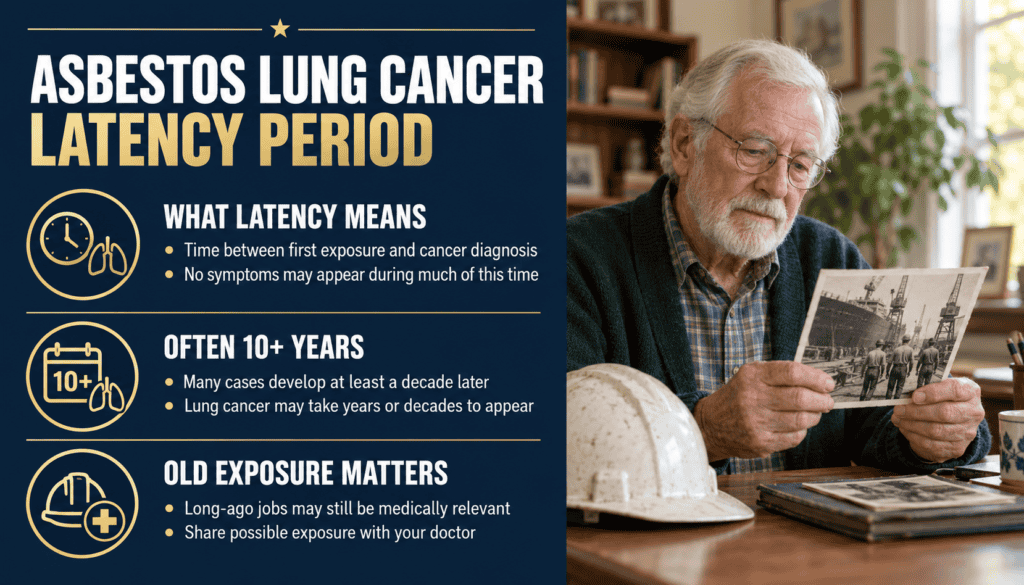
Asbestos Lung Cancer Latency Period
Asbestos-related lung cancer can develop many years after exposure. The time between the first meaningful asbestos exposure and the later development or diagnosis of lung cancer is called the latency period. For many workers and veterans, that interval can extend for decades.
Long latency is one reason a person diagnosed with lung cancer today may need to look far back into employment, military service, construction projects, ships, industrial plants, equipment maintenance, or other exposure settings. A workplace may have closed and a product may no longer be sold, yet those older exposures can still be relevant.
This page is part of the Asbestos Lung Cancer Prognosis & Survival hub within the broader Diagnosed With Lung Cancer section. It focuses specifically on the timing between asbestos exposure and lung cancer—not on predicting how long an individual patient will live after diagnosis.
⏳ What Is the Asbestos Lung Cancer Latency Period?
The latency period is the interval between an earlier asbestos exposure and the later development or diagnosis of disease. Asbestos-related cancers are known for long latency periods, which means the health effects may not become apparent until many years after a person was exposed.
Latency is different from survival. Latency looks backward from diagnosis to earlier exposure. Survival and life expectancy look forward from diagnosis and depend on factors such as cancer type, stage, treatment response, age, overall health, and other clinical characteristics.
Latency also does not prove causation by itself. A diagnosis that occurs decades after a possible exposure may be consistent with an asbestos-related disease timeline, but the actual exposure history and other lung cancer risk factors still need to be evaluated.
📅 How Long Can Asbestos Lung Cancer Take to Develop?
There is no single latency period that applies to every person. Studies of asbestos-exposed populations show that lung cancer may emerge after a prolonged interval, often measured in decades rather than months or only a few years.
In many occupational histories, investigators may be looking back 20, 30, 40, or more years to identify the jobs and tasks that could have produced meaningful exposure. The exact interval can differ considerably from person to person.
| Factor | Why It Matters | What to Review |
|---|---|---|
| Age at first exposure | Earlier exposure may create a longer period for disease to develop | First job, military enlistment, apprenticeship, early work assignments |
| Exposure duration | Some people were exposed repeatedly over many years | Employment dates, assignments, maintenance cycles, projects |
| Exposure intensity | Higher airborne fiber concentrations can increase cumulative exposure | Dust-generating tasks, confined areas, nearby trades |
| Type of work | Different activities created different potential exposure levels | Insulation, demolition, repair, cutting, grinding, mechanical work |
| Smoking history | Smoking is an independent lung cancer cause and can interact with asbestos | Years smoked, amount smoked, date of quitting |
These factors help place an exposure history in context, but none of them alone determines whether asbestos caused an individual lung cancer diagnosis.
🫁 Why Can Lung Cancer Appear Decades After Asbestos Exposure?
When asbestos-containing material is disturbed, microscopic fibers can become airborne and be inhaled deep into the lungs. Some fibers can remain in lung tissue for long periods.
Over time, asbestos exposure can contribute to chronic inflammation, cellular injury, oxidative stress, genetic damage, and other biological changes associated with cancer development. Cancer usually develops through an accumulation of changes rather than from one immediate event.
This gradual biological process helps explain why an exposure that happened in an earlier career or military assignment may still be medically relevant many years later.
For more background on how exposure contributes to risk, see Asbestos Lung Cancer Causes & Risk and Asbestos Lung Cancer Risk.
🕰️ When Does the Latency Period Begin?
Researchers commonly measure latency from the first meaningful or significant asbestos exposure. In real-world occupational histories, however, identifying one exact first exposure date may be difficult.
A person may have started in a trade in one year, encountered asbestos intermittently at first, and later experienced heavier exposure during maintenance, overhaul, demolition, or construction work. That means the full exposure history often matters more than a single calendar date.
| Timeline Question | Evidence to Investigate |
|---|---|
| When did potentially exposed work begin? | Employment records, union records, military enlistment and assignment dates |
| When were asbestos-related tasks performed? | Work orders, maintenance records, project histories, coworker testimony |
| Did exposure continue over several jobs? | Social Security records, resumes, employer history, jobsite records |
| When was lung cancer diagnosed? | Pathology, biopsy, imaging, and oncology records |
A careful timeline helps distinguish speculation from a documented exposure history.
🔁 Repeated Asbestos Exposure Over a Career
Many workers did not experience asbestos exposure as one isolated event. Exposure could occur repeatedly during routine maintenance, periodic shutdowns, ship overhauls, renovations, equipment repairs, demolition work, or work near other trades disturbing asbestos-containing materials.
A worker might also move between employers or facilities while performing the same trade. For example, a pipefitter, mechanic, electrician, insulator, construction worker, or industrial maintenance employee could encounter different products and equipment across several jobsites.
This is why cumulative exposure matters. Investigators may need to reconstruct:
- Every employer and jobsite
- Dates worked at each location
- Specific job duties
- Materials and equipment handled
- Nearby trades and work activities
- Frequency and duration of dusty work
- Ventilation and work conditions
- Changes in protective practices over time
Not every material, machine, building, or jobsite contained asbestos. Product composition varied by manufacturer, model, component, era, and location, so exposure should be supported by evidence whenever possible.
🏠 Asbestos Lung Cancer After Retirement
Long latency helps explain why some people receive a lung cancer diagnosis years or decades after leaving the occupation in which exposure occurred. Retirement does not reset or eliminate earlier asbestos exposure.
By the time cancer is diagnosed, the company may no longer exist, the facility may have been demolished, or the equipment may have been replaced. That can make historical evidence especially important.
Useful sources may include old employment records, Social Security work histories, union records, military records, building plans, equipment manuals, maintenance logs, purchasing records, photographs, and statements from former coworkers.
Need help tracing exposure from an old job or military assignment? Call 800.291.0963 or Submit Your Case. Live help is available 24/7, 365 days a year.
👷 Workers and Veterans With Long Asbestos Latency
Long latency is particularly relevant to people whose possible exposure occurred in industries that historically used asbestos-containing materials. These can include shipbuilding, construction, insulation work, industrial maintenance, power generation, refineries, railroads, manufacturing, mechanical repair, and military service.
| Work or Service Setting | Possible Historical Exposure Pathway | Records to Review |
|---|---|---|
| Shipyards and Navy service | Work near insulated piping, boilers, machinery, pumps, valves, gaskets, packing, or overhaul operations | Ship assignments, yard records, rate history, maintenance records |
| Construction | Renovation or demolition involving certain older insulation, flooring, roofing, cement products, fireproofing, or mechanical systems | Project records, building specifications, employer records |
| Industrial facilities | Maintenance around boilers, steam systems, furnaces, pumps, valves, turbines, and insulated equipment | Plant records, work orders, equipment histories |
| Mechanical work | Historical servicing of certain gaskets, packing, brakes, clutches, or other heat-resistant components | Parts records, equipment models, service procedures |
| Military construction and facilities | Repair, maintenance, renovation, utilities, vehicles, equipment, and older buildings | Service records, duty stations, occupational specialty, project records |
Navy veterans can explore the confirmed U.S. Navy Asbestos Exposure hub. People whose work involved civilian construction, maintenance, or support for military or government projects can review Civilian Contractors Asbestos Exposure.
🚬 Smoking, Asbestos, and Latency
Smoking and asbestos are separate established lung cancer risk factors. When both occurred, the combined risk can be substantially greater than the risk associated with either exposure alone.
A smoking history does not make a decades-old asbestos exposure irrelevant. Likewise, identifying asbestos exposure does not mean smoking should be ignored. Both histories belong in a complete risk assessment.
The timing of each history can matter. Investigators may review when smoking began and ended, the amount smoked, when asbestos-related work began, how long it continued, and the interval between first exposure and diagnosis.
For a focused discussion of these interacting risks, see Smoking and Asbestos Lung Cancer Risk.
📁 Reconstructing Asbestos Exposure From Decades Ago
Long latency can make exposure investigations difficult because people may not remember exact product names from work performed 30 or 40 years earlier. Fortunately, an exposure history does not always depend on memory alone.
| Evidence Source | What It May Help Establish |
|---|---|
| Employment records | Employers, job titles, locations, and dates |
| Military records | Branch, ships, bases, units, rates, MOS, specialties, and assignments |
| Coworker testimony | Work practices, nearby trades, materials, equipment, and dust conditions |
| Maintenance records | Equipment repaired and components replaced |
| Construction documents | Materials and systems installed at a facility |
| Historical product records | Manufacturer, product composition, use period, and application |
| Medical records | Diagnosis, pathology, treatment, and relevant risk history |
For legal purposes, latency is only one part of the analysis. A person diagnosed with lung cancer may be able to investigate a lawsuit, asbestos trust fund claim, or another compensation option depending on the diagnosis, exposure evidence, responsible companies or trusts, jurisdiction, and filing deadlines.
Additional legal information is available on the confirmed Lung Cancer Asbestos Lawsuit page.
❓ Frequently Asked Questions
What is the latency period for asbestos lung cancer?
Latency is the time between earlier asbestos exposure and the later development or diagnosis of lung cancer. It is commonly measured in decades rather than months or only a few years.
Can asbestos lung cancer appear 30 or 40 years after exposure?
Yes. Lung cancer in asbestos-exposed populations can occur decades after the first meaningful exposure. The exact timeline varies by individual.
Does a long latency period prove asbestos caused my lung cancer?
No. A long interval may be consistent with asbestos-related disease, but latency alone does not establish causation. The actual exposure history and other risk factors must also be evaluated.
When does asbestos latency start?
Researchers commonly measure latency from the first significant asbestos exposure. In practice, workers may have experienced repeated or varying exposure over many years, so the complete work history matters.
Can lung cancer develop after I have been retired for many years?
Yes. Because asbestos-related cancers can have long latency periods, a diagnosis may occur long after a person leaves an exposed occupation or military assignment.
Does smoking change the asbestos latency period?
Smoking is an independent lung cancer risk and interacts strongly with asbestos exposure, but an individual’s latency cannot be determined from smoking history alone. Both histories should be reviewed.
How can I prove exposure that happened decades ago?
Employment records, military records, coworker testimony, jobsite documents, construction specifications, maintenance records, equipment information, photographs, and historical product records may help reconstruct older exposure.
Why does latency matter in an asbestos lung cancer claim?
It helps investigators connect a present-day diagnosis with earlier jobs or military service that may have occurred decades before. Legal eligibility still depends on exposure evidence, responsible parties, jurisdiction, deadlines, and other case-specific facts.
📞 Diagnosed With Lung Cancer Decades After Asbestos Exposure?
If you or a family member has been diagnosed with lung cancer after earlier work in construction, shipyards, military service, industrial facilities, mechanical trades, power plants, refineries, or another potentially exposed setting, the long passage of time does not necessarily make that history irrelevant.
Call 800.291.0963 to discuss old jobs, military assignments, worksites, equipment, and materials that may help reconstruct a historical asbestos exposure timeline. Live help is available 24/7, 365 days a year.
Submit Your Case for a case-specific review of potential asbestos exposure and legal options.
⚕️ Legal & Medical Information Disclaimer
This page provides general educational information only. It does not establish a diagnosis, medical causation, legal liability, VA eligibility, or entitlement to compensation. Consult qualified medical and legal professionals for advice about your specific situation.