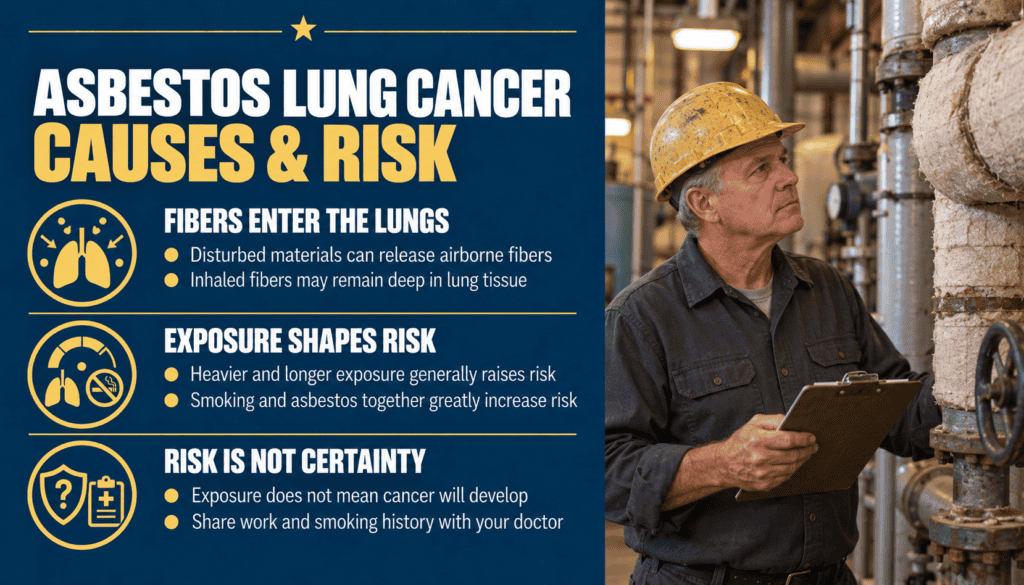
Asbestos Lung Cancer Causes & Risk
Asbestos exposure is an established cause of lung cancer. For some people diagnosed with lung cancer, an important part of understanding possible causes is looking back at jobs, military service, worksites, products, equipment, renovation work, and other situations in which airborne asbestos fibers may have been inhaled years or decades earlier.
Asbestos-related lung cancer is not a separate microscopic type of lung cancer that can always be identified just by looking at a tumor. Instead, determining whether asbestos may have contributed usually requires evaluating the diagnosis together with the person’s exposure history and other risk factors. Smoking is a major cause of lung cancer, but a smoking history does not make prior occupational or military asbestos exposure irrelevant.
This page is the Asbestos Lung Cancer Causes & Risk hub within the broader Diagnosed With Lung Cancer section of MesotheliomaHelp.Center. It explains how asbestos can contribute to lung cancer, who may have been exposed, what risk factors matter, and what evidence can help reconstruct an exposure history.
🫁 How Asbestos Can Cause Lung Cancer
Asbestos is a group of naturally occurring mineral fibers that were historically used in many industrial, construction, transportation, and military applications because of their resistance to heat, fire, and chemical damage. The health danger arises when asbestos-containing material is disturbed and microscopic fibers become airborne.
Inhaled fibers can travel deep into the respiratory tract. Some can remain in lung tissue for long periods and contribute to persistent inflammation, cellular injury, oxidative stress, and other biological changes associated with cancer development. Medical and public-health authorities recognize asbestos as a human carcinogen and an established cause of lung cancer.
Exposure does not mean that a person will inevitably develop cancer. Lung cancer is a complex disease with multiple possible causes and contributing factors. The significance of asbestos in an individual case depends on the facts, including the nature and extent of exposure, the time since exposure, other occupational hazards, smoking history, and medical evidence.
When fibers can become airborne
Potential exposure is generally more concerning when asbestos-containing material is cut, drilled, sanded, scraped, removed, repaired, broken, deteriorated, or otherwise disturbed. Examples can include insulation removal, boiler and pipe work, gasket replacement, brake or clutch servicing, demolition, renovation, and maintenance of older equipment or buildings.
Not every product, building, vehicle, ship, machine, or job contained asbestos. Asbestos content varied by manufacturer, product, component, model, era, specification, and location. A credible exposure investigation therefore focuses on what was actually present and what work occurred, rather than assuming exposure from a job title alone.
⚠️ Asbestos Lung Cancer Risk Factors
The likelihood that asbestos contributed to lung cancer cannot be reduced to a single number. Risk generally reflects a combination of exposure characteristics and personal factors. In occupational studies, greater cumulative asbestos exposure has been associated with greater lung-cancer risk.
- Intensity: how much airborne asbestos may have been present during a task.
- Frequency: how often asbestos-containing materials may have been disturbed.
- Duration: how long the person worked in the environment or performed the activity.
- Type of task: cutting, grinding, removal, repair, demolition, insulation work, and other dust-generating activities may create different exposure circumstances.
- Work environment: enclosed spaces, ventilation, housekeeping practices, and respiratory protection can affect exposure conditions.
- Time since exposure: asbestos-related cancers commonly arise only after a long latency period.
- Smoking history: tobacco is independently a major lung-cancer risk and can interact strongly with asbestos exposure.
- Other carcinogens: some workers had additional occupational exposures that must be evaluated separately.
No single factor proves causation in an individual patient. Medical assessment and, when legal rights are being evaluated, a detailed exposure investigation are both important.
👷 Jobs and Worksites Linked to Possible Asbestos Exposure
Historically, occupational exposure was one of the most important pathways for inhaling asbestos. Workers could be exposed directly while handling a material or indirectly while working near another trade that disturbed asbestos-containing products.
Jobs that may warrant closer review include construction trades, shipyard work, insulation work, pipefitting, plumbing, electrical work, boilermaking, industrial maintenance, mechanics, machinists, welding, refinery work, power-generation work, railroad maintenance, manufacturing, and military service. The job title itself is not proof of exposure; the actual materials, equipment, tasks, dates, and locations must be investigated.
| Job or Work Setting | Possible Exposure Pathway | Records to Review |
|---|---|---|
| Construction and renovation | Cutting, drilling, removing, or working near older insulation, flooring, roofing, cement products, fireproofing, or mechanical systems | Project records, building specifications, contractor records, coworker testimony, job descriptions |
| Shipyards and ships | Maintenance or repair around insulated piping, boilers, valves, pumps, machinery, gaskets, packing, or other historically asbestos-containing components | Ship records, yard assignments, maintenance logs, rate or trade history, witness statements |
| Industrial plants and refineries | Repair of high-heat equipment, piping systems, pumps, valves, boilers, furnaces, and insulated process equipment | Employment records, equipment records, maintenance records, plant specifications |
| Automotive and mechanical work | Historical servicing of certain brakes, clutches, gaskets, heat-resistant components, or machinery | Service records, parts records, employer history, product identification |
| Military service | Work aboard ships, at bases, in repair shops, construction units, engineering spaces, vehicle maintenance, or older facilities | Service records, duty stations, occupational specialty, ship or base history, maintenance records |
Veterans with Navy service can also review the confirmed U.S. Navy Asbestos Exposure hub. People whose exposure history involved civilian work performed for the military or government can review Civilian Contractor Asbestos Exposure.
🧱 Materials and Tasks to Investigate
An exposure investigation should identify both the material or component and the activity that may have released fibers. Simply being in an older building or near a piece of machinery does not establish exposure.
| Material or Component | Exposure Task to Investigate | Evidence That May Help |
|---|---|---|
| Thermal insulation | Removing, cutting, repairing, disturbing, or working next to insulated pipes, boilers, ducts, or equipment | Specifications, maintenance logs, photographs, coworker statements, product records |
| Gaskets and packing | Removing old material, scraping sealing surfaces, replacing packing, repairing pumps or valves | Equipment manuals, parts lists, purchasing records, maintenance history |
| Building materials | Renovation, demolition, drilling, sanding, sawing, or removal of certain older materials | Building age, renovation records, construction specifications, contractor records |
| Brake and clutch components | Historical brake or clutch servicing, especially dust-producing cleaning or mechanical work | Vehicle or equipment model, parts records, shop history, service procedures |
| Fireproofing and heat-resistant materials | Installation, removal, repair, demolition, or work performed nearby | Project specifications, supplier records, testimony, inspection reports |
Asbestos use changed over time, and similar-looking materials could have different compositions. Manufacturer, model, product line, installation date, repair history, and site-specific records can be critical when determining whether asbestos was actually present.
🚬 Smoking and Asbestos Lung Cancer Risk
Cigarette smoking is the leading cause of lung cancer. Asbestos is also an established lung-cancer carcinogen. When both exposures occur, the combined risk can be substantially higher than the risk associated with either exposure alone.
That interaction is important medically and legally. A person who smoked may still have had meaningful occupational asbestos exposure, and smoking history should not be used as a reason to ignore documented asbestos exposure. At the same time, asbestos exposure should not automatically be assumed to be the cause of every lung cancer in a person who worked in an older industry.
The correct approach is to evaluate both risk histories. Relevant questions include how much and how long the person smoked, when smoking began and ended, the type and duration of asbestos-related work, the intensity and frequency of potential exposure, and the interval between exposure and diagnosis.
Need help identifying a past asbestos exposure history? If you have been diagnosed with lung cancer after years in a trade, industrial workplace, shipyard, military assignment, or other potentially exposed environment, call 800.291.0963 or use our Submit Your Case form. Live help is available 24/7, 365 days a year.
⏳ Latency and Lung Cancer in Nonsmokers
Asbestos-related lung cancer usually does not appear immediately after exposure. A long interval can pass between the period when fibers were inhaled and the later diagnosis of cancer. This is why work performed decades earlier can still be relevant to a present-day exposure investigation.
For many workers and veterans, the most important exposure period may have occurred early in a career. By the time lung cancer is diagnosed, an employer may have closed, a ship may have been decommissioned, a facility may have been renovated, and the products involved may no longer be sold. Historical records and witness testimony can therefore become especially important.
Can a nonsmoker develop asbestos-related lung cancer?
Yes. Smoking is not required for asbestos exposure to increase lung-cancer risk. A never-smoker with lung cancer may still have a significant history of occupational, military, environmental, or secondhand asbestos exposure. Conversely, not every lung cancer in a nonsmoker is asbestos-related, so the exposure history still has to be evaluated carefully.
🔎 Reconstructing Past Asbestos Exposure
People diagnosed with lung cancer often remember the places they worked but not the brand names of products used decades earlier. That does not necessarily prevent an exposure history from being investigated.
Useful evidence can come from several independent sources:
- Employment records and Social Security work histories
- Military personnel and service records
- Duty stations, ships, bases, units, ratings, MOS or occupational specialties
- Union records and trade histories
- Job descriptions and coworker testimony
- Building plans and construction specifications
- Maintenance, repair, equipment, and purchasing records
- Historical photographs or work practices
- Manufacturer and product documentation
- Prior testimony involving the same jobsite, product, or work activity when legally available and relevant
A strong reconstruction focuses on specific facts: where the person worked, during what years, what tasks were performed, which materials or equipment were handled, what nearby workers were doing, and whether reliable evidence shows that asbestos-containing products were present.
Secondhand exposure
Some family members historically encountered asbestos carried away from workplaces on clothing, footwear, tools, or other items. A secondhand exposure claim requires its own factual investigation. It should not be assumed merely because a household member worked in an industry associated with asbestos.
🧬 Asbestos Lung Cancer vs. Mesothelioma
Lung cancer and mesothelioma are different cancers, even though both can be associated with asbestos exposure. Lung cancer develops in the lung tissue itself. Pleural mesothelioma develops in the mesothelial lining surrounding the lungs.
| Question | Asbestos-Related Lung Cancer | Pleural Mesothelioma |
|---|---|---|
| Where does it begin? | Within lung tissue | In the pleural lining surrounding the lungs |
| Can asbestos be a cause? | Yes | Yes |
| Is smoking a major causal risk? | Yes, smoking is a major independent cause of lung cancer | Smoking is not considered a cause of mesothelioma |
| Does diagnosis alone identify asbestos as the cause? | No; exposure and risk history must be evaluated | Diagnosis strongly prompts investigation of prior asbestos exposure, but case-specific evidence still matters |
For broader information about mesothelioma itself, see What Is Mesothelioma?. Patients should rely on qualified medical professionals for diagnosis, pathology interpretation, staging, and treatment decisions.
⚖️ Evidence That May Matter in an Asbestos Lung Cancer Claim
A lung cancer diagnosis does not automatically establish a legal claim against an asbestos company. Depending on the jurisdiction and type of claim, a legal team may investigate medical proof of the cancer, evidence of asbestos exposure, potentially responsible companies, product or premises identification, timing, and applicable filing deadlines.
| Evidence Category | What It May Help Establish | Examples |
|---|---|---|
| Medical evidence | The lung cancer diagnosis and relevant clinical history | Pathology, biopsy reports, imaging, oncology records |
| Exposure evidence | Where, when, and how asbestos may have been encountered | Work records, military records, jobsite evidence, witness testimony |
| Product or premises evidence | Whether asbestos-containing materials were present and connected to the exposure | Specifications, invoices, manuals, product records, maintenance history |
| Company evidence | Which entities may have manufactured, supplied, installed, maintained, or controlled relevant products or premises | Corporate records, contracts, purchasing documents, historical records |
| Deadline evidence | Whether a claim may still be filed under applicable law | Diagnosis date, death date when applicable, exposure facts, jurisdictional information |
Depending on the evidence, a person with asbestos-related lung cancer may be able to investigate a lawsuit, asbestos trust fund claim, or other available compensation route. Eligibility is case-specific and can depend on diagnosis, exposure history, responsible companies, jurisdiction, and filing deadlines.
For more information about the legal process, visit Lung Cancer Asbestos Lawsuit.
❓ Frequently Asked Questions
Can asbestos exposure cause lung cancer?
Yes. Asbestos is an established human carcinogen and a recognized cause of lung cancer. Whether asbestos contributed to a particular person’s cancer requires review of the individual’s exposure history, medical information, and other risk factors.
How much asbestos exposure is needed to cause lung cancer?
There is no single exposure amount that determines what will happen to every person. Risk generally increases with greater cumulative exposure, but individual circumstances differ. Duration, intensity, frequency, work practices, ventilation, fiber type, smoking, and other factors may all matter.
Can someone who smoked still have asbestos-related lung cancer?
Yes. Smoking is a major cause of lung cancer, but it does not erase the significance of asbestos exposure. The combined effects of smoking and asbestos can substantially increase lung-cancer risk, so both histories should be considered.
Can a person who never smoked develop lung cancer from asbestos?
Yes. Asbestos exposure can increase lung-cancer risk in nonsmokers. A never-smoker diagnosed with lung cancer should still discuss any occupational, military, environmental, or household asbestos exposure history with medical professionals.
How long after asbestos exposure can lung cancer develop?
Asbestos-related cancers typically have long latency periods, often measured in decades rather than months or a few years. An exposure that happened much earlier in life may therefore remain relevant to a later lung-cancer diagnosis.
Does working in a high-risk trade prove asbestos exposure?
No. A job title or industry can identify a reason to investigate, but it does not by itself prove exposure. Evidence should establish the relevant dates, jobsites, products, materials, equipment, work activities, and circumstances that could have released asbestos fibers.
What records can help prove historical asbestos exposure?
Employment records, Social Security work histories, military service records, union records, job descriptions, coworker testimony, building specifications, equipment and maintenance records, invoices, photographs, and historical product information may all help reconstruct exposure.
Can asbestos lung cancer qualify for compensation?
Some people diagnosed with lung cancer after asbestos exposure may qualify to pursue compensation. Eligibility depends on the medical diagnosis, exposure evidence, responsible companies or trusts, jurisdiction, filing deadlines, and other case-specific facts. Compensation is not guaranteed.
📞 Diagnosed With Lung Cancer After Asbestos Exposure?
If you or a family member has been diagnosed with lung cancer and you worked in an occupation, military assignment, shipyard, industrial plant, construction setting, repair trade, or other environment where asbestos may have been present, the next step is to reconstruct the exposure history carefully.
Call 800.291.0963 to discuss the work, military, product, or jobsite history that may be relevant to an asbestos lung cancer investigation. Live help is available 24/7, 365 days a year.
Submit Your Case for a case-specific review of potential asbestos exposure and legal options. Whether a claim is available depends on the evidence and applicable law.
⚕️ Legal & Medical Information Disclaimer
This page provides general educational information only. It does not establish a diagnosis, medical causation, legal liability, VA eligibility, or entitlement to compensation. Consult qualified medical and legal professionals for advice about your specific situation.