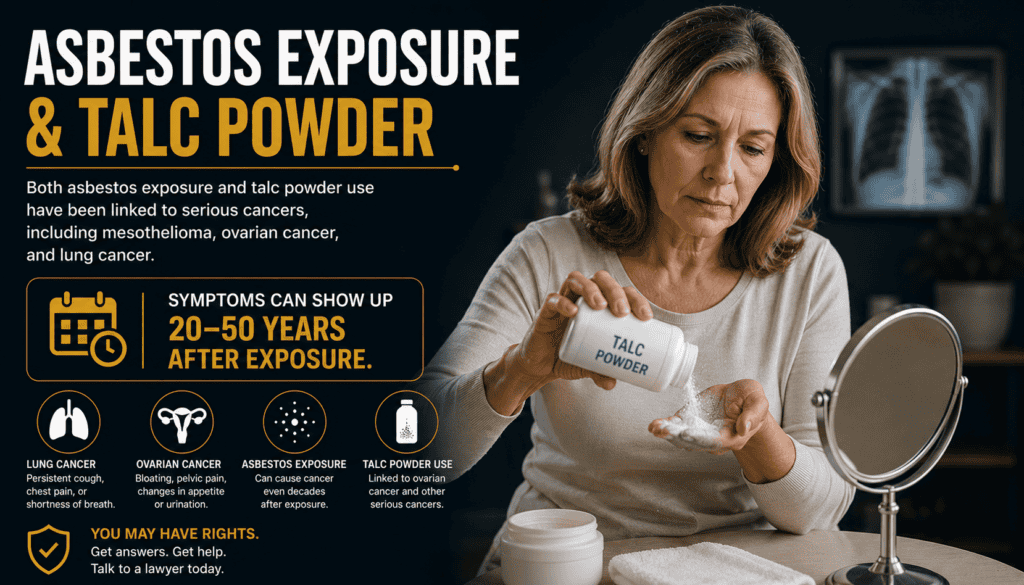
Asbestos Exposure and Talc Powder: Risks, Evidence & Next Steps
A clear guide to talc, possible asbestos contamination, medical concerns and practical steps.
Key point: Talc is not asbestos. Product-specific evidence is needed to establish contamination; exposure does not mean someone will develop cancer.
What Is Talc and Why Can Asbestos Be a Concern?
Talc is a naturally occurring mineral used in some cosmetic powders, industrial products and other materials. Asbestos is a different group of naturally occurring fibrous minerals. Certain talc deposits can occur near asbestos-bearing rock, making contamination possible when mining, testing or processing fails to separate the materials. Talc itself is not asbestos, and not every talc product contains asbestos. The question is whether a particular source or product contained asbestos and whether exposure occurred.
People may encounter talc in personal-care powders or in workplaces that mine, mill, transport, formulate or use talc-containing materials. Historical products and present-day products should not be assumed to have identical compositions. Product-specific records and reliable testing matter.
| Term | Meaning |
|---|---|
| Talc | A soft mineral used for its absorbent and other properties. |
| Asbestos | Fibrous minerals associated with serious diseases when inhaled. |
| Contamination | Asbestos present in talc or a talc-containing product; requires product-specific evidence. |
How Exposure May Happen
Exposure depends on whether asbestos fibers were present, whether they became airborne and whether someone inhaled them. Mining and processing can generate dust; pouring or applying a contaminated loose powder could also release fibers. Handling intact products does not automatically create the same exposure as working with airborne dust.
Workers may have had additional exposure from other materials at the same site. A careful occupational history helps distinguish talc-related concerns from insulation, brakes, construction materials and other possible sources.
| Scenario | Useful details |
|---|---|
| Mining or milling | Mine, dates, job tasks, dust controls and material source. |
| Manufacturing | Product formulas, suppliers, mixing and ventilation. |
| Personal use | Brand, exact product, years, frequency and available packaging. |
Health Conditions and Strength of Evidence
Inhaled asbestos is an established cause of mesothelioma and can cause lung cancer and asbestosis. The presence of asbestos in a talc product must not be assumed solely because someone later developed one of these diseases. Conversely, a history of talc exposure should not be dismissed without examining the product and exposure circumstances.
Questions about genital use of talc and ovarian cancer involve a different exposure pathway and a complex evidence base. The International Agency for Research on Cancer (IARC) classified talc as probably carcinogenic to humans in 2024; that classification concerns hazard and does not establish that any particular talc product caused an individual cancer. IARC separately classifies asbestos as carcinogenic to humans. Patients should discuss personal risk and diagnosis with qualified clinicians.
| Question | What matters |
|---|---|
| Mesothelioma | Diagnosis, pathology and asbestos exposure history. |
| Lung cancer | Clinical findings, smoking and occupational/environmental history. |
| Ovarian cancer | Clinical diagnosis and individualized assessment of possible exposures. |
Testing, Regulation and Product Evidence
Determining whether talc contains asbestos requires appropriate sampling and laboratory methods. A negative result for one sample does not prove every batch or historical formulation was asbestos-free. Likewise, a positive finding in one product cannot be generalized to all talc products. Review the laboratory method, sampling date, lot number and chain of custody before drawing conclusions.
The U.S. Food and Drug Administration publishes information about talc in cosmetics and testing initiatives. Regulatory approaches, recalls and product availability can change; consult current FDA notices for a specific product rather than relying on an old headline.
| Evidence | Why it helps |
|---|---|
| Product name and lot | Identifies the item under discussion. |
| Purchase and use dates | Connects exposure to a relevant formulation period. |
| Qualified lab report | Documents method, sample and findings. |
Symptoms and Medical Evaluation
Asbestos-related illnesses can appear decades after exposure, but exposure alone is not a diagnosis. Persistent shortness of breath, chest pain, an unexplained cough or unexplained weight loss deserves medical assessment. These symptoms have many possible causes. A clinician may review medical history, examine the patient and decide whether imaging or further testing is appropriate.
Seek urgent care for severe or sudden breathing difficulty, chest pain, fainting or other rapidly worsening symptoms. Do not wait for a routine screening appointment in an emergency.
| Situation | Action |
|---|---|
| Exposure concern without symptoms | Discuss history and individualized follow-up with a clinician. |
| Persistent new symptoms | Arrange prompt medical evaluation. |
| Severe breathing difficulty or chest pain | Seek emergency medical attention. |
Reconstructing a Talc Exposure History
Write down the precise product, manufacturer, approximate dates, frequency, setting and how powder or dust was handled. For workplace exposure, include employers, locations, tasks, coworkers and protective equipment. Preserve original labels or photographs when available; avoid disturbing suspected asbestos-containing material to collect a sample yourself.
Medical records should document a clinician’s diagnosis separately from a patient’s suspected exposure source. An exposure timeline can help doctors and, when relevant, independent legal professionals review the facts without prematurely assigning causation.
| Record | Your notes |
|---|---|
| Product or workplace | ____________________________ |
| Years and frequency | ____________________________ |
| Documents or witnesses | ____________________________ |
Practical Steps to Reduce Potential Exposure
Check current product notices and avoid using any item subject to an applicable asbestos-related recall. If you suspect a product contains asbestos, stop disturbing it and seek guidance from appropriate public-health or environmental professionals. Do not shake out powder, dry sweep suspected dust or attempt do-it-yourself asbestos testing that could spread fibers.
For occupational settings, employers should use appropriate exposure assessment, engineering controls, training and protective measures consistent with applicable requirements. A licensed or otherwise qualified professional can advise on suspected asbestos-containing materials.
| Concern | Next step |
|---|---|
| Current product recall | Follow the official notice and manufacturer instructions. |
| Dust at a worksite | Report the concern and request professional assessment. |
| Past exposure | Document it and discuss medical questions with a clinician. |
Medical, Financial and Family Next Steps
Patients with a confirmed diagnosis may benefit from a specialist review and a clear treatment plan. Ask the medical team which symptoms require urgent attention and whether occupational medicine input would help. Family members can assist by organizing product information, medical records and appointments while respecting the patient’s preferences.
Compensation eligibility depends on the diagnosis, exposure evidence, applicable law and deadlines; no result can be promised. Consult an appropriately licensed attorney for individual legal questions. For related medical information, read Related Asbestos Diseases, What Is Asbestos-Related Lung Cancer? and Asbestos Exposure and Ovarian Cancer.
| Professional | Question |
|---|---|
| Clinician | What evaluation is appropriate for my history and symptoms? |
| Occupational specialist | What records could clarify exposure? |
| Attorney, if needed | What evidence and deadlines apply to my circumstances? |
Need help now? Call 800.291.0963 / Live chat 24/7, 365 days a year / Submit Your Case.
Frequently Asked Questions
Does all talc contain asbestos?
No. Talc and asbestos are different minerals. Contamination depends on the deposit, processing and particular product.
Can asbestos-contaminated talc cause mesothelioma?
Inhaled asbestos is an established cause of mesothelioma. Whether a specific talc product contained asbestos and contributed to an individual case requires evidence and expert evaluation.
Is talcum powder the same as asbestos?
No. Talc is a mineral distinct from asbestos; contamination is a separate concern.
Can a negative test prove a product was always asbestos-free?
No. A result applies to the sample and method used; it may not represent every batch or older formulation.
What symptoms should I discuss with my doctor?
Persistent breathlessness, chest pain, cough, unexplained weight loss or other new symptoms warrant evaluation.
Should I test old powder at home?
Avoid disturbing suspected contaminated powder. Seek advice from qualified professionals about appropriate handling and testing.
Is ovarian cancer the same as peritoneal mesothelioma?
No. They are distinct diagnoses that require appropriate pathology and clinical evaluation.
What should I save if I suspect past exposure?
Record product names, dates, job sites and tasks; preserve existing packaging, photographs and medical records without creating dust.
Confirmed Primary Medical and Regulatory Resources
Use the following primary organizations for current guidance and to check product-specific notices. These resources explain general hazards and do not establish contamination of a particular product.
Questions About Asbestos Exposure?
Call 800.291.0963. Live chat available 24/7, 365 days a year. Submit Your Case. An inquiry does not guarantee compensation or establish the source of an illness.
⚕️ Legal & Medical Information Disclaimer
This page provides general information, not medical or legal advice. Consult a qualified clinician about symptoms, diagnosis and treatment, and a licensed attorney about individual legal rights.