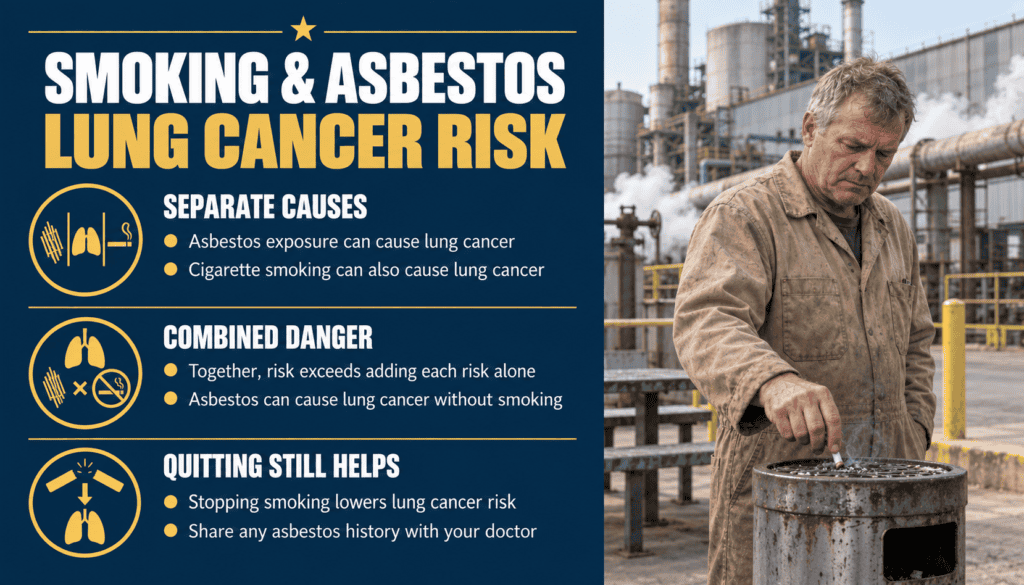
Smoking and Asbestos Lung Cancer Risk
Smoking and asbestos exposure are both established causes of lung cancer. When a person has experienced both tobacco smoke and asbestos exposure, the combined lung cancer risk can be substantially greater than the risk associated with either exposure alone.
This is especially important for former construction workers, shipyard workers, industrial workers, mechanics, military veterans, and others who may have smoked while also working around asbestos-containing materials decades ago. A smoking history does not erase or make occupational asbestos exposure irrelevant.
This page is part of the Asbestos Lung Cancer Causes & Risk hub. For a broader discussion of exposure-related risk, visit Asbestos Lung Cancer Risk, or return to the main Diagnosed With Lung Cancer section.
🚬 How Smoking Causes Lung Cancer
Tobacco smoke contains numerous carcinogenic substances that can damage cells in the respiratory system. Repeated exposure can lead to genetic and cellular changes associated with lung cancer.
Risk is influenced by factors such as how much a person smoked, how long they smoked, the age at which smoking began, and how much time has passed since quitting.
Smoking history is medically important, but it should be evaluated alongside other established lung cancer risks rather than treated as the only possible cause in every case.
🫁 How Asbestos Contributes to Lung Cancer
Asbestos exposure occurs when microscopic fibers become airborne and are inhaled. This can happen when certain asbestos-containing materials are cut, removed, drilled, scraped, sanded, repaired, demolished, or otherwise disturbed.
Some inhaled fibers can remain in lung tissue for long periods. Their presence can contribute to chronic inflammation, cellular injury, and biological changes involved in cancer development.
Not every building, product, machine, vehicle, ship, or workplace contained asbestos. Asbestos content varied by manufacturer, model, component, product, era, and location. Establishing exposure therefore requires more than simply identifying an occupation associated with asbestos.
⚠️ Combined Smoking and Asbestos Lung Cancer Risk
Smoking and asbestos are independent lung cancer hazards, but their effects can interact. People exposed to both have been shown in occupational research to face a substantially higher risk of lung cancer than people exposed to only one of those hazards.
| Risk History | What It Means | What Should Be Reviewed |
|---|---|---|
| Smoking only | Tobacco is a major independent cause of lung cancer | Amount smoked, duration, age started, time since quitting |
| Asbestos exposure only | Asbestos can independently increase lung cancer risk | Jobs, tasks, materials, exposure intensity, duration, latency |
| Smoking and asbestos | The combined risk can be substantially greater | Both histories should be evaluated together |
The existence of two risk factors does not allow anyone to assign an exact percentage of causation to each factor without a case-specific medical and exposure evaluation.
🔍 Why Smoking Does Not Exclude Asbestos Exposure
A person can have more than one factor that contributed to lung cancer risk. Someone may have smoked for years while also experiencing repeated occupational asbestos exposure.
For example, a shipyard worker may have smoked cigarettes and also worked around insulated piping, boilers, machinery, pumps, valves, gaskets, or packing. A mechanic may have smoked while historically servicing certain brakes, clutches, gaskets, or industrial equipment. A construction worker may have smoked while also disturbing older building materials.
The correct question is not simply, “Did the person smoke?” It is also:
- Was asbestos actually present?
- What materials or components were involved?
- What tasks were performed?
- How often and for how many years did exposure occur?
- Was the person working directly with the material or nearby?
- How long was the interval between exposure and diagnosis?
A smoking history should therefore be documented accurately, but it should not prevent a legitimate investigation into asbestos exposure.
⏳ Former Smokers and Past Asbestos Exposure
Quitting smoking provides important health benefits and reduces future health risks. However, quitting does not change the fact that earlier asbestos exposure may have occurred.
Because asbestos-related diseases often have long latency periods, a former smoker may be diagnosed with lung cancer many years after leaving a high-risk occupation or military assignment.
Former smokers diagnosed with lung cancer should consider documenting both histories:
| Smoking History | Asbestos Exposure History |
|---|---|
| Age smoking began | Employers and occupations |
| Approximate amount smoked | Jobsites and facilities |
| Years smoked | Military service and assignments |
| Date or year smoking stopped | Materials, machinery, and equipment encountered |
| Other tobacco exposure | Nearby trades and coworkers |
Maintaining both histories gives medical professionals and, when appropriate, legal investigators a more complete factual picture.
👷 Workers and Veterans With Both Risk Factors
Historically, smoking was common in many industries that also used asbestos-containing materials. Workers who may warrant closer review include shipyard workers, construction workers, insulators, pipefitters, plumbers, boilermakers, mechanics, machinists, welders, railroad workers, refinery workers, power plant workers, industrial maintenance personnel, and military veterans.
The occupation alone does not prove asbestos exposure. The actual tasks, products, materials, equipment, dates, work areas, and surrounding conditions must be investigated.
Military veterans
Some veterans served during periods when asbestos-containing products were used in ships, bases, barracks, mechanical spaces, construction materials, vehicles, and equipment. A veteran who smoked may therefore have had two important lung cancer risk factors.
Service records can help identify military occupation, duty stations, ships, bases, construction assignments, equipment maintained, and years of service.
Navy veterans can review the confirmed U.S. Navy Asbestos Exposure hub. People whose exposure occurred while performing civilian work on military or government projects can review Civilian Contractors Asbestos Exposure.
🚭 Asbestos Lung Cancer in Nonsmokers
Smoking is not required for asbestos exposure to increase lung cancer risk. People who never smoked can still develop lung cancer after significant asbestos exposure.
This is important because asbestos-related lung cancer should not be treated as exclusively a disease of smokers. A nonsmoker diagnosed with lung cancer may have a history involving shipyards, construction, insulation work, industrial maintenance, military service, power generation, mechanical work, or other asbestos-exposed environments.
At the same time, a lung cancer diagnosis in a nonsmoker does not automatically prove asbestos causation. Other risk factors and the evidence of actual exposure still need to be reviewed.
📁 Documenting Smoking and Asbestos Histories
After a lung cancer diagnosis, reconstructing both tobacco exposure and asbestos exposure can provide a more complete risk history.
| Evidence | What It May Help Establish |
|---|---|
| Medical records | Diagnosis, pathology, treatment, and documented smoking history |
| Employment records | Employers, occupations, dates, and locations |
| Military service records | Branch, ships, bases, duty stations, rates, MOS, or specialties |
| Coworker testimony | Work practices, products, equipment, dust conditions, and nearby trades |
| Maintenance and equipment records | Components and materials used at the workplace |
| Construction specifications | Building materials and systems used at a facility |
| Historical product records | Manufacturer, composition, use period, and application |
Someone diagnosed decades after leaving a job may not remember product names. That does not necessarily prevent an exposure investigation. Historical records, coworkers, jobsite information, military records, and equipment documentation can sometimes help reconstruct what occurred.
Need help documenting an old exposure history? Call 800.291.0963 or Submit Your Case. Live help is available 24/7, 365 days a year.
⚖️ Why Both Risk Histories Can Matter in an Asbestos Lung Cancer Claim
A smoking history does not automatically prevent a person with lung cancer from investigating an asbestos claim. Legal eligibility depends on the facts of the individual case, including the diagnosis, asbestos exposure evidence, potentially responsible companies or trusts, jurisdiction, and applicable filing deadlines.
An investigation may look at where the person worked, what products or equipment were present, which companies supplied or controlled relevant asbestos-containing materials, whether coworkers can confirm exposure conditions, and how the medical history relates to the exposure timeline.
Compensation is never guaranteed. However, a person should not assume that smoking automatically eliminates possible legal options when substantial occupational or military asbestos exposure may also have occurred.
For additional information, visit the confirmed Lung Cancer Asbestos Lawsuit page.
❓ Frequently Asked Questions
Is smoking or asbestos a bigger lung cancer risk?
Both are established causes of lung cancer, but their relative importance varies by individual. Smoking is the leading cause of lung cancer overall, while substantial occupational asbestos exposure can independently increase risk. When both occurred, the combined risk can be substantially greater.
Can asbestos contribute to lung cancer in someone who smoked?
Yes. A smoking history does not make prior asbestos exposure irrelevant. Both risk histories should be evaluated.
Can asbestos lung cancer occur in a person who never smoked?
Yes. Smoking is not required for asbestos exposure to increase lung cancer risk. Nonsmokers with significant asbestos exposure can develop lung cancer.
Does quitting smoking eliminate asbestos-related lung cancer risk?
No. Quitting smoking provides important health benefits, but it does not erase earlier asbestos exposure. Because asbestos-related cancers can have long latency periods, exposures from decades earlier may remain relevant.
Does smoking prevent someone from filing an asbestos lung cancer claim?
Not automatically. Eligibility depends on the diagnosis, asbestos exposure evidence, responsible companies or trusts, jurisdiction, deadlines, and other case-specific facts.
How can I prove asbestos exposure if I smoked?
Smoking history and asbestos exposure are documented separately. Employment records, military records, jobsite evidence, coworker testimony, construction records, equipment documentation, and historical product information can help investigate asbestos exposure.
Why are smoking and asbestos especially dangerous together?
Research has shown that the two exposures interact in ways that can produce a substantially higher lung cancer risk than either exposure alone.
Should I tell my doctor about old asbestos exposure?
Yes. People with known or suspected past asbestos exposure should discuss their occupational, military, and smoking histories with qualified healthcare professionals, who can determine appropriate medical evaluation and screening recommendations.
📞 Smoked and Worked Around Asbestos?
If you or a family member has been diagnosed with lung cancer after smoking and also working in a shipyard, construction trade, industrial facility, military assignment, mechanical occupation, power plant, refinery, or another potentially exposed environment, both histories deserve careful review.
Call 800.291.0963 to discuss the person’s jobs, military service, worksites, equipment, and possible asbestos exposure. Live help is available 24/7, 365 days a year.
Submit Your Case for a case-specific review of possible asbestos exposure and legal options.
⚕️ Legal & Medical Information Disclaimer
This page provides general educational information only. It does not establish a diagnosis, medical causation, legal liability, VA eligibility, or entitlement to compensation. Consult qualified medical and legal professionals for advice about your specific situation.