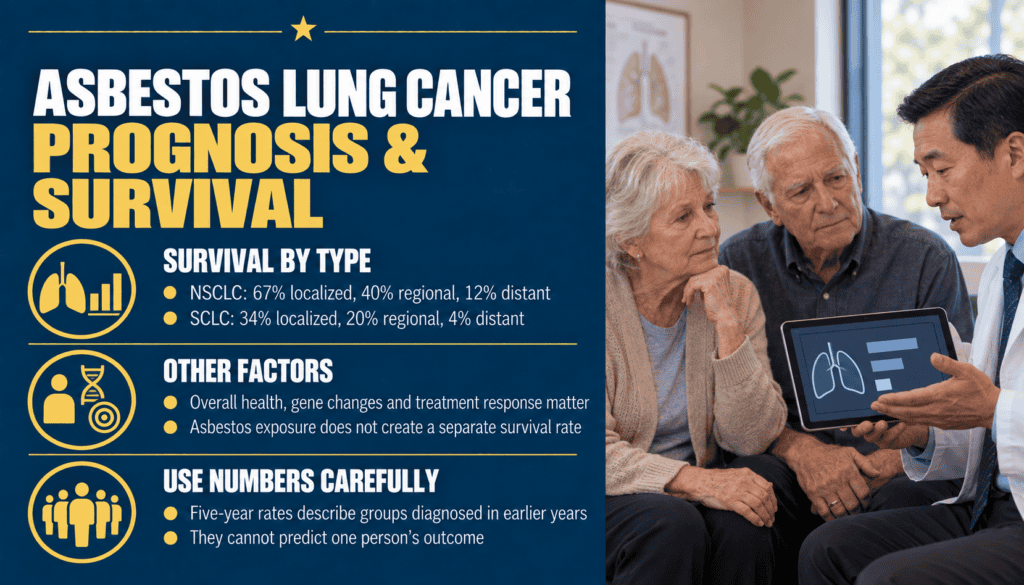
Asbestos Lung Cancer Prognosis & Survival
Prognosis for asbestos-related lung cancer varies widely from person to person. The most important factors generally include the cancer type, stage at diagnosis, whether the tumor can be removed surgically, molecular and biomarker findings, response to treatment, lung function, age, overall health, and other medical conditions.
Asbestos exposure can help explain why lung cancer developed, but it does not by itself determine how long a patient will live. Once lung cancer is diagnosed, prognosis is evaluated according to the same clinical factors used for other lung cancers of the same type and stage.
This page is the Asbestos Lung Cancer Prognosis & Survival hub within the broader Diagnosed With Lung Cancer silo. Related pages include the Asbestos Lung Cancer Latency Period, Asbestos Lung Cancer Treatment, and Diagnosing Asbestos-Related Lung Cancer.
📊 What Asbestos Lung Cancer Prognosis Means
Prognosis is an estimate of how a disease may behave over time. For lung cancer, doctors consider the chance of controlling the disease, the likelihood of recurrence or progression, expected response to treatment, and overall survival.
A prognosis is not a guaranteed prediction for an individual patient. Survival statistics describe groups of people and cannot determine exactly what will happen to one person.
For someone with a history of asbestos exposure, the exposure history is important for understanding possible causation and legal options. The medical prognosis, however, is driven primarily by the characteristics of the diagnosed cancer and the patient’s health.
🗺️ How Lung Cancer Stage Affects Survival
Stage is one of the strongest predictors of lung cancer outcome because it describes how far the cancer has spread. In general, cancers found while still localized have better long-term survival than cancers that have spread to regional lymph nodes or distant organs.
| Extent of Disease | General Prognostic Meaning |
|---|---|
| Localized disease | Cancer remains confined to the lung and may be more likely to be treated with curative-intent local therapy. |
| Regional disease | Cancer has spread to nearby lymph nodes or structures and often requires combined treatment. |
| Distant or metastatic disease | Cancer has spread to distant organs and is generally treated primarily with systemic therapy. |
Recent U.S. population data show major differences in five-year relative survival by extent of disease. However, those statistics combine many patients and cannot account for every modern treatment, biomarker, or individual health factor.
🫁 Non-Small Cell Lung Cancer Prognosis
Non-small cell lung cancer accounts for most lung cancer diagnoses. Prognosis varies considerably by stage and tumor biology.
Selected early-stage NSCLC can sometimes be treated with surgery or highly focused radiation with curative intent. Some patients also receive chemotherapy, targeted therapy, or immunotherapy before or after surgery depending on stage and tumor characteristics.
Locally advanced NSCLC often requires combinations of chemotherapy, radiation, immunotherapy, and occasionally surgery in selected cases. Metastatic disease is generally treated with systemic therapy such as immunotherapy, chemotherapy, targeted therapy, or combinations based on molecular and biomarker testing.
Modern targeted therapies and immune checkpoint inhibitors have improved outcomes for some patients, which means historical survival statistics may not fully represent the outlook for a person receiving current treatment.
🧬 Small Cell Lung Cancer Prognosis
Small cell lung cancer generally grows and spreads more rapidly than NSCLC. Prognosis is strongly influenced by whether disease is limited to a region that can be treated with combined therapy or is already extensive at diagnosis.
Limited-stage SCLC is often treated with chemotherapy and thoracic radiation, while extensive-stage disease is generally treated with systemic therapy that may include chemotherapy and immunotherapy.
SCLC can respond substantially to initial treatment, but recurrence is common. Because of its aggressive biology, long-term survival remains more difficult than for many early-stage NSCLCs.
Individual outcome still depends on treatment response, disease extent, performance status, age, organ function, and other medical factors.
⚠️ Factors That Can Affect Asbestos Lung Cancer Prognosis
Many factors can influence the outlook after a lung cancer diagnosis.
| Prognostic Factor | Why It Matters |
|---|---|
| Stage at diagnosis | Extent of spread is one of the strongest predictors of treatment options and survival. |
| Cancer type | NSCLC and SCLC behave differently and have different treatment pathways. |
| Surgical resectability | Selected localized tumors that can be completely removed may have a more favorable outlook. |
| Molecular alterations | Some tumors have actionable changes that can be treated with targeted therapy. |
| Biomarkers | Can influence immunotherapy options and treatment response. |
| Performance status | Patients able to remain active and tolerate treatment may have more therapeutic options. |
| Lung function | Can affect eligibility for surgery, radiation, and other treatments. |
| Other illnesses | Heart, kidney, liver, pulmonary, and other conditions can affect treatment tolerance. |
| Response to treatment | How well the cancer responds can significantly influence future outlook. |
💊 How Treatment Response Affects Outlook
Prognosis can change over the course of treatment. Initial staging provides an important baseline, but doctors also evaluate whether the tumor shrinks, remains stable, progresses, or recurs.
Treatment options can include surgery, chemotherapy, immunotherapy, radiation therapy, targeted therapy, and supportive care. For some patients, treatment can produce long periods of disease control even when the cancer is not considered curable.
Molecularly targeted treatments can be especially important for patients whose tumors contain actionable genetic alterations. Immunotherapy has also changed the treatment landscape for many patients with NSCLC and SCLC.
Follow-up imaging, symptoms, laboratory tests, and other clinical information help the oncology team reassess prognosis as treatment progresses.
❤️ Age, Overall Health, and Lung Function
Age alone does not determine whether a person can benefit from lung cancer treatment. Doctors look more broadly at performance status, organ function, other medical conditions, frailty, nutrition, and the ability to tolerate therapy.
For asbestos-exposed patients, preexisting lung disease can be especially relevant. Some people may also have asbestosis, pleural abnormalities, emphysema, COPD, or other respiratory conditions.
Reduced pulmonary reserve can affect whether surgery is safe, how radiation is planned, and how well a person tolerates systemic treatment. Cardiovascular disease, kidney disease, neuropathy, hearing problems, or other conditions may also influence treatment choices.
The goal is to select treatment according to the entire clinical picture rather than age or asbestos exposure alone.
⏳ Asbestos Lung Cancer Latency vs. Survival
Latency and survival describe two different periods.
| Term | Meaning |
|---|---|
| Latency period | The time between earlier asbestos exposure and the later development or diagnosis of lung cancer. |
| Survival | The period after diagnosis, often measured from diagnosis or the start of treatment. |
| Life expectancy | An individualized estimate influenced by stage, treatment response, health, age, and other factors. |
A person may have a 30- or 40-year asbestos latency period but that does not tell doctors how long the person will live after diagnosis. Prognosis is evaluated using current cancer findings.
For a focused explanation, see Asbestos Lung Cancer Latency Period.
📈 Understanding Lung Cancer Survival Statistics
Survival statistics can help describe broad population patterns, but they have important limitations. Five-year relative survival compares people with cancer to similar people in the general population and does not predict exactly how long an individual patient will live.
Current National Cancer Institute information reports that lung cancer survival varies markedly according to whether disease is localized, regional, or distant at diagnosis. Stage therefore remains one of the most important pieces of information when discussing prognosis.
Statistics can also lag behind modern medicine because they are based on people diagnosed in earlier years. New immunotherapies, targeted therapies, improved surgical techniques, radiation technology, biomarker testing, and better supportive care can change outcomes for current patients.
Patients should ask their oncology team to interpret survival information using their exact cancer type, stage, pathology, biomarkers, treatment response, and health status.
Diagnosed with lung cancer after occupational or military asbestos exposure? Call 800.291.0963 or Submit Your Case. Live help is available 24/7, 365 days a year.
❓ Frequently Asked Questions
What is the prognosis for asbestos-related lung cancer?
Prognosis varies widely. Stage, lung cancer type, tumor biology, treatment options, response to therapy, lung function, age, overall health, and other medical conditions are more useful predictors than asbestos exposure alone.
Does asbestos exposure make lung cancer prognosis worse?
Not automatically. Asbestos can contribute to lung cancer risk and some patients also have asbestos-related lung disease, but prognosis for the cancer itself is primarily determined by stage, cancer type, treatment response, and overall health.
Is early-stage asbestos lung cancer curable?
Some selected early-stage lung cancers can be treated with curative intent using surgery or radiation, often with additional systemic treatment when appropriate. No treatment can guarantee cure for an individual patient.
Does stage 4 asbestos-related lung cancer have treatment options?
Yes. Metastatic lung cancer can be treated with immunotherapy, chemotherapy, targeted therapy when appropriate, radiation for selected sites, and supportive care. The goal may be to control disease, relieve symptoms, and extend survival.
Does small cell lung cancer have a worse prognosis than non-small cell lung cancer?
SCLC generally grows and spreads more rapidly and has lower long-term survival overall. However, prognosis for any individual depends on disease extent, treatment response, and health status.
Can immunotherapy improve survival?
Immunotherapy has improved outcomes for selected patients with NSCLC and SCLC. Whether it is appropriate depends on cancer type, stage, biomarkers, previous treatment, and other medical factors.
Are five-year survival statistics a prediction of how long I will live?
No. They describe outcomes for groups of patients and cannot predict an individual’s lifespan. Your oncology team can provide a more individualized discussion based on your current medical information.
Does the asbestos latency period affect prognosis after diagnosis?
Latency describes how long disease took to appear after exposure. It does not directly determine survival after diagnosis. Stage, biology, treatment, and health are more important to prognosis.
📞 Lung Cancer Prognosis After Asbestos Exposure?
If you or a family member has been diagnosed with lung cancer after years in construction, shipyards, industrial plants, military service, mechanical trades, power generation, refineries, or another potentially exposed setting, medical prognosis should be discussed with the treating oncology team. A separate exposure investigation can determine whether older asbestos contact may also support legal options.
Call 800.291.0963 to discuss jobs, military assignments, worksites, equipment, and materials that may help reconstruct historical asbestos exposure. Live help is available 24/7, 365 days a year.
Submit Your Case for a case-specific review of potential asbestos exposure and legal options. Eligibility depends on diagnosis, exposure evidence, responsible companies or trusts, jurisdiction, and applicable filing deadlines.
For additional legal information, visit Lung Cancer Asbestos Lawsuit.
⚕️ Legal & Medical Information Disclaimer
This page provides general educational information only. It does not establish a diagnosis, prognosis, life expectancy, medical causation, legal liability, VA eligibility, or entitlement to compensation. Consult qualified medical and legal professionals about your specific situation.