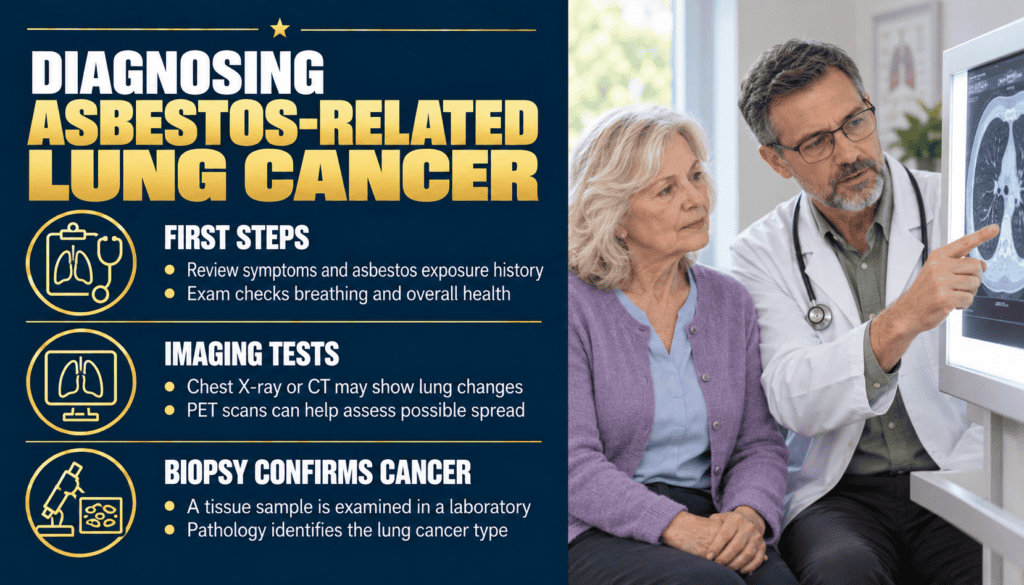
Diagnosing Asbestos-Related Lung Cancer
Diagnosing asbestos-related lung cancer usually requires two separate evaluations: first, doctors must determine whether lung cancer is present and identify its type and stage; second, the patient’s occupational, military, smoking, and other exposure history must be reviewed to determine whether asbestos may have contributed to the disease.
No single symptom, chest X-ray, CT scan, or biopsy normally proves that asbestos caused a lung cancer. Imaging can identify suspicious abnormalities, and pathology can confirm the presence and type of cancer, but asbestos causation depends on the broader medical and exposure history.
This page is part of the Asbestos Lung Cancer Symptoms & Diagnosis hub within the broader Diagnosed With Lung Cancer silo. For symptom-focused information, see Asbestos Lung Cancer Symptoms and Early Signs of Asbestos-Related Lung Cancer.
🔬 How Asbestos-Related Lung Cancer Is Diagnosed
The medical process for diagnosing lung cancer is generally the same whether asbestos exposure is suspected or not. Doctors evaluate symptoms and risk factors, use imaging to identify suspicious areas, obtain cells or tissue when necessary, and use pathology to determine whether cancer is present.
If cancer is confirmed, additional testing may be performed to determine the tumor type, stage, and molecular characteristics. These findings help the oncology team develop an appropriate treatment plan.
| Diagnostic Step | Purpose | What It Can Show |
|---|---|---|
| Medical history | Identify symptoms and risk factors | Smoking history, asbestos exposure, other occupational risks, family history |
| Physical examination | Assess general health and symptoms | Breathing changes and other clinical findings |
| Imaging | Locate suspicious abnormalities | Nodules, masses, enlarged lymph nodes, fluid, or other findings |
| Biopsy or cell sampling | Obtain tissue for examination | Whether malignant cells are present |
| Pathology | Identify cancer type | Small cell, non-small cell, and specific histologic subtype |
| Staging | Determine extent of disease | Local tumor involvement, lymph nodes, distant spread |
🩺 Medical and Asbestos Exposure History
A physician will typically ask about symptoms, prior illnesses, medications, family history, smoking, and other known lung cancer risks. For someone who has worked around asbestos, occupational and military history can add important context.
Patients may want to tell their doctors about:
- Construction, demolition, or renovation work
- Shipyard or shipboard employment
- Military service and duty assignments
- Insulation, boiler, pipe, pump, valve, or furnace work
- Industrial plant, refinery, or power-generation employment
- Mechanical, brake, clutch, or equipment maintenance
- Work near other trades that generated substantial dust
- Possible household or secondhand asbestos exposure
Not every job in these industries involved asbestos. The material, product, equipment, manufacturer, model, work practice, era, and location can all affect whether exposure actually occurred.
Long latency also matters. A relevant exposure may have occurred decades before the lung cancer diagnosis. See the Asbestos Lung Cancer Latency Period page for more information.
🩻 Imaging Tests for Suspected Lung Cancer
Imaging is often the first major diagnostic step after symptoms, screening, or another medical test identifies a possible lung abnormality.
Chest X-ray
A chest X-ray can identify some lung masses, fluid collections, or other abnormalities. It can also miss small lesions, so an X-ray alone cannot rule out lung cancer.
CT scan
Computed tomography provides more detailed cross-sectional images of the lungs and surrounding structures. CT can help doctors evaluate the size, shape, and location of a suspicious nodule or mass and identify enlarged lymph nodes or other abnormalities.
PET/CT
PET/CT may be used in appropriate cases to evaluate areas of increased metabolic activity and to help determine whether cancer may have spread. PET findings are not definitive on their own because infection and inflammation can also produce increased activity.
MRI and other imaging
MRI or other imaging may be used when doctors need more information about particular organs or possible areas of spread. The testing plan depends on the patient’s individual clinical situation.
🧪 Biopsy Methods for Lung Cancer
A biopsy involves obtaining cells or tissue so a pathologist can examine them under a microscope. The best biopsy method depends on where the suspicious area is located, whether lymph nodes are involved, the patient’s overall health, and what information the medical team needs.
| Biopsy Method | How It May Be Used |
|---|---|
| Bronchoscopy | A scope is passed through the airways to examine and sample accessible abnormalities |
| Needle biopsy | A needle may be guided through the chest wall into a suspicious lung lesion |
| Endobronchial ultrasound | Can help sample lymph nodes and areas near major airways |
| Thoracoscopy or surgery | May obtain larger tissue samples when less invasive procedures are insufficient |
| Fluid or other cell sampling | May identify malignant cells in certain clinical situations |
Every procedure has potential benefits and risks. The medical team selects the approach that is appropriate for the patient’s condition and the location of the suspected cancer.
🧬 Pathology and Lung Cancer Type
Pathology is central to confirming lung cancer. A pathologist examines the sample to determine whether malignant cells are present and, when possible, classify the tumor.
Lung cancer is broadly divided into:
- Non-small cell lung cancer (NSCLC): the larger group, including adenocarcinoma, squamous cell carcinoma, and other subtypes.
- Small cell lung cancer (SCLC): a distinct cancer that generally behaves and is treated differently.
The pathology report may also describe histologic features and results from immunohistochemistry or other laboratory tests used to distinguish lung cancer from cancers arising elsewhere.
Importantly, pathology generally does not label a lung tumor as “asbestos-caused.” The diagnosis identifies the cancer. The relationship to asbestos requires a separate evaluation of the person’s exposure history and other risk factors.
📊 Tests Used to Determine Lung Cancer Stage
After lung cancer is confirmed, doctors determine how far the disease has spread. Stage is important because it helps guide treatment decisions and provides information about prognosis.
Depending on the type of lung cancer and clinical findings, staging may involve CT, PET/CT, brain imaging, lymph-node sampling, bronchoscopy, or other tests.
| Staging Question | What Doctors Evaluate |
|---|---|
| Primary tumor | Size and involvement of nearby structures |
| Lymph nodes | Whether regional lymph nodes contain cancer |
| Distant disease | Whether cancer has spread to other organs or tissues |
Symptoms alone cannot determine lung cancer stage. Two patients with similar symptoms can have very different imaging and pathology findings.
🧬 Biomarker and Molecular Testing
For many patients with non-small cell lung cancer, especially certain advanced cancers, doctors may test the tumor for molecular alterations or biomarkers that can affect treatment decisions.
Depending on the tumor and clinical situation, testing may evaluate genes or proteins associated with targeted therapies or immunotherapy. The exact panel depends on current clinical guidelines, tumor subtype, available tissue, stage, and other factors.
These tests help guide treatment. They do not determine whether asbestos caused the cancer.
⚖️ How Asbestos Causation Is Evaluated
Confirming lung cancer and determining whether asbestos contributed to it are related but separate questions.
An asbestos investigation may consider:
- The intensity, frequency, and duration of exposure
- The jobs and work activities performed
- Whether asbestos-containing products or components were actually present
- Whether the person handled those materials or worked nearby when they were disturbed
- The time between exposure and diagnosis
- Smoking history and other lung cancer risk factors
- Medical and pathology evidence
A history of cigarette smoking does not automatically eliminate asbestos as a relevant risk factor. Smoking and asbestos are both established causes of lung cancer and can interact to substantially increase risk.
For more detail, see Asbestos Lung Cancer Causes & Risk.
Need help investigating a lung cancer diagnosis after occupational or military asbestos exposure? Call 800.291.0963 or Submit Your Case. Live help is available 24/7, 365 days a year.
📁 Records to Gather After a Lung Cancer Diagnosis
Medical records establish the diagnosis. Historical employment and military records can help reconstruct possible asbestos exposure.
| Record | What It May Help Establish |
|---|---|
| Pathology and biopsy reports | Confirmed diagnosis and lung cancer type |
| Imaging reports | Tumor location, extent, and staging information |
| Oncology records | Treatment recommendations and clinical history |
| Employment records | Employers, jobs, dates, and worksites |
| Military records | Branch, ships, bases, units, ratings, MOS, and assignments |
| Coworker testimony | Work practices, materials, equipment, and nearby exposure |
| Product and equipment records | Whether asbestos-containing components may have been used |
| Building and maintenance records | Materials and systems present at a jobsite |
If evidence supports substantial asbestos exposure, a person diagnosed with lung cancer may be able to investigate a lawsuit, asbestos trust fund claim, or another compensation option. Eligibility depends on diagnosis, exposure evidence, potentially responsible parties, jurisdiction, and filing deadlines.
See the confirmed Lung Cancer Asbestos Lawsuit page for additional legal information.
❓ Frequently Asked Questions
How do doctors diagnose asbestos-related lung cancer?
Doctors diagnose lung cancer using medical history, imaging, and usually tissue or cell testing. The asbestos connection is then evaluated separately through exposure history and other evidence.
Can a CT scan diagnose lung cancer?
A CT scan can identify a suspicious mass or nodule, but imaging alone generally cannot confirm the exact cancer type. A biopsy or another form of cell or tissue sampling is often needed.
Is a biopsy required to confirm lung cancer?
In many cases, tissue or cell sampling is needed to establish the diagnosis and determine the type of cancer. The medical team decides which procedure is appropriate.
Can pathology prove asbestos caused lung cancer?
Generally, pathology identifies the cancer type rather than the cause. Asbestos causation requires evaluation of occupational or military exposure, latency, smoking, and other evidence.
What is the difference between small cell and non-small cell lung cancer?
They are the two major categories of lung cancer. They have different biological behavior, staging approaches, and treatment strategies.
Why do doctors perform molecular testing?
Molecular and biomarker testing can identify tumor characteristics that may affect eligibility for targeted therapy or immunotherapy in appropriate patients.
Should I tell my doctor about asbestos exposure from 30 or 40 years ago?
Yes. Asbestos-related lung cancer can develop after a long latency period, so old occupational or military exposure can remain medically relevant.
What records can help investigate whether my lung cancer is asbestos-related?
Medical records, employment history, military records, coworker testimony, jobsite documents, equipment records, construction specifications, and historical product evidence may all be useful.
📞 Diagnosed With Lung Cancer After Possible Asbestos Exposure?
If you or a family member has a confirmed lung cancer diagnosis after years in construction, shipyards, industrial facilities, military service, mechanical trades, power generation, refineries, or another potentially exposed setting, the medical diagnosis is only one part of the investigation. Reconstructing the exposure history may identify asbestos-related work that occurred decades earlier.
Call 800.291.0963 to discuss jobs, worksites, military assignments, products, equipment, and other evidence that may be relevant. Live help is available 24/7, 365 days a year.
Submit Your Case for a case-specific review of potential asbestos exposure and legal options.
⚕️ Legal & Medical Information Disclaimer
This page provides general educational information only. It does not establish a diagnosis, medical causation, legal liability, VA eligibility, or entitlement to compensation. Consult qualified medical and legal professionals for advice about your specific situation.