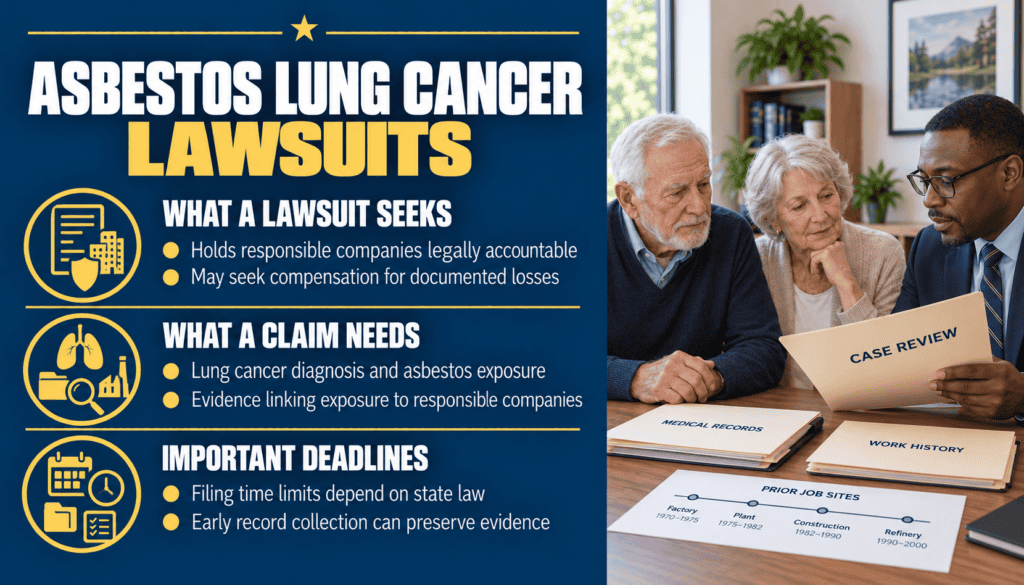
Asbestos Lung Cancer Lawsuits
An asbestos lung cancer lawsuit may allow a person diagnosed with lung cancer after asbestos exposure to seek compensation from companies or other parties that may be legally responsible. Potential cases can involve exposure at construction sites, shipyards, industrial plants, refineries, power plants, military facilities, mechanical shops, factories, and other workplaces where asbestos-containing materials were used or disturbed.
A lung cancer diagnosis alone does not establish an asbestos lawsuit. A case generally requires evidence showing where and how asbestos exposure occurred, when it happened, which products or premises were involved, and which companies or entities may bear legal responsibility under applicable law.
This page is a child of the Asbestos Lung Cancer Lawsuits & Compensation hub within the broader Diagnosed With Lung Cancer silo. It focuses specifically on lawsuits, defendants, evidence, filing procedure, settlements, trials, and the practical steps involved in investigating a claim.
⚖️ Who May File an Asbestos Lung Cancer Lawsuit?
A person diagnosed with lung cancer may be able to investigate an asbestos lawsuit when there is credible evidence of significant asbestos exposure and one or more potentially responsible companies or other legally liable parties can be identified.
Possible claimants can include:
- Construction workers
- Shipyard workers
- Industrial workers
- Insulators and pipefitters
- Boilermakers and maintenance workers
- Mechanics and machinists
- Power plant and refinery workers
- Railroad workers
- Military veterans
- Civilian contractors
- Family members with documented secondhand exposure
A person’s occupation alone is not enough. A claim typically requires investigation of the actual work performed, the materials or equipment involved, the period of exposure, and the companies connected to those products or premises.
For broader eligibility information, see Who Can File an Asbestos Lawsuit & When.
📋 What Must an Asbestos Lung Cancer Lawsuit Establish?
Exact legal requirements vary by jurisdiction and claim type. In general, an asbestos lung cancer lawsuit may require evidence addressing several key issues.
| Issue | What May Need to Be Established | Examples of Evidence |
|---|---|---|
| Diagnosis | That the claimant has lung cancer | Pathology, biopsy, imaging, oncology records |
| Asbestos exposure | Where, when, and how exposure occurred | Employment records, military records, jobsite evidence, testimony |
| Product or premises connection | That relevant asbestos-containing materials were present | Product records, invoices, specifications, equipment records |
| Responsible parties | Which companies or entities may be legally responsible | Corporate records, supplier records, contracts, ownership records |
| Causation | Whether asbestos exposure may have contributed to the lung cancer under applicable legal standards | Medical evidence, exposure history, expert analysis |
| Damages | Losses caused by the disease | Medical bills, wage records, caregiving costs, other evidence |
| Timeliness | Whether the claim was filed within the applicable deadline | Diagnosis date, death date when applicable, jurisdictional facts |
Requirements differ among states, so the applicable jurisdiction can materially affect how a claim is evaluated.
🔎 Identifying Asbestos Exposure and Products
Many lung cancer patients were exposed decades before diagnosis and may not remember the names of products they encountered. That does not necessarily prevent an investigation.
Potentially relevant materials and components can include certain historical:
- Pipe and boiler insulation
- Gaskets and packing
- Pumps and valves
- Fireproofing materials
- Cement products
- Flooring and roofing materials
- Brake and clutch components
- Electrical and heat-resistant materials
- Industrial equipment components
Not every product in these categories contained asbestos. Composition varied by manufacturer, model, component, product line, year, and location. Product identification should therefore rely on evidence rather than assumptions.
| Evidence Source | What It May Help Identify |
|---|---|
| Coworker testimony | Products, work practices, equipment, and dust conditions |
| Employment records | Employers, jobsites, occupations, and dates |
| Jobsite records | Contractors, suppliers, projects, and materials used |
| Equipment records | Models, replacement parts, and maintenance practices |
| Construction specifications | Building systems and materials specified for installation |
| Military records | Ships, bases, units, occupations, and assignments |
| Historical photographs and catalogs | Products and equipment used during the relevant period |
For more background on exposure risk, see Asbestos Lung Cancer Risk.
🚬 Can Smokers File Asbestos Lung Cancer Lawsuits?
A history of cigarette smoking does not automatically prevent someone from investigating an asbestos lung cancer lawsuit. Smoking and asbestos are both established lung cancer hazards, and a person can have experienced both risk factors.
A case involving a smoker may require careful evaluation of:
- Smoking duration and intensity
- When smoking began and ended
- Duration and intensity of asbestos exposure
- Jobs and tasks performed
- Exposure latency
- Medical and pathology evidence
- Applicable causation law in the jurisdiction
A smoking history should be documented accurately, but it should not be used as a reason to ignore a substantial and independently documented occupational or military asbestos exposure history.
🎖️ Military Veterans and Asbestos Lung Cancer Lawsuits
Some veterans served during periods when asbestos-containing products were used aboard ships, at bases, in mechanical systems, construction materials, vehicles, equipment, and maintenance operations.
An asbestos lawsuit involving a veteran generally focuses on companies or other legally responsible entities connected to asbestos-containing products or exposure circumstances rather than treating military service itself as proof of liability.
Important records can include:
- Service dates
- Branch of service
- Military occupation or rating
- Ships and shipyards
- Bases and duty stations
- Maintenance and repair assignments
- Construction or engineering work
- Equipment and systems serviced
Veterans may also have separate VA-related options depending on service connection and eligibility. Legal claims and VA benefits are distinct processes and should be evaluated separately.
🏭 Claims Involving Multiple Asbestos Companies
A worker may have encountered asbestos-containing materials from multiple companies over a long career. As a result, one lung cancer case may involve several potential defendants, different jobsites, and multiple asbestos bankruptcy trusts.
For example, an industrial worker could have encountered insulation supplied by one company, gaskets made by another, pumps or valves containing third-party components, and asbestos-containing construction materials at several facilities.
A comprehensive investigation attempts to identify each legally relevant source without assuming that every company connected to a workplace was responsible for asbestos exposure.
Evidence must connect the claimant to the relevant product, premises, work activity, or exposure pathway under the law governing the claim.
📁 What Happens After an Asbestos Lung Cancer Lawsuit Is Filed?
The exact process varies by jurisdiction, but an asbestos lawsuit can involve several stages.
| Stage | What May Happen |
|---|---|
| Case investigation | Medical, employment, military, product, and jobsite evidence is collected. |
| Complaint filed | The legal claims are formally brought against identified defendants. |
| Defendant responses | Defendants answer the allegations and may raise defenses. |
| Discovery | The parties exchange records, documents, and other evidence. |
| Depositions | Claimants, coworkers, experts, or other witnesses may give sworn testimony. |
| Settlement discussions | The parties may negotiate possible resolution before trial. |
| Trial | If the case does not settle, disputed issues may be decided in court. |
What is a deposition?
A deposition is sworn testimony taken as part of the litigation process. A person may be asked about employment, jobsites, work duties, products, military service, smoking history, medical history, and exposure circumstances.
Because some asbestos claimants are seriously ill, certain jurisdictions may have procedures that can accelerate parts of litigation, but availability and requirements vary.
🤝 Asbestos Lung Cancer Settlement vs. Trial
Many asbestos cases resolve through negotiated settlements rather than trial. A settlement is an agreement that resolves claims against one or more defendants under agreed terms.
Settlement is not guaranteed, and no specific amount can be predicted from another person’s case. Relevant factors can include diagnosis, exposure strength, jurisdiction, defendants, damages, evidentiary issues, litigation history, and the willingness of the parties to resolve the dispute.
If a settlement cannot be reached, a case may proceed toward trial. At trial, the parties present evidence and legal arguments, and a judge or jury may decide liability and damages depending on the jurisdiction and type of case.
A person may also have separate asbestos trust fund claims when qualifying exposure involves companies that established bankruptcy trusts. Lawsuits and trust claims are different compensation routes.
Need help reviewing an asbestos lung cancer lawsuit? Call 800.291.0963 or Submit Your Case. Live help is available 24/7, 365 days a year.
⏱️ Filing Deadlines and Wrongful Death Lawsuits
Asbestos lawsuits are subject to statutes of limitations. The filing deadline can depend on the state, diagnosis date, date of death in a wrongful death case, residence, exposure locations, defendants, and other jurisdictional facts.
Because asbestos-related lung cancer can appear decades after exposure, many legal systems focus on when disease was diagnosed or discovered rather than when the original exposure occurred. However, no single deadline applies nationwide.
Wrongful death after asbestos lung cancer
If a person dies from lung cancer that may be connected to asbestos exposure, qualifying survivors or an estate representative may be able to investigate a wrongful death lawsuit depending on state law.
Wrongful death rules determine who can file, which damages may be recovered, and how quickly the case must be brought. A prior personal injury lawsuit or settlement may also affect the analysis.
Anyone considering an asbestos lawsuit should determine the applicable deadline promptly rather than assuming there is unlimited time to file.
❓ Frequently Asked Questions
Can lung cancer qualify for an asbestos lawsuit?
Yes, potentially. A person does not need a mesothelioma diagnosis to investigate an asbestos claim. The lung cancer diagnosis, asbestos exposure, causation evidence, responsible parties, jurisdiction, and filing deadline must all be evaluated.
Do I need to know the asbestos product name before contacting a lawyer?
Not necessarily. Historical employment records, military records, coworker testimony, jobsite documents, equipment information, specifications, and product records may help identify exposure sources.
Can a smoker file an asbestos lung cancer lawsuit?
Potentially. Smoking does not automatically eliminate a claim. Smoking and asbestos are separate lung cancer risk factors, and the legal effect of both depends on the evidence and applicable law.
Can an asbestos lung cancer lawsuit involve more than one company?
Yes. Workers often encountered different products at multiple jobsites over many years. A case can potentially involve multiple defendants or asbestos trusts when supported by evidence.
How long does an asbestos lung cancer lawsuit take?
There is no universal timeline. Duration can depend on jurisdiction, number of defendants, claimant health, complexity of exposure evidence, court scheduling, discovery, and settlement negotiations.
Do all asbestos lung cancer lawsuits go to trial?
No. Many cases resolve through settlement, but some proceed to trial. No settlement or outcome is guaranteed.
Can veterans file asbestos lung cancer lawsuits?
Potentially. A veteran’s case may investigate private companies or other legally responsible entities connected to asbestos exposure during service. Separate VA benefits may also be available in qualifying circumstances.
Can a family file after someone dies from asbestos lung cancer?
Depending on state law, eligible family members or an estate representative may be able to pursue a wrongful death claim. Filing rights and deadlines vary by jurisdiction.
📞 Investigating an Asbestos Lung Cancer Lawsuit?
If you or a family member has been diagnosed with lung cancer after years in construction, shipyards, industrial plants, military service, mechanical trades, power generation, refineries, or another potentially exposed setting, a detailed investigation may determine whether an asbestos lawsuit is available.
Call 800.291.0963 to discuss the diagnosis, employers, military assignments, jobsites, products, equipment, and possible exposure history. Live help is available 24/7, 365 days a year.
Submit Your Case for a case-specific review of potential asbestos claims and legal options. Eligibility and compensation depend on the evidence, responsible parties, jurisdiction, and applicable filing deadlines.
For additional background, visit the confirmed Lung Cancer Asbestos Lawsuit page.
⚕️ Legal & Medical Information Disclaimer
This page provides general educational information only. It does not establish diagnosis, medical causation, legal liability, VA eligibility, or entitlement to compensation. Consult qualified medical and legal professionals about your specific situation.