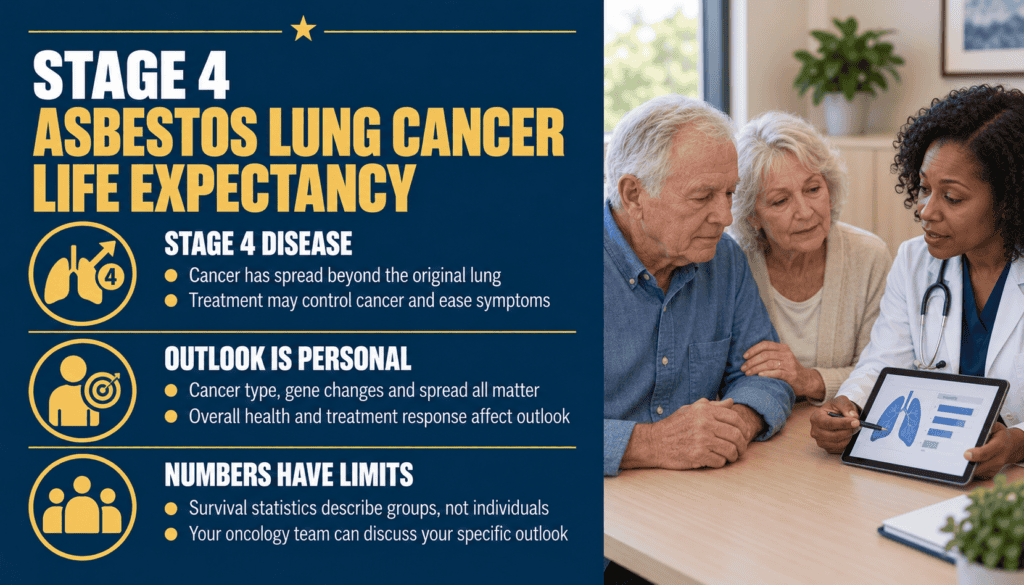
Stage 4 Asbestos Lung Cancer Life Expectancy
There is no single life-expectancy number for stage 4 asbestos-related lung cancer. Stage 4 means the cancer has spread beyond its original location, but survival can vary considerably depending on whether the cancer is non-small cell lung cancer (NSCLC) or small cell lung cancer (SCLC), where it has spread, tumor molecular features, response to treatment, overall health, and the therapies available.
Asbestos exposure may help explain why lung cancer developed, but it does not by itself determine survival after diagnosis. A patient with stage 4 asbestos-related lung cancer is generally treated according to the same stage, pathology, biomarker, and health factors used for other stage 4 lung cancers.
This page is a child of the Asbestos Lung Cancer Prognosis & Survival hub. Related pages include Asbestos Lung Cancer Life Expectancy, Asbestos Lung Cancer Survival Rates, and the Asbestos Lung Cancer Treatment hub.
🗺️ What Stage 4 Asbestos Lung Cancer Means
Stage 4 lung cancer is advanced cancer that has spread beyond the original lung tumor. For NSCLC, stage IV includes stage IVA and IVB. Depending on the exact classification, cancer may involve the opposite lung, fluid or nodules around the lungs or heart, distant lymph nodes, or organs such as the brain, bone, liver, adrenal glands, or other sites.
Stage 4 does not mean that every patient has the same amount or pattern of disease. One person may have a limited number of metastatic sites, while another may have cancer in several organs. Those differences can affect treatment options and prognosis.
For SCLC, doctors commonly use the terms limited-stage and extensive-stage in addition to TNM staging. Extensive-stage disease generally indicates cancer that has spread beyond a region that can reasonably be treated within one radiation field.
⏳ Stage 4 Asbestos Lung Cancer Life Expectancy
It is not medically reliable to assign every stage 4 patient a fixed number of months or years. Population statistics show that advanced lung cancer has a poorer overall prognosis than localized disease, but individuals can experience very different treatment responses.
Life expectancy can depend on:
- NSCLC versus SCLC
- Exact sites and amount of metastatic disease
- Performance status
- Whether the tumor has an actionable molecular alteration
- PD-L1 expression and other biomarkers
- Response to immunotherapy, targeted therapy, chemotherapy, or other treatment
- Lung function and other medical conditions
- Age and overall physical condition
- Whether cancer has progressed after previous treatment
For this reason, an oncologist who knows the exact diagnosis and treatment response can provide a more meaningful prognosis than a broad online average.
🫁 Stage 4 Non-Small Cell Lung Cancer Outlook
Stage 4 NSCLC is usually treated primarily with systemic therapy. Current National Cancer Institute guidance includes chemotherapy, targeted therapy, immunotherapy, and combinations selected according to histology, molecular features, PD-L1 expression, previous treatment, performance status, and other clinical factors.
For some patients, modern targeted therapies can control cancers with specific actionable molecular alterations for meaningful periods. Immunotherapy has also improved survival for selected patients with advanced NSCLC.
| Stage 4 NSCLC Factor | Why It Can Matter |
|---|---|
| Actionable molecular alteration | May create an opportunity for targeted treatment. |
| PD-L1 expression | Can influence use of immune checkpoint inhibitors. |
| Performance status | Affects treatment tolerance and available options. |
| Metastatic pattern | Number and location of metastases can influence local treatment decisions. |
| Treatment response | Durable response or disease control can extend survival. |
Selected patients with a limited number of metastatic sites may sometimes receive local treatment such as radiation or surgery to specific areas in addition to systemic therapy, depending on the clinical situation.
🧬 Extensive-Stage Small Cell Lung Cancer Outlook
Extensive-stage SCLC is an aggressive form of lung cancer that typically requires systemic treatment. Chemotherapy has traditionally been central to treatment, and immunotherapy is now incorporated into treatment for many appropriate patients.
SCLC often responds initially to treatment, sometimes substantially, but recurrence and treatment resistance remain major challenges. Prognosis depends on disease burden, treatment response, performance status, organ function, age, and other health factors.
Radiation may also be used for selected metastatic sites or symptom relief and, in some cases, for residual thoracic disease according to the treatment plan.
📊 Stage 4 Lung Cancer Survival Rates
Population survival statistics often use the SEER category distant disease rather than the exact term “stage 4.” Distant disease generally corresponds to cancer that has spread to distant parts of the body and includes many stage 4 cancers.
| Lung Cancer Type | 5-Year Relative Survival for Distant Disease |
|---|---|
| Non-small cell lung cancer | About 12% |
| Small cell lung cancer | About 4% |
These current American Cancer Society figures are based on SEER population data and should not be treated as an individual prediction. They include people with different ages, health conditions, tumor biology, treatment access, metastatic patterns, and treatment responses.
Survival statistics also look backward. Some people diagnosed today have access to targeted drugs and immunotherapies that were not available to all patients represented in older survival cohorts.
See Asbestos Lung Cancer Survival Rates for the broader localized, regional, and distant survival comparison.
⚠️ Factors That Affect Stage 4 Lung Cancer Survival
| Factor | Potential Effect on Prognosis |
|---|---|
| Cancer subtype | NSCLC and SCLC have different biological behavior and treatment approaches. |
| Molecular profile | Actionable alterations may make targeted therapies available. |
| Immunotherapy biomarkers | Can help determine whether checkpoint inhibitors may be useful. |
| Sites of metastasis | Brain, liver, bone, adrenal, pleural, and other metastatic patterns can affect treatment planning. |
| Overall tumor burden | The amount of cancer can influence symptoms and treatment response. |
| Performance status | Patients who remain physically functional may tolerate more treatment options. |
| Lung function | Can influence tolerance of treatment, particularly with other respiratory disease. |
| Response to therapy | Patients whose cancer remains controlled can live substantially longer than population medians in some circumstances. |
No one factor should be used by itself to estimate how long an individual patient will live.
💊 Treatment Options for Stage 4 Asbestos Lung Cancer
The goal of stage 4 lung cancer treatment is often to prolong survival, control the disease, preserve quality of life, and relieve symptoms. Treatment can sometimes keep advanced cancer controlled for extended periods.
Depending on the exact diagnosis, options may include:
- Immunotherapy
- Chemotherapy
- Targeted therapy for actionable molecular alterations
- Radiation therapy for selected tumors or symptoms
- Surgery in uncommon, carefully selected metastatic situations
- Clinical trials
- Palliative and supportive care
Treatment choice should be individualized. For stage 4 NSCLC, comprehensive molecular testing and appropriate biomarker testing can be particularly important because some results can significantly change first-line treatment.
The broader Asbestos Lung Cancer Treatment hub explains these therapies in more detail.
❤️ Can People Live Longer Than Stage 4 Statistics Suggest?
Yes. Survival statistics describe populations, not maximum survival. Some patients live considerably longer than broad averages, particularly when their cancer responds well to treatment or has a molecular feature that can be treated effectively.
Factors associated with longer disease control can include:
- Strong response to initial treatment
- Actionable molecular alterations with effective targeted therapies
- Durable response to immunotherapy
- Good performance status
- Lower overall metastatic burden in selected patients
- Ability to receive multiple lines of effective treatment
- Management of symptoms and other medical conditions
Conversely, some patients have aggressive disease that progresses quickly despite treatment. Population percentages cannot tell in advance which course an individual will experience.
👷 How Asbestos Exposure Fits Into Stage 4 Prognosis
Asbestos is relevant to the cause of lung cancer, but it does not establish a separate stage 4 prognosis. Once metastatic lung cancer is diagnosed, doctors base prognosis and treatment primarily on the cancer’s type, molecular profile, spread, treatment response, and patient health.
Some asbestos-exposed patients also have asbestosis, pleural disease, emphysema, COPD, or other conditions that can reduce respiratory reserve and affect treatment tolerance.
The asbestos history can still be important for a different reason: determining whether earlier occupational or military exposure may support a legal claim. Because lung cancer can develop after decades of latency, relevant work may have occurred far in the past.
See the Asbestos Lung Cancer Latency Period page for more about that timeline.
Stage 4 lung cancer after occupational or military asbestos exposure? Call 800.291.0963 or Submit Your Case. Live help is available 24/7, 365 days a year.
❓ Frequently Asked Questions
How long can someone live with stage 4 asbestos lung cancer?
There is no single reliable answer. Survival can range widely depending on lung cancer type, molecular features, sites of spread, response to treatment, performance status, and overall health.
What is the five-year survival rate for stage 4 NSCLC?
Current American Cancer Society data report about 12% five-year relative survival for NSCLC classified as distant disease. Distant SEER stage includes many stage 4 cancers but is not identical to every individual stage 4 situation.
What is the five-year survival rate for extensive-stage SCLC?
Current ACS data report about 4% five-year relative survival for SCLC classified as distant disease. Individual outcomes can differ substantially.
Does stage 4 lung cancer mean only a few months to live?
No. Stage 4 indicates metastatic disease, not a fixed time remaining. Some cancers progress rapidly, while others can be controlled for longer periods with modern treatment.
Can immunotherapy extend survival in stage 4 lung cancer?
Yes, for selected patients. Immune checkpoint inhibitors can improve survival in several advanced NSCLC and SCLC treatment settings.
Can targeted therapy improve stage 4 NSCLC survival?
Yes. Patients whose tumors have certain actionable molecular alterations may benefit substantially from targeted therapies, which is why appropriate molecular testing is important.
Does asbestos exposure make stage 4 prognosis worse?
Not automatically. Asbestos exposure may be relevant to causation and other lung disease, but stage, tumor biology, treatment response, and overall health are more direct predictors of cancer prognosis.
Is stage 4 life expectancy the same as the asbestos latency period?
No. Latency is the interval between asbestos exposure and later diagnosis. Life expectancy concerns survival after diagnosis. They are separate timelines.
📞 Stage 4 Lung Cancer After Years of Asbestos Exposure?
If you or a family member has stage 4 lung cancer, prognosis and treatment should be discussed with the oncology team using the exact cancer type, molecular results, metastatic pattern, treatment response, and overall health. If there is also a history of asbestos exposure, that history can be investigated separately.
Call 800.291.0963 to discuss jobs, military assignments, worksites, equipment, and materials that may help reconstruct historical asbestos exposure. Live help is available 24/7, 365 days a year.
Submit Your Case for a case-specific review of potential asbestos exposure and legal options. Eligibility depends on diagnosis, exposure evidence, responsible companies or trusts, jurisdiction, and applicable filing deadlines.
For additional legal information, visit Lung Cancer Asbestos Lawsuit.
⚕️ Legal & Medical Information Disclaimer
This page provides general educational information only. It does not establish a diagnosis, prognosis, life expectancy, medical causation, legal liability, VA eligibility, or entitlement to compensation. Consult qualified medical and legal professionals about your specific situation.