Radiation Therapy for Asbestos-Related Lung Cancer
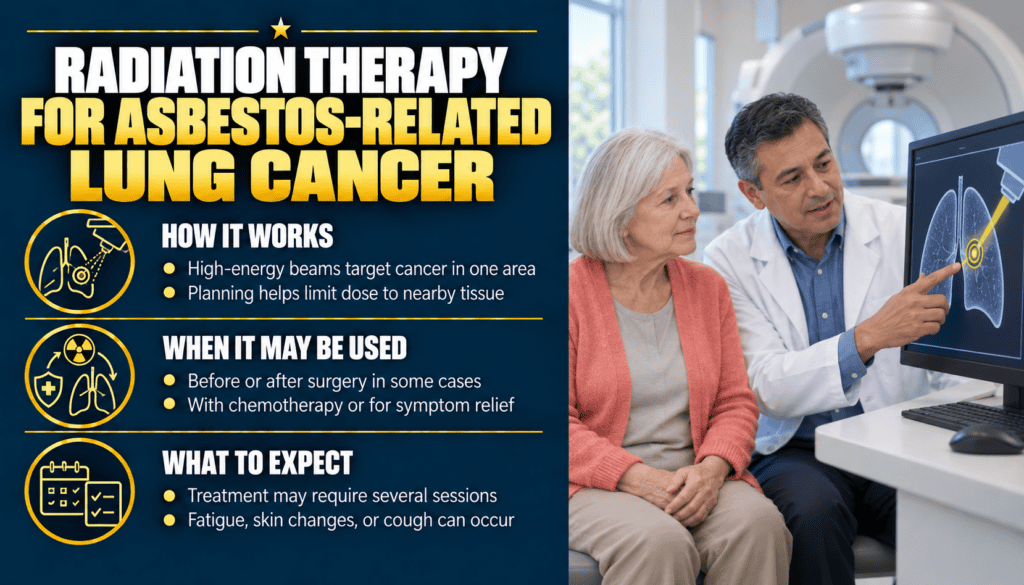
Radiation therapy can be an important part of treatment for some people with asbestos-related lung cancer. It uses high-energy radiation to damage cancer cells and control or destroy tumors while treatment planning aims to limit exposure to nearby healthy tissue.
Asbestos exposure does not determine whether a patient should receive radiation. Treatment decisions are based on whether the cancer is non-small cell lung cancer (NSCLC) or small cell lung cancer (SCLC), the stage and location of disease, lymph-node involvement, previous treatment, lung function, overall health, and the goals of care.
This page is a child of the Asbestos Lung Cancer Treatment hub. Related treatment pages include Surgery for Asbestos-Related Lung Cancer, Chemotherapy for Asbestos-Related Lung Cancer, and Immunotherapy for Asbestos-Related Lung Cancer.
☢️ How Radiation Therapy Treats Lung Cancer
Radiation therapy uses high-energy X-rays or other forms of radiation to damage the DNA of cancer cells. When cancer cells cannot repair enough of that damage, they stop dividing or die.
Most lung cancer radiation is delivered from a machine outside the body. Modern treatment planning uses imaging and computer-based techniques to shape radiation beams around the tumor while reducing unnecessary exposure to nearby organs such as the heart, esophagus, spinal cord, and healthy lung.
Radiation may be given with the goal of long-term cancer control, as part of combined treatment with chemotherapy or immunotherapy, or to relieve symptoms in advanced disease.
📋 When Radiation Therapy Is Used
Radiation can play different roles depending on the lung cancer type and stage.
| Clinical Situation | How Radiation May Be Used |
|---|---|
| Early localized NSCLC | SBRT may be used for selected patients who cannot undergo surgery or when it is otherwise appropriate. |
| Locally advanced NSCLC | Radiation may be combined with chemotherapy and followed by other systemic treatment in selected cases. |
| Limited-stage SCLC | Thoracic radiation is commonly combined with chemotherapy. |
| Selected extensive-stage SCLC | Thoracic or site-specific radiation may be considered depending on response, symptoms, and disease pattern. |
| Brain metastases | Stereotactic radiosurgery or whole-brain radiation may be considered depending on the number, size, and distribution of lesions. |
| Bone or other painful metastases | Palliative radiation can reduce pain and other tumor-related symptoms. |
Radiation is not automatically required for every lung cancer diagnosis. The oncology team determines whether it adds meaningful benefit to the overall treatment plan.
🎯 SBRT for Early-Stage Lung Cancer
Stereotactic body radiation therapy (SBRT) delivers highly focused radiation to a tumor using precise positioning and treatment planning. It typically uses a small number of treatment sessions compared with conventional radiation schedules.
SBRT can be particularly important for selected patients with early-stage NSCLC who are not candidates for surgery because of reduced lung function, heart disease, frailty, or other medical concerns.
Some asbestos-exposed patients may have asbestosis or other chronic lung disease that makes surgery more difficult. In those cases, the treatment team may evaluate whether a nonsurgical approach such as SBRT is medically appropriate.
SBRT is not suitable for every tumor. Size, location, proximity to major airways and other organs, previous radiation, and overall lung condition all affect treatment planning.
🫁 Radiation for Locally Advanced Non-Small Cell Lung Cancer
For some locally advanced NSCLC that cannot be removed surgically, chemotherapy and radiation may be used together. This is known as concurrent chemoradiation when the two treatments are delivered during the same treatment period.
In selected patients, immunotherapy may follow definitive chemoradiation. The exact sequence depends on stage, tumor characteristics, treatment response, and the patient’s ability to tolerate therapy.
Radiation planning is especially important in the chest because the tumor may be close to the heart, esophagus, spinal cord, major airways, and healthy lung tissue.
For related systemic treatment information, see Chemotherapy for Asbestos-Related Lung Cancer and Immunotherapy for Asbestos-Related Lung Cancer.
🧬 Radiation for Small Cell Lung Cancer
Small cell lung cancer is generally more sensitive to radiation and chemotherapy than many other lung cancers, but it also has a strong tendency to spread early.
Limited-stage SCLC
For many patients with limited-stage disease, thoracic radiation is combined with platinum-based chemotherapy and etoposide. The timing and radiation schedule are selected by the oncology team.
Extensive-stage SCLC
Systemic therapy is central to extensive-stage SCLC. Radiation may be used in selected patients for persistent thoracic disease, symptomatic metastases, or other specific clinical needs.
Radiation to the brain
Because SCLC can spread to the brain, brain imaging and radiation decisions can become part of treatment planning. Depending on the individual situation, clinicians may discuss brain surveillance, prophylactic cranial irradiation, or treatment of known brain metastases.
🧠 Radiation for Brain, Bone, and Other Metastases
When lung cancer spreads to other organs, radiation can be used to control specific tumors and relieve symptoms even when it cannot treat all cancer throughout the body.
| Site or Symptom | Potential Role of Radiation |
|---|---|
| Brain metastases | Control individual or multiple brain lesions using stereotactic or broader-field techniques when appropriate. |
| Bone metastases | Reduce pain and help control tumor growth in affected bones. |
| Airway compression | Shrink a tumor causing cough, obstruction, or breathing problems. |
| Bleeding | Help control tumor-related bleeding in selected cases. |
| Pressure on nearby structures | Reduce symptoms caused by a tumor pressing on nerves, blood vessels, or other organs. |
This type of symptom-directed treatment is often called palliative radiation. Palliative does not mean that other cancer treatment must stop; radiation can be integrated with systemic therapy and supportive care.
📐 Radiation Planning and Treatment Delivery
Radiation treatment usually begins with a planning session called simulation. Imaging is used to define the tumor and nearby organs, and the treatment team develops a plan designed to deliver the prescribed dose accurately.
Planning can include:
- CT simulation
- Custom positioning devices
- Mapping of the tumor and nearby organs
- Motion assessment for tumors that move with breathing
- Computerized dose calculations
- Image guidance during treatment
Techniques can include three-dimensional conformal radiation therapy, intensity-modulated radiation therapy, image-guided radiation therapy, SBRT, stereotactic radiosurgery for selected brain lesions, and other approaches depending on the cancer and treatment center.
The number of treatments can range from a small number of highly focused sessions to several weeks of treatment depending on the goal, tumor location, dose, and technique.
⚠️ Radiation Therapy Side Effects
Radiation side effects depend on the area treated, total dose, treatment schedule, nearby organs, previous therapy, and the patient’s health.
| Possible Side Effect | When It May Occur |
|---|---|
| Fatigue | Can develop during treatment and sometimes persist afterward. |
| Skin irritation | May occur in areas where radiation enters the body. |
| Esophagitis | Chest radiation can cause painful or difficult swallowing. |
| Cough | Airway and lung irritation can temporarily worsen cough. |
| Radiation pneumonitis | Inflammation of lung tissue can develop after chest radiation. |
| Long-term fibrosis | Some treated lung tissue can develop permanent scarring. |
Patients should promptly report new or worsening breathing problems, fever, chest symptoms, swallowing difficulty, or other concerning changes to their treatment team.
🫁 Asbestos-Related Lung Disease and Radiation Planning
Some people with asbestos-related lung cancer also have asbestosis, pleural thickening, emphysema, COPD, or other lung disease. These conditions can reduce pulmonary reserve and may affect the amount of healthy lung that can safely receive radiation.
Radiation oncologists therefore evaluate existing imaging, pulmonary function, the location of diseased lung, previous treatments, and other health conditions when planning therapy.
Preexisting lung disease does not automatically prevent radiation, but careful planning can be especially important because radiation itself can cause lung inflammation or scarring.
Asbestos exposure remains a separate question from treatment selection. The medical team treats the diagnosed cancer, while an exposure investigation can determine whether historical occupational or military asbestos contact may have contributed to the disease.
Receiving radiation for lung cancer after years of possible asbestos exposure? Call 800.291.0963 or Submit Your Case. Live help is available 24/7, 365 days a year.
❓ Frequently Asked Questions
Can radiation therapy treat asbestos-related lung cancer?
Yes. Radiation can be used in several NSCLC and SCLC settings, including localized disease, locally advanced cancer, and treatment of symptomatic or metastatic sites.
Does asbestos exposure require a special type of radiation?
No. Radiation is selected according to the lung cancer type, stage, tumor location, previous treatment, lung function, and other medical factors.
What is SBRT?
Stereotactic body radiation therapy is a highly focused external radiation technique that delivers a high dose to a defined tumor over a small number of treatments. It is commonly used for selected early-stage NSCLC patients, including some who cannot undergo surgery.
Can radiation be given with chemotherapy?
Yes. Chemoradiation is an important treatment approach for certain locally advanced NSCLC and for many patients with limited-stage SCLC.
Can radiation be used if lung cancer has spread?
Yes. Radiation may treat specific metastatic sites such as the brain or bones and can relieve symptoms caused by tumors pressing on airways, nerves, blood vessels, or other structures.
What is radiation pneumonitis?
Radiation pneumonitis is inflammation of lung tissue that can develop after chest radiation. Symptoms can include cough, shortness of breath, and sometimes fever. New respiratory symptoms should be reported to the oncology team.
Can someone with asbestosis receive radiation therapy?
Possibly. Preexisting lung disease can affect treatment risk and planning but does not automatically rule out radiation. The radiation oncologist evaluates pulmonary reserve and the amount of healthy lung that would be exposed.
Is radiation used after lung cancer surgery?
It can be in selected situations, depending on stage, surgical margins, lymph-node findings, recurrence risk, and other factors. Radiation is not routinely required after every lung cancer operation.
📞 Radiation Treatment After Occupational Asbestos Exposure?
If you or a family member is undergoing radiation therapy for lung cancer after years in construction, shipyards, industrial facilities, military service, mechanical trades, power generation, refineries, or another potentially exposed setting, cancer treatment should remain the priority. A separate exposure investigation can determine whether older asbestos contact may also be legally relevant.
Call 800.291.0963 to discuss jobs, military assignments, worksites, equipment, and materials that may help reconstruct historical asbestos exposure. Live help is available 24/7, 365 days a year.
Submit Your Case for a case-specific review of potential asbestos exposure and legal options. Eligibility depends on diagnosis, exposure evidence, responsible companies or trusts, jurisdiction, and applicable filing deadlines.
For additional legal information, visit Lung Cancer Asbestos Lawsuit.
⚕️ Legal & Medical Information Disclaimer
This page provides general educational information only. It does not establish a diagnosis, treatment plan, medical causation, legal liability, VA eligibility, or entitlement to compensation. Consult qualified medical and legal professionals about your specific situation.