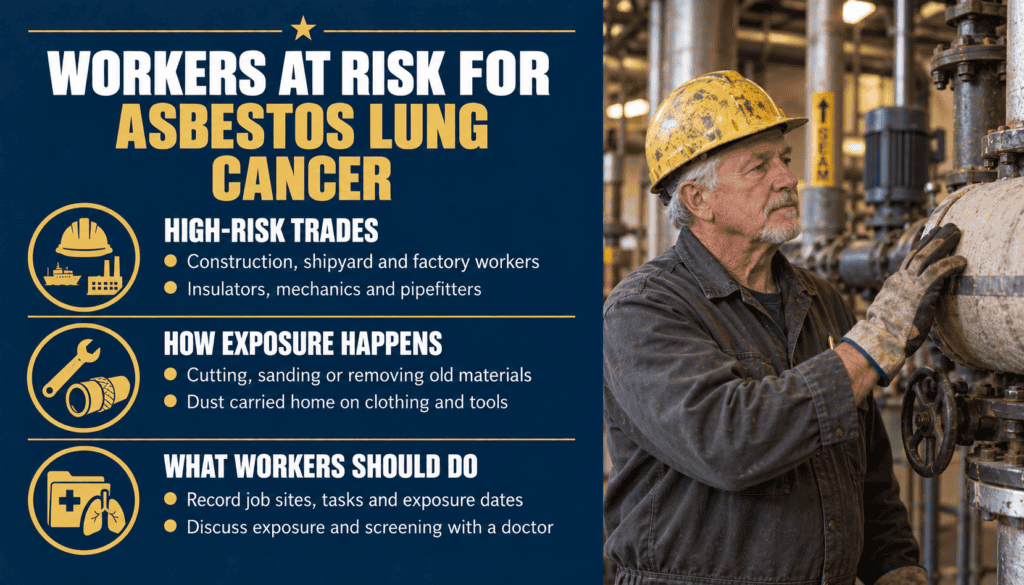
Workers at Risk for Asbestos Lung Cancer
Workers in construction, shipyards, industrial plants, mechanical trades, and other occupations may face asbestos lung cancer risk when asbestos-containing materials are disturbed and fibers become airborne. Historically, asbestos was used in insulation, fireproofing, friction materials, gaskets, packing, cement products, roofing, flooring, mechanical systems, and other heat-resistant products.
A job title alone does not prove asbestos exposure. Exposure risk depends on the specific tasks performed, the materials or equipment involved, the era, frequency and duration of work, ventilation, nearby trades, and whether confirmed asbestos-containing products were actually disturbed.
This page is the Workers at Risk for Asbestos Lung Cancer hub within the broader Diagnosed With Lung Cancer silo. Confirmed child pages include Construction Workers Asbestos Lung Cancer, Shipyard Workers Asbestos Lung Cancer, Industrial Workers Asbestos Lung Cancer, and Mechanics Asbestos Lung Cancer.
👷 Occupational Asbestos Exposure and Lung Cancer Risk
Asbestos is an established cause of lung cancer. Occupational exposure can occur when workers inhale fibers released from asbestos-containing materials during installation, repair, maintenance, renovation, demolition, overhaul, manufacturing, or cleanup.
Workplace risk can vary substantially. A worker who repeatedly removes friable insulation in a confined area may have a very different exposure history from someone who worked in the same industry but never disturbed asbestos-containing materials.
| Exposure Factor | Why It Matters |
|---|---|
| Material actually contained asbestos | Confirms that asbestos was present in the product or system being disturbed. |
| Task performed | Cutting, sanding, scraping, removal, demolition, and repair can release fibers. |
| Frequency and duration | Repeated exposure can increase cumulative dose. |
| Ventilation | Confined or poorly ventilated spaces can increase airborne concentrations. |
| Nearby trades | Workers can inhale fibers released by another trade in the same work area. |
| Era and product history | Asbestos content varied over time by manufacturer, model, product, and location. |
For the broader medical risk discussion, see Asbestos Lung Cancer Risk.
⚠️ Workers and Trades to Investigate
Many occupations can involve potential asbestos exposure, but the strongest exposure histories are usually tied to identifiable tasks, products, equipment, or work areas.
| Worker or Trade | Possible Exposure Pathway | Records to Review |
|---|---|---|
| Construction workers | Renovation, demolition, insulation, flooring, roofing, fireproofing, piping, and mechanical systems | Project records, specifications, contractor records, union records |
| Shipyard workers | Shipbuilding, overhaul, insulation, boilers, piping, pumps, valves, gaskets, and shipbreaking | Vessel records, yard records, work orders, equipment manuals |
| Industrial workers | Boilers, turbines, furnaces, piping, pumps, valves, insulation, and process equipment | Plant records, maintenance logs, purchasing records |
| Mechanics | Historical brakes, clutches, gaskets, seals, and heat-resistant components | Parts records, repair manuals, fleet records, shop records |
| Insulators and pipefitters | Pipe covering, boiler insulation, steam systems, gaskets, and valves | Employment records, product records, coworker testimony |
| Boilermakers and millwrights | Boilers, turbines, machinery, insulation, gaskets, packing, and overhaul work | Maintenance records, equipment records, shutdown records |
| Electricians and maintenance workers | Work near older insulation, fireproofing, electrical components, and building systems | Facility records, work orders, renovation documents |
These occupations should be treated as reasons to investigate—not proof that every worker in the trade was exposed.
🏗️ Construction Workers and Asbestos Lung Cancer
Construction workers can encounter legacy asbestos during remodeling, demolition, repair, maintenance, and work in older buildings. Potential materials include certain historical insulation, flooring, roofing, cement products, fireproofing, pipe covering, and mechanical-system components.
Exposure can be direct or bystander. Electricians, carpenters, plumbers, laborers, HVAC workers, roofers, flooring workers, and demolition crews may work in the same area while asbestos-containing materials are disturbed.
The investigation should identify the specific building, project, trade, task, material, and time period.
See the dedicated Construction Workers Asbestos Lung Cancer page.
⚓ Shipyard Workers and Asbestos Lung Cancer
Shipyards historically used asbestos-containing materials in some boilers, steam systems, piping, turbines, pumps, valves, insulation, gaskets, packing, fireproofing, and other vessel systems.
Potential exposure can occur during shipbuilding, repair, overhaul, maintenance, demolition, salvage, and shipbreaking. Confined vessel compartments can be especially relevant when asbestos-containing materials are disturbed nearby.
Insulators, pipefitters, boilermakers, machinists, electricians, welders, riggers, laborers, and shipbreakers can have different exposure pathways depending on their actual tasks.
🏭 Industrial Workers and Asbestos Lung Cancer
Industrial exposure can occur in power plants, refineries, chemical plants, factories, mills, foundries, and other facilities that historically used asbestos-containing heat-resistant or insulating materials.
Maintenance, repair, turnarounds, shutdowns, and equipment overhauls can disturb pipe insulation, boiler materials, gaskets, packing, pumps, valves, turbines, furnaces, and process equipment.
Maintenance mechanics, pipefitters, boilermakers, electricians, machinists, millwrights, insulators, laborers, and housekeeping workers may warrant closer review depending on the plant and job duties.
🔧 Mechanics and Asbestos Lung Cancer
Mechanics may have encountered asbestos in certain historical friction, gasket, sealing, and heat-resistant components. Potential settings include automobile repair, truck and bus maintenance, heavy equipment, military vehicles, industrial machinery, agricultural equipment, and transit systems.
Brake and clutch work can be especially relevant when older asbestos-containing friction materials were cleaned, sanded, ground, or removed. Certain gaskets and other high-temperature parts can also warrant investigation.
Not every brake, clutch, or gasket contained asbestos. Manufacturer, part number, equipment model, year, and replacement history matter.
🌫️ Bystander and Nearby-Worker Exposure
Workers did not always have to handle asbestos directly to inhale fibers. Bystander exposure can occur when another trade disturbs confirmed asbestos-containing material in the same room, compartment, shop, plant area, or jobsite.
Relevant factors can include:
- Distance from the work
- Frequency and duration
- Room or compartment size
- Ventilation
- Dust-generating methods
- Cleanup practices
- Respiratory protection and controls
A generally dusty workplace is not enough by itself. The exposure history should connect the dust to asbestos-containing materials or components.
⏳ Latency, Symptoms, and Diagnosis
Asbestos-related lung cancer can develop decades after exposure, so workers may receive a diagnosis long after changing careers or retiring.
Possible symptoms can include a persistent or worsening cough, shortness of breath, chest pain, coughing up blood, unexplained weight loss, hoarseness, fatigue, and recurrent respiratory infections. These symptoms are not specific to asbestos-related lung cancer and require medical evaluation.
A work history does not diagnose lung cancer. Diagnosis generally requires imaging and usually biopsy or cytology to determine the cancer type.
See Asbestos Lung Cancer Symptoms and Diagnosing Asbestos-Related Lung Cancer.
Once cancer is diagnosed, treatment and prognosis depend primarily on cancer type, stage, biomarkers, molecular features, lung function, overall health, and treatment response. See Asbestos Lung Cancer Treatment and Asbestos Lung Cancer Prognosis & Survival.
📁 How Occupational Asbestos Exposure Is Documented
Because exposure often occurred decades earlier, a useful investigation may combine several sources of evidence.
| Evidence | What It May Help Establish |
|---|---|
| Employment records | Employers, occupations, departments, and dates worked |
| Union records | Trade, job assignments, contractors, and jobsites |
| Product records | Whether particular materials or components contained asbestos |
| Equipment manuals | Models, parts, gaskets, packing, brakes, clutches, and maintenance procedures |
| Plant, ship, or building records | Installed systems, renovation history, overhaul work, and materials |
| Coworker testimony | Tasks, work practices, products, and dust conditions |
| Asbestos surveys or abatement records | Confirmation that asbestos-containing materials were present at a location |
| Medical records | Lung cancer diagnosis, pathology, stage, and treatment |
For broader jobsite exposure resources, visit Asbestos Exposure in Job Sites.
Workers diagnosed with lung cancer after documented asbestos exposure may also be able to investigate legal compensation depending on the evidence and applicable law. See Asbestos Lung Cancer Lawsuits & Compensation, Asbestos Lung Cancer Trust Fund Claims, and Who Qualifies for Asbestos Lung Cancer Compensation?.
Worked around asbestos and later developed lung cancer? Call 800.291.0963 or Submit Your Case. Live help is available 24/7, 365 days a year.
❓ Frequently Asked Questions
Which workers are most at risk for asbestos lung cancer?
Risk can be higher in jobs involving repeated disturbance of asbestos-containing materials, including some construction, shipyard, industrial, mechanical, insulation, boiler, pipe, and maintenance work. The actual exposure history matters more than the job title alone.
Does working in construction prove asbestos exposure?
No. Construction work can create exposure opportunities, but evidence should show that asbestos-containing materials were actually present and disturbed.
Were shipyard workers exposed to asbestos?
Some shipyard workers had substantial historical exposure, especially during work involving confirmed asbestos-containing insulation, boilers, piping, machinery, gaskets, packing, overhaul, or shipbreaking.
Can factory and industrial workers develop asbestos lung cancer?
Yes. Asbestos is an established cause of lung cancer. Industrial exposure can be relevant when workers encountered confirmed asbestos-containing materials or equipment.
Can mechanics be exposed through brakes and clutches?
Potentially. Certain historical brake and clutch components contained asbestos, but not every part did. Product and equipment evidence matter.
Can a worker be exposed without directly handling asbestos?
Yes. Bystander exposure can occur when asbestos-containing material is disturbed nearby, especially in enclosed or poorly ventilated spaces.
Does smoking prevent an asbestos-related lung cancer claim?
Not automatically. Smoking and asbestos are separate established lung cancer risk factors. A smoking history does not erase documented occupational asbestos exposure.
What evidence helps prove workplace asbestos exposure?
Employment and union records, product records, equipment manuals, jobsite or plant records, asbestos surveys, coworker testimony, and medical records can help reconstruct exposure.
📞 Diagnosed With Lung Cancer After Workplace Asbestos Exposure?
If you or a family member worked in construction, shipyards, industrial plants, mechanical trades, boiler work, insulation, maintenance, manufacturing, power generation, refineries, or another potentially exposed occupation and later developed lung cancer, a detailed exposure review can reconstruct jobs, worksites, products, equipment, and tasks from decades earlier.
Call 800.291.0963 to discuss the worker’s occupational history and possible asbestos exposure. Live help is available 24/7, 365 days a year.
Submit Your Case for a case-specific review of potential asbestos lawsuits, trust fund claims, and other legal options. Eligibility for compensation depends on the diagnosis, exposure evidence, responsible parties or trusts, jurisdiction, and filing deadlines.
⚕️ Legal & Medical Information Disclaimer
This page provides general educational information only. It does not establish diagnosis, medical causation, legal liability, claim eligibility, or entitlement to compensation. Consult qualified medical and legal professionals about your specific situation.