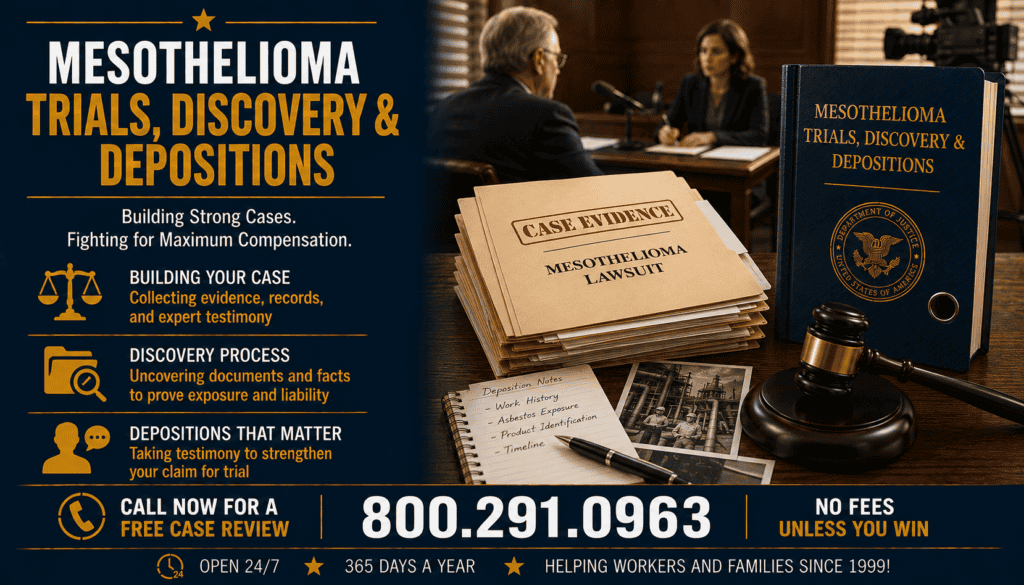
Mesothelioma Trials, Discovery & Depositions
After a mesothelioma lawsuit is filed, the case can move into discovery—the formal process through which the parties identify, exchange and develop evidence. Discovery can include documents, written questions, requests for admissions, depositions and expert evidence. The U.S. Courts explains that discovery helps litigants assemble evidence and prepare witnesses for trial.
Mesothelioma litigation can require reconstruction of events that occurred decades earlier. Employment records, product evidence, corporate documents, medical records, coworkers and expert testimony may all become important, but each item should be evaluated for what it actually proves. Discovery does not guarantee that a case will reach trial; civil cases can settle or otherwise resolve during litigation.
⚖️ Understanding Trials, Discovery & Depositions
A civil lawsuit generally moves through pleadings, discovery, motions and—if it does not resolve—trial. Courts manage the schedule, and procedures vary by jurisdiction.
Discovery is particularly important in asbestos cases because families may not possess historical corporate records or know every product or company involved when a lawsuit begins.
🔍 What Is Discovery?
The U.S. Courts describes discovery as the stage in which litigants assemble evidence and prepare witnesses. It can include exchanging documents and taking depositions, where witnesses answer questions under oath before trial.
Discovery can confirm existing evidence, reveal additional records, identify witnesses and test disputed claims and defenses.
📂 Scope of Discovery
Federal Rule of Civil Procedure 26 generally permits discovery of nonprivileged matters relevant to a party’s claim or defense and proportional to the needs of the case. Information within the permissible discovery scope does not necessarily have to be admissible at trial to be discoverable.
State courts use their own procedural rules, so federal rules should not be assumed to govern every mesothelioma case.
📋 Initial Disclosures
In federal cases subject to Rule 26(a)(1), parties generally disclose categories of information without waiting for a discovery request, including people likely to have discoverable information, documents or electronically stored information that may support claims or defenses, and certain damages information.
Rule 26 also states that initial disclosures are based on information then reasonably available; a party is not excused merely because its investigation is incomplete.
📑 Document Requests and Records
Document discovery in mesothelioma cases can involve employment records, invoices, purchase orders, specifications, safety materials, product literature, maintenance records, photographs, corporate records, medical records and electronically stored information.
A document’s significance depends on its connection to the claimant. An invoice can show a purchase but does not automatically prove personal exposure; a product catalog can show availability but not necessarily presence at a specific jobsite.
❓ Written Interrogatories
Interrogatories are written questions served during discovery. They can seek information about employment, exposure, witnesses, products, medical history, damages or defenses, subject to applicable procedural rules and objections.
Answers should be accurate and consistent with available evidence. If exact historical dates are unknown, estimates should be identified as estimates rather than presented as verified facts.
✅ Requests for Admission
Requests for admission can ask another party to admit the truth of specified facts or the genuineness of documents. Their purpose can include narrowing issues that genuinely remain disputed.
Responses are governed by the applicable procedural rules and should not be treated casually because admissions can have significant effects within the litigation.
🎙️ What Happens During a Deposition?
The U.S. Courts explains that a deposition requires a witness to answer questions about the case under oath before trial, typically with a court reporter producing a transcript. Federal Rule 30 governs oral depositions in federal civil litigation.
A deposition is testimony, not an informal interview. Witnesses should answer truthfully, listen carefully and distinguish what they personally remember from what they learned later.
👤 Claimant Depositions
A claimant may be questioned about employment, military service, asbestos exposure, products, coworkers, diagnosis, treatment and damages. Because mesothelioma can affect health and stamina, scheduling and preservation of testimony may receive special attention depending on the court and circumstances.
Preparation should focus on accuracy—not memorizing a script. It is appropriate for a witness to say when an exact detail is not remembered.
👷 Coworker and Witness Depositions
Coworkers can provide firsthand evidence about jobsites, tasks, equipment, products and working conditions. Family witnesses may have information about household exposure, caregiving or damages.
Witness testimony is strongest when the witness identifies the basis of personal knowledge. A coworker should not adopt a brand name merely because someone later suggested it.
🏢 Corporate Witnesses
Corporate testimony can address historical products, operations, records, warnings, distribution, jobsite relationships and document systems. In federal cases, Rule 30(b)(6) provides a procedure for depositions of organizations through designated persons who testify about identified matters.
Corporate testimony does not replace claimant-specific exposure evidence; the two can address different parts of the liability analysis.
🧪 Expert Witnesses
Expert witnesses can address specialized subjects such as medicine, industrial hygiene, pathology or other technical issues. Federal Rule of Evidence 702 requires the proponent of expert testimony to establish specified reliability and helpfulness requirements.
Federal Rule 26 also contains expert-disclosure requirements. Retained experts who fall within Rule 26(a)(2)(B) generally provide reports describing opinions, bases, considered facts or data and other required information.
🔬 Expert Depositions
Rule 26 permits a party to depose an identified expert whose opinions may be presented at trial. When a written expert report is required, the deposition generally occurs after the report is provided.
Expert discovery can examine the foundation, data, methods and application supporting the opinions, subject to protections and limitations in the rules.
🩺 Medical Evidence
Pathology, imaging, treatment records and physician testimony can establish diagnosis and address medical issues. Medical evidence should be distinguished from evidence identifying the asbestos source or responsible defendant.
A mesothelioma diagnosis does not independently establish where exposure occurred or which company’s product was involved.
🏭 Asbestos Exposure Evidence
Exposure evidence can include employment histories, military records, product documents, invoices, photographs, specifications, jobsite records and witness testimony. A timeline can organize the relationship among jobs, locations, tasks and products.
🔐 Evidence Preservation
Potentially relevant evidence should be preserved when litigation is reasonably anticipated. Keep original documents, digital files and available metadata, and avoid unnecessary alteration of photographs or electronic records.
Preservation letters can identify categories of evidence that should not be destroyed. See How Evidence Preservation Letters Protect Your Case.
🔄 Correcting and Supplementing Discovery
Federal Rule 26(e) requires supplementation or correction of covered disclosures and discovery responses when a party learns that material information is incomplete or incorrect and the corrective information has not otherwise been made known as provided by the rule.
If new records legitimately change an exposure date or product identification, preserve the earlier information and document the basis for the correction rather than silently rewriting history.
⚠️ Discovery Disputes and Court Orders
Parties can disagree about relevance, proportionality, privilege, burden or whether a discovery response is adequate. Courts can resolve discovery disputes through motions and protective orders under applicable procedural rules.
A discovery dispute does not itself establish that evidence exists or that a claim or defense is valid.
📜 Pretrial Motions
Before trial, parties may ask the court to resolve procedural, evidentiary or substantive questions. Motions can address discovery, admissibility, experts, claims, defenses or other issues.
The effect of a motion depends on the specific relief requested and the court’s ruling.
⚖️ Summary Judgment
Summary judgment can resolve a claim or issue without trial when the governing standard is satisfied. Asbestos cases can involve disputes about whether sufficient evidence connects a particular defendant to the alleged exposure.
Historical documents or testimony should therefore be connected to the claimant rather than simply showing that asbestos products existed somewhere in an industry.
🗂️ Preparing for Trial
Trial preparation can include final witness lists, exhibit preparation, deposition designations, expert preparation and evidentiary objections. Rule 26 includes federal pretrial disclosure requirements for witnesses, deposition testimony and exhibits unless the court orders otherwise.
Courts typically establish case-specific scheduling orders, so deadlines should be taken from the actual court docket and governing rules.
🏛️ What Happens at Trial?
If the case does not settle or otherwise resolve, the parties present admissible evidence and witness testimony at trial. The applicable factfinder determines disputed facts, and the court applies governing law and evidentiary rules.
Trial results are case-specific. A prior mesothelioma verdict does not establish liability or damages in a new case.
🤝 Settlement During Litigation
The U.S. Courts notes that civil litigants often resolve disputes through settlement rather than trial. Negotiations can occur while discovery and motion practice continue.
Settlement decisions should consider the complete agreement, including release language, payment terms, liens and expected net recovery—not simply the headline offer.
📚 Post-Trial Proceedings
A verdict may be followed by post-trial motions or an appeal when legally available. An appeal generally reviews alleged legal error; it is not simply a new trial because one party disagrees with the result.
Payment timing after a verdict can therefore differ from payment under a finalized settlement.
🧭 Explore Trial & Discovery Topics
- The Role of Expert Witnesses in Mesothelioma Cases
- The Discovery Phase of a Mesothelioma Lawsuit
- Why Witness Statements Are Crucial in Asbestos Trials
- How Lawyers Use Expert Witnesses in Asbestos Trials
- What Happens During a Mesothelioma Deposition?
- How Discovery Works in Mesothelioma Cases
- What to Expect at a Mesothelioma Court Hearing
- How Evidence Preservation Letters Protect Your Case
✅ Discovery Preparation Checklist
| Area | What to organize |
|---|---|
| Medical | Pathology, diagnosis and treatment records |
| Employment | Employers, dates, trades and departments |
| Exposure | Jobsites, tasks, products and equipment |
| Witnesses | Coworkers and family with firsthand knowledge |
| Documents | Original records and available metadata |
| Prior claims | Trust filings, lawsuits and exposure statements |
| Damages | Medical bills, earnings and supported losses |
| Corrections | Document legitimate updates to prior information |
| Deposition | Review chronology without memorizing answers |
| Deadlines | Follow court orders and applicable rules |
❓ Frequently Asked Questions
What is discovery in a mesothelioma lawsuit?
Discovery is the formal process used to obtain and exchange relevant information and prepare evidence and witnesses for litigation.
What is a deposition?
A deposition is sworn testimony taken before trial, usually recorded by a court reporter and preserved in a transcript.
Will a mesothelioma claimant have to give a deposition?
Potentially. Whether and how a deposition occurs depends on the case, court schedule and applicable rules.
Can coworkers be deposed?
Yes. Coworkers with relevant firsthand knowledge may be questioned about jobsites, products, tasks and working conditions.
What do expert witnesses do?
Experts can provide specialized opinions when the applicable evidentiary requirements are satisfied. Their role depends on the issues in the case.
Are expert witnesses subject to discovery?
Yes. Federal Rule 26 provides for expert disclosures and permits depositions of experts whose opinions may be presented at trial, subject to its requirements and protections.
Can discovery uncover records a family does not have?
Potentially. Discovery can seek relevant corporate documents, records and testimony within the scope permitted by applicable rules.
What if an old discovery answer turns out to be wrong?
Applicable rules may require supplementation or correction. Preserve the basis for the change rather than concealing the earlier information.
Does every mesothelioma case go to trial?
No. Civil cases can resolve through settlement, dismissal, court rulings or other procedures before trial.
Does a prior verdict predict a new trial result?
No. Each case depends on its own evidence, defendants, law and procedural history.
📞 Request a Case Evaluation
If you are preparing for a mesothelioma lawsuit, preserve medical records, employment and military history, exposure timelines, product information, photographs, witness contacts and prior asbestos claims. Keep verified facts separate from estimates and avoid guessing at products or dates you do not remember.
Call 800.291.0963 for a no-obligation case evaluation and to talk to a real person 24/7, 365 days a year. Many mesothelioma law firms handle qualifying cases on a contingency-fee basis; confirm the fee agreement and terms directly with the firm you retain. Submit your case here.
📝 Summary
Discovery, depositions and trial preparation are central stages of many mesothelioma lawsuits. Discovery can develop documents, witness testimony, exposure evidence and expert opinions that were not available when the complaint was filed. Depositions preserve sworn testimony, while expert evidence can address specialized medical and technical issues under applicable evidentiary rules. Parties must preserve relevant evidence, provide accurate responses and correct material information when required. Many civil cases resolve before trial, but cases that proceed to trial are decided from the admissible evidence and law applicable to that individual dispute.
🔗 Confirmed Sources
- United States Courts — Civil Cases
- Federal Rule of Civil Procedure 26 — Disclosures and Discovery
- Federal Rule of Civil Procedure 30 — Depositions by Oral Examination
- Federal Rule of Evidence 702 — Expert Witness Testimony
Disclaimer: General information only—not legal or medical advice. This website is not a law firm. Discovery procedures, deposition rules, expert requirements, evidentiary standards, scheduling and trial practices vary by jurisdiction and case. No deposition, expert opinion, document or prior verdict guarantees liability, compensation or a particular outcome. Past results do not guarantee future outcomes.