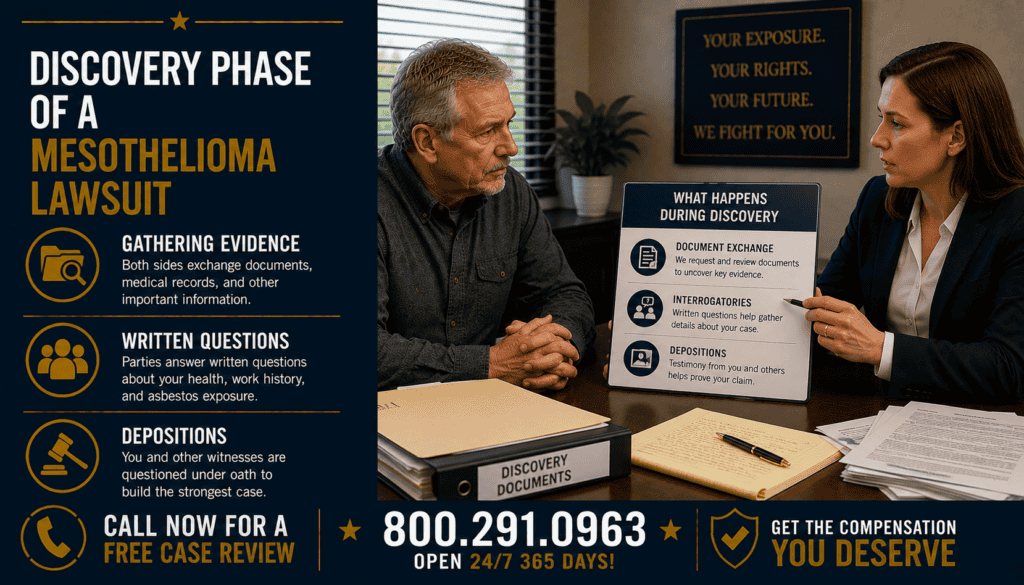
The Discovery Phase of a Mesothelioma Lawsuit
Discovery is the pretrial process in which parties exchange information, obtain documents, question witnesses and develop evidence relevant to the claims and defenses. In a mesothelioma lawsuit, discovery can be especially important because alleged asbestos exposure may have occurred decades earlier and may involve numerous jobsites, products, employers and companies.
In federal court, Rules 26 through 37 of the Federal Rules of Civil Procedure provide the principal discovery framework. State courts use their own procedural rules, which can differ in scope, deadlines and requirements.
⚖️ What the Discovery Phase Is
Discovery gives each side an opportunity to investigate the factual basis of the opposing side’s positions before trial. It is not limited to evidence that will necessarily be admitted at trial.
Discovery Builds the Evidentiary Record
Lawyers may use discovery to investigate exposure history, identify products and companies, obtain corporate records, review medical evidence, locate witnesses and understand claimed damages.
Both Sides Participate
Plaintiffs can seek information from defendants, and defendants can request information from plaintiffs. Each side can challenge requests that exceed applicable discovery rules.
Discovery Does Not Determine Liability by Itself
A document showing that asbestos products were present at a facility does not automatically prove that a particular claimant encountered them. Discovery develops evidence that must later be evaluated under the governing substantive and evidentiary law.
🔎 Scope & Timing of Discovery
Federal Rule 26(b)(1) generally permits discovery of nonprivileged matter relevant to a party’s claim or defense and proportional to the needs of the case. Proportionality considers factors including the importance of the issues, amount in controversy, access to information, party resources, importance of discovery and whether the burden or expense outweighs its likely benefit.
Discovery Usually Follows the Rule 26(f) Conference
Under federal Rule 26(d), a party ordinarily may not seek discovery before the parties confer under Rule 26(f), subject to specified exceptions, stipulation or court order.
Initial Disclosures
Rule 26(a) can require parties to disclose categories of witnesses, documents, damages computations and insurance information without waiting for a discovery request, subject to the rule’s exceptions.
Court Scheduling Orders Matter
Courts establish deadlines for fact discovery, expert disclosures, motions and other stages. Case-specific orders can therefore be as important as the general rules.
📂 Documents & Written Discovery
Discovery is not one procedure. Lawyers combine several tools to obtain information and narrow disputed issues.
| Discovery tool | Typical purpose |
|---|---|
| Interrogatories | Written questions answered by a party |
| Document requests | Obtain documents, electronically stored information and tangible items |
| Requests for admission | Ask a party to admit or deny specified matters |
| Depositions | Obtain sworn oral testimony |
| Subpoenas | Seek documents or testimony from appropriate nonparties |
Interrogatories
Federal Rule 33 generally limits a party to 25 written interrogatories, including discrete subparts, unless otherwise stipulated or ordered. Answers must generally be served within 30 days and, except for objections, answered separately and fully in writing under oath.
Document Requests
Rule 34 can be used to request documents, electronically stored information and tangible things within the rule’s scope. In asbestos litigation, this may include employment records, product documents, specifications, invoices, safety materials and corporate records.
Requests for Admission
Rule 36 allows requests concerning facts, application of law to fact, opinions about either, and genuineness of documents. An admission made under the rule is generally conclusively established for the pending action unless withdrawn or amended with court permission.
🎙️ Depositions & Witness Testimony
Depositions allow lawyers to question witnesses under oath before trial. Mesothelioma depositions can involve the diagnosed person, family members, coworkers, corporate representatives and expert witnesses.
Plaintiff Deposition
Questions may cover employment, military service, jobsites, asbestos products, work practices, household exposure, medical history and damages.
Coworker and Family Testimony
Coworkers may help reconstruct products and work conditions. Family members may have relevant knowledge about household exposure, the claimant’s history or effects of the disease.
Corporate Representatives
Federal Rule 30(b)(6) provides a procedure for deposing an organization about designated matters through one or more persons it identifies to testify on its behalf.
👩⚕️ Expert Witness Discovery
Expert discovery can address medical diagnosis, causation, industrial hygiene, materials, workplace practices and economic damages.
Expert Disclosures
Federal Rule 26(a)(2) requires disclosure of witnesses a party may use at trial to provide expert testimony. Retained or specially employed testifying experts ordinarily must provide signed written reports unless otherwise stipulated or ordered.
What Reports Include
Rule 26 requires specified reports to contain the expert’s opinions and reasons, facts or data considered, supporting exhibits, qualifications, specified prior testimony and compensation.
Expert Depositions
Testifying experts can generally be deposed under Rule 26. Their assumptions, methodology, factual foundation and opinions may be examined before trial.
Protected Materials
Rule 26 provides protections for draft expert reports and many attorney-expert communications, subject to specified exceptions.
🏭 Asbestos Exposure Evidence
Discovery can help reconstruct an exposure history that occurred many years earlier. The strongest record often combines several independent categories of evidence.
| Evidence category | Examples |
|---|---|
| Employment | Personnel files, Social Security history, union and payroll records |
| Worksite | Plans, specifications, maintenance files and photographs |
| Products | Invoices, catalogs, purchase orders and product records |
| Witnesses | Coworkers, supervisors, family members and contractors |
| Corporate | Internal documents, warnings, testing and historical policies |
| Medical | Pathology, imaging, diagnosis and treatment records |
Separate Product Presence From Personal Exposure
Evidence that a product was sold to a facility can support investigation, but it does not automatically establish that the claimant worked with or near that product.
Historical Records Need Context
An invoice, photograph or specification should be evaluated for date, location, product identity and relationship to the claimant’s actual work.
Preserve Source Information
Maintaining originals, metadata and provenance can help authenticate records and clarify how they were obtained.
🛡️ Objections, Privilege & Discovery Disputes
Discovery is broad but not unlimited. Privilege, work-product protection, relevance, proportionality and court orders can limit what must be produced.
Attorney-Client Privilege
Confidential attorney-client communications can be protected from discovery when the legal requirements for privilege are met. The existence and scope of privilege can be fact-specific.
Work Product
Rule 26(b)(3) provides protection for qualifying materials prepared in anticipation of litigation or for trial, subject to exceptions. Courts give additional protection to attorney mental impressions, conclusions, opinions and legal theories.
Discovery Objections
Parties may object to requests they believe are improper. Federal discovery rules require specificity in many objections and provide procedures for resolving disputes.
Motions to Compel and Sanctions
Rule 37 provides mechanisms for seeking court orders when required disclosures or discovery responses are not provided and authorizes remedies or sanctions in specified circumstances.
🧭 What Happens After Discovery
As discovery closes, lawyers evaluate the developed record and prepare the case for motions, settlement discussions or trial.
Evidence Is Organized by Issue
The parties may organize proof concerning exposure, product identification, causation, liability and damages and determine which disputes remain genuinely contested.
Dispositive Motions
Depending on the record and procedural posture, parties may file motions asking the court to resolve claims or defenses without a trial when the applicable legal standard is satisfied.
Pretrial Preparation
Witness lists, exhibit lists, evidentiary motions, expert challenges and proposed jury materials may be prepared according to court deadlines.
Settlement Can Occur During Discovery
Discovery may clarify strengths, weaknesses and disputed facts, but it does not guarantee settlement. Negotiations can occur at different stages of a case.
❓ Frequently Asked Questions
What is discovery in a mesothelioma lawsuit?
It is the pretrial process used to exchange information, obtain documents, question witnesses and investigate claims and defenses.
What kinds of records can be requested?
Depending on relevance, proportionality and other rules, requests may involve employment, medical, product, worksite, corporate and electronically stored records.
What are interrogatories?
They are written questions served on another party. Federal Rule 33 governs interrogatories in federal civil cases.
What is a request for admission?
It asks another party to admit or deny specified matters within the scope of Rule 36, helping narrow issues that may otherwise require proof.
Are depositions part of discovery?
Yes. Depositions provide sworn testimony before trial and can involve parties and other witnesses.
Are expert witnesses included in discovery?
Yes. Federal Rule 26 includes expert disclosure and discovery provisions for witnesses who may provide expert testimony.
Can privileged communications be discovered?
Properly privileged communications are generally outside ordinary discovery, although privilege disputes can require court resolution.
Can a party refuse every discovery request?
No. Parties must comply with applicable discovery obligations while making appropriate objections where supported by the rules.
What happens if a party does not cooperate?
Federal Rule 37 provides motions to compel and potential sanctions or other remedies in specified circumstances.
Does discovery prove that a defendant is liable?
No. Discovery develops evidence. Liability ultimately depends on the admissible evidence and governing law.
📞 Request a Case Evaluation
Discovery becomes more effective when an exposure history is organized early. Preserve employment records, product information, jobsite photographs, coworker names, military records and medical documentation that may help reconstruct the relevant history.
Call 800.291.0963 for a no-obligation case evaluation and to talk to a real person 24/7, 365 days a year. Many mesothelioma law firms handle qualifying cases on a contingency-fee basis; confirm the terms with the firm you retain. Submit your case here.
📝 Summary
The discovery phase allows parties in a mesothelioma lawsuit to obtain documents, written answers, admissions, deposition testimony and expert evidence before trial. In federal court, Rule 26 defines the general scope and disclosure framework, while Rules 30, 33, 34, 36 and 37 govern important discovery tools and enforcement procedures. The process can help reconstruct decades-old asbestos exposure, but the resulting evidence must still be connected to the claimant, defendants and legal elements of the case.
🔗 Confirmed Sources
- Cornell Legal Information Institute — Federal Rule of Civil Procedure 26
- Cornell Legal Information Institute — Federal Rule of Civil Procedure 30
- Cornell Legal Information Institute — Federal Rule of Civil Procedure 33
- Cornell Legal Information Institute — Federal Rule of Civil Procedure 34
- Cornell Legal Information Institute — Federal Rule of Civil Procedure 36
- Cornell Legal Information Institute — Federal Rule of Civil Procedure 37
Disclaimer: General information only—not legal advice. This website is not a law firm. Discovery rules vary by court and jurisdiction. Past results do not guarantee future outcomes.