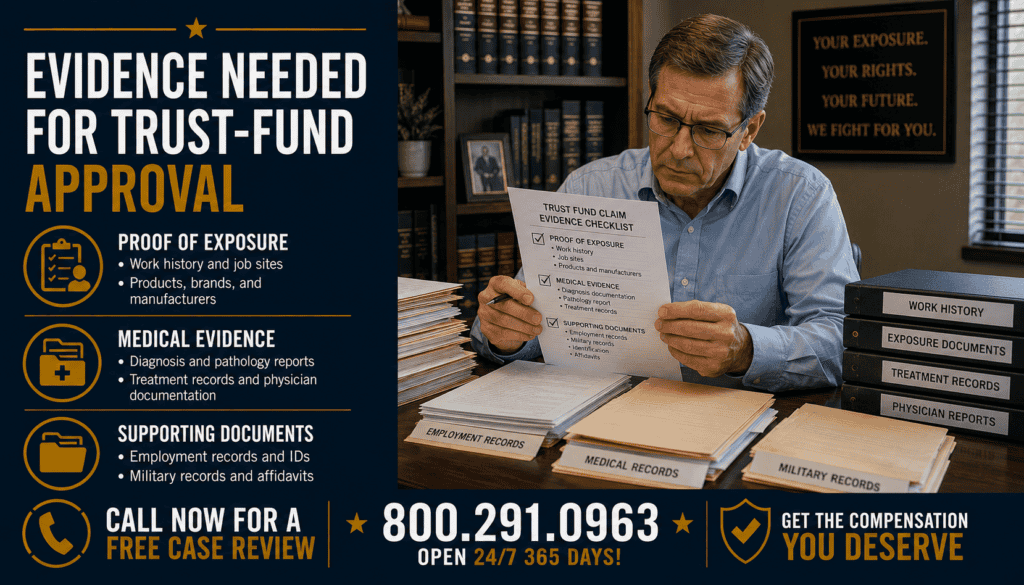
Evidence Needed for Asbestos Trust Fund Approval
Approval of an asbestos bankruptcy trust claim generally depends on whether the claimant satisfies the specific trust’s medical and exposure criteria. A diagnosis alone is not enough to establish every trust claim, and an employment record alone does not prove exposure to a particular company’s asbestos product. The evidence must be evaluated under the governing Trust Distribution Procedures (TDP) and related claim instructions.
The U.S. Government Accountability Office reviewed 52 asbestos trust TDPs and reported that trusts use those procedures to govern claim intake, evaluation and payment. For expedited review, claims generally must meet the medical and exposure criteria for the claimed disease level. Supporting evidence can include medical records, work histories, Social Security records, invoices, employer records, and claimant or coworker testimony.
⚖️ What Trust Fund Approval Requires
A trust does not approve a claim simply because the claimant has mesothelioma or worked in an industry historically associated with asbestos. The submission must satisfy the criteria established for that trust and disease level.
| Evidence category | What it may establish | What it does not establish alone |
|---|---|---|
| Medical records | Diagnosis and disease-level evidence | Which company caused exposure |
| Employment records | Employer and work period | Contact with a specific asbestos product |
| Site records | Presence at a facility or project | Exposure to every asbestos material there |
| Product evidence | Product/company connection | Claimant contact without additional evidence |
| Witness evidence | Firsthand facts about work and exposure | Facts outside the witness’s knowledge |
📘 Start With the Trust Distribution Procedures
Each asbestos trust has its own TDP. GAO found that TDPs establish how claims are reviewed and paid, set medical criteria for different disease levels, prescribe review procedures and provide dispute-resolution processes.
Before gathering evidence, identify the correct trust and obtain its current TDP, claim form, filing instructions and any current exposure-site or product criteria. Evidence sufficient for one trust is not automatically sufficient for another.
🩺 Medical Evidence
GAO reported that a claimant or the claimant’s attorney submits medical reports or records sufficient to support the diagnosis for the specific disease being claimed. For mesothelioma, the exact qualifying documentation depends on the trust’s medical criteria.
Relevant records may include pathology or cytology reports, physician reports, diagnostic records and other materials specifically required by the trust. Submit the diagnosis as documented by qualified medical providers rather than changing medical terminology to match a form.
🔬 Disease-Level Criteria
Trusts commonly organize claims into disease levels. Under expedited review, GAO found that claims meeting the medical and exposure criteria for the alleged disease level are generally assigned the scheduled value established in the TDP.
A medical diagnosis and approval under a particular trust’s disease level are therefore distinct questions. The diagnosis is medical evidence; the trust separately determines whether the submitted evidence satisfies its governing criteria.
🏭 Exposure Evidence
Exposure evidence is used to connect the claimant’s history to asbestos liabilities administered by the trust. GAO identified work histories, Social Security records, invoices, employer records and deposition testimony from claimants or coworkers as examples.
Strong exposure evidence answers four basic questions: where the claimant was, when the claimant was there, what work or activity occurred, and how the covered product or operation is connected to that exposure.
💼 Employment and Social Security Records
Employment evidence can establish that a claimant worked for a particular employer during a particular period. Useful sources can include Social Security earnings histories, payroll records, personnel files, union records, pension files, apprenticeship records and work orders.
GAO specifically noted that Social Security records may document where a claimant was employed at the time of alleged exposure. It also cautioned, through its description of trust practice, that an employment record may not create a direct link between the worker and a particular asbestos product. Additional evidence may be needed.
📍 Job-Site and Exposure-Site Evidence
Site evidence can place a claimant at a plant, shipyard, refinery, construction project, military facility, ship or other location during a relevant period. Records may include work orders, contractor files, ship records, project specifications, maintenance records and historical directories.
A site’s association with asbestos is a research lead, not automatic proof that every person at that site encountered a covered product. Compare site evidence with the trust’s current exposure requirements.
🧱 Product and Company Evidence
Product evidence can include invoices, purchase orders, catalogs, labels, specifications, photographs, equipment records and testimony. It may help establish that a company’s asbestos-containing product or operation was present at a relevant place and time.
An invoice showing that a product was purchased does not by itself prove that the claimant personally handled or worked near it. Likewise, equipment identification does not automatically identify the manufacturer of insulation, gaskets or replacement components used with that equipment.
👥 Coworker and Witness Evidence
Witness evidence can be particularly useful when decades have passed and business records are incomplete. GAO reported that claimant or coworker deposition testimony may be used as exposure evidence.
A useful witness statement identifies how the witness knows the claimant, where and when they worked together, what tasks the witness personally observed, and what products or equipment the witness can identify from firsthand knowledge. Preserve independent recollection rather than coaching a witness toward a desired product name.
🎖️ Military and Government Records
For veterans and government workers, service or personnel records can document assignments, occupations, ships, bases, facilities and dates. Ship histories, maintenance records and unit documents can provide additional context.
Service at a particular ship or base does not by itself establish exposure to a product associated with a particular trust. The evidence still must satisfy that trust’s exposure criteria.
🏠 Household and Secondary Exposure
When a trust’s procedures permit a claim based on household or secondary exposure, the evidence may need to establish the occupational source, the relationship between the worker and claimant, and the pathway by which asbestos could have been carried into the home.
Records may include the worker’s employment history, product or site evidence, shared-address records and firsthand family testimony. The required showing is trust-specific.
🕊️ Evidence for Deceased Claimants
If the injured person has died, additional documentation may be required. GAO identified a death certificate as one document that may be submitted when applicable. The trust may also require documentation establishing who has authority to act for the deceased claimant or estate.
Representative requirements vary. Follow the trust’s instructions rather than assuming a family relationship alone establishes filing authority.
📅 Building an Exposure Timeline
An exposure timeline can organize employers, sites, dates, tasks, products, witnesses and supporting documents in chronological order. It is especially useful when a career involved many employers or possible asbestos sources.
Keep confirmed facts separate from estimates and unresolved leads. Do not convert a vague memory into a precise date or product identification. See How Exposure Timelines Strengthen Mesothelioma Claims.
🔎 Expedited and Individual Review
GAO found that trusts typically offer expedited and individual review. Expedited review generally applies scheduled values when a claim satisfies the specified medical and exposure criteria. Individual review allows additional consideration of claimant-specific information under the trust’s procedures and can result in a value above or below the expedited value.
The evidence needed may therefore depend on the review route and disease category. Confirm the current trust rules before making a review election.
⚠️ Deficiency Requests
GAO described a review process in which deficient claims are returned for additional evidence or information. A deficiency does not necessarily mean the claim has been finally denied; it may identify a missing or insufficient element that can be addressed.
Read the notice carefully, identify the exact issue, submit responsive evidence through the required channel and retain the notice, response and confirmation. Avoid sending unrelated documents that do not address the deficiency.
🧾 Quality Assurance and Audits
GAO found that 50 of the 52 TDPs it reviewed contained provisions requiring claims audit programs, and trust officials described quality-assurance procedures involving medical and work-history documentation. Trusts may request additional independent records when questions arise.
That makes source quality important. Preserve originals, identify where each record came from and do not alter documents or create unsupported details to fill gaps.
🔄 Consistency Across Trust Claims
A worker may have qualifying exposure associated with more than one bankrupt company. Different trust forms may ask different questions, but the underlying employment and exposure history should remain accurate across submissions.
Maintain a master file of previous trust claims, work histories, affidavits and deposition testimony. If new evidence legitimately changes an earlier understanding, preserve the new source and explain the correction rather than silently rewriting history.
🏛️ Trust Evidence and Civil Lawsuits
Trust claims and civil lawsuits against solvent defendants are separate compensation routes, but evidence can overlap. GAO reported that trust compensation and occupational exposure and medical evidence submitted to trusts may be considered in tort litigation, with disclosure practices varying by jurisdiction.
For that reason, preserve complete copies of trust submissions and coordinate them with other asbestos claims. See How Trust Funds and Lawsuits Work Together.
🚫 What Evidence Does Not Prove by Itself
- A mesothelioma diagnosis does not identify the responsible company.
- Employment at an asbestos-related facility does not establish exposure to every product used there.
- A Social Security record documents employment, not a specific product encounter.
- An invoice documents a transaction, not necessarily claimant contact.
- A photograph can document appearance or location, but it does not prove asbestos content by sight.
- A coworker can support facts personally observed, not facts outside the witness’s knowledge.
- Approval by one trust does not automatically establish eligibility for another trust.
- A complete submission does not guarantee approval or a particular payment.
✅ Evidence Approval Checklist
| Evidence | Verify before submission |
|---|---|
| Current TDP | Correct trust and current criteria |
| Medical proof | Supports the disease level being claimed |
| Employment history | Employers and dates supported where possible |
| Exposure history | Site, dates, tasks and pathway identified |
| Product/company link | Supported by records or reliable testimony |
| Witnesses | Firsthand knowledge clearly described |
| Representative authority | Included when claimant cannot file personally |
| Prior claims | Reviewed for factual consistency |
| Sources | Originals and provenance preserved |
| Submission copy | Complete packet and confirmation retained |
For the supporting paperwork itself, see Documents Needed for Trust Fund Claims and Building a Complete Trust Fund Submission Packet Checklist.
❓ Frequently Asked Questions
What evidence is usually required for asbestos trust approval?
Trusts commonly require medical evidence supporting the claimed disease and evidence satisfying their exposure criteria. Exact requirements differ by trust.
Is a mesothelioma diagnosis enough for approval?
No. A diagnosis can satisfy part of the medical inquiry, but the trust must also evaluate exposure and other applicable criteria.
Can Social Security records prove exposure?
They can document employment history but generally do not prove contact with a specific asbestos product by themselves.
Can coworker testimony be used?
Yes. GAO identified claimant and coworker deposition testimony as possible exposure evidence.
What if my employer’s records no longer exist?
Other sources can include Social Security records, union files, witnesses, invoices, site records, prior testimony and other historical evidence. The trust determines whether the combined proof is sufficient.
Does a trust have to accept a site list as proof?
No. Site information may help support exposure, but the trust applies its own criteria to the evidence submitted.
What happens when a claim is deficient?
The trust may request additional evidence or information. Respond specifically to the stated deficiency and preserve the response.
Are trust claims audited?
GAO found audit provisions in most TDPs it reviewed and reported that trusts use quality-assurance measures to evaluate supporting evidence.
Can the same exposure evidence support more than one trust claim?
Potentially, when the evidence independently satisfies each trust’s requirements. Each trust evaluates eligibility separately.
Can trust evidence affect a lawsuit?
It can. Disclosure and use of trust claim information in tort litigation vary by jurisdiction and court rules.
Does approval guarantee the scheduled value?
No. Trusts can apply payment percentages and other TDP provisions to an approved claim value.
Should I keep all evidence after approval?
Yes. Preserve the claim form, evidence, deficiency correspondence, offer, release, payment records and source documents.
📞 Request a Case Evaluation
If you or a family member has been diagnosed with mesothelioma, preserve medical records, employment history, exposure details, product evidence, witness information and prior asbestos claim records while they remain available.
Call 800.291.0963 for a no-obligation case evaluation and to talk to a real person 24/7, 365 days a year. Many mesothelioma law firms handle qualifying cases on a contingency-fee basis; confirm the fee agreement and terms directly with the firm you retain. Submit your case here.
📝 Summary
Asbestos trust approval depends on the criteria of the specific trust. Medical evidence supports the claimed disease, while employment, site, product and witness evidence can help establish qualifying exposure. Strong submissions preserve original records, separate confirmed facts from assumptions, maintain consistency across claims and respond precisely to trust deficiencies. No single document—or prior approval by another trust—guarantees approval.
🔗 Confirmed Sources
- U.S. Government Accountability Office — Asbestos Injury Compensation: The Role and Administration of Asbestos Trusts (GAO-11-819)
- 11 U.S.C. § 524 — Bankruptcy Discharge and Asbestos Trust/Injunction Framework
Disclaimer: General information only—not legal, medical, tax or financial advice. This website is not a law firm. Trust Distribution Procedures, exposure criteria, medical requirements, review options and payment rules differ among asbestos trusts and can change. Confirm current requirements with the applicable trust. Approval or payment of one claim does not guarantee another result.