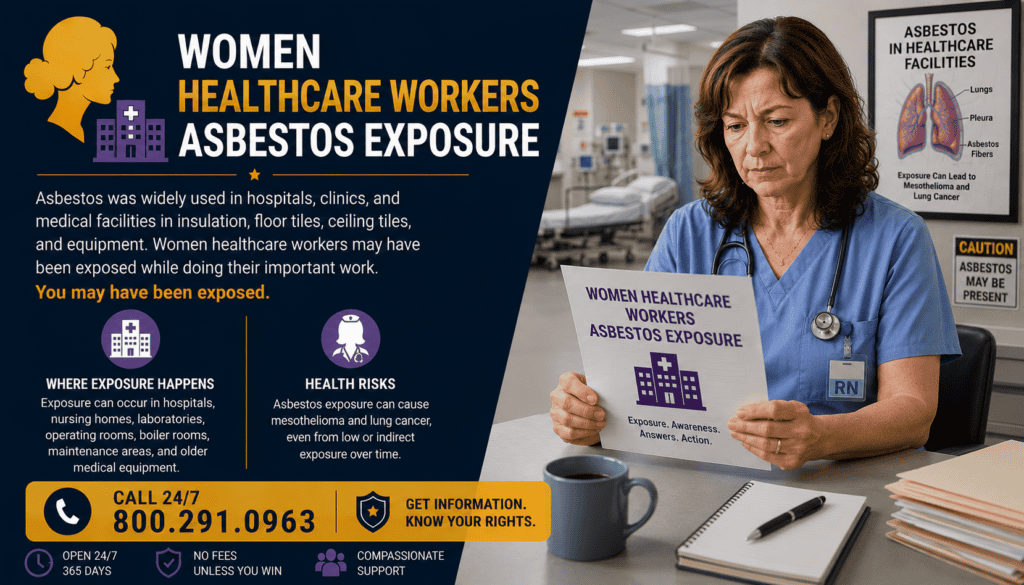
Women Healthcare Workers Asbestos Exposure
Women who worked as nurses, nursing assistants, technicians, therapists, laboratory staff, administrators, housekeepers or other healthcare employees may have spent years in hospitals and medical facilities containing asbestos materials. Healthcare employment alone does not prove asbestos exposure. A meaningful investigation identifies the specific facility, department, work dates, documented asbestos-containing materials and any maintenance, deterioration or renovation that may have disturbed them.
OSHA specifically identifies asbestos as a facilities-management hazard in hospitals and lists potential historical sources including HVAC duct insulation, boiler and pipe insulation, floor and ceiling tile, electrical wiring insulation, wallboard and spackling compounds. Healthcare workers who did not maintain these materials could still have worked near construction or maintenance, but exposure must be evaluated from the actual building conditions and records rather than assumed from occupation alone.
🏥 Women Healthcare Workers: Exposure Overview
OSHA’s hospital safety guidance recognizes asbestos exposure as a facilities-management concern, especially in older buildings and during repairs or renovations. The agency notes that significant exposure can occur when asbestos insulation in old buildings is removed during renovation. This does not establish exposure for every hospital employee; location, timing, material condition and work activity matter.
Start with the Women’s Occupations & Workplace Asbestos Exposure hub. Record each hospital, clinic, medical office or care facility, department, floor, job title, employment dates and known renovation or maintenance periods.
| Question | Details to document |
|---|---|
| Where? | Facility, building, floor, department and work area |
| When? | Employment dates and renovation periods |
| What happened? | Routine work, damage, maintenance or construction |
| What material? | Surveyed ACM, insulation, flooring, ceiling or debris |
🏢 Hospitals, Clinics and Older Healthcare Buildings
Hospitals can include patient-care areas, laboratories, offices, kitchens, laundries, mechanical rooms, utility tunnels and other spaces constructed or renovated at different times. OSHA notes that asbestos can be found in older buildings and identifies numerous hospital building components where it historically may have been used.
See Women Working in Asbestos-Containing Buildings. Useful facility records can include asbestos surveys, operations-and-maintenance records, floor plans, renovation specifications, work orders, laboratory reports and abatement documentation.
| Record | Potential value |
|---|---|
| Asbestos survey | May identify documented ACM and its location |
| Facility O&M file | May document monitoring and maintenance |
| Renovation file | May identify disturbed materials and dates |
| Abatement report | May document removal areas and controls |
🔧 Building Systems and Materials to Investigate
OSHA’s hospital guidance lists HVAC duct insulation, boiler insulation, pipe insulation, cooling towers, floor and ceiling tile, electrical wiring insulation, wallboard and spackling compounds among potential asbestos sources in older healthcare buildings. A particular material should not be identified as asbestos from appearance alone.
The strongest evidence comes from facility surveys, product specifications, laboratory analyses, maintenance records and abatement files that identify the material actually present during the relevant employment period.
| Area/material | Evidence to seek |
|---|---|
| Pipes/boilers | Insulation surveys and maintenance records |
| HVAC systems | Duct-insulation and renovation documentation |
| Floors/ceilings | Material surveys and laboratory records |
| Walls/repairs | Wallboard, compound and project specifications |
👩⚕️ Healthcare Jobs and Work Areas
Potential exposure circumstances depend more on location and activity than on a healthcare title. Nurses or technicians may have worked in patient areas affected by renovation; laboratory employees may have occupied older laboratory buildings; administrative workers may have worked near remodeling; and environmental-services employees may have performed cleanup in affected areas.
For laboratory-specific issues, see Women Laboratory Workers Asbestos Exposure. Document the worker’s normal department as well as temporary assignments, storage areas, utility spaces and construction zones encountered during the workday.
🔨 Renovation, Maintenance and Construction
OSHA notes that hospital maintenance workers and engineers can encounter asbestos while working around insulated boilers, old piping and minor renovations, and that removal of insulation during renovation can create significant exposure. For a healthcare employee who did not perform the construction work, the investigation should determine proximity, timing, containment and whether asbestos-containing material was actually disturbed.
Preserve employee notices, project schedules, contractor names, asbestos surveys, air-monitoring results and abatement records when available. Presence in a hospital during renovation does not by itself prove asbestos exposure.
| Question | Evidence |
|---|---|
| What work occurred? | Pipe, boiler, ceiling, floor, wall or HVAC work |
| Where? | Department, floor and proximity to worker |
| When? | Project dates compared with work schedule |
| Was asbestos identified? | Survey, laboratory, notification or abatement record |
🗂️ Employment and Facility Evidence
Build a chronological employment history connecting the woman with specific healthcare facilities and departments. Preserve personnel files, payroll records, job descriptions, schedules, employee notices, facility directories, coworker names, asbestos surveys, renovation files, work orders, contractor records and abatement reports.
The Mesothelioma Lawsuit Evidence & Documentation hub provides additional record-gathering guidance. Keep firsthand recollections separate from facts verified through facility, project or material records.
🫁 Medical Documentation and Exposure History
The National Cancer Institute identifies asbestos exposure as the major risk factor for mesothelioma and states that asbestos exposure can also cause cancers of the lung, larynx and ovary. NCI explains that asbestos fibers can become airborne when asbestos-containing products are disturbed and that disease can develop many years after exposure.
Use the Women’s Asbestos Diseases hub for focused health information. Medical records establish diagnosis and treatment, while employment and facility records address whether a particular healthcare workplace can be documented as a possible exposure source.
⚖️ Potential Claim Questions
A healthcare-worker claim investigation may examine the employer, facility owner, property manager, renovation contractor, asbestos-product manufacturer, supplier or bankruptcy trust depending on the documented source and governing law. The responsible entity may differ from the hospital or healthcare organization that employed the worker.
Review the Women’s Asbestos Legal Options hub and Mesothelioma Lawsuits in All 50 States. Workers’ compensation, civil claims and asbestos trust claims have different requirements and deadlines. Compensation is not guaranteed.
🛡️ Current Healthcare-Facility Asbestos Safety
OSHA directs healthcare facilities to follow applicable asbestos requirements under the general-industry and construction standards. These rules include exposure limits, assessment or monitoring requirements and controls for regulated asbestos work. Modern controls do not establish what conditions existed decades earlier, so historical records remain important.
Do not disturb pipe insulation, ceiling material, flooring or other suspect material today to investigate an old exposure. Existing facility surveys, laboratory reports, maintenance records and qualified asbestos professionals are safer sources of information.
❓ Frequently Asked Questions
Could women healthcare workers have encountered asbestos?
Potentially, particularly in older facilities where documented asbestos-containing materials were damaged or disturbed during maintenance or renovation. Individual evidence is required.
Does working in an older hospital prove asbestos exposure?
No. Building age is a research clue, not proof that asbestos was present or airborne.
What hospital materials has OSHA identified as potential asbestos sources?
OSHA lists examples including HVAC duct, boiler and pipe insulation, floor and ceiling tile, electrical wiring insulation, wallboard and spackling compounds.
Could hospital renovation be relevant?
Yes. OSHA notes that asbestos exposure can occur during renovations involving old asbestos insulation, but the actual material, location and work conditions must be established.
Do nurses have to handle asbestos directly to investigate possible workplace exposure?
No. A history may involve nearby building work or disturbed materials, but proximity and exposure require supporting evidence.
What records are useful?
Personnel records, department assignments, facility surveys, renovation files, work orders, air-monitoring records, abatement reports and coworker accounts may help.
What if the hospital was remodeled or demolished?
Historical facility records, permits, surveys, contractor files, archived plans and former coworkers may still help reconstruct conditions.
Is compensation guaranteed?
No. Exposure evidence, responsible parties, medical documentation, deadlines and applicable law affect whether a claim is available.
📞 Submit Your Case
If you or a loved one has a mesothelioma diagnosis and a history of healthcare work in an older hospital or medical facility, gather employer names, facility addresses, departments, work dates, renovation history and any known asbestos-management records. Unknown details should remain research leads rather than guesses.
Call 800.291.0963 for a no-obligation case evaluation. Live chat is available 24/7, 365 days a year. Submit your case here.
📝 Summary
Women healthcare workers may have encountered asbestos when documented asbestos-containing materials in hospitals or medical facilities were damaged or disturbed during maintenance, repair or renovation. OSHA specifically recognizes asbestos as a hospital facilities-management hazard. A reliable investigation connects the worker to a specific facility, department, time period and event using employment, facility, project, witness and medical records.
🔗 Confirmed Sources
- OSHA — Hospitals: Facilities Management, Asbestos Exposure
- OSHA — 29 CFR 1910.1001 Asbestos
- U.S. EPA — Information for Owners and Managers of Buildings That Contain Asbestos
- National Cancer Institute — Asbestos Exposure and Cancer Risk
- National Cancer Institute — Mesothelioma Causes and Risk Factors
This page provides general information, not legal or medical advice. This website is not a law firm. Exposure, eligibility, filing deadlines and compensation depend on individual facts and applicable law. No outcome is guaranteed.