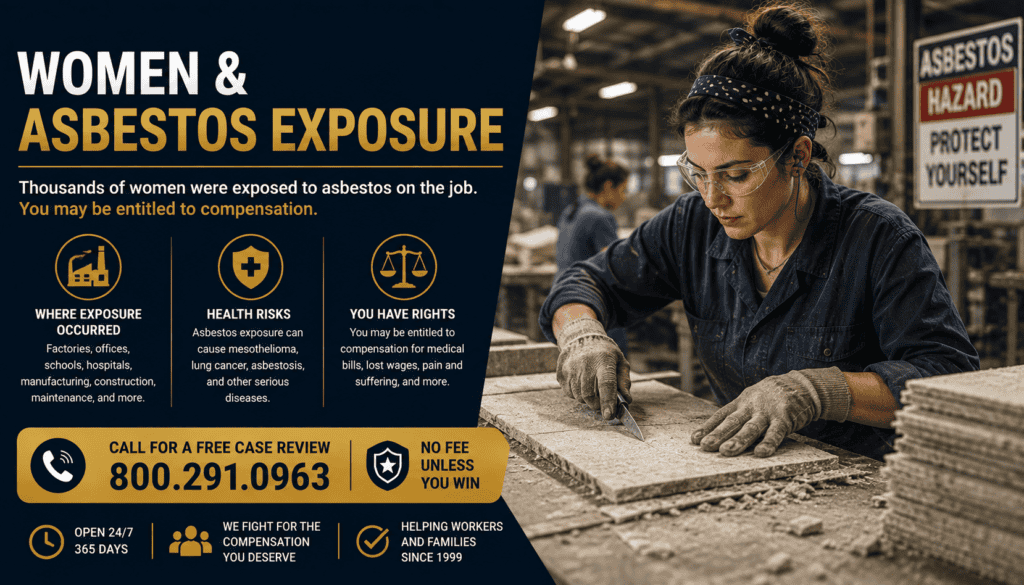
đź‘© Women’s Asbestos Exposure
For decades, asbestos exposure was widely viewed as a workplace hazard affecting men in heavy industry, shipbuilding, manufacturing, and the military. Today, researchers know that millions of women were also exposed to asbestos—often through occupations, household products, contaminated clothing, military family members, schools, hospitals, offices, factories, and consumer products.
Many women diagnosed with mesothelioma, asbestos lung cancer, ovarian cancer associated with asbestos exposure, pleural disease, or other asbestos-related illnesses never worked directly with asbestos insulation or industrial equipment. Instead, exposure frequently occurred through secondhand contact, environmental contamination, older buildings, or occupations not traditionally recognized as high-risk.
This Women’s Asbestos Exposure authority hub explains how women encountered asbestos, the occupations and environments where exposure commonly occurred, the diseases linked to asbestos, and the legal and medical resources available to women and their families.
Whether exposure occurred while working in healthcare, education, manufacturing, laboratories, retail, government offices, military installations, or inside the home, understanding how exposure happened is often the first step toward understanding the health and legal implications.
🎯 What You’ll Learn
This comprehensive guide explains:
- How women were exposed to asbestos
- Occupational exposure risks for women
- Household and secondhand asbestos exposure
- Military family exposure
- Consumer product exposure
- Diseases linked to asbestos exposure in women
- Legal options available after diagnosis
- Resources for women and their families
Throughout this guide you’ll find links to detailed resources covering workplace exposure, military-related exposure, asbestos diseases, consumer products, legal options, and historical asbestos use affecting women.
đź‘· Why Women Were Exposed to Asbestos
For much of the twentieth century, asbestos was used in thousands of commercial, industrial, institutional, and consumer products because it was inexpensive, durable, and resistant to heat and fire.
Although many asbestos regulations focused on industrial occupations dominated by men, women routinely encountered asbestos in many other settings.
Common exposure environments included:
- Schools
- Hospitals
- Medical clinics
- Office buildings
- Retail stores
- Factories
- Laboratories
- Universities
- Government buildings
- Military bases
- Military housing
- Homes
- Apartment buildings
- Commercial buildings
- Textile manufacturing
- Cosmetic products
- Household products
Many women experienced repeated asbestos exposure over years or decades without realizing the danger.
To understand how asbestos exposure evolved over time, see our History of Women’s Asbestos Exposure guide.
🏠Workplace Asbestos Exposure in Women
Women worked in virtually every industry where asbestos-containing materials were present.
Although they were not always directly handling insulation or industrial equipment, many worked in buildings containing asbestos insulation, ceiling tiles, flooring materials, pipe coverings, boilers, heating systems, and fireproof construction products.
Occupations discussed throughout this resource center include:
- Factory workers
- Healthcare workers
- Teachers
- Office workers
- Retail employees
- Laboratory workers
- Custodial workers
- Civilian contractors
- Shipyard personnel
- Port workers
Learn more in our detailed guides:
- Women Factory Workers Asbestos Exposure
- Women Healthcare Workers Asbestos Exposure
- Women Teachers Asbestos Exposure
- Women Office Workers Asbestos Exposure
- Women Retail Workers Asbestos Exposure
- Women Laboratory Workers Asbestos Exposure
- Women Custodial Workers Asbestos Exposure
- Women Working in Asbestos-Containing Buildings
🏠Household & Secondhand Asbestos Exposure
One of the most common ways women encountered asbestos was through household exposure.
For decades, workers unknowingly carried asbestos dust home on work clothing, boots, gloves, jackets, uniforms, and tools. Family members frequently shook out dusty clothing before washing it, exposing themselves to airborne asbestos fibers inside the home.
Women may also have encountered asbestos while:
- Washing contaminated work clothing
- Cleaning work boots
- Sweeping garages
- Cleaning family vehicles
- Renovating older homes
- Handling household insulation
- Living near asbestos-using industries
Learn more:
- Secondhand Asbestos Exposure in Women
- Take-Home Asbestos Exposure in Women
- Household Asbestos Exposure in Women
- Laundry-Related Asbestos Exposure in Women
Military Family Exposure
Military families also experienced asbestos exposure in unique ways.
Women whose spouses served aboard Navy ships, worked in military maintenance facilities, repaired military vehicles, or served on military bases sometimes encountered asbestos fibers brought home on uniforms, boots, equipment, and work clothing.
Other women worked directly on military installations as civilian employees or contractors.
Learn more:
- Military Family Asbestos Exposure in Women
- Women Veterans Asbestos Exposure
- Women Working on Military Bases Asbestos Exposure
- Women Civilian Contractors Asbestos Exposure
🛍️ Consumer Products & Everyday Exposure
Women were also exposed through products used in daily life.
Historically, asbestos has been identified in certain cosmetic products, talcum powder products, household materials, textiles, and hobby products.
Although regulations have changed significantly, historical exposure continues to affect women diagnosed many decades later because asbestos-related diseases often develop after long latency periods.
Learn more:
- Asbestos-Contaminated Talc Exposure in Women
- Makeup and Cosmetic Asbestos Exposure in Women
- Household Product Asbestos Exposure in Women
- Asbestos Exposure from Clothing and Textiles in Women
- Asbestos Exposure from Craft and Hobby Materials in Women
🧬 Health Risks Unique to Women
Women often have different exposure histories than men, which can affect how asbestos-related diseases are recognized and diagnosed.
Many women experienced lower-dose exposures over long periods rather than intense occupational exposure. Even so, asbestos exposure has been associated with serious diseases including mesothelioma, asbestos lung cancer, pleural disease, and ovarian cancer.
Learn more in:
Continue to Part 2, where we’ll explore asbestos-related diseases affecting women, diagnosis, historical manufacturers, legal options, asbestos trust funds, and the documentation that may help women understand their exposure history.
🩺 Diseases Linked to Women’s Asbestos Exposure
Many women who develop asbestos-related diseases have no history of working in heavy industry or traditional asbestos occupations. Instead, exposure often occurred over many years through workplaces, homes, military families, consumer products, or contaminated clothing.
Because asbestos-related diseases usually develop decades after exposure, many women are diagnosed long after they have retired or after the original source of exposure has disappeared.
The most common asbestos-related diseases affecting women include:
- Mesothelioma
- Asbestos lung cancer
- Ovarian cancer associated with asbestos exposure
- Pleural plaques
- Pleural thickening
- Diffuse pleural disease
Although these diseases differ in their symptoms and treatment approaches, they all share one important characteristic—they often have a very long latency period between asbestos exposure and diagnosis.
To learn more about specific diseases, visit:
- Mesothelioma in Women
- Asbestos Lung Cancer in Women
- Ovarian Cancer and Asbestos Exposure
- Pleural Asbestos Disease in Women
- Help for Women Diagnosed with Pleural Disease
🧬 Why Mesothelioma in Women Is Often Diagnosed Later
Mesothelioma has historically been viewed as a disease affecting men because many early studies focused on shipbuilding, manufacturing, mining, and construction occupations.
As a result, women with similar symptoms were sometimes not immediately evaluated for asbestos-related diseases.
Today, physicians recognize that women may develop mesothelioma following:
- Household exposure
- Secondhand exposure
- Military family exposure
- Workplace exposure
- Consumer product exposure
- Environmental exposure
Because symptoms often resemble more common illnesses, women may experience delays before receiving an accurate diagnosis.
Understanding a person’s complete exposure history—including occupational, household, and military-related exposures—can play an important role during the diagnostic process.
⏳ The Long Latency Period of Asbestos Diseases
One of the defining characteristics of asbestos-related diseases is the lengthy time between exposure and diagnosis.
Many women diagnosed today were exposed:
- Twenty years ago
- Thirty years ago
- Forty years ago
- Fifty years ago
- Or even earlier
This long latency period often makes it difficult to connect a current diagnosis with exposures that occurred decades before.
Our Latency Period of Asbestos Diseases in Women explains why asbestos-related diseases frequently remain undetected for many years.
🏠Manufacturers Linked to Women’s Asbestos Exposure
Thousands of asbestos-containing products were manufactured during the twentieth century for use in homes, schools, hospitals, factories, military facilities, commercial buildings, and consumer products.
Many women encountered products manufactured by private companies without realizing those products contained asbestos.
Examples include products used in:
- Building construction
- Pipe insulation
- Heating systems
- Floor tile
- Ceiling materials
- Joint compounds
- Electrical equipment
- Industrial machinery
- Cosmetics
- Talcum powder products
- Household appliances
- Fireproof materials
- Textiles
Learning which manufacturers supplied products used in a particular workplace or building may help women better understand their historical exposure.
Additional information is available in our Manufacturers Linked to Women’s Asbestos Exposure guide.
đź“‹ Documenting Women’s Asbestos Exposure
Many women diagnosed today cannot remember the names of products, manufacturers, or building materials they encountered decades earlier.
Documenting an exposure history often begins by gathering information about:
- Places of employment
- Job duties
- Military family history
- Home renovation projects
- Consumer product use
- School attendance
- Hospital employment
- Building maintenance
- Military housing
- Laundry responsibilities involving contaminated clothing
Supporting documentation may include:
- Employment records
- Personnel files
- Union records
- Medical records
- Pathology reports
- Building records
- Military service records of family members
- Historical product information
Creating a timeline of employment and residential history often helps identify periods when asbestos exposure was most likely.
⚖️ Legal Options Available to Women
Women diagnosed with asbestos-related diseases may wish to learn more about legal options that could be available depending on their individual circumstances.
Potential areas of interest include:
- Civil asbestos lawsuits
- Asbestos bankruptcy trust funds
- Wrongful death claims
- Product liability claims
- Compensation programs
Understanding where exposure occurred is often one of the first steps in evaluating these options.
Learn more in:
- Asbestos Trust Fund Claims for Women
- Wrongful Death Lawsuits for Women’s Asbestos Exposure
- Statute of Limitations for Women’s Asbestos Claims
đź‘© Common Questions Women Ask About Asbestos Exposure
Many women diagnosed with asbestos-related diseases ask similar questions after learning about their condition.
Common questions include:
- How was I exposed if I never worked with asbestos?
- Could my spouse’s work clothing have exposed me?
- Did older schools or hospitals contain asbestos?
- Could cosmetics or talcum powder have contributed?
- Can asbestos exposure cause ovarian cancer?
- Why did my disease appear decades after exposure?
- What documentation should I gather?
- What legal options may be available?
Understanding your complete exposure history often helps answer many of these questions while providing valuable information for physicians and legal professionals.
đź”— Continue Exploring Women’s Asbestos Exposure
Continue your research by visiting these related resources:
Exposure Sources
- History of Women’s Asbestos Exposure
- Health Risks Unique to Women from Asbestos
- Manufacturers Linked to Women’s Asbestos Exposure
- Latency Period of Asbestos Diseases in Women
Diseases
âť“ Frequently Asked Questions About Women’s Asbestos Exposure
Women diagnosed with mesothelioma, asbestos lung cancer, ovarian cancer associated with asbestos exposure, pleural disease, or other asbestos-related illnesses often have many questions about how exposure occurred and what steps they should take next.
Below are answers to some of the most frequently asked questions.
Can women develop mesothelioma even if they never worked in construction or shipyards?
Yes.
Many women diagnosed with mesothelioma never worked in traditional high-risk industrial occupations.
Instead, exposure frequently occurred through:
- Household exposure
- Secondhand exposure
- Military family exposure
- Healthcare employment
- Schools
- Office buildings
- Factories
- Retail stores
- Laboratories
- Older commercial buildings
- Consumer products
Understanding every possible source of exposure often helps explain how asbestos fibers were encountered.
Can washing contaminated work clothes cause asbestos exposure?
Yes.
For many years, workers unknowingly brought asbestos fibers home on clothing, boots, uniforms, gloves, and tools.
Family members often handled contaminated clothing while:
- Sorting laundry
- Shaking out dusty clothing
- Washing uniforms
- Cleaning work boots
- Sweeping laundry rooms
These activities could release asbestos fibers into the air inside the home.
Learn more:
- Laundry-Related Asbestos Exposure in Women
- Take-Home Asbestos Exposure in Women
- Secondhand Asbestos Exposure in Women
Were schools, hospitals, and office buildings common sources of exposure?
Many schools, hospitals, universities, office buildings, and government facilities built before modern asbestos regulations contained asbestos in insulation, floor tiles, ceiling materials, pipe covering, roofing products, and heating systems.
Teachers, nurses, office personnel, laboratory workers, custodians, and administrative staff may have encountered asbestos during routine building maintenance, renovations, or deteriorating building materials.
Learn more:
- Women Teachers Asbestos Exposure
- Women Healthcare Workers Asbestos Exposure
- Women Office Workers Asbestos Exposure
Could cosmetics or talcum powder have contained asbestos?
Some historical cosmetic and talcum powder products have been the subject of asbestos contamination allegations and litigation because talc deposits can occur near naturally occurring asbestos.
Women who regularly used these products over many years sometimes wonder whether they contributed to their exposure history.
Learn more:
Can asbestos exposure increase the risk of ovarian cancer?
Research has found an association between asbestos exposure and ovarian cancer, and asbestos has been classified as a cause of ovarian cancer by major health authorities. Every person’s medical history is unique, so women should discuss their individual diagnosis and risk factors with their healthcare providers.
Learn more in Ovarian Cancer and Asbestos Exposure.
Why are asbestos-related diseases diagnosed decades later?
Asbestos-related diseases often develop very slowly.
Many women diagnosed today experienced asbestos exposure:
- 20 years ago
- 30 years ago
- 40 years ago
- 50 years ago
- Or even longer
This long latency period is one reason exposure is often difficult to recognize until many years later.
Our Latency Period of Asbestos Diseases in Women explains this process in greater detail.
⚠️ Common Misconceptions About Women’s Asbestos Exposure
Many misconceptions continue to surround asbestos exposure in women.
Myth: Only men develop asbestos-related diseases.
Fact: Women have developed mesothelioma, asbestos lung cancer, ovarian cancer associated with asbestos exposure, pleural disease, and other asbestos-related illnesses through occupational, household, environmental, military family, and consumer product exposure.
Myth: Women must have worked directly with insulation to be exposed.
Fact: Many women encountered asbestos while working in schools, hospitals, factories, laboratories, offices, military facilities, or by handling contaminated clothing brought home by family members.
Myth: Household exposure is not dangerous.
Fact: Repeated household exposure over many years has been documented in women who regularly handled contaminated work clothing or lived with someone working around asbestos.
Myth: Consumer products never contained asbestos.
Fact: Certain historical talc-based cosmetic products, household materials, textiles, and other products have been the subject of asbestos contamination concerns and litigation.
Myth: It is impossible to identify asbestos exposure decades later.
Fact: Employment records, military records, residential history, building information, product research, and medical documentation often help reconstruct historical exposure.
📚 Related Women’s Asbestos Resources
Continue learning through our Women’s Mesothelioma authority library.
Household & Secondary Exposure
- Secondhand Asbestos Exposure in Women
- Household Asbestos Exposure in Women
- Laundry-Related Asbestos Exposure in Women
- Take-Home Asbestos Exposure in Women
- Military Family Asbestos Exposure in Women
Workplace Exposure
- Women Factory Workers Asbestos Exposure
- Women Healthcare Workers Asbestos Exposure
- Women Teachers Asbestos Exposure
- Women Office Workers Asbestos Exposure
- Women Working in Asbestos-Containing Buildings
Diseases & Legal Resources
- Mesothelioma in Women
- Asbestos Lung Cancer in Women
- Ovarian Cancer and Asbestos Exposure
- Pleural Asbestos Disease in Women
- Asbestos Trust Fund Claims for Women
- Statute of Limitations for Women’s Asbestos Claims
- Wrongful Death Lawsuits for Women’s Asbestos Exposure
đź§ What You Should Do Next
If you or someone you love has been diagnosed with mesothelioma, asbestos lung cancer, ovarian cancer associated with asbestos exposure, pleural disease, or another asbestos-related illness, taking a few practical steps now can help you better understand your exposure history and available resources.
- Create a timeline of your employment, residences, schools attended, and any military family history.
- Gather medical records, pathology reports, imaging studies, and other documentation related to your diagnosis.
- Think about potential sources of exposure, including workplaces, older buildings, consumer products, household exposure, and military family exposure.
- Review the detailed Women’s Asbestos Exposure resources throughout this website to identify occupations, products, or environments that may apply to your situation.
- Learn about available medical care, asbestos trust funds, legal options, and other resources that may be available based on your individual circumstances.
- Preserve employment records, military records of family members (if applicable), and other historical documents that may help establish an exposure history.
Understanding where, when, and how asbestos exposure occurred is often the first step toward making informed medical, legal, and financial decisions.
If you have questions about women’s asbestos exposure, asbestos-related diseases, or available resources, call 📞 800.291.0963 or complete the form below to learn more.