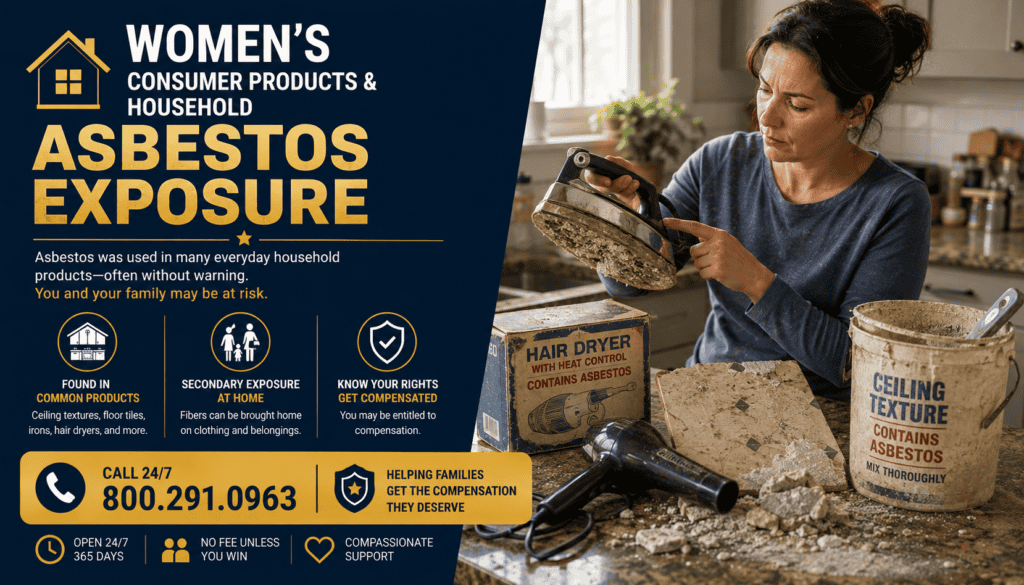
Women’s Consumer Products & Household Asbestos Exposure
Women may have encountered asbestos outside traditionally recognized industrial jobs. Historical exposure can involve older household building materials, certain consumer products, home renovation activities, family members who carried workplace dust home, or a combination of pathways. For a mesothelioma claim, identifying the specific source, time period, product or activity is more useful than assuming exposure occurred simply because asbestos was historically common.
The U.S. Environmental Protection Agency (EPA) identifies historical asbestos uses in floor tiles, roofing, insulation, cement products, heat-resistant fabrics, gaskets, coatings and other manufactured materials. Exposure generally becomes a concern when asbestos-containing material is damaged or disturbed and fibers become airborne.
🏠 Understanding Household Asbestos Exposure
Household exposure can refer to asbestos already present in a home, asbestos-containing products used or handled there, or fibers transported into the home from another location.
Presence Is Different From Exposure
The presence of an asbestos-containing material does not establish that a person inhaled asbestos fibers. EPA states that material in good condition and left undisturbed is unlikely to present a health risk. Disturbance, deterioration, cutting, sanding, drilling, scraping or improper removal can release fibers.
Exposure Histories Can Have Multiple Sources
A woman diagnosed with mesothelioma may have had occupational, household, take-home, environmental or other exposure. A careful investigation should evaluate each plausible pathway separately and avoid assuming one source without evidence.
Latency Can Complicate Reconstruction
Because mesothelioma can develop many years after asbestos exposure, historical residences, renovations, family occupations and product use may need to be reconstructed from old records and witness memories.
📦 Consumer Products & Materials
Asbestos was historically incorporated into numerous manufactured goods because of its heat resistance and fiber strength. The relevant question in an individual case is whether the particular product, formulation and time period involved asbestos and whether its use created an exposure pathway.
| Historical category | Examples identified by EPA |
|---|---|
| Flooring | Vinyl floor tile, sheet-flooring backing and adhesives |
| Heat-resistant materials | Fabrics, stove-area materials and some insulation |
| Home construction | Roofing, siding, cement products and some wall/ceiling materials |
| Mechanical materials | Pipe insulation, furnace insulation and gaskets |
| Friction products | Automotive brakes, clutches and transmission components |
Do Not Identify Asbestos by Appearance
EPA cautions that a person generally cannot determine whether material contains asbestos simply by looking at it. Historical product identification may require labels, manufacturer information, records or laboratory analysis by qualified professionals.
Product Versions Can Change
A brand name alone is not enough to establish asbestos content. Formulations can change over time, so the relevant product and date should be investigated.
🔨 Asbestos in Older Homes
Older homes can contain legacy asbestos materials that remain in place long after their original installation.
Renovation and Remodeling
Activities such as sanding flooring, removing old insulation, cutting cement products or disturbing wall and ceiling materials can release fibers when those materials contain asbestos.
Routine Cleaning Can Spread Dust
EPA advises against dusting, sweeping or vacuuming debris that may contain asbestos. Improper cleanup can redistribute fibers rather than safely contain them.
Undamaged Material May Be Better Left Alone
EPA generally recommends leaving suspect asbestos-containing material alone when it is in good condition and will not be disturbed.
DIY Sampling Is Not Recommended
EPA recommends that suspect materials requiring testing be sampled by a properly trained and accredited asbestos professional because incorrect sampling can increase exposure.
👕 Take-Home & Secondary Exposure
Another historical pathway is take-home exposure from a family member’s occupation. Workplace contaminants can travel on clothing, shoes, skin, hair, tools or personal items and enter vehicles and homes.
Work Clothing
Family members who shook out, handled or laundered contaminated work clothing may have encountered dust brought home from industrial jobs.
Vehicles and Living Areas
Contamination carried from work can settle in cars, floors, furniture and other household areas. CDC/NIOSH recognizes take-home exposure as a pathway through which workplace contaminants can reach family members.
The Worker’s Job Helps Identify the Source
Employment records, union records, military records, coworker testimony and job descriptions may help determine whether the worker handled asbestos-containing materials.
See Legal Options After Secondary Household Asbestos Exposure.
👩 Why Women’s Exposure May Be Overlooked
An exposure investigation focused only on heavy industrial employment can miss household and secondary pathways. The goal should be to reconstruct the individual’s actual history rather than rely on assumptions about gender or occupation.
Household Tasks May Provide Clues
Historical laundering, cleaning, home repair, flooring work or handling heat-resistant household materials may be relevant when evidence shows asbestos-containing materials were involved.
Women Also Had Occupational Exposure
Household exposure should not overshadow a woman’s own employment history. Manufacturing, healthcare facilities, schools, offices, laboratories, textile operations and other older buildings or workplaces may also require investigation depending on the facts.
More Than One Pathway Can Exist
A person may have had both workplace and household exposure. Each alleged source should be supported independently where possible.
📂 Documenting Historical Exposure
A strong historical investigation separates confirmed facts from possibilities and looks for evidence connecting the person, product or source, place and time period.
| Evidence | What it may help establish |
|---|---|
| Residence records | Where and when the person lived |
| Renovation records | Work performed and materials disturbed |
| Receipts/catalogs | Potential product identity and purchase period |
| Photographs | Historical rooms, materials, packaging or work clothing |
| Family testimony | Household routines and firsthand observations |
| Worker employment records | Potential source of take-home contamination |
| Manufacturer records | Product formulation and asbestos-content history |
Build a Residence Timeline
List homes, apartments and other residences with approximate dates. Note major renovations, flooring replacement, insulation work or other disturbances.
Build a Family Work-History Timeline
Record household members’ employers, jobs, facilities, trades and work clothing practices during the relevant years.
Preserve Original Records
Keep photographs, receipts, correspondence and other originals when available. Do not disturb suspected asbestos material merely to create evidence.
⚖️ Lawsuits & Potential Liability
Legal responsibility for household or consumer-product exposure depends on the jurisdiction and evidence. Potential issues can include product identification, exposure, duty, warnings, causation, corporate history and applicable filing deadlines.
Product Claims
A product-related claim generally requires evidence connecting the relevant product or defendant to the alleged exposure. A product found in the same home is not automatically proof that it caused the exposure at issue.
Take-Home Exposure Claims
Secondary-exposure law varies by state. Courts may differ on which defendants can owe duties to household members and what proof is required.
Multiple Potential Defendants
Historical exposure may involve products from several manufacturers or more than one exposure setting. Liability should be evaluated defendant by defendant.
Deadlines Vary
Statutes of limitation and other filing rules differ by jurisdiction and claim type. A diagnosis, death or other event can affect when deadlines are calculated under applicable law.
Explore Women’s Mesothelioma Lawsuits.
🛡️ What to Do About Suspected Asbestos
Do not disturb a household material simply to determine whether it contains asbestos. Disturbance can create the exposure that safe management is intended to prevent.
Leave Undamaged Material Alone
EPA advises that asbestos-containing material in good condition and unlikely to be disturbed generally should be left alone.
Use Qualified Professionals
If material is damaged or a renovation will disturb it, EPA recommends evaluation by trained and accredited asbestos professionals.
Do Not Sweep or Vacuum Suspect Debris
EPA specifically cautions against ordinary dusting, sweeping or vacuuming of debris that may contain asbestos.
Preserve Information Without Collecting Material Yourself
Photographs taken from a safe distance, property records, renovation documents and professional inspection reports can preserve useful information without unnecessary disturbance.
❓ Frequently Asked Questions
Could women have been exposed to asbestos without working in an asbestos trade?
Yes. Potential pathways include household building materials, historical products, home renovation and asbestos carried home by another worker.
Can you tell whether household material contains asbestos by looking at it?
Generally no. EPA says visual inspection alone cannot reliably identify asbestos content.
Are undamaged asbestos materials dangerous simply because they are present?
EPA states that materials in good condition and left undisturbed are unlikely to present a health risk.
Can laundering a worker’s clothing be relevant?
Potentially. Take-home contaminants can travel on work clothing, and historical laundering practices may be relevant to a secondary-exposure investigation.
Does an old product name prove it contained asbestos?
No. Product formulation and time period should be verified with reliable evidence.
Should I collect a sample myself?
EPA recommends against homeowner sampling of suspected asbestos and advises using trained and accredited professionals when testing is warranted.
Can renovation disturb asbestos?
Yes. Cutting, sanding, drilling, scraping or removing asbestos-containing material can release fibers.
Can household exposure support a mesothelioma lawsuit?
Potentially, depending on the evidence and governing law. Exposure source, product or defendant identification, causation and deadlines must be evaluated for the individual case.
Can there be more than one exposure source?
Yes. Occupational, household, secondary and environmental pathways can overlap and should be investigated separately.
What records should families preserve?
Residence histories, employment records, photographs, renovation documents, receipts, product information and witness contact information may all be useful.
📞 Request a Case Evaluation
If a woman diagnosed with mesothelioma may have encountered asbestos through household materials, consumer products, renovation or take-home exposure, reconstructing the history early can help identify records and witnesses that still exist.
Call 800.291.0963 for a no-obligation case evaluation and to talk to a real person 24/7, 365 days a year. Many mesothelioma law firms handle qualifying cases on a contingency-fee basis; confirm the terms with the firm you retain. Submit your case here.
📝 Summary
Women’s asbestos exposure can involve more than traditional industrial employment. Older household materials, historical consumer products, renovation and asbestos carried home from another person’s workplace can all be relevant pathways. A reliable case investigation identifies the actual material or product, time period, activity and defendant-specific evidence while avoiding assumptions about asbestos content or exposure.
🔗 Confirmed Sources
- U.S. EPA — Learn About Asbestos
- U.S. EPA — Protect Your Family from Exposures to Asbestos
- U.S. EPA — Asbestos and Home Remodeling
- CDC/NIOSH — About Take-Home Exposures
Disclaimer: General information only—not legal or medical advice. This website is not a law firm. Exposure, liability and deadlines vary by case and jurisdiction. Do not disturb suspected asbestos. Past results do not guarantee future outcomes.