⚓ Battleships Propulsion & Turret Lagging Exposure
(USS New Jersey, USS Missouri): Propulsion & Turret Lagging Exposure
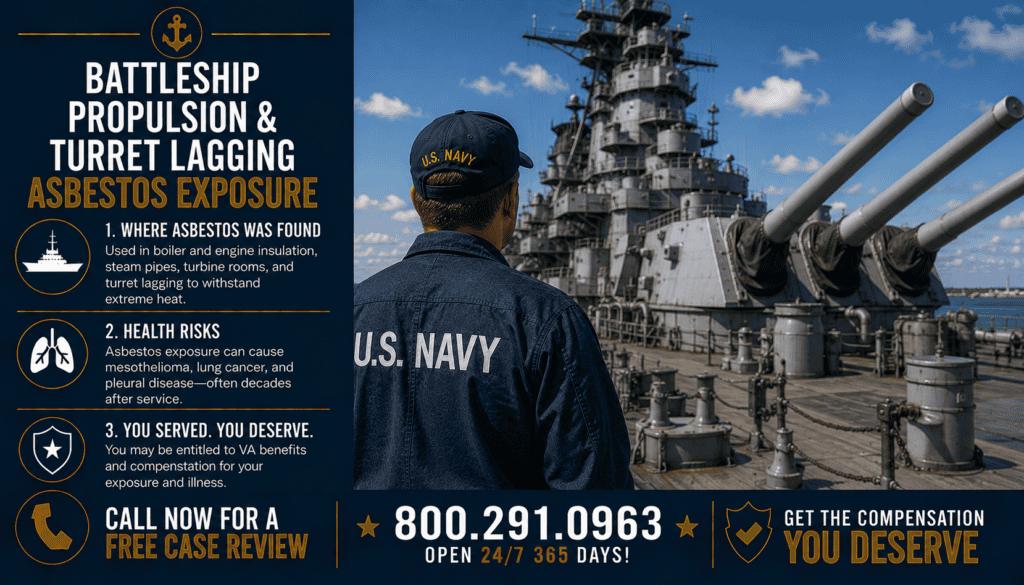
The great battleships of the U.S. Navy—especially the USS New Jersey (BB-62) and USS Missouri (BB-63)—stand as icons of American sea power. Yet below their steel decks lay a hidden danger: asbestos insulation used extensively throughout propulsion systems, gun turrets, and living spaces. From World War II through the Gulf War era, sailors, shipyard workers, and mechanics aboard these vessels were unknowingly exposed to deadly asbestos fibers that still cause illness decades later.
This guide details where asbestos was found aboard these battleships, who was most at risk, and how veterans can file VA disability, trust-fund, and civil claims for mesothelioma and related diseases.
📞 Need help proving exposure aboard a Navy battleship? Call 800.291.0963 for free assistance today.
🧭 Step 1: Asbestos Use Aboard U.S. Battleships
Battleships required immense heat resistance to manage high-pressure propulsion systems and gun turrets.
Common asbestos-containing components:
-
⚙️ Boiler and engine-room insulation (lagging, pipe wrap).
-
🧱 Turbine and steam-line gaskets and packing.
-
💨 Ventilation ducts and exhaust manifolds.
-
🔩 Fireproof bulkheads and deck panels near ammunition magazines.
-
🪖 Gun-turret recoil chambers and powder-handling rooms lined with heat-resistant asbestos.
Goal: Understand how asbestos was integrated throughout propulsion and combat systems.
📁 Step 2: Ships and Service Periods Most Affected
USS New Jersey (BB-62) and USS Missouri (BB-63) both saw multiple combat deployments and overhauls involving asbestos.
Key exposure eras:
-
⚓ WWII service (1943-1945): Original construction with heavy lagging and gasket materials.
-
⚙️ Korean War (1950-1953): Refit at Navy yards disturbed aging asbestos.
-
🧱 Vietnam era (1967-1969): Steam-system replacements released fiber dust.
-
🔩 1980s reactivation: Modernization at Long Beach and Philadelphia Naval Shipyards included asbestos removal but exposed crews during abatement.
Goal: Identify which commissioning or overhaul period aligns with your service.
🏗️ Step 3: Who Was Exposed
Nearly every engineering, gunnery, and maintenance rate encountered asbestos aboard.
Highest-risk groups:
-
🧰 Boiler Technicians (BT) and Machinist’s Mates (MM) working propulsion.
-
⚙️ Hull Maintenance Technicians (HT), welders, and pipefitters.
-
🧱 Gunner’s Mates (GM) servicing turrets and powder magazines.
-
💡 Electrician’s Mates (EM) maintaining insulated control systems.
-
🧾 Civilian shipyard and contractor personnel during overhauls.
Goal: Match your Navy rating to documented asbestos zones.
💼 Step 4: How Exposure Happened
Daily work and modernization projects released invisible asbestos fibers.
Typical exposure scenarios:
-
🔧 Removing or replacing turbine and pump gaskets.
-
💨 Cleaning soot and debris from boiler spaces.
-
🧱 Chipping or grinding lagging during system maintenance.
-
⚙️ Overhauling gun turrets lined with asbestos pads and seals.
-
🧾 Working in confined engine compartments with poor ventilation.
Goal: Document tasks or maintenance logs proving direct fiber exposure.
🩺 Step 5: Health Risks for Battleship Personnel
Asbestos exposure aboard battleships leads to severe diseases decades later.
Common diagnoses:
-
💀 Pleural or peritoneal mesothelioma.
-
🫁 Asbestosis and restrictive lung disease.
-
💬 Pleural plaques and effusions.
-
🩺 Lung, throat, and gastrointestinal cancers.
Goal: Seek early screening and maintain complete medical documentation.
⚖️ Step 6: VA Disability Benefits for Battleship Veterans
Veterans diagnosed with asbestos-related illnesses are eligible for 100% VA disability compensation.
Available benefits:
-
💰 Tax-free monthly payments.
-
🏥 Specialized VA mesothelioma care and travel reimbursement.
-
🕊️ DIC benefits for surviving family members.
-
⚖️ Ability to pursue additional asbestos trust-fund and civil claims.
Goal: File coordinated VA and trust-fund claims for maximum recovery.
🧱 Step 7: Civilian Shipyard & Contractor Exposure
Shipyard employees who built or refitted the battleships were also exposed.
Eligible claimants include:
-
⚙️ Workers from Philadelphia, Norfolk, Long Beach, and Pearl Harbor shipyards.
-
💵 Asbestos trust-fund beneficiaries (over $32 billion available).
-
🧾 SSDI and workers’-comp recipients.
-
🕊️ Families filing wrongful-death claims.
Goal: Combine employment and naval service records in one case file.
🧠 Step 8: Evidence That Strengthens Battleship Claims
Useful documentation:
-
🧾 Navy service records or deck logs showing assignment aboard BB-62 or BB-63.
-
⚙️ Maintenance and modernization reports.
-
💬 “Buddy statements” confirming engine-room or turret work.
-
🧱 Shipyard abatement and environmental records.
Goal: Prove both exposure history and medical causation.
🌈 Step 9: Decommissioning & Museum Conversion
USS New Jersey (Camden, NJ) and USS Missouri (Pearl Harbor, HI) are now museum ships.
Abatement timeline:
-
🏗️ Asbestos removed during late-1980s deactivations.
-
⚙️ Ongoing environmental monitoring under EPA and Navy supervision.
-
🧾 Public abatement reports confirming prior asbestos presence.
Goal: Use museum or EPA records to verify exposure legacy.
💬 Step 10: Filing Your Claim
Next steps:
-
🧭 Confirm your service aboard BB-62, BB-63, or similar battleships.
-
⚙️ Collect medical and diagnostic evidence.
-
🧾 File VA, trust-fund, and civil claims together.
-
📞 Call 800.291.0963 for free claim preparation and review.
Goal: Preserve your right to full compensation before time limits expire.
🤝 Where to Get Help
Our advocates assist battleship veterans and shipyard workers nationwide in filing asbestos claims.
📞 Call 800.291.0963 to begin your case today.
🧭 Summary
The USS New Jersey and USS Missouri represent proud naval history—but also tragic asbestos exposure for thousands who served aboard them. From propulsion spaces to turret compartments, asbestos insulation protected steel but endangered lives. Veterans diagnosed with mesothelioma or other asbestos-related diseases can receive VA disability, trust-fund, and civil compensation.
Your service deserves justice.
800.291.0963