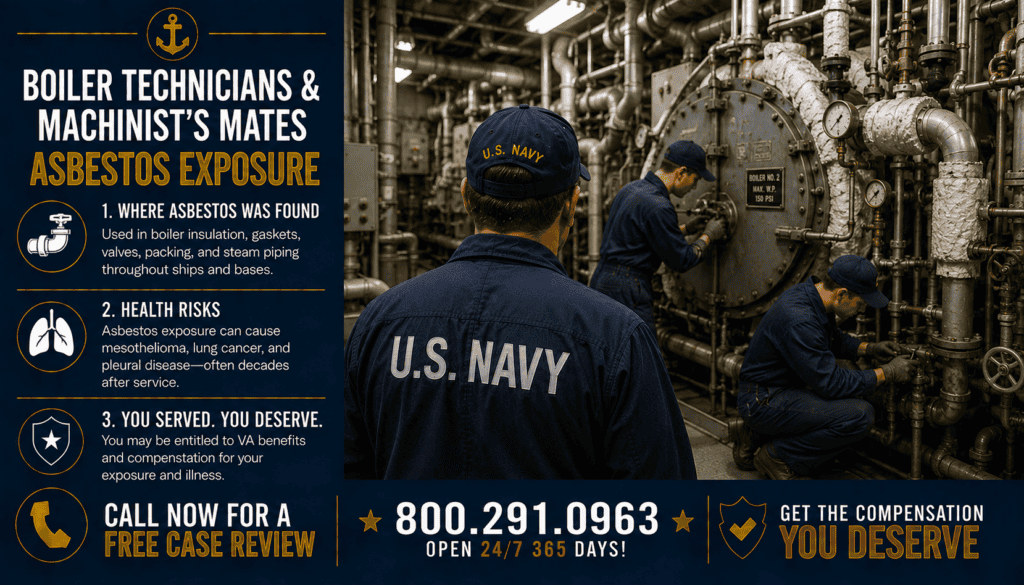
⚓ Boiler Technicians & Machinist’s Mates
Inside the Hottest Workspaces — Navy’s Asbestos Exposure Legacy
For decades, Navy boiler rooms were the most intense, dangerous environments on any ship.
Temperatures regularly exceeded 100°F, steam lines hissed under pressure, and the air was thick with asbestos dust.
Boiler Technicians (BTs) and Machinist’s Mates (MMs) worked shoulder-to-shoulder inside these confined spaces to keep engines running — unaware that every gasket, pipe wrap, and insulation panel around them was made of asbestos.
These hardworking sailors powered the fleet but also inhaled millions of asbestos fibers that now cause mesothelioma, asbestosis, and lung cancer decades later.
📞 If you served as a Navy Boiler Technician or Machinist’s Mate before 1990, call 800.291.0963 for free veteran asbestos claim assistance and exposure verification.
🧭 Step 1 – Why Asbestos Was Used in Navy Boiler Rooms
During World War II and the Cold War, ship designers needed insulation that could survive extreme heat and pressure.
Asbestos became the standard material across every Navy vessel — from aircraft carriers to destroyers.
Reasons for asbestos use:
-
🔥 Withstood temperatures above 1,200°F.
-
⚙️ Prevented fires and insulated superheated steam lines.
-
🧱 Reduced noise and vibration in engine rooms.
-
💨 Protected machinery and bulkheads from heat damage.
Unfortunately, this same mineral shed microscopic fibers that remained airborne for hours, filling engine and boiler compartments with invisible danger.
Goal: Understand that asbestos was considered essential for ship safety — until decades later, when its deadly health effects became undeniable.
⚙️ Step 2 – Where Asbestos Was Found in Navy Boiler Rooms
Boiler Technicians and Machinist’s Mates constantly worked in close contact with asbestos materials.
Almost every surface and component in a Navy boiler room contained asbestos.
Common asbestos sources:
-
🧾 Pipe insulation and lagging wraps.
-
⚙️ Boiler gaskets, seals, and refractory brick.
-
💨 Steam valves, pumps, and flanges.
-
🧱 Turbine casings and exhaust manifolds.
-
🧰 Deck tiles, bulkhead panels, and adhesive cement.
-
🔩 Protective gloves and heat-resistant blankets.
Goal: Recognize that asbestos exposure in boiler rooms was continuous — not occasional — and affected every crew member inside.
🪖 Step 3 – Daily Duties That Released Asbestos Fibers
Boiler Technicians and Machinist’s Mates worked long shifts maintaining high-pressure systems, often performing maintenance without protective gear.
Tasks that caused exposure:
-
⚙️ Scraping or removing worn gaskets from valves and flanges.
-
💨 Cutting or applying new asbestos pipe insulation.
-
🧾 Mixing asbestos cement for sealing joints.
-
🧰 Repacking pumps and compressors with asbestos rope.
-
🧱 Cleaning boiler tubes with air hoses or wire brushes.
Goal: Understand that routine maintenance spread asbestos fibers through confined compartments where ventilation was poor and temperatures were high.
🧾 Step 4 – Types of Ships and Shipyards Affected
Asbestos-filled boiler systems existed on nearly every type of Navy vessel built between the 1930s and 1980s.
High-risk ship classes:
-
⚓ Aircraft Carriers (e.g., USS Enterprise, USS Midway).
-
🚢 Destroyers and Frigates (e.g., USS Fletcher, USS Perry).
-
🛳️ Cruisers and Battleships (e.g., USS Missouri, USS Iowa).
-
🛠️ Submarines and Auxiliary Ships (e.g., tenders, oilers, and repair vessels).
Major shipyards with heavy asbestos use:
-
🏭 Norfolk Naval Shipyard (VA)
-
⚙️ Puget Sound Naval Shipyard (WA)
-
💨 Brooklyn Navy Yard (NY)
-
🧱 Long Beach Naval Shipyard (CA)
-
🛠️ Portsmouth Naval Shipyard (NH)
Goal: Identify where your exposure occurred — whether aboard ship or during overhauls at asbestos-contaminated shipyards.
🩺 Step 5 – Health Risks From Boiler Room Asbestos Exposure
Navy boiler rooms created perfect conditions for asbestos inhalation — high heat, vibration, and poor airflow.
Every breath carried a hidden risk.
Diseases linked to exposure:
-
🫁 Mesothelioma: Cancer of the lung or abdominal lining, unique to asbestos exposure.
-
💨 Asbestosis: Lung scarring that causes chronic breathlessness.
-
🩺 Lung Cancer: Significantly increased risk for smokers.
-
🧠 Pleural Plaques: Thickening of lung membranes visible on X-rays.
Goal: Veterans with any of these conditions should seek immediate medical and legal support, even decades after discharge.
🧰 Step 6 – VA Recognition of Boiler Technician and Machinist’s Mate Exposure
The Department of Veterans Affairs (VA) officially recognizes Boiler Technicians (BT) and Machinist’s Mates (MM) as high-risk occupations for asbestos exposure.
These ratings are listed in the VA’s internal Asbestos Job Exposure Matrix (AJEM) used for disability claims.
VA documentation includes:
-
🧾 M21-1 Adjudication Manual (Part IV, Subpart ii, Chapter 2, Section C).
-
⚙️ MOS ratings confirming “High Probability” of exposure.
-
💬 VA medical opinions linking mesothelioma to boiler-room duties.
-
🏛️ Established latency periods (10–45 years after exposure).
Goal: Strengthen your VA claim by citing official documentation recognizing these jobs as asbestos-related.
💼 Step 7 – Evidence Needed to File a VA Claim
Filing a VA asbestos-related claim requires clear documentation of your service, exposure, and medical diagnosis.
Key evidence includes:
-
🪖 DD214 showing Navy service dates and MOS (BT or MM).
-
🧾 Ship assignment or shipyard work records.
-
💨 Medical diagnosis of mesothelioma, asbestosis, or lung cancer.
-
🧱 Statements from shipmates confirming work in boiler or engine rooms.
-
⚙️ VA medical opinions linking your illness to in-service asbestos exposure.
Goal: Build a claim package that connects your duties directly to recognized asbestos sources aboard Navy vessels.
💬 Step 8 – Filing a Civil Asbestos Lawsuit Alongside VA Benefits
Veterans cannot sue the U.S. government for asbestos exposure, but they can pursue claims against private manufacturers who made asbestos products used by the Navy.
Common asbestos product suppliers:
-
⚙️ Johns-Manville (pipe insulation and cement).
-
💨 Garlock Sealing Technologies (valve gaskets and packing).
-
🧾 Owens-Corning and Unarco (boiler insulation).
-
🧰 Eagle-Picher and Armstrong (heat insulation and adhesives).
-
🪖 Foster Wheeler, Babcock & Wilcox (asbestos-lined boilers).
Goal: Work with an asbestos attorney who can pursue compensation from these companies without affecting your VA benefits.
🧱 Step 9 – Compensation Options for Affected Veterans and Families
Boiler Technicians and Machinist’s Mates exposed to asbestos may qualify for multiple forms of financial recovery.
Compensation programs:
-
⚖️ VA Disability Compensation: Monthly tax-free benefit for service-connected illness.
-
💵 Asbestos Bankruptcy Trust Funds: Over $30 billion available for victims.
-
🧾 Civil Lawsuits: Hold manufacturers accountable for negligence.
-
🕊️ Dependency and Indemnity Compensation (DIC): Support for surviving spouses.
Goal: Secure both VA and private compensation to cover treatment, loss of income, and family care.
🤝 Step 10 – How Experienced Attorneys and VSOs Can Help
Coordinating both VA benefits and civil compensation requires expertise in military occupational exposure.
A qualified team will:
-
🧾 Gather service records and ship logs proving asbestos exposure.
-
⚙️ Coordinate with VA-approved physicians for nexus letters.
-
🩺 File trust-fund and court claims while preserving VA eligibility.
-
🏛️ Represent families in wrongful-death claims if a veteran has passed away.
Goal: Partner with experienced advocates who specialize in asbestos exposure among Navy personnel.
🌈 Summary
Boiler Technicians and Machinist’s Mates served in the heart of America’s Navy fleet — powering ships, keeping engines running, and protecting their crews.
But inside those sweltering boiler rooms, asbestos dust filled the air, silently endangering their health for years to come.
Today, both the VA and legal system recognize these sailors’ service and sacrifice.
📞 Call 800.291.0963 today for free help verifying Navy asbestos exposure, gathering claim evidence, and filing for VA or private compensation.