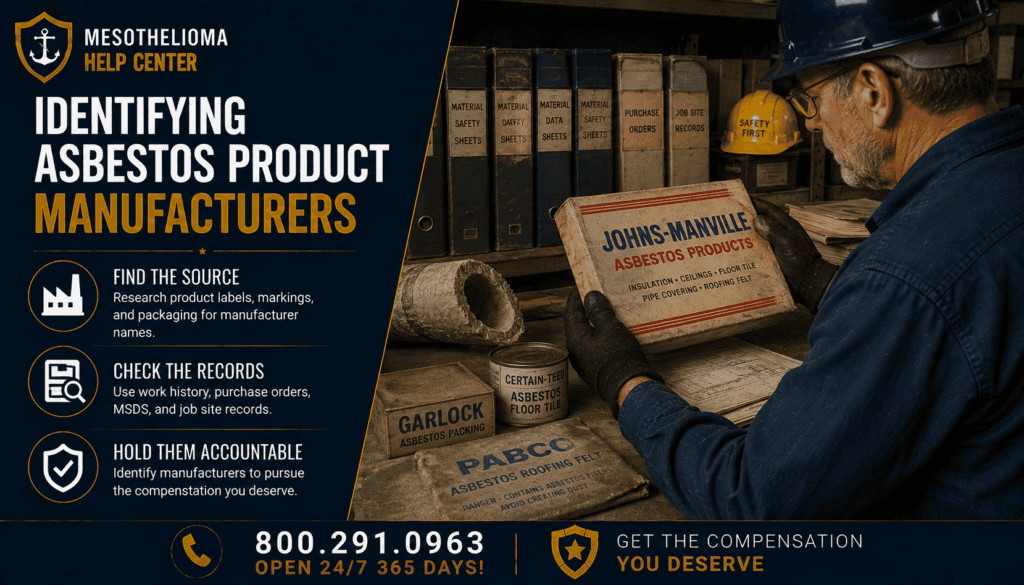
Identifying Asbestos Product Manufacturers from Service Records
Military, government and employment service records can help narrow the products and equipment a person may have worked around decades ago. These records may identify duty stations, units, job specialties, ships, facilities, assignments, maintenance duties or equipment that can then be compared with historical manufacturer and procurement records.
A service record usually does not name every asbestos-containing product present at a workplace, and it does not by itself prove asbestos exposure. The strongest research combines service records with equipment records, purchasing documents, manufacturer catalogs, maintenance histories, photographs and witness statements.
For broader research guidance, see Product Research, Identification & Legal Resources for Asbestos Exposure and the main Asbestos Exposure in Products guide.
How Service Records Can Support Product Identification
Service records can establish where a person served, what work they were assigned to perform and which units, departments or facilities they were connected with. Those facts can help researchers narrow the equipment and products that were likely present during the relevant period.
For example, a record showing assignment to an engine room, maintenance shop, communications section, vehicle unit or boiler facility can direct research toward different product categories and manufacturers.
The record is a starting point. Additional evidence is usually needed to identify the specific product and determine whether a historical version contained asbestos.
Types of Service and Employment Records to Review
Potentially useful records may include:
- personnel files and assignment histories;
- military occupational specialty or rating records;
- unit, ship or facility assignments;
- training and qualification records;
- maintenance logs and work orders;
- equipment inventories and technical manuals;
- procurement and purchasing records;
- inspection and repair records;
- employment and union records;
- payroll or timekeeping records;
- facility engineering records; and
- photographs or archived workplace documents.
Different records answer different questions, so multiple sources may be needed to reconstruct a product history.
Connecting Duties to Equipment and Products
Job duties can help identify the types of products most likely to have been encountered. A mechanic may have worked with brakes, clutches, gaskets and engine components, while an electrician may have worked around wiring, electrical panels, arc chutes or heat-resistant electrical materials.
Similarly, boiler or machinery work may direct research toward machinery products, while pipe, pump and valve work may point toward industrial components and sealing products. Electrical duties may warrant review of electrical and communications products, and insulation work may require review of insulation products.
Duty descriptions should not be treated as proof that a particular asbestos product was present. Product-specific documentation is still needed.
How Records Can Narrow Possible Manufacturers
Once the equipment, facility or product type is known, researchers can compare the service period with historical manufacturer records.
Useful manufacturer-identification sources may include:
- equipment nameplates and model numbers;
- technical manuals and illustrated parts lists;
- procurement specifications;
- purchase orders and invoices;
- supplier records;
- manufacturer catalogs;
- replacement-parts records;
- maintenance bulletins; and
- historical photographs showing labels or packaging.
A manufacturer may have produced both asbestos and non-asbestos versions of similar products. Model, formulation and year can be critical.
Corroborating Product Identity with Other Evidence
Service records are most useful when they can be corroborated with independent evidence.
Corroborating evidence may include:
- coworker or supervisor statements;
- facility asbestos surveys;
- ship or plant engineering records;
- maintenance and repair documents;
- archived product catalogs;
- invoices and purchasing records;
- photos of products or equipment;
- packaging or labels; and
- laboratory analysis of surviving material where appropriate.
Consistent evidence from several sources can strengthen product identification, while conflicting records should be reviewed carefully rather than forced into a conclusion.
Connecting Product Identity to Actual Exposure
Identifying a product manufacturer is only part of an exposure investigation. The next question is whether the person actually worked with or near the asbestos-containing material in a way that could release fibers.
Relevant details include whether the material was cut, sanded, drilled, scraped, removed, ground, broken, deteriorated or disturbed during maintenance.
Frequency, duration, proximity, ventilation, enclosed-space conditions and cleanup practices can also matter.
Need help connecting service records to possible asbestos products? Call 800.291.0963. Live chat available 24/7, 365 days a year. Submit Your Case.
How Service-Record Evidence May Be Used in Legal Review
Legal review may use service records to establish where and when a person worked, what duties they performed and which equipment or facilities were involved.
That information may then be compared with product-identification evidence, manufacturer records, medical records and witness testimony.
Service records do not automatically establish exposure, liability, claim eligibility or compensation. Those questions depend on the complete evidence and the law that applies.
Filing deadlines vary by jurisdiction and circumstances, and old service dates alone do not determine whether a claim is timely.
Where to Continue Asbestos Product Research
After reviewing service records, continue with the product category that best matches the documented duties or equipment:
- Machinery Products Asbestos Exposure
- Industrial Components & Sealing Products Asbestos Exposure
- Electrical & Communications Products Asbestos Exposure
- Insulation Products Asbestos Exposure
- Transportation & Automotive Products Asbestos Exposure
- Consumer, Household & Commercial Products Asbestos Exposure
If the product type is still unknown, return to Product Research, Identification & Legal Resources for Asbestos Exposure for a broader research process.
Service-Record Product Identification FAQs
Can service records identify an asbestos manufacturer?
Sometimes indirectly. They may identify the facility, unit, equipment or work assignment that allows researchers to narrow possible manufacturers.
Do military records list every asbestos product used?
Usually not. Product identification often requires technical manuals, procurement records, maintenance records and other supporting documents.
Can a job specialty help identify asbestos products?
Yes. A specialty can point researchers toward the types of equipment and materials commonly associated with that work.
Does a service record prove asbestos exposure?
No. It can help establish location and duties, but product-specific and task-specific evidence is usually needed.
Can equipment manuals help identify manufacturers?
Yes. Manuals and parts lists may identify equipment makers, component manufacturers and replacement parts used during a particular period.
Can coworker statements support service-record research?
Yes. Coworkers may remember brands, equipment, packaging, maintenance practices or specific products that records do not name.
Does identifying a manufacturer establish liability?
No. Manufacturer identification is only one part of a legal investigation. Exposure and legal responsibility must still be established.
Can old service records still be useful decades later?
Yes. Even old records can help establish assignments, duties, equipment and locations that guide further historical product research.
Get Help Reviewing Service Records and Product Manufacturers
If you or a family member has been diagnosed with mesothelioma, asbestos-related lung cancer or another asbestos-related disease and you are trying to connect military or employment service records to historical asbestos products or manufacturers, we can help organize the information that may be relevant.
Call 800.291.0963 to discuss what you remember about the assignment, facility, equipment, work duties and years of possible exposure. Live chat is available 24/7, 365 days a year. Submit Your Case using the form below.
Prior exposure does not automatically establish a legal claim. Eligibility depends on the evidence, diagnosis, jurisdiction and other circumstances, and compensation is not guaranteed.
⚕️ Legal & Medical Information Disclaimer
This page provides general educational information and is not medical or legal advice. The information does not establish asbestos exposure, diagnosis, causation, liability, claim eligibility or compensation. Medical concerns should be discussed with a qualified healthcare professional, and legal questions should be reviewed with a qualified attorney.