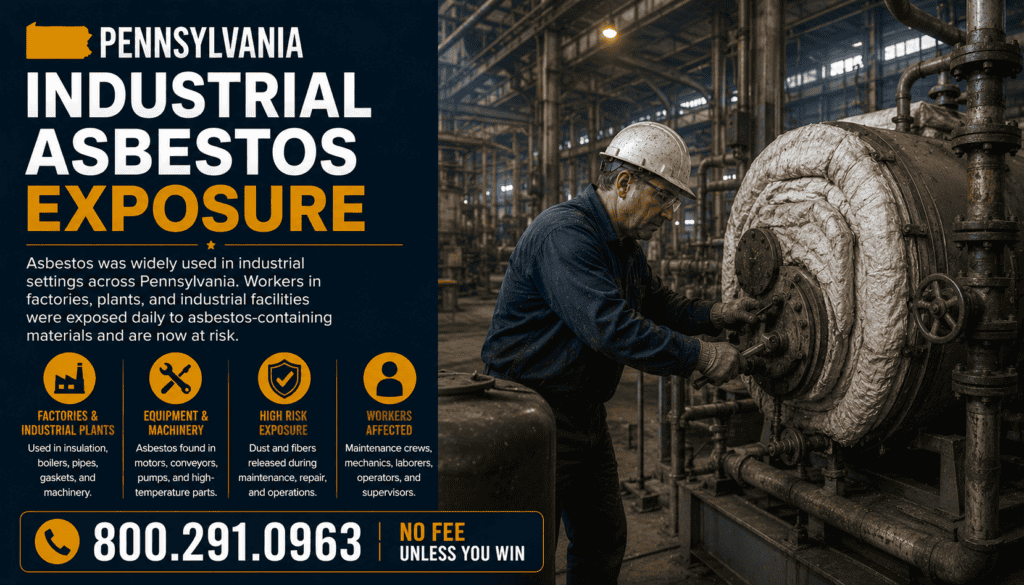
🏭 Pennsylvania Industrial Asbestos Exposure
Pennsylvania has a long industrial history built around steel production, manufacturing, power generation, chemical processing, machinery, foundries, railroad equipment, glass plants, paper mills, refineries, and heavy construction.
For decades, many of these facilities used asbestos-containing insulation, gaskets, packing, fireproofing, electrical materials, brake components, and industrial equipment parts.
Asbestos was valued because it resisted:
- Heat
- Fire
- Steam
- Friction
- Electrical current
- Chemical damage
- Heavy industrial wear
Workers were often not warned that disturbing asbestos-containing materials could release microscopic fibers into the air.
Pennsylvania industrial workers may have inhaled asbestos while:
- Repairing machinery
- Removing insulation
- Replacing gaskets
- Repacking valves
- Maintaining boilers
- Repairing pumps
- Working around steam pipes
- Cleaning industrial areas
- Participating in plant shutdowns
- Working near outside contractors
Exposure was not limited to workers who directly handled asbestos.
Machine operators, supervisors, warehouse workers, production employees, laborers, and cleaners could also inhale fibers released nearby.
Because asbestos-related diseases often take decades to develop, former Pennsylvania industrial workers may not receive a diagnosis until many years after retirement.
Learn more about statewide legal options on our Pennsylvania Asbestos Exposure Lawsuits page.
⚠️ Why Pennsylvania Industrial Facilities Used Asbestos
Industrial workplaces needed materials capable of withstanding extreme heat, pressure, steam, and fire.
Asbestos was inexpensive, durable, and widely available. Manufacturers added it to thousands of industrial and construction products.
Pennsylvania facilities used asbestos to:
- Insulate steam pipes
- Cover boilers
- Protect turbines
- Line furnaces
- Seal pumps
- Seal valves
- Control friction
- Fireproof buildings
- Protect electrical systems
- Reduce heat loss
Many asbestos-containing materials did not appear dangerous.
Workers may not have known that ordinary industrial products contained asbestos, including:
- Gaskets
- Packing
- Electrical panels
- Brake linings
- Clutch facings
- Heat shields
- Insulating cement
- Protective cloth
- Cement board
Asbestos was also installed throughout industrial buildings.
Common building materials included:
- Pipe insulation
- Boiler insulation
- Floor tile
- Ceiling tile
- Roofing
- Fireproofing
- Wall panels
- Joint compound
- Electrical insulation
Over time, heat, vibration, water leaks, steam, and physical wear could damage these materials.
Once asbestos insulation or equipment components became brittle, routine repairs and cleanup could release fibers into occupied work areas.
🏗️ Pennsylvania Industries Associated With Asbestos Exposure
Pennsylvania developed one of the largest industrial workforces in the United States.
Workers may have encountered asbestos in:
- Steel mills
- Iron foundries
- Metal fabrication plants
- Manufacturing plants
- Power plants
- Chemical facilities
- Refineries
- Glass plants
- Paper mills
- Textile mills
- Cement plants
- Rubber factories
- Machinery plants
- Boiler manufacturers
- Pump manufacturers
- Valve manufacturers
- Railroad repair facilities
- Automotive parts plants
- Machine shops
- Industrial warehouses
- Defense manufacturing facilities
Large industrial properties often contained several connected operations.
A single facility might include:
- Production departments
- Boiler rooms
- Powerhouses
- Maintenance shops
- Electrical rooms
- Warehouses
- Utility tunnels
- Loading areas
- Machine shops
- Rail yards
Workers could therefore encounter asbestos outside their normal department.
A production worker might inhale dust while pipefitters removed insulation overhead.
A warehouse employee might pass through a boiler room containing damaged pipe covering.
A supervisor might enter a maintenance area while mechanics scraped old gaskets from pumps.
Learn more about factory-related exposure on our Pennsylvania Factory Workers Asbestos Exposure page.
Additional information is available on our Pennsylvania Manufacturing Asbestos Exposure page.
🔥 Steel Mills, Foundries, and Metal Plants
Pennsylvania steel mills and metal-processing plants operated at extremely high temperatures.
These facilities commonly contained:
- Blast furnaces
- Boilers
- Turbines
- Rolling mills
- Pumps
- Valves
- Compressors
- Cranes
- Electrical equipment
- Steam systems
Asbestos may have been used in:
- Furnace insulation
- Boiler insulation
- Pipe covering
- Gaskets
- Packing
- Turbine insulation
- Electrical panels
- Heat shields
- Protective blankets
- Crane brake systems
Steelworkers and foundry employees may have experienced asbestos exposure during:
- Furnace repairs
- Equipment overhauls
- Boiler maintenance
- Pipe replacement
- Shutdown work
- Electrical repairs
- Cleanup
Maintenance shutdowns could be especially hazardous.
During a shutdown, insulators, millwrights, pipefitters, electricians, boilermakers, and laborers often worked in the same area.
One crew might remove insulation while another repaired machinery only a few feet away.
Dust could spread throughout open work areas and settle on floors, equipment, and clothing.
Employees at historic steel facilities can learn more on our Bethlehem Steel Corporation Asbestos Exposure page.
⚡ Power Plants and Industrial Powerhouses
Many Pennsylvania factories generated their own steam or electricity.
Industrial powerhouses commonly contained:
- Boilers
- Turbines
- Generators
- Condensers
- Pumps
- Valves
- Heat exchangers
- Steam pipes
- Electrical panels
- Control systems
Asbestos-containing materials were often installed on high-temperature equipment.
Workers may have encountered asbestos in:
- Boiler insulation
- Turbine insulation
- Pipe covering
- Pump gaskets
- Valve packing
- Generator insulation
- Electrical boards
- Expansion joints
Powerhouse workers may have been exposed during:
- Boiler inspections
- Turbine overhauls
- Valve repairs
- Pump rebuilding
- Pipe replacement
- Emergency maintenance
- Annual shutdowns
- Cleanup
Before mechanics could repair a boiler, turbine, valve, or steam line, insulation often had to be removed.
This work could release fibers throughout boiler rooms, mechanical spaces, and utility tunnels.
Learn more on our Pennsylvania Power Plant Asbestos Exposure page.
Former employees can also review our Pennsylvania Power Plant Workers Mesothelioma page.
👷 Pennsylvania Industrial Workers at Risk
Many types of Pennsylvania industrial workers may have encountered asbestos.
Potentially exposed occupations include:
- Steelworkers
- Factory workers
- Production workers
- Maintenance mechanics
- Millwrights
- Machinists
- Electricians
- Pipefitters
- Steamfitters
- Boilermakers
- Boiler operators
- Furnace operators
- Welders
- Insulators
- Engineers
- Turbine operators
- Pump repair workers
- Valve repair workers
- Crane operators
- Laborers
- Industrial cleaners
- Warehouse employees
- Supervisors
- Inspectors
- Construction workers
- Demolition workers
Maintenance workers often had direct exposure because they repaired asbestos-containing machinery and equipment.
Production employees may have experienced nearby exposure while maintenance crews disturbed insulation, gaskets, packing, or electrical materials.
Cleaners and laborers could have been exposed after repairs were completed.
Sweeping debris or using compressed air could return settled asbestos fibers to the air.
🔧 Maintenance Mechanics and Millwrights
Maintenance mechanics and millwrights repaired industrial equipment throughout Pennsylvania.
Their work may have included:
- Rebuilding pumps
- Repacking valves
- Removing gaskets
- Maintaining boilers
- Repairing compressors
- Servicing turbines
- Repairing furnaces
- Replacing steam lines
- Maintaining conveyors
- Installing machinery
Gaskets often became attached to metal after years of heat and pressure.
Workers may have used:
- Scrapers
- Wire brushes
- Sanders
- Grinders
- Chisels
These tools could break old gasket material into dust.
Valve and pump packing could also become brittle.
Workers often removed old packing with hooks before installing replacement material.
These tasks were usually performed close to the worker’s face.
Nearby helpers, supervisors, and machine operators could also inhale released fibers.
🔩 Pipefitters, Steamfitters, and Boilermakers
Pennsylvania industrial plants relied on piping systems to transport:
- Steam
- Hot water
- Oil
- Chemicals
- Gases
- Process materials
Pipefitters and steamfitters may have been exposed while:
- Cutting pipe insulation
- Removing pipe covering
- Repairing steam lines
- Replacing valves
- Opening flanges
- Removing gaskets
- Working in utility tunnels
- Repairing boiler connections
- Replacing expansion joints
Boilermakers could encounter asbestos in:
- Boiler insulation
- Rope seals
- Gaskets
- Packing
- Refractory materials
- Connected steam lines
Boiler overhauls could release large amounts of dust.
Workers might remove insulation, open access doors, replace gaskets, and repair internal components.
Learn more on our Pennsylvania Pipefitters Mesothelioma page.
Additional information is available on our Pennsylvania Boiler Equipment Asbestos Exposure page.
⚡ Electricians and Electrical Maintenance Workers
Asbestos was used in electrical systems because it resisted heat, fire, and electrical current.
Industrial electricians may have encountered asbestos in:
- Electrical panels
- Switchgear
- Transformers
- Generators
- Motor control centers
- Arc chutes
- Insulating boards
- Cable coverings
- Fire barriers
Electricians could release fibers while:
- Cutting panels
- Drilling boards
- Replacing old components
- Repairing switchgear
- Removing insulation
- Installing new equipment
They may also have worked near boilers, turbines, furnaces, steam pipes, and generators.
Learn more on our Pennsylvania Electricians Asbestos Exposure page.
⚙️ Industrial Equipment That May Have Contained Asbestos
Many types of industrial equipment used asbestos-containing parts.
Equipment associated with asbestos exposure may include:
- Boilers
- Pumps
- Valves
- Turbines
- Compressors
- Furnaces
- Kilns
- Industrial ovens
- Heat exchangers
- Condensers
- Generators
- Motors
- Conveyors
- Crushers
- Mixers
- Presses
- Dryers
- Braking systems
- Clutch systems
- Electrical switchgear
A pump might contain asbestos packing and flange gaskets.
A valve might contain asbestos packing around the stem.
A furnace could be lined with heat-resistant asbestos material.
A crane or conveyor might use asbestos brake components.
Workers often did not know which parts contained asbestos because the material was built into the equipment.
Learn more on our Pennsylvania Industrial Machinery Asbestos Exposure page.
🧱 Asbestos Products Used in Pennsylvania Industrial Facilities
Pennsylvania industrial workplaces may have contained many asbestos products.
Common materials included:
- Pipe insulation
- Boiler insulation
- Block insulation
- Insulating cement
- Gaskets
- Sheet gasket material
- Pump packing
- Valve packing
- Rope packing
- Furnace insulation
- Turbine insulation
- Thermal blankets
- Asbestos cloth
- Heat shields
- Electrical insulation
- Cement board
- Floor tile
- Ceiling tile
- Roofing
- Wall panels
- Joint compound
- Fireproofing
- Brake linings
- Clutch facings
- Expansion joints
Some materials remained installed for decades.
Others were replaced repeatedly during routine maintenance.
Gaskets and packing may have been removed and replaced many times during a worker’s career.
Each repair created another possible exposure event.
Learn more on our Pennsylvania Industrial Asbestos Products page.
💨 How Industrial Asbestos Exposure Occurred
Pennsylvania industrial workers may have inhaled asbestos during ordinary operations, maintenance, shutdowns, renovations, and cleanup.
Exposure could occur while:
- Cutting insulation
- Removing boiler covering
- Scraping gaskets
- Grinding gasket residue
- Pulling packing
- Rebuilding pumps
- Repairing valves
- Opening boilers
- Maintaining turbines
- Cleaning furnaces
- Repairing brakes
- Drilling electrical panels
- Removing floor tile
- Demolishing walls
- Sweeping floors
- Using compressed air
Asbestos fibers released during these tasks could remain airborne.
They could also settle on:
- Machinery
- Floors
- Pipes
- Workbenches
- Tools
- Clothing
- Rafters
- Vehicles
Later movement or cleanup could make the fibers airborne again.
Workers did not need to see a visible cloud of dust to experience exposure.
👥 Bystander Asbestos Exposure
Many industrial workers never handled asbestos directly.
They may still have inhaled fibers released by nearby employees or contractors.
Bystander exposure may have affected:
- Machine operators
- Production workers
- Warehouse employees
- Supervisors
- Inspectors
- Crane operators
- Shipping employees
- Drivers
- Cleaners
A machine operator could inhale dust while pipefitters removed insulation overhead.
A supervisor might enter a boiler room during maintenance.
A warehouse worker could work near deteriorating pipe covering.
Large, open industrial buildings allowed dust to move through work areas.
Ventilation systems, forklifts, overhead cranes, and employee traffic could spread fibers beyond the immediate repair location.
🧹 Shutdowns, Cleanup, and Demolition
Industrial shutdowns often brought several trades into the same area.
Workers might:
- Remove insulation
- Rebuild pumps
- Repair turbines
- Replace valves
- Open boilers
- Demolish machinery
- Repair furnaces
- Replace pipes
- Clean production areas
Cleanup practices could increase exposure.
Workers may have:
- Dry-swept floors
- Shoveled debris
- Emptied open containers
- Used compressed air
- Shaken dusty cloths
- Cleaned machinery without respiratory protection
Older industrial facilities were also renovated, expanded, or demolished.
These projects could disturb asbestos in:
- Pipes
- Boilers
- Floors
- Ceilings
- Walls
- Roofing
- Electrical systems
- Machinery
Factories sometimes remained open while construction or demolition occurred nearby.
Learn more on our Pennsylvania Construction Asbestos Exposure page.
🏠 Secondary Household Asbestos Exposure
Industrial workers could unknowingly carry asbestos home.
Fibers may have collected on:
- Shirts
- Pants
- Jackets
- Coveralls
- Boots
- Gloves
- Hair
- Tools
- Vehicles
Family members may have been exposed while:
- Shaking work clothes
- Washing uniforms
- Cleaning boots
- Handling jackets
- Vacuuming vehicles
- Cleaning tools
- Sweeping laundry areas
Spouses who regularly washed dusty industrial clothing may have experienced repeated secondary exposure.
A family member diagnosed with an asbestos-related disease may need to investigate the worker’s employment, duties, products, and clothing practices.
🩺 Diseases Linked to Industrial Asbestos Exposure
Industrial asbestos exposure has been associated with:
- Mesothelioma
- Asbestos-related lung cancer
- Asbestosis
- Pleural plaques
- Pleural thickening
- Pleural effusions
Mesothelioma is a cancer affecting the tissue surrounding certain organs.
Pleural mesothelioma develops in the lining around the lungs.
Asbestos-related diseases may take 20 to 50 years or more to develop.
A worker exposed early in a career may remain symptom-free for decades.
Former industrial workers should tell their doctors about possible asbestos exposure, especially if they experience:
- Shortness of breath
- Persistent cough
- Chest pain
- Unexplained weight loss
- Fatigue
- Reduced exercise tolerance
- Fluid around the lungs
Workers diagnosed with lung cancer can learn more on our Pennsylvania Asbestos Lung Cancer Lawsuits page.
🔍 Investigating a Pennsylvania Industrial Exposure History
An exposure investigation may need to reconstruct work performed decades ago.
The investigation may review:
- Employer names
- Facility locations
- Employment dates
- Job titles
- Department assignments
- Daily duties
- Machinery used
- Equipment repaired
- Boilers and steam systems
- Products handled
- Nearby maintenance
- Outside contractors
- Plant shutdowns
- Cleanup practices
Evidence may include:
- Social Security records
- Union records
- Pension documents
- Personnel files
- Machinery manuals
- Equipment inventories
- Maintenance logs
- Purchase orders
- Supplier invoices
- Factory photographs
- Coworker testimony
A worker does not need to remember every product brand.
Job duties, department names, machinery descriptions, packaging details, and coworker memories may help identify likely asbestos products.
Even if a facility has closed, changed ownership, or been demolished, historical evidence may still be available.
Learn more on our Pennsylvania Asbestos Exposure Sites page.
⚖️ Legal Options for Pennsylvania Industrial Workers
Pennsylvania industrial workers diagnosed with mesothelioma, asbestos-related lung cancer, or another qualifying disease may have legal options.
Potential claims may include:
- A personal injury lawsuit
- Asbestos trust fund claims
- A household exposure claim
- A wrongful death claim
- A survival claim
An investigation may examine companies that:
- Manufactured insulation
- Produced gaskets
- Made packing
- Manufactured boilers
- Produced pumps
- Manufactured valves
- Supplied replacement parts
- Distributed asbestos products
- Installed insulation
- Performed maintenance
- Conducted demolition
A single worker may have encountered products from several manufacturers.
Compensation may help address:
- Medical expenses
- Lost income
- Treatment travel
- Home care
- Pain and suffering
- Funeral expenses
- Family financial losses
Compensation is not guaranteed and depends on the evidence and applicable law.
Some asbestos manufacturers later established bankruptcy trust funds.
A worker may qualify for several trusts if products from multiple bankrupt companies were used at the facility.
Learn more on our Pennsylvania Asbestos Trust Fund Claims page.
⏰ Pennsylvania Filing Deadlines
Pennsylvania asbestos claims are subject to legal filing deadlines.
The deadline may depend on:
- Date of diagnosis
- Date the disease was discovered
- Date of death
- Type of claim
- Location of exposure
- Companies involved
- Other legal factors
Because asbestos diseases develop decades after exposure, deadlines are generally connected to diagnosis or discovery rather than the original employment date.
Each case should be reviewed individually.
Families should not assume they have unlimited time because exposure happened many years ago.
Learn more on our Pennsylvania Mesothelioma Statute of Limitations page.
Information about claims after a death is available on our Pennsylvania Wrongful Death Mesothelioma Lawsuits page.
❓ Frequently Asked Questions About Pennsylvania Industrial Asbestos Exposure
1. Which Pennsylvania industrial workers were exposed to asbestos?
Potentially exposed workers included maintenance mechanics, millwrights, pipefitters, electricians, boilermakers, machinists, steelworkers, furnace operators, production workers, laborers, warehouse employees, cleaners, and outside contractors.
Exposure depended on the facility, equipment, products, duties, and time period.
2. What industrial products commonly contained asbestos?
Common products included pipe insulation, boiler insulation, gaskets, valve packing, pump packing, insulating cement, furnace materials, electrical boards, brake linings, clutch facings, floor tile, roofing, and fireproofing.
3. Can a claim be investigated if the plant closed?
Yes.
Social Security records, union files, pension documents, machinery manuals, photographs, supplier records, historical materials, and coworker testimony may help establish exposure.
4. What if the worker cannot remember product names?
A claim may still be investigated.
Employer names, job duties, departments, machinery descriptions, maintenance tasks, coworkers, and approximate dates may provide a starting point.
5. Can family members exposed through work clothes have legal options?
A family member diagnosed with an asbestos-related disease may have legal options when evidence shows repeated exposure to fibers carried home from an industrial workplace.
Employment history, laundry practices, duration of exposure, and medical evidence must be reviewed.
6. How long after industrial exposure can mesothelioma develop?
Mesothelioma may develop 20 to 50 years or more after exposure.
Workers exposed decades ago may not receive a diagnosis until long after retirement.
🔗 Related Pennsylvania Asbestos Resources
- Pennsylvania Asbestos Exposure Lawsuits
- Pennsylvania Asbestos Exposure Articles
- Pennsylvania Asbestos Exposure Sites
- Pennsylvania Factory Workers Asbestos Exposure
- Pennsylvania Manufacturing Asbestos Exposure
- Pennsylvania Industrial Machinery Asbestos Exposure
- Pennsylvania Industrial Asbestos Products
- Pennsylvania Boiler Equipment Asbestos Exposure
- Pennsylvania Electricians Asbestos Exposure
- Pennsylvania Pipefitters Mesothelioma
- Pennsylvania Power Plant Asbestos Exposure
- Pennsylvania Asbestos Trust Fund Claims
📞 Find Out Whether You May Qualify for Compensation
Pennsylvania industrial workers and family members affected by mesothelioma, asbestos-related lung cancer, or another qualifying asbestos disease may have legal options.
A free case evaluation may help determine:
- Where asbestos exposure may have occurred
- Which industrial facilities should be investigated
- Which machinery or products may have contained asbestos
- Which manufacturers, suppliers, or contractors may be connected to the exposure
- Whether asbestos trust fund claims may be available
- Whether surviving family members may have legal options
- Which filing deadlines may apply
- Free case evaluation
- Help reviewing Pennsylvania employment and exposure history
- Assistance identifying industrial asbestos products and equipment
- Help locating manufacturers, suppliers, and contractors
- Assistance investigating asbestos trust fund claims
- Nationwide help for asbestos victims and their families
- No upfront attorney fees
- No fees unless compensation is recovered
Call 800-291-0963