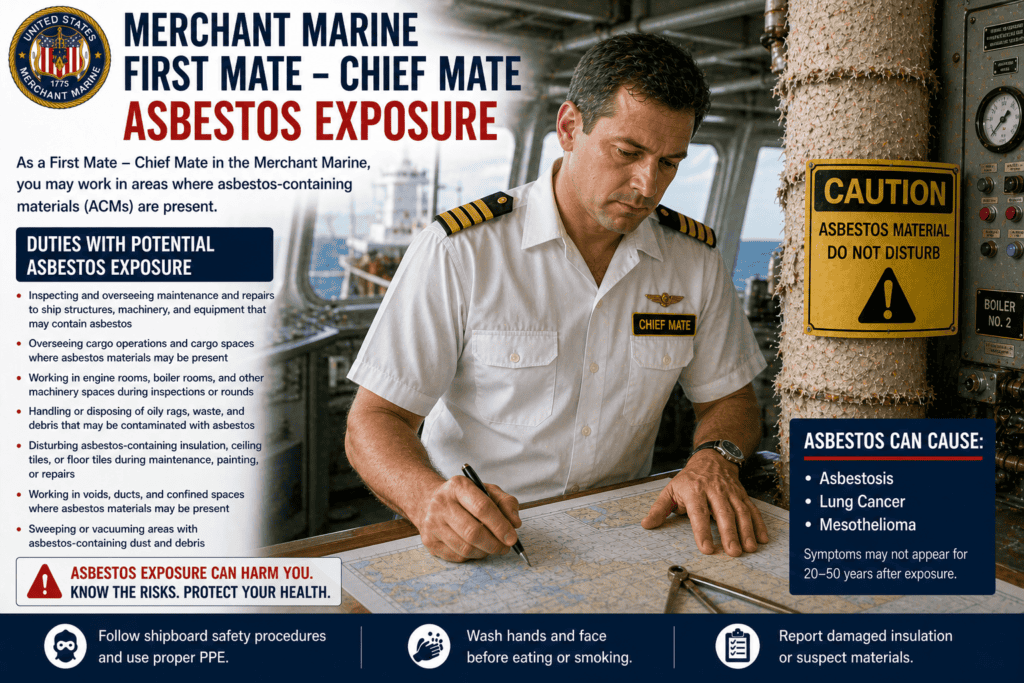
Merchant Marine First Mate / Chief Mate Asbestos Exposure
A Merchant Marine First Mate, commonly called the Chief Mate or Chief Officer, is the senior deck officer below the Captain/Master. Depending on the vessel, employer, and era, the Chief Mate could supervise deck crews, oversee cargo operations, coordinate maintenance, manage safety responsibilities, conduct inspections, and help organize repair work throughout deck and cargo areas.
Because the Chief Mate often worked closely with deck personnel and vessel maintenance, potential asbestos exposure could differ from that of the Captain/Master. A Chief Mate might spend more time around deck machinery, cargo spaces, piping, structural materials, maintenance projects, and repair crews. That does not mean every First Mate or Chief Mate was exposed to asbestos. Exposure must be tied to the specific vessel, dates of service, duties, work areas, maintenance activity, and evidence that asbestos-containing materials were present and disturbed.
This page is part of the Merchant Marines Ranks Asbestos Exposure hub within the broader Merchant Marines Asbestos Exposure silo. Related officer pages include Merchant Marine Captain / Master Asbestos Exposure, Merchant Marine Second Mate Asbestos Exposure, and Merchant Marine Third Mate Asbestos Exposure.
⚓ First Mate / Chief Mate Role and Responsibilities
The Chief Mate is generally the highest-ranking deck officer after the Master and often has direct responsibility for deck operations, cargo handling, maintenance planning, crew supervision, and safety. In many situations, the First Mate functions as the operational manager of the deck department.
For asbestos exposure analysis, this matters because a Chief Mate may have spent substantial time in work areas where maintenance, inspection, cargo preparation, machinery operation, and repair activity occurred.
| Chief Mate Duty | Possible Exposure Pathway | Evidence to Review |
|---|---|---|
| Deck crew supervision | Presence near maintenance work that disturbed older ship materials | Deck logs, maintenance schedules, crew statements |
| Cargo operations | Work in cargo holds, hatch areas, deck spaces, and adjacent service areas containing older materials | Cargo records, vessel plans, photographs |
| Maintenance planning | Inspection and oversight of deck machinery, piping, structural materials, and repair projects | Work orders, maintenance files, ship specifications |
| Safety inspections | Entry into multiple shipboard spaces to inspect equipment and conditions | Safety records, inspection reports, logbooks |
| Shipyard coordination | Presence around concentrated repair, removal, and replacement work | Shipyard records, contractor files, overhaul documents |
🛠️ Possible Asbestos Exposure Pathways
Asbestos was historically used in some maritime products because of its heat, fire, and wear resistance. Depending on the vessel and era, asbestos-containing materials could be associated with piping insulation, gaskets, packing, boilers, machinery, electrical systems, fire-resistant panels, flooring, bulkhead materials, and other components.
A Chief Mate could potentially encounter asbestos through direct contact during inspection or maintenance assistance, or through bystander exposure while supervising deck crews, contractors, or shipyard workers disturbing asbestos-containing materials nearby.
Command and supervisory responsibility alone do not prove exposure. A credible history should identify the location, material, task, frequency, duration, distance from the work, and evidence that the product actually contained asbestos.
🧰 Deck Crew Supervision and Maintenance
Chief Mates commonly supervised Able Seamen, Ordinary Seamen, and other deck personnel. This role could place the First Mate near routine maintenance, equipment repairs, line-handling gear, deck machinery, structural work, and cleaning operations.
For exposure reconstruction, it can be useful to review whether the Chief Mate personally inspected work, remained in the area during repairs, assigned crew to remove or replace materials, or entered spaces where dust-producing work was underway.
Career connections may also be relevant. A Chief Mate could have earlier served in lower deck-officer or deck ratings, potentially creating different exposure pathways over time. The Merchant Marine Able Seaman (AB) Asbestos Exposure page may be useful when reconstructing earlier deck service.
📦 Cargo, Safety, and Inspection Duties
Chief Mates often played a major role in cargo planning, deck safety, vessel stability, and inspections. Depending on ship type, this could involve cargo holds, hatch covers, deck machinery, piping, pumps, ventilation systems, and structural spaces.
Cargo spaces
Older cargo vessels could contain insulated piping, machinery, panels, flooring, or other materials near holds and adjacent service spaces. Whether these contained asbestos depends on the specific vessel and product evidence.
Safety inspections
Inspection duties could bring a Chief Mate into areas outside normal deck stations, including machinery-adjacent, storage, accommodation, utility, or emergency-equipment spaces.
Emergency response
During fires, leaks, collisions, machinery failures, or other incidents, the Chief Mate could enter damaged areas where materials had been disturbed. Any claimed asbestos exposure from such an event should be supported by incident and vessel records.
⚙️ Materials and Equipment to Investigate
Not every vessel component contained asbestos. Material composition varied by manufacturer, product, installation date, vessel, repair history, and replacement part. The categories below are investigative starting points.
| Material or Equipment | Potential Exposure Situation | Evidence to Investigate |
|---|---|---|
| Deck machinery | Inspection or maintenance around winches, capstans, brakes, seals, gaskets, or adjacent systems | Equipment manuals, repair records, parts lists |
| Piping and valves | Nearby repair or removal of insulation, gaskets, packing, or flange materials | Piping plans, maintenance logs, product records |
| Cargo-area systems | Inspection or work near insulated lines, pumps, ventilation, or fire-resistant construction materials | Ship plans, cargo-system manuals, specifications |
| Electrical systems | Presence near older electrical panels, wiring, cable systems, or heat-resistant components | Electrical diagrams, repair logs, manufacturer data |
| Interior and structural materials | Maintenance or repair of older panels, flooring, insulation, or fire-resistant construction products | Construction records, renovation files, photographs |
For system-specific investigation, see the confirmed Merchant Marine Equipment Asbestos Exposure hub.
🚢 Ships, Work Areas, and Overhaul Periods
First Mates and Chief Mates served aboard cargo ships, tankers, container ships, bulk carriers, passenger ships, Liberty ships, Victory ships, and other merchant vessels. Vessel type may help narrow the search for plans, specifications, machinery, and repair records, but it does not establish exposure by itself.
The Merchant Marine Ships Asbestos Exposure hub can be used to investigate the vessel category involved. Shoreside repair work may also connect to the Merchant Marine Facilities Asbestos Exposure hub.
Major overhaul periods can be particularly important because removal or replacement of insulation, piping, machinery, electrical systems, panels, gaskets, and packing could create dust. Review Merchant Marine Shipyards Asbestos Exposure and Merchant Marine Dry Docks Asbestos Exposure when relevant.
The Merchant Marine Asbestos Exposure Timeline can provide historical context for the era of service.
📋 Evidence for a Chief Mate Exposure History
Because asbestos disease can appear decades after maritime employment, reconstructing exposure may require several types of records.
| Evidence | What It May Help Establish |
|---|---|
| Merchant mariner credentials | Officer rating, qualifications, and career progression |
| Employment and vessel records | Ships, employers, and dates of service |
| Deck logs | Deck operations, maintenance, incidents, and repairs |
| Cargo records | Ship operations, holds used, and cargo-related work periods |
| Maintenance and repair files | Projects supervised or performed during the Chief Mate’s service |
| Shipyard and dry-dock records | Major overhaul and removal or replacement work |
| Product and manufacturer records | Whether specific materials or components contained asbestos |
| Crew testimony | Actual duties, work locations, frequency, and proximity to dust-producing work |
| Medical records | Diagnosis and relevant clinical history |
The strongest exposure history links the Chief Mate to a specific vessel, work location, maintenance event, and asbestos-containing material.
🫁 Asbestos-Related Health Risks
Inhaling asbestos fibers is associated with serious diseases including mesothelioma, lung cancer, and asbestosis. These diseases can have long latency periods, so maritime work from decades earlier may still be medically relevant.
A diagnosis alone does not establish asbestos causation. Medical evaluation may consider occupational exposure history, smoking history, other risk factors, imaging, pathology, and additional clinical evidence.
See Merchant Marine Asbestos Exposure Health Risks for the dedicated health-risk page.
Need help now? If a Merchant Marine First Mate or Chief Mate—or a family member—is trying to reconstruct possible asbestos exposure, Call 800.291.0963, use our 24/7 live chat, or Submit Your Case. Vessel names, service dates, officer positions, cargo operations, maintenance projects, shipyard periods, and crew members can all be useful starting points.
⚖️ Legal Options and Claim Investigation
A Merchant Marine First Mate or Chief Mate diagnosed with an asbestos-related disease may be able to investigate legal options depending on the evidence. Potential claims can depend on diagnosis, exposure history, product identification, responsible companies, jurisdiction, and filing deadlines.
The Merchant Marine Asbestos Exposure Legal Options hub covers Merchant Marine mesothelioma lawsuits, asbestos trust fund claims, wrongful death lawsuits, and statutes of limitations. Compensation is not automatic, and supervisory responsibility alone does not establish liability.
What a case investigation may examine
- Diagnosis and pathology records.
- Merchant mariner credentials and employment history.
- Vessel names and dates of service.
- Chief Mate deck, cargo, inspection, and safety duties.
- Maintenance projects and repair oversight.
- Shipyard and dry-dock periods.
- Products, equipment, manufacturers, and contractors.
- Crew and witness statements.
- Jurisdiction and applicable filing deadlines.
❓ Frequently Asked Questions
What is a Merchant Marine First Mate or Chief Mate?
The First Mate, commonly called the Chief Mate or Chief Officer, is generally the senior deck officer below the Captain/Master and often supervises deck operations, cargo, maintenance, safety, and deck personnel.
Were all Merchant Marine Chief Mates exposed to asbestos?
No. The officer title does not prove exposure. Evidence must identify the vessel, duties, work areas, maintenance activity, and whether asbestos-containing materials were disturbed nearby.
How could a Chief Mate encounter asbestos?
Possible pathways include supervising deck maintenance, inspecting machinery and cargo spaces, coordinating repairs, entering areas where insulation or other materials were being disturbed, and working around shipyard or dry-dock activity.
Could cargo operations create asbestos exposure?
Possibly, but cargo duty itself does not establish exposure. The relevant question is whether the Chief Mate worked near asbestos-containing ship materials or equipment that were damaged, deteriorated, maintained, or removed.
What records help reconstruct a First Mate’s work history?
Useful records can include mariner credentials, vessel assignments, deck logs, cargo records, maintenance files, shipyard records, ship plans, product documents, photographs, and crew testimony.
Can earlier deck-officer service matter?
Yes. A Chief Mate may previously have served as Third Mate or Second Mate, and those positions can involve different work areas and responsibilities. Each period should be evaluated separately.
Can asbestos exposure be relevant to lung cancer?
Yes. Asbestos is a recognized cause of lung cancer, but an individual diagnosis does not by itself prove asbestos causation. Medical and occupational evidence should be evaluated together.
Can a family investigate a claim after a Chief Mate dies?
Possibly. Depending on diagnosis, exposure evidence, responsible parties, jurisdiction, and filing deadlines, surviving family members may be able to investigate wrongful death or other asbestos-related claims.
☎️ Help for Merchant Marine First Mates, Chief Mates, and Families
If you or a family member served as a Merchant Marine First Mate or Chief Mate and later developed mesothelioma or lung cancer, an exposure investigation can examine vessel assignments, officer history, deck supervision, cargo operations, maintenance projects, shipyard periods, equipment, products, and available historical records.
Call 800.291.0963 to discuss a Merchant Marine asbestos exposure history. Live chat is available 24/7, 365 days a year. You can also Submit Your Case online.
There is no guarantee that a diagnosis or work history will qualify for compensation. Eligibility depends on the facts, evidence, responsible parties, jurisdiction, and filing deadlines.
⚕️ Legal & Medical Information Disclaimer
This page provides general educational information and is not medical or legal advice. It does not establish diagnosis, asbestos exposure, causation, liability, eligibility, or compensation. Consult qualified medical and legal professionals for guidance specific to your situation.