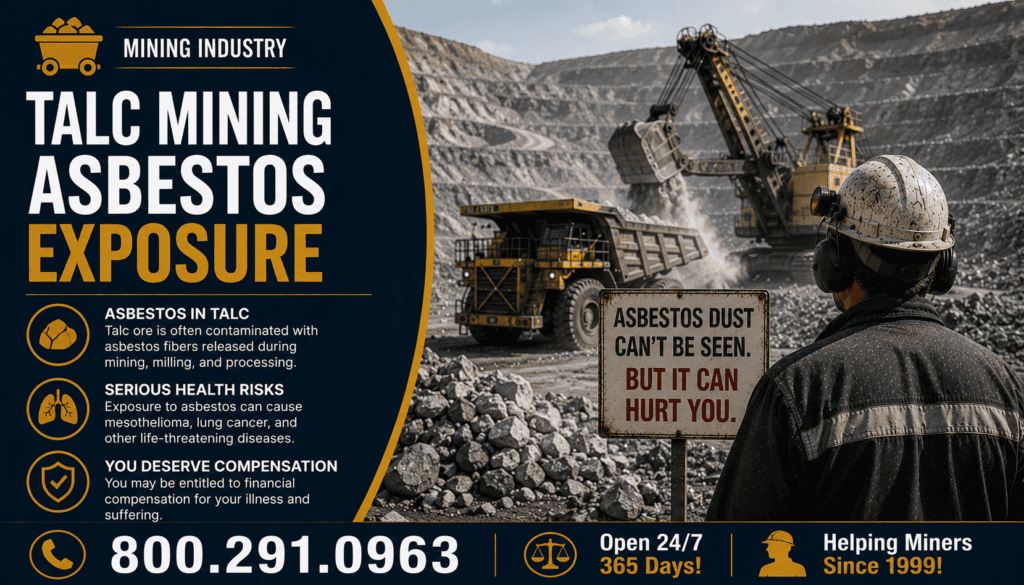
Talc Mining Asbestos Exposure
Talc Mining Asbestos Exposure concerns talc extraction and mineral processing. Talc itself is not asbestos. Some talc deposits occur near asbestos-forming minerals, making deposit-specific mineralogy, analytical methods and time period essential. Historical work tasks, ore origin, equipment design and controls determine whether asbestos fibers were present and could become airborne.
People diagnosed with mesothelioma or asbestos-related lung cancer may need help identifying employers, materials and exposure dates. This guide separates documented industry risks from facts that must be established for a specific mine, mill or worker.
⛏️ Where Exposure Occurred
Quarry Drilling
At quarry drilling, exposure questions turn on the exact material being handled and the period when work occurred. Talc itself is not asbestos. Some talc deposits occur near asbestos-forming minerals, making deposit-specific mineralogy, analytical methods and time period essential. Workers should identify their tasks, shift location, nearby operations and whether visible dust came from the ore, worn machinery components or ordinary mineral handling. Do not assume all talc is asbestos-contaminated; silica and other dust hazards are distinct. Site plans, work orders and contemporaneous monitoring records are more reliable than assuming a hazard from the facility name alone.
Ore Sorting
At ore sorting, exposure questions turn on the exact material being handled and the period when work occurred. Talc itself is not asbestos. Some talc deposits occur near asbestos-forming minerals, making deposit-specific mineralogy, analytical methods and time period essential. Workers should identify their tasks, shift location, nearby operations and whether visible dust came from the ore, worn machinery components or ordinary mineral handling. Do not assume all talc is asbestos-contaminated; silica and other dust hazards are distinct. Site plans, work orders and contemporaneous monitoring records are more reliable than assuming a hazard from the facility name alone.
Dry Grinding
At dry grinding, exposure questions turn on the exact material being handled and the period when work occurred. Talc itself is not asbestos. Some talc deposits occur near asbestos-forming minerals, making deposit-specific mineralogy, analytical methods and time period essential. Workers should identify their tasks, shift location, nearby operations and whether visible dust came from the ore, worn machinery components or ordinary mineral handling. Do not assume all talc is asbestos-contaminated; silica and other dust hazards are distinct. Site plans, work orders and contemporaneous monitoring records are more reliable than assuming a hazard from the facility name alone.
Bagged Talc Handling
At bagged talc handling, exposure questions turn on the exact material being handled and the period when work occurred. Talc itself is not asbestos. Some talc deposits occur near asbestos-forming minerals, making deposit-specific mineralogy, analytical methods and time period essential. Workers should identify their tasks, shift location, nearby operations and whether visible dust came from the ore, worn machinery components or ordinary mineral handling. Do not assume all talc is asbestos-contaminated; silica and other dust hazards are distinct. Site plans, work orders and contemporaneous monitoring records are more reliable than assuming a hazard from the facility name alone.
Equipment Repair
At equipment repair, exposure questions turn on the exact material being handled and the period when work occurred. Talc itself is not asbestos. Some talc deposits occur near asbestos-forming minerals, making deposit-specific mineralogy, analytical methods and time period essential. Workers should identify their tasks, shift location, nearby operations and whether visible dust came from the ore, worn machinery components or ordinary mineral handling. Do not assume all talc is asbestos-contaminated; silica and other dust hazards are distinct. Site plans, work orders and contemporaneous monitoring records are more reliable than assuming a hazard from the facility name alone.
👷 Workers And Job Duties
Equipment Operators
Equipment Operators working in talc extraction and mineral processing had duties that varied across sites and decades. A job title alone cannot establish exposure. The key questions are which machines they operated or repaired, whether they opened enclosed systems, and whether they worked near dust-generating tasks such as quarry drilling. Shift records and interviews may help reconstruct those conditions. Do not assume all talc is asbestos-contaminated; silica and other dust hazards are distinct.
Mill And Process Workers
Mill And Process Workers working in talc extraction and mineral processing had duties that varied across sites and decades. A job title alone cannot establish exposure. The key questions are which machines they operated or repaired, whether they opened enclosed systems, and whether they worked near dust-generating tasks such as ore sorting. Shift records and interviews may help reconstruct those conditions. Do not assume all talc is asbestos-contaminated; silica and other dust hazards are distinct.
Laborers And Material Handlers
Laborers And Material Handlers working in talc extraction and mineral processing had duties that varied across sites and decades. A job title alone cannot establish exposure. The key questions are which machines they operated or repaired, whether they opened enclosed systems, and whether they worked near dust-generating tasks such as dry grinding. Shift records and interviews may help reconstruct those conditions. Do not assume all talc is asbestos-contaminated; silica and other dust hazards are distinct.
Mechanics And Maintenance Crews
Mechanics And Maintenance Crews working in talc extraction and mineral processing had duties that varied across sites and decades. A job title alone cannot establish exposure. The key questions are which machines they operated or repaired, whether they opened enclosed systems, and whether they worked near dust-generating tasks such as bagged talc handling. Shift records and interviews may help reconstruct those conditions. Do not assume all talc is asbestos-contaminated; silica and other dust hazards are distinct.
Supervisors And Contract Workers
Supervisors And Contract Workers working in talc extraction and mineral processing had duties that varied across sites and decades. A job title alone cannot establish exposure. The key questions are which machines they operated or repaired, whether they opened enclosed systems, and whether they worked near dust-generating tasks such as equipment repair. Shift records and interviews may help reconstruct those conditions. Do not assume all talc is asbestos-contaminated; silica and other dust hazards are distinct.
⚙️ Ore, Products And Equipment
Ore And Mineral Identification
Ore And Mineral Identification can clarify the materials and machinery present at a particular facility. Talc itself is not asbestos. Some talc deposits occur near asbestos-forming minerals, making deposit-specific mineralogy, analytical methods and time period essential. To establish asbestos content, review mineral analysis, manufacturers’ documentation, historical product specifications and replacement-part records. A mineral label or equipment model without a date and product identification is not conclusive. Investigate mineralogical assays and preserve original documents where possible.
Machinery Friction Components
Machinery Friction Components can clarify the materials and machinery present at a particular facility. Talc itself is not asbestos. Some talc deposits occur near asbestos-forming minerals, making deposit-specific mineralogy, analytical methods and time period essential. To establish asbestos content, review mineral analysis, manufacturers’ documentation, historical product specifications and replacement-part records. A mineral label or equipment model without a date and product identification is not conclusive. Investigate mine and mill geology and preserve original documents where possible.
Insulation And Heat-Resistant Materials
Insulation And Heat-Resistant Materials can clarify the materials and machinery present at a particular facility. Talc itself is not asbestos. Some talc deposits occur near asbestos-forming minerals, making deposit-specific mineralogy, analytical methods and time period essential. To establish asbestos content, review mineral analysis, manufacturers’ documentation, historical product specifications and replacement-part records. A mineral label or equipment model without a date and product identification is not conclusive. Investigate historic testing methods and preserve original documents where possible.
Processing And Shipment Records
Processing And Shipment Records can clarify the materials and machinery present at a particular facility. Talc itself is not asbestos. Some talc deposits occur near asbestos-forming minerals, making deposit-specific mineralogy, analytical methods and time period essential. To establish asbestos content, review mineral analysis, manufacturers’ documentation, historical product specifications and replacement-part records. A mineral label or equipment model without a date and product identification is not conclusive. Investigate talc product lot records and preserve original documents where possible.
| Work Area | Possible Exposure Question | Useful Records |
|---|---|---|
| Quarry Drilling | Was asbestos-bearing ore or material disturbed during this operation? | Mineralogical Assays |
| Ore Sorting | Was asbestos-bearing ore or material disturbed during this operation? | Mine And Mill Geology |
| Dry Grinding | Was asbestos-bearing ore or material disturbed during this operation? | Historic Testing Methods |
| Bagged Talc Handling | Was asbestos-bearing ore or material disturbed during this operation? | Talc Product Lot Records |
| Equipment Repair | Was asbestos-bearing ore or material disturbed during this operation? | Mineralogical Assays |
🌫️ How Airborne Fibers Were Released
Disturbance Of Mineral-Bearing Dust
Disturbance Of Mineral-Bearing Dust is relevant when fibers could be liberated from asbestos-bearing material. Talc itself is not asbestos. Some talc deposits occur near asbestos-forming minerals, making deposit-specific mineralogy, analytical methods and time period essential. Consider the duration and frequency of work, dust suppression, local exhaust, housekeeping practices and respiratory protection. Historic controls were not uniform. Exposure reconstruction should separate asbestos fibers from other dust, including crystalline silica, using actual mineral and sampling evidence. Do not assume all talc is asbestos-contaminated; silica and other dust hazards are distinct.
Maintenance And Equipment Opening
Maintenance And Equipment Opening is relevant when fibers could be liberated from asbestos-bearing material. Talc itself is not asbestos. Some talc deposits occur near asbestos-forming minerals, making deposit-specific mineralogy, analytical methods and time period essential. Consider the duration and frequency of work, dust suppression, local exhaust, housekeeping practices and respiratory protection. Historic controls were not uniform. Exposure reconstruction should separate asbestos fibers from other dust, including crystalline silica, using actual mineral and sampling evidence. Do not assume all talc is asbestos-contaminated; silica and other dust hazards are distinct.
Ventilation And Housekeeping
Ventilation And Housekeeping is relevant when fibers could be liberated from asbestos-bearing material. Talc itself is not asbestos. Some talc deposits occur near asbestos-forming minerals, making deposit-specific mineralogy, analytical methods and time period essential. Consider the duration and frequency of work, dust suppression, local exhaust, housekeeping practices and respiratory protection. Historic controls were not uniform. Exposure reconstruction should separate asbestos fibers from other dust, including crystalline silica, using actual mineral and sampling evidence. Do not assume all talc is asbestos-contaminated; silica and other dust hazards are distinct.
Transport And Secondary Exposure
Transport And Secondary Exposure is relevant when fibers could be liberated from asbestos-bearing material. Talc itself is not asbestos. Some talc deposits occur near asbestos-forming minerals, making deposit-specific mineralogy, analytical methods and time period essential. Consider the duration and frequency of work, dust suppression, local exhaust, housekeeping practices and respiratory protection. Historic controls were not uniform. Exposure reconstruction should separate asbestos fibers from other dust, including crystalline silica, using actual mineral and sampling evidence. Do not assume all talc is asbestos-contaminated; silica and other dust hazards are distinct.
🩺 Mesothelioma And Long-Term Health
Understanding The Diagnosis
Mesothelioma is a cancer associated with asbestos exposure and often develops decades after the relevant work. Diagnosis requires appropriate medical evaluation and pathology. A person may have worked at several mines, mills or industrial sites; an accurate history should include all of them.
Reconstructing Older Exposure
Historical asbestos exposure may be difficult to recognize because job titles, employers and product names change. Collect a chronological employment record and note any work involving ore handling, industrial insulation, friction materials or nearby dust. A clinician can advise on appropriate medical records.
Medical Documentation And Care
Keep pathology reports, imaging summaries, specialist notes and treatment records together. Medical evidence addresses diagnosis; employment and product records address potential exposure. Neither alone identifies every responsible party. Discuss medical decisions with qualified treating clinicians.
🫁 Asbestos-Related Lung Cancer
Asbestos And Lung Cancer
Asbestos exposure increases lung cancer risk. Smoking also increases risk, and the two exposures can act together. A lung cancer diagnosis alone does not prove the cancer was caused by a particular worksite; individual medical and exposure histories matter.
Evaluating Work History
Document years of employment, job duties, material handling and potential nonoccupational exposures. Include other hazardous dusts but distinguish them from asbestos. A medical professional can explain the significance of an exposure history without promising a particular outcome.
Records To Preserve
Preserve diagnostic records, occupational histories, union or payroll documents and names of coworkers. If the person is deceased, family members may be able to locate these records. Legal time limits differ by jurisdiction and claim type.
📋 Records That May Support A Claim
Mine And Mill Records
Mine And Mill Records can help determine whether a particular mine, processing operation or maintenance task involved asbestos. Look for dated and attributable originals rather than undated web summaries. Useful items include mineralogical assays, plant maps, employment histories, union rosters, contractor invoices and product purchase records. Record what each item proves and what remains unknown. Do not assume all talc is asbestos-contaminated; silica and other dust hazards are distinct.
Product And Supplier Documents
Product And Supplier Documents can help determine whether a particular mine, processing operation or maintenance task involved asbestos. Look for dated and attributable originals rather than undated web summaries. Useful items include mine and mill geology, plant maps, employment histories, union rosters, contractor invoices and product purchase records. Record what each item proves and what remains unknown. Do not assume all talc is asbestos-contaminated; silica and other dust hazards are distinct.
Coworker And Contractor Accounts
Coworker And Contractor Accounts can help determine whether a particular mine, processing operation or maintenance task involved asbestos. Look for dated and attributable originals rather than undated web summaries. Useful items include historic testing methods, plant maps, employment histories, union rosters, contractor invoices and product purchase records. Record what each item proves and what remains unknown. Do not assume all talc is asbestos-contaminated; silica and other dust hazards are distinct.
Industrial Hygiene Evidence
Industrial Hygiene Evidence can help determine whether a particular mine, processing operation or maintenance task involved asbestos. Look for dated and attributable originals rather than undated web summaries. Useful items include talc product lot records, plant maps, employment histories, union rosters, contractor invoices and product purchase records. Record what each item proves and what remains unknown. Do not assume all talc is asbestos-contaminated; silica and other dust hazards are distinct.
⚖️ Compensation And Legal Options
Personal Injury And Wrongful Death Claims
A person diagnosed with an asbestos-related disease, or eligible surviving family members, may have legal options depending on state law, exposure facts and responsible entities. The availability and deadlines of claims differ. This page does not determine eligibility.
Asbestos Bankruptcy Trusts
Some companies established asbestos bankruptcy trusts. Each trust has its own proof, product and exposure criteria, deadlines and payment rules. Working in a mine or mill does not automatically establish qualification for a trust payment.
Statutes Of Limitations
Legal filing deadlines may depend on diagnosis, death, location and other facts. Waiting to collect every historical record before seeking legal advice can risk missing a deadline. A licensed attorney in the appropriate jurisdiction can assess timing.
Veterans And Other Benefits
Workers with qualifying military service may also consider applicable veterans benefits. Civil claims, trust claims and benefits may interact, so a qualified adviser should review the individual circumstances.
🔗 Related Mining And Occupational Pages
These related pages cover adjacent mine operations and other industrial work. They are background comparisons, not evidence that any particular mine used asbestos.
- Asbestos Mining — related occupational or exposure context; verify site-specific facts separately.
- Vermiculite Mining — related occupational or exposure context; verify site-specific facts separately.
- Crushing And Milling — related occupational or exposure context; verify site-specific facts separately.
- Bagging And Loading — related occupational or exposure context; verify site-specific facts separately.
- Mine Maintenance Shops — related occupational or exposure context; verify site-specific facts separately.
- Railroad Work — related occupational or exposure context; verify site-specific facts separately.
- Railroad Repair Shops — related occupational or exposure context; verify site-specific facts separately.
- Power Plant Pipefitters — related occupational or exposure context; verify site-specific facts separately.
- Power Plant Welders — related occupational or exposure context; verify site-specific facts separately.
- Power Plant Supervisors — related occupational or exposure context; verify site-specific facts separately.
- Auto Plant Maintenance Workers — related occupational or exposure context; verify site-specific facts separately.
- Auto Plant Machinists — related occupational or exposure context; verify site-specific facts separately.
- Auto Plant Welders — related occupational or exposure context; verify site-specific facts separately.
- Auto Plant Production Workers — related occupational or exposure context; verify site-specific facts separately.
- Mesothelioma Lawsuit — related occupational or exposure context; verify site-specific facts separately.
❓ Frequently Asked Questions
Did Every Mine Or Mill Contain Asbestos?
No. Do not assume all talc is asbestos-contaminated; silica and other dust hazards are distinct. The ore deposit, product source and installed machinery materials must be established for each site.
Could Nearby Workers Have Been Exposed?
Potentially, if airborne asbestos fibers reached shared work areas. Distance, ventilation, timing and measured or reconstructed exposure matter.
What Records Are Most Helpful?
Employment records, mineralogical assays, mine and mill geology, parts records and dated coworker testimony may help reconstruct exposure.
Can Family Members Seek Legal Advice?
Yes. Depending on state law, survivors may be able to discuss wrongful death or other claims with counsel. Eligibility and deadlines are fact-specific.
Does A Diagnosis Automatically Qualify Someone For Compensation?
No. Medical diagnosis, documented exposure, responsible entities and applicable legal requirements are separate questions.
📚 Confirmed Sources
- ATSDR — Asbestos And Your Health
- OSHA — Asbestos Overview
- OSHA — General Industry Asbestos Standard
- EPA — Libby Asbestos Site
- ATSDR — Libby Vermiculite Processing Reports
🧭 Summary
Talc Mining Asbestos Exposure requires a careful distinction between historical asbestos risks and site-specific proof. Talc itself is not asbestos. Some talc deposits occur near asbestos-forming minerals, making deposit-specific mineralogy, analytical methods and time period essential. People affected by mesothelioma or asbestos-related lung cancer can organize work and medical records and ask qualified professionals about treatment and legal options.
GET THE COMPENSATION YOU DESERVE
Find out if you may qualify for asbestos compensation today. 800.291.0963 . Help is available 24/7/365. 25+ years of experience. Submit Your Case Here .
Mesothelioma Help Center is not a law firm or medical provider and does not determine legal or VA eligibility. This information is not individualized medical or legal advice.