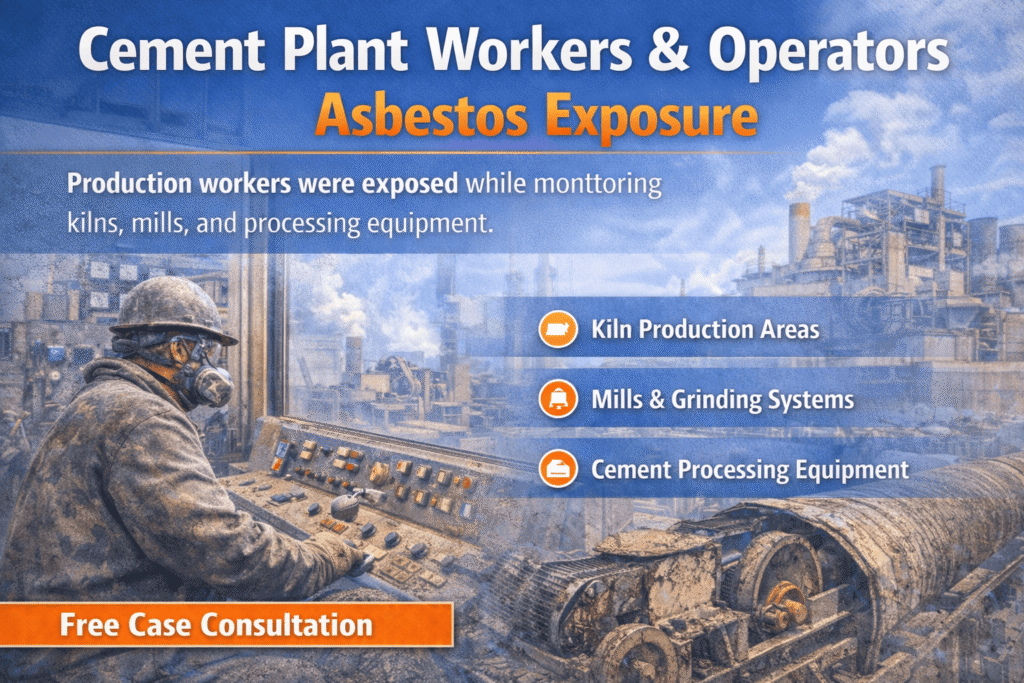
👷 Cement Plant Workers & Operators Asbestos Exposure
Production workers were exposed while monitoring kilns, mills, and processing equipment.
Cement plant workers and operators faced daily, long-term asbestos exposure while running production lines, monitoring equipment, and responding to operational issues across sprawling facilities. Unlike specialized maintenance crews who encountered asbestos during discrete tasks, operators worked continuously in areas where asbestos-containing materials were already deteriorating—kilns, mills, conveyors, boiler rooms, and processing floors.
Because cement plants operated around the clock, operators spent long shifts in dusty, noisy environments where asbestos fibers mixed with cement dust and remained airborne. Over years and decades, this repeated exposure placed cement plant workers among the highest-risk industrial occupations for asbestos-related disease.
🧱 Why Cement Plant Operators Were Exposed to Asbestos
Cement plant operations depended on equipment that required insulation, fireproofing, and heat-resistant materials. Asbestos exposure occurred because:
-
🔥 High-temperature systems required asbestos insulation
-
🧱 Aging equipment released fibers as materials degraded
-
⚙️ Continuous vibration broke down insulation and seals
-
🌫️ Heavy dust levels carried asbestos throughout work areas
-
⏱️ Long shifts and careers increased cumulative exposure
Operators were rarely informed that asbestos was present in the systems they monitored daily.
🧪 Common Asbestos Sources in Operator Work Areas
Cement plant workers and operators encountered asbestos from multiple sources, including:
🔥 Kilns & Clinker Systems
-
Insulation and refractory materials
-
Expansion joints and seals
-
Heat shields and fireproofing
⚙️ Mills, Crushers & Conveyors
-
Insulated housings and panels
-
Brake linings and mechanical components
-
Gaskets and seals
🔧 Piping & Utility Systems
-
Pipe insulation and lagging
-
Valve packing and gaskets
-
Steam and compressed air lines
🧱 Structural Materials
-
Sprayed-on fireproofing
-
Insulated steel beams
-
Cement boards and panels
As these materials aged, asbestos fibers were released directly into operator work zones.
⚠️ How Asbestos Exposure Occurred During Daily Operations
Asbestos exposure commonly occurred during routine operator activities such as:
-
Monitoring kilns, mills, and processing lines
-
Clearing blockages and equipment jams
-
Responding to alarms and system failures
-
Working near deteriorating insulation
-
Walking through conveyor galleries and power areas
-
Cleaning dust-covered workstations
Because asbestos fibers are invisible and odorless, operators often inhaled fibers unknowingly.
🧑🏭 Which Cement Plant Workers Faced the Highest Risk
⚙️ Process & Control Room Operators
Operators overseeing multiple systems were exposed to airborne fibers migrating from production areas.
🔥 Kiln & Mill Operators
Workers stationed near high-heat equipment experienced continuous exposure from insulation and refractory materials.
🔄 Conveyor & Material Handling Operators
Operators working along conveyor systems inhaled fibers released from mechanical components.
🧹 Utility & Cleanup Workers
Workers assigned to cleanup and support roles were exposed to asbestos mixed with cement dust.
🧬 Health Risks Linked to Cement Plant Worker Asbestos Exposure
Long-term asbestos exposure among cement plant workers has been linked to serious and often fatal diseases, including:
🫁 Asbestosis
A chronic lung disease caused by asbestos scarring, leading to progressive breathing difficulty.
🧠 Mesothelioma
A rare and aggressive cancer of the lung or abdominal lining, almost exclusively caused by asbestos exposure.
🫁 Lung Cancer
Extended asbestos exposure significantly increases lung cancer risk in industrial environments.
Because asbestos-related diseases have latency periods of 20–50 years, many cement plant workers are diagnosed long after leaving employment.
📜 Employer Responsibilities Toward Cement Plant Workers
Cement plant owners and operators were required to:
-
Identify asbestos-containing materials throughout facilities
-
Monitor and control fiber release during operations
-
Provide protective equipment and safety training
-
Maintain asbestos management and abatement plans
Despite these responsibilities, many workers report never being informed that asbestos was present across their job sites.
❓ Frequently Asked Questions (FAQs)
1️⃣ Were cement plant operators exposed even without maintenance duties?
Yes. Deteriorating materials released fibers into operational areas.
2️⃣ Can asbestos fibers spread throughout the plant?
Yes. Fibers traveled through air currents and ventilation systems.
3️⃣ Did cement dust increase asbestos exposure?
Yes. Dust carried and concealed asbestos fibers.
4️⃣ Were operators warned about asbestos risks?
In many cases, no. Warnings and training were often absent.
5️⃣ Can illness develop decades after exposure?
Yes. Asbestos-related diseases often appear many years later.
⚖️ How a Lawyer Can Help Get Compensation
Cement plant workers and operators diagnosed with asbestos-related illnesses may have legal options. An experienced asbestos lawyer can help by:
-
Identifying cement plants and job roles linked to exposure
-
Tracing asbestos products used throughout production areas
-
Filing claims against asbestos manufacturers and suppliers
-
Pursuing compensation for medical expenses, lost income, and suffering
-
Assisting families with wrongful death claims
Because worker exposure often involved multiple systems over long careers, experienced legal representation is essential.
📞 Free Case Evaluation – Get Help Today
If you or a loved one worked as a cement plant worker or operator and later developed an asbestos-related illness, help is available.
📞 Call Now for a FREE Case Evaluation: 800-291-0963
There is no obligation, and compensation may be available.
📌 Key Takeaways
-
Cement plant workers faced daily asbestos exposure during operations
-
Kilns, mills, conveyors, and piping released fibers
-
Long shifts increased cumulative exposure
-
Health effects may appear decades later
-
Legal options may be available for exposed workers