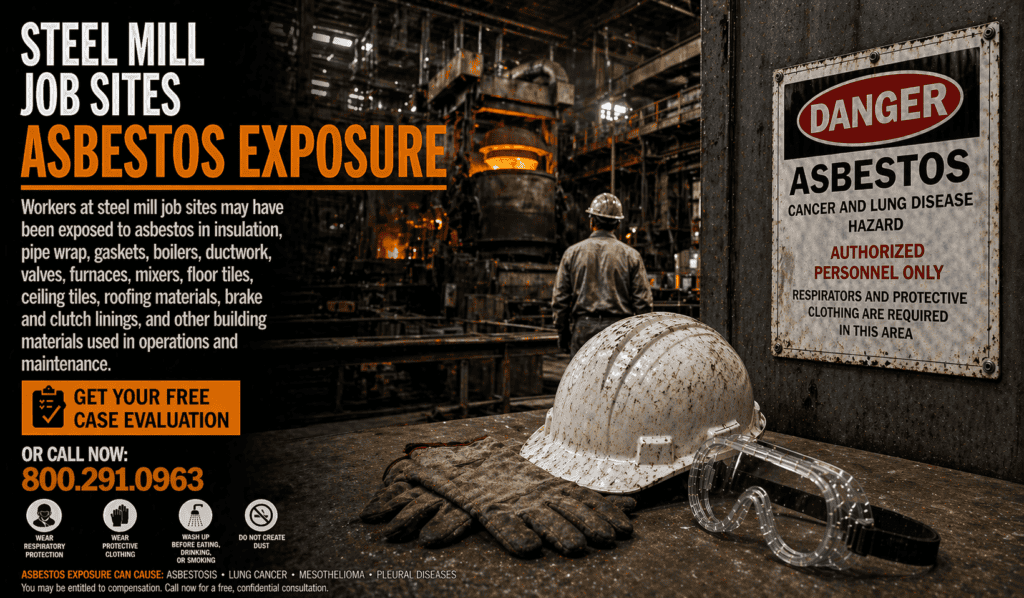
🏭 Steel Mills Asbestos Exposure
Large integrated steel mills relied extensively on asbestos-containing materials to withstand extreme heat, pressure, and nonstop industrial production. For decades, steelworkers throughout these massive facilities were routinely exposed to airborne asbestos fibers released from blast furnaces, coke ovens, boilers, rolling mills, and on-site power systems. This widespread occupational exposure has caused thousands of former steelworkers to develop mesothelioma, lung cancer, and other fatal asbestos-related diseases years after leaving the job.
Read more articles about Steel Mill Asbestos Exposure.
🏗️ What Are Integrated Steel Mills?
Integrated steel mills are vast industrial complexes that manufacture steel from raw materials such as iron ore, coal, and limestone. Unlike mini-mills, integrated mills perform every step of steelmaking on-site, including:
-
Coke production
-
Ironmaking in blast furnaces
-
Steel refining and casting
-
Hot and cold rolling
-
Finishing and fabrication
-
On-site power and steam generation
Because these operations involve extreme temperatures and continuous production, asbestos was considered essential for insulation and fireproofing throughout the facility.
🔥 Why Asbestos Was Widely Used in Integrated Steel Mills
Asbestos was heavily used due to its unique industrial properties, including:
-
Exceptional heat resistance
-
Fireproofing capabilities
-
Thermal insulation efficiency
-
Chemical resistance
-
Durability under vibration and pressure
Asbestos materials were installed in virtually every department. When insulation aged, cracked, or was disturbed during maintenance, microscopic fibers became airborne and easily inhaled.
⚙️ Primary Asbestos Exposure Sources in Integrated Steel Mills
🔥 Blast Furnaces
Blast furnaces operated at extreme temperatures and were lined with asbestos-containing refractory bricks and insulation. Exposure occurred during:
-
Furnace relining
-
Brick replacement
-
Emergency shutdowns
-
Furnace teardown and rebuilds
🔥 Coke Ovens
Coke ovens used asbestos insulation, cement, and gasketing to retain heat and control combustion gases. Workers were exposed while:
-
Repairing oven doors
-
Replacing insulation
-
Maintaining flues and chambers
⚡ Steel Mill Powerhouses & Boilers
Integrated mills operated on-site power plants that contained:
-
Boilers wrapped in asbestos lagging
-
Turbines insulated with asbestos blankets
-
Steam piping coated in asbestos cement
-
Pumps and valves with asbestos gaskets
Routine boiler maintenance released heavy concentrations of airborne fibers.
🔄 Rolling Mills & Finishing Equipment
Hot rolling mills relied on asbestos for:
-
Heat shields
-
Brake pads
-
Roller insulation
-
Bearing housings
Asbestos dust was released during pad replacement, mechanical repairs, and equipment servicing.
🧰 Piping, Valves & Gaskets
Miles of steam and process piping ran throughout integrated steel mills, insulated with asbestos materials. Exposure occurred during:
-
Cutting and removing insulation
-
Scraping valve packing
-
Replacing asbestos gaskets
👷 Steel Mill Job Roles at High Risk of Exposure
Nearly every department faced asbestos exposure, including:
-
Blast furnace operators
-
Coke oven workers
-
Steelworkers and production operators
-
Millwrights
-
Pipefitters and insulators
-
Maintenance and repair crews
-
Electricians
-
Boiler operators
-
Powerhouse workers
-
Laborers and cleanup crews
Many workers were exposed daily for decades, often without respiratory protection or warnings.
🌫️ How Asbestos Exposure Occurred
Asbestos exposure most often occurred during:
-
Routine maintenance and inspections
-
Emergency equipment repairs
-
Shutdowns and restarts
-
Plant renovations and expansions
-
Equipment retrofitting
-
Demolition of aging mill structures
Even workers not directly handling asbestos inhaled fibers due to poor ventilation and the sheer scale of integrated mills.
🩺 Health Risks Linked to Steel Mill Asbestos Exposure
Asbestos fibers embed in lung tissue and organ linings, causing diseases that may not appear for 20–50 years after exposure.
Common illnesses include:
-
Mesothelioma (pleural, peritoneal, pericardial)
-
Lung cancer
-
Asbestosis
-
Chronic obstructive pulmonary disease (COPD)
-
Pleural plaques and thickening
Mesothelioma is almost exclusively caused by asbestos and is strongly linked to steel mill exposure.
⚠️ Integrated Steel Mills & Mesothelioma
Many steelworkers diagnosed with mesothelioma were exposed decades earlier and had no symptoms until retirement age. Secondary exposure also occurred when fibers were carried home on work clothing.
Key facts:
-
Mesothelioma has no known cure
-
Integrated steel mills are among the highest-risk industrial environments
-
Family members may also develop asbestos-related illnesses
⚖️ Legal Options for Steel Mill Workers
Steelworkers diagnosed with asbestos-related diseases may qualify for compensation through:
📄 Mesothelioma Lawsuits
Claims may be filed against:
-
Asbestos product manufacturers
-
Equipment suppliers
-
Contractors responsible for installation or repairs
💼 Asbestos Trust Fund Claims
Many asbestos manufacturers created trust funds after bankruptcy. Steelworkers may qualify without filing a lawsuit.
🕊️ Wrongful Death Claims
Families of deceased steelworkers may pursue compensation for medical costs, lost income, and suffering.
⏰ Statute of Limitations for Steel Mill Claims
Filing deadlines depend on:
-
Date of diagnosis
-
Date of death (for families)
-
State jurisdiction
Missing deadlines can permanently bar compensation, making early legal review essential.
✅ Why Integrated Steel Mill Asbestos Cases Are Strong
These cases are often well-supported because:
-
Asbestos use in steel mills is historically documented
-
Product manufacturers are identifiable
-
Job roles directly align with exposure sources
-
Medical science clearly links asbestos to mesothelioma
❓ FAQs (Steel Mill Powerhouses & Boiler Rooms)
1) Were powerhouses really worse than other areas of a steel mill?
Often, yes. Powerhouses contained dense concentrations of insulation, steam piping, valves, and gaskets—and work frequently happened in confined rooms where fibers accumulated.
2) I worked near boilers but didn’t remove insulation. Can I still have a claim?
Possibly. Asbestos fibers can spread through enclosed areas, settle on surfaces, and become airborne again during routine work. Many claims involve secondary or bystander exposure in boiler rooms.
3) What if my exposure happened decades ago?
That’s common. Asbestos diseases typically have a long latency period. Claims are often still possible because filing deadlines usually start at diagnosis, not first exposure.
4) Can family members file if a steelworker passed away?
Yes, in many cases families can pursue a wrongful death claim if the death was linked to an asbestos-related disease.
5) Do I have to go to court?
Not always. Many cases resolve through settlements or trust fund claims without trial, depending on the facts and available evidence.
👨⚖️ How a Lawyer Can Help With a Steel Mill Powerhouse Asbestos Claim
A lawyer experienced with asbestos cases can do far more than “file paperwork.” Key ways they help include:
-
Worksite & job-history investigation: Mapping where you worked (powerhouse, boiler room, steam tunnels, turbine decks) and when.
-
Product identification: Identifying insulation, gasket, valve packing, and equipment brands commonly used in steel mill power systems.
-
Evidence development: Gathering employment records, union records, coworker statements, and worksite documentation that supports exposure.
-
Medical documentation support: Ensuring pathology reports and diagnostic records are properly collected and presented for claims.
-
Choosing the best compensation path: Lawsuit vs. trust funds (or both), based on available evidence and deadlines.
-
Handling deadlines and filings: Statutes of limitation vary by state and can be unforgiving.
-
Maximizing total recovery: Coordinating multiple claims where allowed, without leaving money on the table.
If you’re dealing with a diagnosis, this support can remove much of the burden from you and your family.
📞 Free Case Consultation (CTA)
If you or a loved one worked in a steel mill powerhouse or boiler room and was diagnosed with mesothelioma or asbestos-related lung cancer, you may have legal options.
Call now for a Free Case Consultation: 800-291-0963
Time limits may apply based on diagnosis date and state jurisdiction.