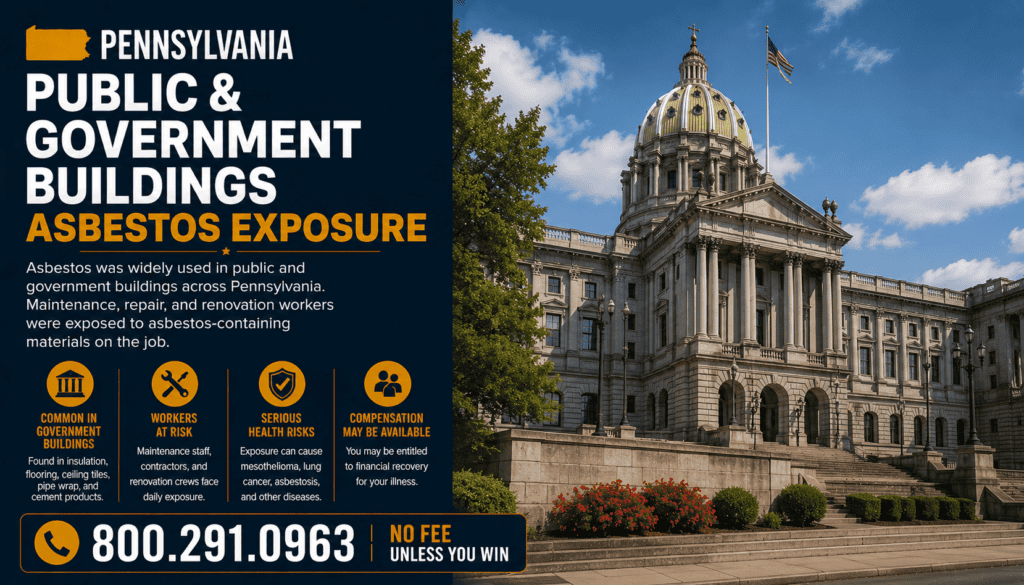
🏫 Pennsylvania Public & Government Buildings Asbestos Exposure
Pennsylvania public and government buildings asbestos exposure affected teachers, students, healthcare workers, maintenance personnel, custodians, government employees, contractors, and visitors for decades. Throughout much of the twentieth century, asbestos was widely incorporated into schools, colleges, universities, courthouses, hospitals, libraries, municipal buildings, government offices, correctional facilities, and other public structures because of its fire-resistant and insulating properties.
As these buildings aged, asbestos-containing materials gradually deteriorated or were disturbed during maintenance, renovations, remodeling projects, HVAC upgrades, plumbing repairs, electrical work, and emergency repairs. Once disturbed, microscopic asbestos fibers became airborne where they could be inhaled by workers and building occupants—often without anyone realizing the danger.
Individuals diagnosed with mesothelioma or another asbestos-related disease after exposure in a Pennsylvania public building may have legal rights. Learn more by visiting our Pennsylvania Asbestos Exposure Lawsuits guide and our complete library of Pennsylvania Asbestos Exposure Articles.
🧱 Why Asbestos Was Widely Used in Pennsylvania Public Buildings
During much of the twentieth century, architects, engineers, and government agencies selected asbestos-containing building materials because they were considered durable, economical, and highly resistant to fire.
Pennsylvania public buildings commonly used asbestos because it:
- 🔥 Resisted fire and extreme heat
- 🧱 Strengthened walls, ceilings, and structural materials
- ❄️ Improved thermal insulation
- 🔇 Reduced sound transmission
- 💧 Helped resist moisture damage
- ⚙️ Protected boilers, pipes, and mechanical equipment
- 💰 Lowered long-term construction and maintenance costs
Because many public buildings remained in service for decades, asbestos-containing materials often remained in place long after the health hazards became known.
🏛️ Common Pennsylvania Public Buildings That Contained Asbestos
Thousands of public buildings constructed before the 1980s contained asbestos somewhere within their construction or mechanical systems.
🏫 Schools, Colleges and Universities
Schools were among the most common public buildings containing asbestos.
Materials frequently included:
- Ceiling tiles
- Floor tile and mastic
- Pipe insulation
- Boiler insulation
- Spray-applied fireproofing
- Wall panels
- Roofing materials
- HVAC duct insulation
- Mechanical room insulation
Teachers, custodians, maintenance workers, contractors, and even students could be exposed when these materials deteriorated or were disturbed.
🏥 Hospitals and Healthcare Facilities
Older Pennsylvania hospitals frequently incorporated asbestos throughout their construction and mechanical systems.
Common asbestos-containing materials included:
- Boiler insulation
- Steam piping
- Fireproofing
- Floor tile
- Ceiling materials
- Mechanical insulation
- Electrical components
- HVAC equipment
Healthcare workers often spent decades inside these buildings while maintenance personnel routinely worked directly with asbestos-containing materials.
🏛️ Courthouses and Municipal Buildings
Courthouses, city halls, township buildings, county offices, and other government facilities frequently used asbestos-containing insulation and fireproofing.
As buildings aged, routine maintenance and renovation projects often disturbed:
- Wall insulation
- Pipe insulation
- Boiler systems
- Electrical panels
- Floor coverings
- Ceiling systems
Government employees working inside these buildings could unknowingly inhale airborne asbestos fibers over many years.
📚 Libraries, Museums and Civic Centers
Libraries, museums, community centers, and civic buildings also commonly contained asbestos products used during original construction.
Renovation work frequently disturbed aging insulation, flooring, ceiling systems, roofing materials, and HVAC equipment, creating exposure risks for employees, contractors, and visitors.
🏢 Government Housing and Public Facilities
Public housing complexes, correctional facilities, maintenance garages, utility buildings, transportation facilities, and other government-owned structures frequently incorporated asbestos products throughout their construction.
Maintenance work often exposed employees while replacing aging insulation, boilers, roofing materials, flooring, and mechanical equipment.
Many of these building materials are discussed in our Pennsylvania Asbestos Products Used in Construction guide.
🛠️ How Public Building Asbestos Exposure Occurred
Most asbestos exposure inside public buildings occurred during routine maintenance rather than during normal occupancy.
Common exposure situations included:
- Building renovations
- Remodeling projects
- Demolition work
- Boiler repairs
- HVAC replacement
- Plumbing upgrades
- Electrical upgrades
- Ceiling replacement
- Floor tile removal
- Pipe insulation repairs
- Roof replacement
- Emergency maintenance
- Water damage restoration
- Custodial cleanup after construction
When asbestos-containing materials were cut, drilled, sanded, broken, or removed, microscopic fibers entered the air and could remain suspended for hours before settling throughout the building.
Many older facilities also shared HVAC systems that circulated dust into occupied offices, classrooms, hallways, and work areas.
Workers performing these activities frequently encountered hazards similar to those described in our Pennsylvania Construction Asbestos Exposure and Pennsylvania Industrial Asbestos Exposure guides.
👷 Workers and Occupants Most at Risk
Although maintenance personnel often experienced the greatest asbestos exposure, many other groups spent years inside aging public buildings where asbestos-containing materials slowly deteriorated.
High-risk occupations and occupants included:
🧰 Maintenance and Custodial Personnel
Maintenance workers routinely repaired boilers, steam lines, pumps, valves, electrical systems, flooring, ceilings, and insulation.
Custodians often cleaned construction debris, swept contaminated dust, and maintained mechanical rooms where asbestos fibers accumulated over time.
👩🏫 Teachers and School Employees
Teachers, administrators, office personnel, librarians, counselors, and school support staff frequently spent decades inside older school buildings containing asbestos insulation and aging building materials.
Even when they never handled asbestos directly, long-term occupancy could increase cumulative exposure.
🏥 Healthcare Workers
Doctors, nurses, therapists, technicians, maintenance workers, and hospital support staff often worked in older healthcare facilities where asbestos remained in mechanical systems, insulation, and building materials.
🧱 Contractors and Renovation Crews
Construction workers, electricians, plumbers, HVAC technicians, painters, flooring installers, and demolition crews frequently disturbed asbestos during renovation projects.
Many of these workers are also discussed in our Pennsylvania Electricians Asbestos Exposure and Pennsylvania Construction Workers Mesothelioma guides.
👨👩👧 Students, Patients and Visitors
Although exposure levels were generally lower than those experienced by maintenance personnel, students, patients, visitors, jurors, and members of the public could also inhale asbestos fibers released from deteriorating building materials or renovation projects.
🏠 Secondary Exposure to Families
Not every person diagnosed with mesothelioma worked directly around asbestos-containing materials. Many Pennsylvania families developed asbestos-related diseases after years of secondary exposure, also known as take-home or household asbestos exposure.
Secondary exposure commonly occurred when workers unknowingly carried asbestos fibers home on:
- Work clothing
- Jackets
- Boots
- Gloves
- Hard hats
- Hair
- Skin
- Tools
- Lunch boxes
- Vehicle interiors
Family members could inhale these microscopic fibers while laundering contaminated clothing, cleaning work boots, or simply hugging a loved one returning home from work.
Teachers, custodians, maintenance workers, contractors, plumbers, electricians, and government employees who worked in older public buildings may have unknowingly exposed family members for years before asbestos hazards became widely recognized.
🩺 Health Risks From Pennsylvania Public & Government Building Asbestos Exposure
Once inhaled, microscopic asbestos fibers can become permanently lodged in the lungs and surrounding tissues. The body cannot easily remove these fibers, allowing inflammation and scarring to develop over many years.
Because asbestos-related diseases typically have a 20- to 50-year latency period, many people are not diagnosed until decades after their original exposure.
Common asbestos-related diseases include:
🧬 Mesothelioma
Mesothelioma is a rare but aggressive cancer affecting the lining surrounding the lungs, abdomen, heart, or testes. Occupational asbestos exposure remains its primary known cause.
Teachers, custodians, maintenance workers, healthcare employees, and government workers have all been diagnosed after years spent inside asbestos-containing public buildings.
🫁 Asbestos-Related Lung Cancer
Long-term asbestos exposure significantly increases the risk of developing lung cancer, particularly among individuals who also smoked. However, many nonsmokers have also developed asbestos-related lung cancer after prolonged occupational exposure.
Workers diagnosed with lung cancer may qualify for compensation through Pennsylvania Asbestos Lung Cancer Lawsuits.
🫀 Asbestosis
Asbestosis is a progressive scarring disease of the lungs caused by inhaling asbestos fibers.
Common symptoms include:
- Persistent cough
- Shortness of breath
- Chest tightness
- Fatigue
- Reduced lung function
Although there is no cure, early diagnosis and medical treatment may help manage symptoms.
📉 Pleural Disease
Asbestos exposure may also cause several non-cancerous conditions affecting the lining of the lungs, including:
- Pleural plaques
- Pleural thickening
- Pleural effusions
- Diffuse pleural fibrosis
These conditions may indicate significant past asbestos exposure even when cancer is not present.
⚖️ Legal Responsibility for Asbestos in Public Buildings
Although many Pennsylvania public buildings still remain in use today, liability for asbestos exposure often rests with the companies that manufactured, supplied, or installed asbestos-containing products—not necessarily the government agency occupying the building.
Potentially responsible parties may include:
- Asbestos insulation manufacturers
- Flooring manufacturers
- Ceiling tile manufacturers
- Fireproofing manufacturers
- Boiler manufacturers
- HVAC equipment manufacturers
- Construction contractors
- Renovation contractors
- Equipment suppliers
- Product distributors
Evidence commonly used in public building asbestos cases includes:
- Employment records
- School or government employment history
- Building maintenance records
- Construction specifications
- Renovation records
- Product identification
- Coworker testimony
- Historical building documentation
Many claims involve products manufactured decades before a diagnosis occurred.
🏦 Asbestos Trust Funds for Public Building Exposure
Numerous manufacturers that supplied asbestos-containing products to schools, hospitals, courthouses, and government facilities later established asbestos bankruptcy trust funds.
These trusts were created to compensate individuals diagnosed with asbestos-related diseases long after exposure occurred.
Trust fund claims may:
- 🏦 Provide compensation without a trial
- ⚖️ Supplement lawsuit recoveries
- 📄 Cover exposure involving bankrupt manufacturers
- ⏳ Often resolve faster than traditional litigation
Because many public buildings contained products from multiple manufacturers, eligible claimants may qualify for compensation from more than one asbestos trust.
Learn more by visiting Pennsylvania Asbestos Trust Fund Claims.
💰 Compensation Options for Public Building Asbestos Victims
Individuals diagnosed with mesothelioma or another asbestos-related disease after exposure in Pennsylvania public buildings may qualify for compensation through one or more legal avenues.
Potential compensation may include:
- ⚖️ Mesothelioma lawsuits
- 🏦 Asbestos trust fund claims
- 👨👩👧 Wrongful death lawsuits
- 📄 Product liability claims
Compensation may help pay for:
- Medical treatment
- Lost income
- Future medical expenses
- Pain and suffering
- Home healthcare
- Travel expenses
- Funeral expenses
- Financial support for surviving family members
Families who have lost a loved one may also qualify through Pennsylvania Wrongful Death Mesothelioma Lawsuits.
⏳ Pennsylvania Statute of Limitations for Public Building Claims
Pennsylvania law limits the amount of time available to file asbestos-related claims.
Because asbestos diseases often develop decades after exposure, filing deadlines generally begin when the disease is diagnosed rather than when the original exposure occurred.
Waiting too long may permanently prevent recovery.
More information is available in our Pennsylvania Mesothelioma Statute of Limitations guide.
⚖️ How a Pennsylvania Asbestos Lawyer Can Help
Public building asbestos cases often involve exposures that occurred many years ago and may require identifying numerous asbestos-containing products used during construction, maintenance, or renovation.
An experienced asbestos lawyer can help:
- Identify asbestos exposure sources
- Research historical building records
- Locate asbestos-containing products
- Identify responsible manufacturers
- Interview former coworkers
- Prepare lawsuits
- File asbestos trust fund claims
- Gather supporting documentation
- Meet Pennsylvania filing deadlines
- Maximize available compensation
Most mesothelioma attorneys work on a contingency-fee basis, meaning there are generally no upfront legal fees unless compensation is recovered.
❓ Pennsylvania Public & Government Buildings Asbestos Exposure FAQs
Are older Pennsylvania schools still dangerous today?
Many older schools still contain asbestos materials that remain safe if left undisturbed. However, deterioration, renovations, or improper maintenance can release asbestos fibers into the air.
Can teachers file asbestos claims?
Yes. Teachers and other school employees who developed mesothelioma or another asbestos-related disease after long-term occupational exposure may have legal options.
Do public employees have legal rights?
Yes. Government employees may pursue claims against manufacturers, suppliers, or other responsible companies that produced asbestos-containing products.
Can visitors develop asbestos-related diseases?
Although less common than occupational exposure, visitors and members of the public may develop asbestos-related diseases following significant or repeated exposure.
Can maintenance workers face greater risks than office employees?
Yes. Maintenance personnel, custodians, electricians, plumbers, HVAC technicians, and renovation crews frequently disturbed asbestos-containing materials and generally experienced higher exposure levels.
Do asbestos trust funds cover exposure in public buildings?
Yes. Many trust funds compensate individuals exposed to asbestos products commonly used in schools, hospitals, government offices, and other public facilities.
Should I speak with a lawyer if I believe I was exposed?
Yes. An experienced asbestos attorney can investigate where the exposure occurred, identify responsible manufacturers, and explain available legal options.
📞 Free Case Evaluation – Pennsylvania Public & Government Buildings Asbestos Exposure
If you or a loved one were exposed to asbestos while working in or regularly visiting a Pennsylvania public or government building and later developed mesothelioma, asbestos-related lung cancer, or another asbestos-related disease, compensation may still be available.
✔️ Free, confidential case evaluation
✔️ No upfront legal fees
✔️ Nationwide asbestos legal support
✔️ Experienced mesothelioma legal team
📞 Call 800-291-0963 today to discuss your legal options.