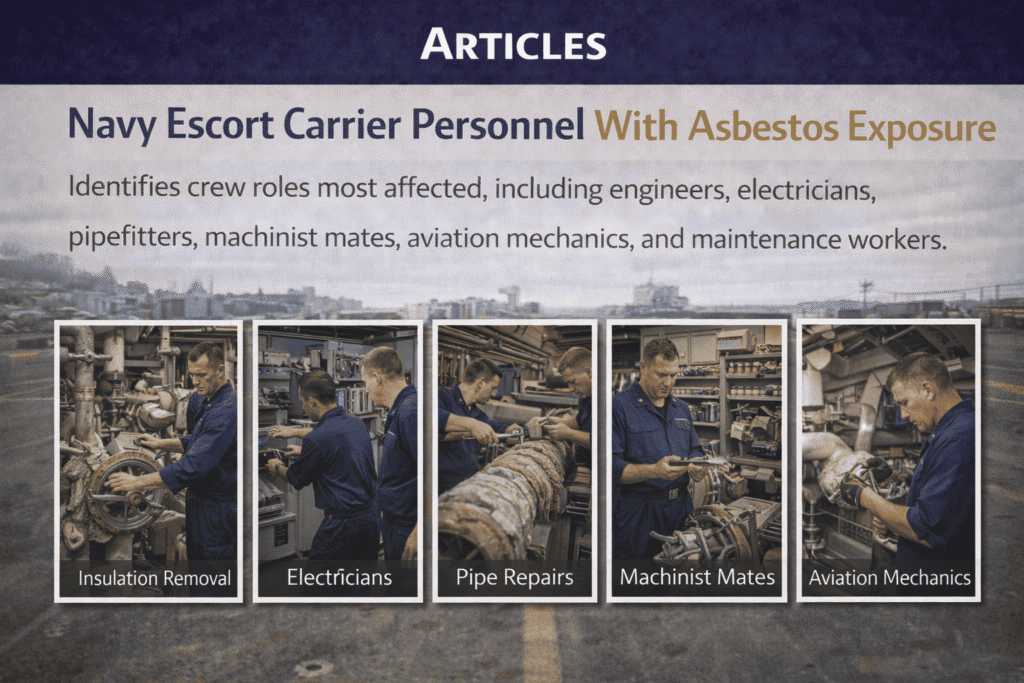
🔹 Navy Escort Carrier Personnel With Asbestos Exposure
Navy escort carriers were built with asbestos in insulation, fireproofing, wiring, machinery, and aviation-support systems. Because asbestos was used throughout the ship, nearly every sailor faced some exposure. However, certain job roles faced much higher risk because their daily duties required direct contact with asbestos-containing materials.
This article explains which Navy escort carrier personnel were most affected and how their job duties created dangerous asbestos exposure.
⚙️ Engineering and Machinery Crews
• Machinist mates – Serviced turbines, pumps, compressors, and generators containing asbestos insulation and packing that released fibers during repairs.
• Enginemen – Worked around propulsion systems wrapped in asbestos lagging that cracked under heat and vibration.
• Boiler technicians – Cleaned and repaired boilers covered in asbestos insulation that shed fibers during scraping.
• Turbine operators – Maintained asbestos-insulated turbines that released dust during servicing.
These crews worked in hot, enclosed spaces where asbestos stayed airborne.
🔌 Electricians and Electronics Technicians
• Electricians – Cut and replaced asbestos-coated wiring, releasing fibers into breathing zones.
• Electronics technicians – Serviced radar, navigation, and aviation-control systems fireproofed with asbestos materials.
• Control panel technicians – Drilled asbestos-backed panels during upgrades.
• Cable crews – Pulled asbestos-sleeved cables through tight compartments, stirring fibers.
Electrical spaces were poorly ventilated, increasing inhalation risk.
🚿 Pipefitters and Plumbers
• Pipefitters – Removed asbestos pipe insulation to access steam and hot-water lines, creating heavy dust clouds.
• Plumbers – Repaired insulated water and waste systems wrapped in asbestos.
• Valve technicians – Repacked valves with asbestos rope that shed fibers during removal.
• Flange workers – Scraped asbestos gaskets from joints, releasing dust.
Their faces were often inches from asbestos fibers.
⚙️ Mechanics and Maintenance Crews
• Maintenance technicians – Removed asbestos insulation during repairs across ship systems.
• Machinery mechanics – Serviced compressors and generators lined with asbestos materials.
• Repair crews – Cut fireproof panels containing asbestos during modifications.
• Overhaul workers – Tore out large amounts of asbestos during shipyard refits.
They often had the highest cumulative exposure.
✈️ Aviation and Hangar Deck Personnel
• Aviation mechanics – Worked near asbestos fireproofing around engines, fuel systems, and support equipment.
• Flight deck crews – Operated equipment with asbestos brake linings that released fibers during use.
• Hangar deck workers – Worked around spray-on asbestos fireproofing that deteriorated from heat.
• Fuel handling crews – Serviced insulated fuel lines wrapped in asbestos materials.
Aviation operations exposed sailors outside engine rooms.
🚢 Cargo and Support Personnel
• Winch and crane operators – Used equipment with asbestos brake linings that released fibers during operation.
• Supply crews – Worked in asbestos-lined storage compartments.
• Fuel transfer crews – Handled insulated fuel systems wrapped in asbestos.
• Workshop technicians – Worked in asbestos fireproofed repair spaces.
🏥 Medical and Service Personnel
• Medical staff – Worked in hospital areas lined with asbestos fireproofing.
• Cooks and stewards – Worked in galleys with asbestos insulation around stoves and ovens.
• Laundry workers – Handled asbestos-contaminated clothing.
• Administrative staff – Worked in asbestos-lined offices and compartments.
Ventilation systems spread fibers into all work areas.
🌬️ How Exposure Spread Throughout the Ship
• Ventilation systems – Carried fibers from machinery spaces to living areas.
• Clothing and bedding – Trapped asbestos dust that sailors breathed repeatedly.
• Foot traffic – Stirred settled fibers into the air.
• Cleaning duties – Re-aerosolized asbestos dust.
Even sailors far from machinery inhaled asbestos.
🧠 Why Escort Carrier Crews Faced High Risk
Escort carriers combined many exposure dangers:
• Heavy steam and aviation fuel systems
• Large machinery spaces
• Extensive fireproofing
• Frequent maintenance
• Confined compartments
• Poor ventilation
Few naval environments had so many exposure sources.
🩺 Long-Term Health Effects by Job Role
Higher exposure increased risk of:
• Mesothelioma
• Lung cancer
• Asbestosis
• Pleural disease
Risk depended on:
• Job duties
• Length of service
• Number of overhauls
• Intensity of exposure
Symptoms often appear 20–50 years after service.
❓ Navy Escort Carrier Personnel – FAQs
Was every crew member exposed?
Most sailors on pre-1980s escort carriers were exposed.
Which jobs had highest risk?
Engineering, pipefitting, electrical, aviation, and maintenance roles.
Were officers exposed?
Yes. Ventilation spread fibers everywhere.
Can short service still cause illness?
Yes. Even limited exposure can be dangerous.
Do job titles matter for claims?
Yes. Duties help prove exposure.
⚖️ How an Asbestos Lawyer Can Get You Compensation
An asbestos lawyer builds your case using your job role and ship assignments.
An asbestos lawyer will:
• Review service history
• Identify exposure sources
• Match asbestos products to manufacturers
• Work with doctors to confirm disease
• File lawsuits and trust fund claims
• Handle deadlines and negotiations
This process maximizes compensation while reducing stress.
📞 Get Help Now
If you served in any of these roles on a Navy escort carrier and later developed mesothelioma, lung cancer, or another asbestos-related disease, you may be entitled to compensation.
You may qualify for:
• Lawsuit settlements or verdicts
• Asbestos trust fund payments
• VA disability and survivor benefits
There is no upfront cost.
📞 Call now for a free, confidential case consultation:
800.291.0963