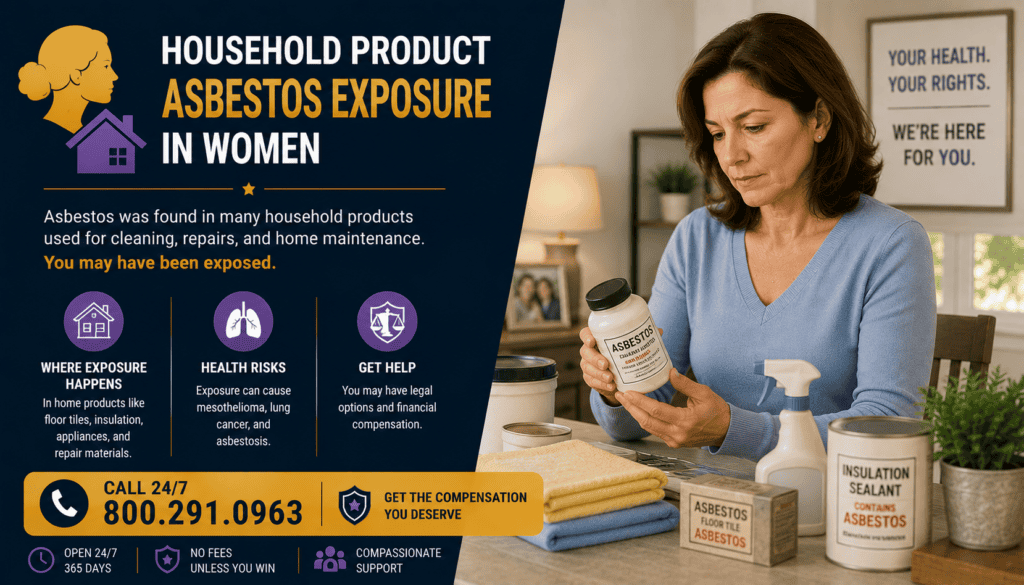
Household Product Asbestos Exposure in Women
Women may have encountered asbestos through certain historical household, repair, appliance, craft or personal-use products, as well as asbestos-containing materials already installed in a home. Federal sources document asbestos in products ranging from older patching compounds and artificial fireplace embers to some textiles and heat-resistant household items. A product category alone, however, does not prove that a particular item contained asbestos.
Reconstructing household product exposure requires attention to the exact product, manufacturer, approximate year, formulation, frequency of use and whether the material was cut, sanded, scraped, heated, damaged or otherwise disturbed. Packaging, photographs, catalogs, receipts, regulatory records and qualified testing may provide corroboration. This guide separates historical evidence from assumptions and explains how to preserve useful product, household and medical documentation.
🏠 Household Product Asbestos Exposure Overview
The National Cancer Institute states that asbestos was used widely because its fibers resist heat, fire and chemicals. Historical uses included paints, coatings, adhesives, plastics and numerous building materials. NCI also notes findings involving some talc-containing crayons and vermiculite-containing garden products. These examples show why old consumer products can warrant research, but they should not be generalized to every product in a category.
Start with the Women’s Consumer Products & Household Asbestos Exposure hub. Identify the item, where and when it was obtained, who used it, how it was handled and whether dust or fibers could have been released.
| Question | Details to document |
|---|---|
| What product? | Brand, model, product name or package |
| When used? | Approximate purchase and use dates |
| How handled? | Cut, sanded, mixed, heated, repaired or left intact |
| What evidence? | Catalog, receipt, label, recall, specification or testing |
📦 Historical Household Products to Investigate
EPA’s Part 2 asbestos risk evaluation describes legacy consumer uses involving older paints and coatings, asbestos textiles, heat-resistant home products, mineral kits and vermiculite lawn-and-garden products. CPSC separately banned certain consumer patching compounds and artificial fireplace emberizing materials containing respirable free-form asbestos in the late 1970s.
Historical regulation does not mean all products sold during the same period contained asbestos. Product identification should be tied to the relevant brand, model, formulation and date whenever possible.
| Product category | Examples documented by federal sources |
|---|---|
| Repair/finishing | Older patching compounds, coatings and textured paints |
| Fireplace products | Artificial ashes or embers containing asbestos |
| Heat-resistant household goods | Older iron rests, burner mats, barbecue mitts and potholders |
| Garden/mineral products | Some vermiculite products and historical mineral kits |
🛠️ Home Repair and DIY Products
CPSC’s asbestos ban covers consumer patching products such as spackling compounds, tape-joint compounds and similar mixtures when they contain respirable free-form asbestos. CPSC explains that fibers can become airborne when these compounds are sanded. Older home repair histories should therefore identify both the exact product and the work performed with it.
The broader Household Asbestos Exposure in Women page can help with building-material histories. EPA advises that suspect home materials should not be sampled or disturbed by homeowners merely to determine whether asbestos is present.
| Activity | Useful evidence |
|---|---|
| Patching | Product package, brand and approximate year |
| Sanding/scraping | Material worked on, duration and room |
| Flooring work | Tile/backing/adhesive records and renovation documents |
| Renovation | Photos, contractor files, survey or laboratory records |
♨️ Heat-Resistant Products and Appliances
Federal records document asbestos in some historical heat-resistant consumer products. EPA’s Part 2 evaluation identifies examples such as older iron rests, burner mats, barbecue mitts and potholders. CPSC also documented asbestos-containing heat shields in certain hand-held hair dryers and corrective actions by manufacturers in 1979.
These records should be used as product-specific leads. A woman who remembers an old appliance should identify the manufacturer, model and approximate purchase period rather than assuming that all hair dryers or heat-resistant household products contained asbestos.
🧴 Personal, Craft and Textile Products
Household-product research can overlap with craft, textile and personal-product histories. Use Asbestos Exposure From Craft and Hobby Materials in Women and Asbestos Exposure From Clothing and Textiles in Women when those pathways fit the history.
For talc or cosmetic questions, review Asbestos-Contaminated Talc Exposure in Women and Makeup and Cosmetic Asbestos Exposure in Women. Talc and asbestos are different minerals; evidence is needed to establish contamination in a particular product or relevant product line.
🌫️ How Fibers Could Become Airborne
NCI explains that when asbestos-containing products are disturbed, microscopic fibers can be released into the air and inhaled. EPA similarly advises that materials in good condition and left undisturbed are generally less likely to release fibers, while cutting, tearing, sanding, drilling, scraping or improper removal can increase the chance of fiber release.
For that reason, a historical exposure chronology should describe not only what product was present but how it was used or damaged. Do not disturb an old suspect item today in an attempt to recreate or prove an exposure.
| Condition/activity | Investigation question |
|---|---|
| Intact item | Was it ever cut, repaired or damaged? |
| Dry powder | Was it poured or mixed in a way that created dust? |
| Surface material | Was it sanded, scraped or drilled? |
| Heat-resistant product | What exact product/model and period were involved? |
🗂️ Product Identification and Exposure Evidence
Product identification is often the central challenge in a decades-old household exposure history. Preserve original packaging, labels, photographs, receipts, manuals and model numbers when available. Archived catalogs, CPSC records, manufacturer literature and reliable product testing may help corroborate a remembered item.
The Mesothelioma Lawsuit Evidence & Documentation hub provides additional guidance. Keep personal recollections clearly distinguished from facts verified by records, and do not collect samples from suspect materials yourself.
| Evidence | Potential purpose |
|---|---|
| Package/label | Identifies product, maker and formulation clues |
| Receipt/catalog | Supports product and time period |
| Photo/manual | May identify model or use context |
| Regulatory/recall record | Documents action involving a specific product class or model |
| Qualified test | May establish composition of a relevant sample |
🫁 Medical Documentation and Exposure History
NCI classifies asbestos as a known human carcinogen and states that asbestos exposure causes mesothelioma and cancers including lung, laryngeal and ovarian cancer. Risk varies with dose, duration, fiber characteristics and exposure source. A diagnosis does not identify which household product, if any, was responsible for an individual’s exposure.
Use the Women’s Asbestos Diseases hub for focused health information. Preserve pathology, imaging and treating-clinician records separately from the household-product timeline so medical diagnosis and exposure-source evidence are not conflated.
⚖️ Potential Product-Related Claim Questions
A product-related claim investigation may examine a manufacturer, supplier, retailer or another entity when evidence connects a specific asbestos-containing product to the individual’s exposure. Product identity, relevant dates, exposure circumstances, medical evidence and applicable law can all affect whether a claim is available.
Review the Women’s Asbestos Legal Options hub. Depending on documented facts, potential routes could include a civil claim or asbestos bankruptcy trust claim. Historical use of asbestos in consumer products does not by itself establish liability or guarantee compensation.
❓ Frequently Asked Questions
Were asbestos-containing household products sold in the United States?
Yes. Federal sources document historical asbestos use in several consumer-product categories, but each individual product must be investigated.
Did old patching compounds contain asbestos?
Some did. CPSC banned consumer patching compounds containing respirable free-form asbestos in the late 1970s.
Did some old hair dryers contain asbestos?
Yes. CPSC documented asbestos-containing heat shields in certain hand-held hair dryers and manufacturer corrective actions in 1979.
Did all old household products contain asbestos?
No. Product age or category alone does not establish asbestos content.
Can I identify asbestos by looking at an old product?
Generally no. EPA advises that visual inspection alone cannot reliably determine whether a material contains asbestos unless it is labeled.
Should I sample a suspect household material myself?
No. EPA recommends that trained and accredited asbestos professionals perform sampling when it is needed.
Can a household-product asbestos claim be possible?
Potentially, when reliable evidence connects a specific asbestos-containing product and responsible entity to the individual’s exposure and applicable legal requirements are met.
Is compensation guaranteed?
No. Product identification, exposure evidence, responsible parties, deadlines and governing law affect whether a claim is available and its outcome.
📞 Submit Your Case
If you or a loved one has a mesothelioma diagnosis and remembers using older household products that may have contained asbestos, gather product names, manufacturers, model numbers, approximate dates, photographs, packaging, receipts and names of witnesses. Unknown details should remain research leads rather than guesses.
Call 800.291.0963 for a no-obligation case evaluation. Live chat is available 24/7, 365 days a year. Submit your case here.
📝 Summary
Federal sources document historical asbestos use in a range of household and consumer products, but broad categories do not prove exposure from a particular item. A reliable investigation identifies the exact product and period, documents how it was handled or disturbed, preserves corroborating records and keeps medical diagnosis separate from product-source evidence.
🔗 Confirmed Sources
- National Cancer Institute — Asbestos Exposure and Cancer Risk
- U.S. CPSC — Asbestos Consumer Product Bans
- U.S. EPA — Protect Your Family From Asbestos Exposure
- U.S. EPA — Risk Evaluation for Asbestos
- U.S. CPSC — 1979 Hair Dryer Corrective Actions
This page provides general information, not legal or medical advice. This website is not a law firm. Product identification, exposure, eligibility, filing deadlines and compensation depend on individual facts and applicable law. No outcome is guaranteed.