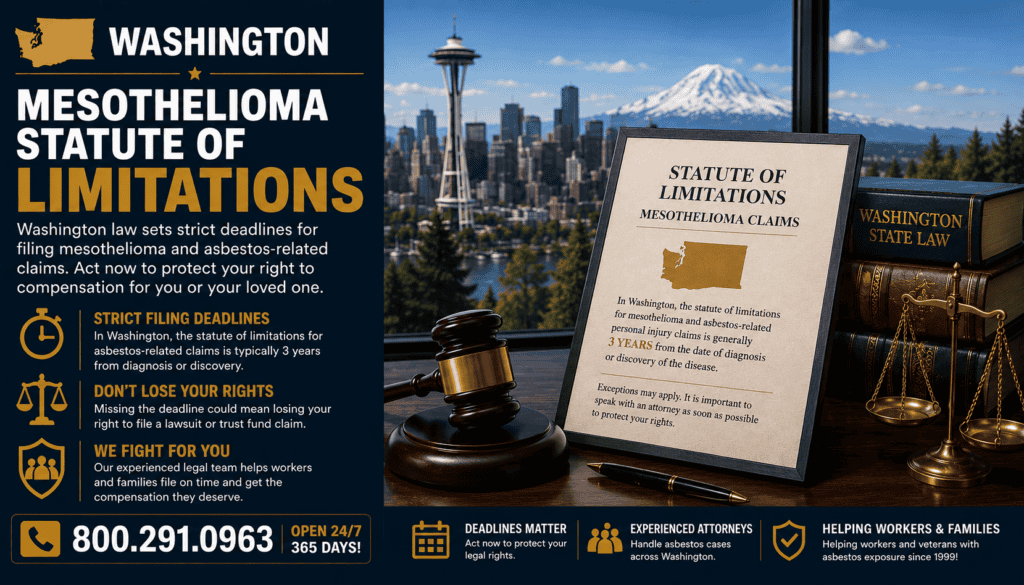
⏳ Washington Mesothelioma Statute of Limitations
Washington law limits how long people diagnosed with mesothelioma and other asbestos-related diseases have to file lawsuits. Separate deadlines may apply when a family pursues a wrongful death claim after losing a loved one.
These deadlines can be enforced even when the asbestos exposure occurred several decades earlier. The age of the exposure does not automatically prevent a claim, but waiting too long after a diagnosis or death may eliminate important legal options.
Washington generally applies a three-year limitations period to actions involving injury to a person. Washington’s wrongful death law permits a deceased person’s personal representative to bring an action for qualifying beneficiaries, but the precise filing deadline and the date on which it begins can depend on the facts and legal claims involved.
Because mesothelioma has a long latency period, the filing analysis often focuses on when the disease and its possible connection to asbestos exposure were discovered or reasonably should have been discovered—not simply the date when the worker encountered asbestos.
Failing to commence an action within the applicable period can permanently prevent compensation from that lawsuit, regardless of how serious the diagnosis or how strong the exposure evidence may be.
📞 If you or a loved one has been diagnosed with an asbestos-related disease, call 800-291-0963 for a confidential evaluation of the deadlines that may apply.
🚨 Washington Mesothelioma Deadline Evaluation
If you or a loved one was diagnosed with mesothelioma, asbestos-related lung cancer, asbestosis, or another occupational asbestos disease in Washington, a filing deadline may already be running.
📞 Call 800-291-0963
✔ No upfront costs
✔ Confidential case review
✔ Prompt evaluation of possible filing deadlines
✔ Help identifying asbestos exposure sources
✔ No legal fee unless compensation is recovered
⏱️ Washington Filing Deadlines for Asbestos Claims
Washington law generally requires actions involving injury to a person to be commenced within three years. This rule appears in RCW 4.16.080, which covers actions for injuries to a person or the rights of another that are not otherwise assigned a different limitations period.
The deadline applicable to a particular asbestos case may depend on:
The type of disease diagnosed
When the diagnosis occurred
When the person learned or reasonably should have learned that asbestos contributed to the illness
Whether the injured person is living
Whether a personal representative has been appointed
Where the exposure occurred
Where the defendants are located
Whether exposure occurred in more than one state
Whether the claim is a lawsuit, trust fund submission, workers’ compensation matter, or another form of recovery
Whether a government agency or public entity may be involved
Because these details can change the filing analysis, a person should not calculate the deadline solely from a general website description.
🩺 Personal Injury Mesothelioma Claims
A personal injury asbestos claim may be filed by a living person diagnosed with mesothelioma, asbestos-related lung cancer, asbestosis, or another qualifying disease.
Washington generally provides a three-year limitations period for injury-to-person claims. In a latent-disease case, however, determining when that period began can require a detailed review of the diagnosis, medical information, and the person’s knowledge of the possible asbestos connection.
For many people, exposure occurred decades before symptoms appeared. A worker may have handled asbestos in the 1960s, 1970s, or 1980s but not receive a mesothelioma diagnosis until much later.
The filing deadline is therefore not ordinarily calculated by simply counting three years from the original workplace exposure. Latent diseases present different discovery issues because the injury may not have been reasonably detectable when the exposure occurred.
A personal injury case may seek compensation for:
Medical expenses
Lost income
Reduced earning capacity
Pain and suffering
Loss of normal activities
Travel for treatment
Home-care expenses
Other losses caused by the disease
People considering a personal injury claim can learn more through our main Washington mesothelioma lawsuits resource.
👨👩👧 Washington Wrongful Death Claims
When a person dies from mesothelioma or another asbestos-related disease, the personal injury case and potential family claims require immediate legal review.
Washington’s wrongful death statute states that when a death results from another person’s wrongful act, neglect, or default, the deceased person’s personal representative may maintain an action for qualifying beneficiaries. Those beneficiaries can include a spouse, state-registered domestic partner, children, and stepchildren. Parents or siblings may qualify under specified circumstances when there is no spouse, registered domestic partner, or child.
Wrongful death actions are generally treated as subject to a three-year filing period, but the exact deadline and available claims should be determined by an attorney after reviewing the date of death, diagnosis history, estate status, and procedural circumstances.
A wrongful death case may seek compensation for losses such as:
Final medical expenses
Funeral and burial expenses
Loss of financial support
Loss of services
Loss of companionship
Loss of care and guidance
Other economic and noneconomic damages allowed by law
Families can review additional information on our Washington wrongful death mesothelioma lawsuits page.
🔍 How the Discovery Rule May Affect a Mesothelioma Claim
The discovery rule can delay the accrual of certain claims when an injury or its cause could not reasonably have been discovered when it occurred.
This principle is particularly important in latent-disease cases because a person may not experience symptoms for decades after asbestos fibers enter the body.
A filing-period analysis may consider when the person knew or reasonably should have known:
That a serious illness existed
That the illness may have resulted from asbestos exposure
That another party’s product or conduct may have contributed to the disease
A formal mesothelioma diagnosis is often a major date in this analysis, but it should not automatically be assumed to be the only legally relevant date.
Earlier medical findings, an asbestos-related diagnosis, physician statements, pathology reports, or knowledge of occupational exposure could affect when a defendant argues that the claim accrued.
The discovery rule is fact-dependent. It should not be treated as an automatic extension or a guaranteed exception to a missed deadline.
⚠️ Why Mesothelioma Filing Deadlines Are Frequently Missed
Asbestos victims and families can miss filing deadlines for several reasons.
Diagnosis occurs decades after exposure
Mesothelioma often develops long after the person worked around asbestos. Because so much time has passed, workers may assume their exposure is too old to support a case.
The age of the exposure does not necessarily prevent a claim. The more immediate concern is often the time that has passed since diagnosis, discovery, or death.
Early symptoms resemble other conditions
Shortness of breath, chest pain, fatigue, coughing, and weight loss can initially be attributed to other health problems. A delayed or incorrect diagnosis may complicate the filing timeline.
Families focus on treatment
After a diagnosis, patients and families understandably focus on medical appointments, treatment decisions, travel, caregiving, and household responsibilities.
Legal deadlines continue to run during this difficult period.
People do not know where exposure occurred
A worker may remember being exposed to dust but not know which products contained asbestos or which companies manufactured them.
Exact product identification is not required before contacting an attorney. An investigation can use employment records, facility histories, job duties, equipment records, and known product information.
Employers and manufacturers no longer operate
Some companies responsible for asbestos exposure closed, reorganized, merged, or entered bankruptcy decades ago.
A closed employer or manufacturer does not automatically mean compensation is unavailable. Lawsuits, successor-company claims, insurance sources, and asbestos trust funds may still require investigation.
Families do not know wrongful death claims exist
Surviving family members may not realize that the personal representative of an estate can potentially pursue a wrongful death action.
Waiting to appoint a representative or investigate the claim can consume valuable time.
📂 Claims That May Have Different Filing Rules
Not every form of asbestos compensation follows the same deadline or procedure.
Possible claims include:
🏦 Asbestos bankruptcy trust fund claims
⚖️ Personal injury lawsuits
👨👩👧 Wrongful death and estate claims
🛠️ Product liability claims
🏭 Claims involving industrial products and machinery
🚢 Maritime or shipyard exposure claims
🎖️ Veterans benefits and military exposure matters
🏛️ Claims involving public entities
🩺 Workers’ compensation or occupational disease matters
Each avenue may involve separate eligibility standards, forms, evidence requirements, and filing rules.
Even when one deadline appears to have passed, another potential source of compensation may remain available. That possibility should be evaluated rather than assumed.
🏦 Do Asbestos Trust Funds Have the Same Deadline?
Asbestos trust fund claims do not necessarily follow the same statute of limitations as a Washington civil lawsuit.
Each asbestos bankruptcy trust establishes its own procedures. A trust may require:
Proof of diagnosis
Evidence of exposure to the company’s products
Employment or job-site records
Compliance with the trust’s limitations rules
Medical documentation meeting trust criteria
Disclosure of other claims
Trust distribution procedures may also change over time.
Some trusts look to the statute of limitations that would have applied to an underlying lawsuit, while others have separate tolling, filing, or eligibility provisions. A person should not assume that an expired lawsuit deadline automatically permits or prevents every trust claim.
More information is available in our guide to Washington asbestos trust fund claims.
🌎 Exposure in More Than One State
Many Washington workers were exposed to asbestos in more than one jurisdiction.
A person may have:
Worked in Washington shipyards and later moved to another state
Served at military installations throughout the country
Worked for a railroad crossing state lines
Traveled to power plants, refineries, or industrial facilities
Handled products manufactured outside Washington
Lived in one state when diagnosed but experienced exposure elsewhere
These circumstances may raise questions about jurisdiction, applicable law, defendants, and filing deadlines.
The state where the person currently lives is not always the only possible location for a claim. An attorney may evaluate:
Where the exposure occurred
Where the responsible companies operated
Where the products were sold or used
Where the disease was diagnosed
Where the person lived during relevant periods
Whether another state’s limitations law may apply
Multiple-state exposure can make early review especially important.
🏛️ Claims Involving Government Entities
Special procedures may apply when a claim involves the State of Washington, a county, city, school district, public hospital, transit agency, or other government entity.
Government-related claims can involve notice requirements or procedural steps in addition to the ordinary statute of limitations.
A person exposed in a public building should not assume that the standard lawsuit deadline is the only date that matters.
Potential public exposure locations include:
Government offices
Schools
Hospitals
Municipal power facilities
Public transit garages
Utility buildings
Fire stations
Courthouses
Maintenance facilities
Public housing
More information about these locations is available in our Washington public and government buildings asbestos exposure guide.
🏭 Workplace History Can Affect the Filing Analysis
Identifying when and where asbestos exposure occurred is an important part of evaluating a claim.
Washington workers may have been exposed in:
Factories
Manufacturing plants
Power plants
Shipyards
Rail facilities
Construction sites
Public buildings
Maintenance shops
Automotive garages
Warehouses
Mills
Military installations
A worker may have encountered several asbestos sources across different employers and industries.
For example, an industrial maintenance worker could have been exposed to Washington industrial asbestos products, asbestos-containing industrial machinery, and Washington asbestos insulation products during the same period.
Construction employees may have encountered materials described in our Washington asbestos products used in construction guide.
Mechanics may have worked with Washington automotive asbestos products or asbestos-containing brake equipment.
A detailed exposure history can help an attorney identify the companies, products, job sites, and jurisdictions that may be involved.
📍 Washington Locations Connected to Asbestos Claims
Asbestos exposure occurred throughout Washington, including:
Seattle — Shipyards, industrial facilities, commercial buildings, power operations, construction sites, and automotive garages
Tacoma — Ports, manufacturing plants, mills, shipyards, power facilities, and heavy industry
Everett — Aerospace plants, manufacturing facilities, public buildings, shipyards, and industrial operations
Spokane — Rail facilities, power operations, public buildings, manufacturing plants, and construction sites
Auburn — Warehouses, fabrication shops, trucking operations, rail-adjacent industries, and maintenance yards
Exposure histories involving Seattle and Auburn may include facilities throughout King County.
Everett-area claims may involve sites throughout Snohomish County.
Eastern Washington cases may involve facilities throughout Spokane County.
Reviewing known Washington asbestos exposure sites may help workers and families remember former employers, facilities, and job locations.
📑 Evidence to Gather Before the Deadline Expires
A person does not need to assemble every record before speaking with an attorney. However, the following information can help begin the investigation:
Date of diagnosis
Type of asbestos-related disease
Pathology and biopsy reports
Medical providers and treatment centers
Employment history
Military service records
Union membership
Job titles and duties
Facility and job-site names
Approximate work dates
Coworker names
Products and equipment handled
Names of contractors or suppliers
Locations where the person lived
Date of death, when applicable
Estate or personal representative documents
Attorneys may be able to obtain additional records after identifying the likely claims.
Waiting to locate every document before requesting a deadline review can create unnecessary risk.
⚖️ How a Washington Asbestos Attorney Protects Filing Deadlines
A Washington asbestos attorney can evaluate the facts, determine which deadlines may apply, and take steps to preserve available claims.
An attorney can:
✔ Review diagnosis, discovery, and death dates
✔ Determine which statute of limitations may govern each claim
✔ Identify possible jurisdictions for filing
✔ Investigate exposure in Washington and other states
✔ Identify asbestos-containing products, manufacturers, and job sites
✔ Determine whether government notice requirements may apply
✔ File lawsuit and trust fund claims when appropriate
✔ Coordinate personal injury, estate, and wrongful death issues
✔ Preserve medical, employment, and witness evidence
✔ Commence the action in accordance with Washington filing and service requirements
Under RCW 4.16.170, an action may be deemed commenced for limitations purposes when the complaint is filed or the summons is served, whichever occurs first, subject to the statute’s service requirements. Filing paperwork without properly addressing service rules can therefore create serious procedural problems.
An attorney can also investigate compensation for people diagnosed with asbestos-related lung cancer through a Washington asbestos lung cancer lawsuit.
📞 Call 800-291-0963 to speak with a Washington asbestos attorney today.
❓ Washington Mesothelioma Statute of Limitations FAQs
Does Washington start the filing period on the exposure date?
Not necessarily. Mesothelioma is a latent disease that may not be discoverable for decades. The deadline analysis commonly considers when the disease and its possible cause were discovered or reasonably should have been discovered.
How long do I generally have to file a Washington personal injury claim?
Washington generally applies a three-year limitations period to actions involving injury to a person. The date on which that period starts in a latent asbestos-disease case can depend on the diagnosis, discovery, medical history, and other facts.
What if my diagnosis occurred more than three years ago?
Do not assume that every possible claim has expired. Exceptions, accrual disputes, claims under another state’s law, bankruptcy trust claims, or other compensation options may require evaluation.
Can a family file after a loved one dies?
Washington law allows a deceased person’s personal representative to bring a qualifying wrongful death action for designated beneficiaries. Strict deadlines and estate procedures apply, so the case should be evaluated promptly.
Do asbestos trust fund claims follow the same deadline?
Not always. Each asbestos trust has its own procedures, evidentiary standards, and limitations provisions. Delaying can still affect eligibility and available evidence.
What if I do not know where asbestos exposure occurred?
You may still be able to pursue a claim. Attorneys can investigate employment records, military service, job duties, union records, facility histories, products, equipment, and coworker information.
🧠 What You Should Do Next
📞 Call 800-291-0963 for a confidential Washington mesothelioma deadline evaluation.
📋 Gather the diagnosis date, pathology reports, medical records, employment history, job-site names, military records, and date of death when applicable.
📍 Review known Washington asbestos exposure sites to help identify former employers and exposure locations.
⚖️ Speak with an attorney before assuming that a claim is timely or expired. Waiting can permanently eliminate legal options.
⏳ Washington Mesothelioma Case Evaluation
If you or a loved one was diagnosed with mesothelioma, asbestos-related lung cancer, asbestosis, or another asbestos-related disease, filing deadlines may already be running.
A prompt case review can help determine which Washington laws, trust procedures, jurisdictions, and filing periods may apply.
📞 Call 800-291-0963
✔ No upfront costs
✔ Confidential case review
✔ Prompt evaluation of potential filing deadlines
✔ Help identifying asbestos exposure sources
✔ Assistance pursuing lawsuits and asbestos trust fund claims
✔ No legal fee unless compensation is recovered