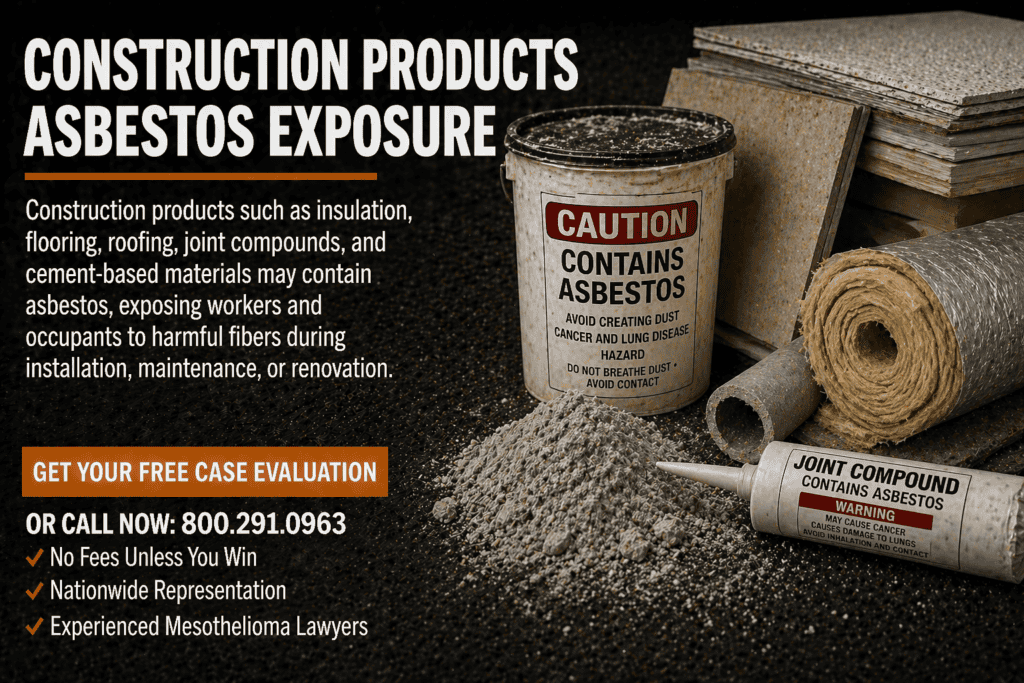
Construction Products Asbestos Exposure
Construction products once incorporated asbestos in insulation, floor coverings, roofing, cement materials, textured finishes and other building components. Disturbing certain older materials during installation, repair or demolition could release fibers into the air.
Workers and families seeking to understand a mesothelioma diagnosis can begin by identifying the specific material, construction task, job location and years involved rather than assuming every building product contained asbestos.
Construction Materials That Historically Contained Asbestos
Asbestos was added to some building materials for fire resistance, reinforcement, durability and insulation. Examples include certain asbestos-cement sheets, pipe insulation, vinyl floor tiles, mastics, roofing products, sprayed fireproofing and joint compounds. Formulations varied by manufacturer, product line and year. A product category alone cannot establish that a particular item contained asbestos.
Reviewing original packaging, specifications, purchase records and material surveys may help distinguish asbestos-containing products from visually similar alternatives. A wallboard, floor tile or roof shingle should not be identified as asbestos-containing solely from its appearance.
An important distinction is between the date a building was constructed and the date a worker disturbed a material. Older products could remain in place for many years, and renovations could bring different crews into contact with them. Documentation should record both dates whenever possible.
When reconstructing an older exposure, distinguish a documented product from a possible product. A photograph, purchase order or eyewitness account may establish different parts of the story. The strongest chronology states the evidence for each assertion, gives an approximate date when exact dates are unavailable, and identifies what still needs checking. This approach also helps avoid confusing a product category with a particular manufacturer or a current non-asbestos formulation.
Where Construction Exposure Could Occur
Potential exposure settings included new construction, renovation of older commercial properties, demolition, school maintenance, shipyard construction and residential remodeling. Tasks involving sawing, drilling, sanding, scraping or tearing out asbestos-containing material could release airborne fibers. Dust may also travel beyond the worker performing the task.
An electrician working alongside a demolition crew, for example, could have encountered dust without installing insulation personally. Whether meaningful exposure occurred requires attention to the actual material, disturbance, ventilation, proximity and duration.
Construction projects often involve several employers at once. A general contractor, specialty subcontractor and property owner may hold different records. Identifying who purchased, installed, maintained or removed a material can make a timeline more precise without assigning legal responsibility prematurely.
A useful interview asks what the worker actually did on an ordinary day: which surfaces were opened, which tools were used, where waste went and whether coworkers performed dusty work nearby. The answers can vary greatly even within one occupation. Avoid assuming that every task involved asbestos. The relevant question is whether a particular asbestos-containing material was disturbed under conditions that could produce inhalable dust.
Trades and Work Activities
Insulators, carpenters, floor installers, roofers, plasterers, pipefitters, laborers and demolition workers may have encountered different asbestos-containing construction products. Their potential exposure routes were not interchangeable. A floor installer might cut old tile or remove adhesive, while an insulator could handle pipe covering.
Record the trade, tasks, tools, subcontractors and building areas involved. Do not infer a specific product manufacturer from a job title. Coworkers may recall deliveries, bags, labels or maintenance practices that the worker no longer remembers.
Materials may have been substituted during construction or later maintenance. A specification calling for one product does not conclusively prove it was installed. Receipts, change orders and witness accounts can help test that assumption.
Records from several sources can sometimes corroborate one another. A job title establishes employment, a service ticket may identify a repair, and a catalog may describe the composition of a part sold during that period. None of these records necessarily proves every remaining element alone. Keep originals or clear copies, note where they came from and avoid changing old documents to make the timeline appear more certain.
Renovation and Demolition Risks
Legacy asbestos-containing materials can remain in structures long after their original installation. Damage, repair and removal are important considerations because intact material does not necessarily release fibers at the same rate as material that is aggressively disturbed. EPA and OSHA describe risks from renovation and demolition involving asbestos.
People who suspect asbestos should avoid scraping or sampling materials themselves. Qualified professionals can assess materials and applicable abatement requirements. Legal documentation and safe building management are separate needs; collecting evidence should never require creating dust.
A family should avoid collecting samples or disturbing damaged material for the sake of a claim. Qualified asbestos professionals can advise on identification and safe management under applicable requirements.
For someone who is currently concerned about material in a workplace or building, do not attempt to identify asbestos by sight or disturb a suspected component. Appropriate inspection, sampling and controls belong with qualified professionals following applicable rules. This safety question is different from the retrospective legal question of whether a person encountered a specific product decades earlier. Both deserve careful handling.
Identifying Products and Manufacturers
Useful evidence may include job specifications, building permits, invoices, contractor records, photographs, asbestos surveys, product catalogs and coworkers’ accounts. Names printed on packaging can help, but brand ownership and product composition may change over time. The relevant product must be tied to the right years and worksite.
A claim review may consider more than one potential exposure source, including prior industrial work, military service and household exposure. Organize what is known separately from recollections that need corroboration.
Evidence can be incomplete after several decades. A missing invoice does not prove an exposure never occurred, and an old catalog does not prove a particular product was used at a site. Responsible assessment weighs both strengths and limits of records.
Manufacturers may have offered several versions of a product over time. A modern online listing, an old advertisement and a current company name may refer to different materials or corporate entities. Look for the part number, installation date and supplier where possible. If records are missing, a responsible article should acknowledge uncertainty rather than turn a general industry practice into a definite claim about an individual.
Health Effects and Medical Documentation
Asbestos exposure is an established cause of mesothelioma and can also contribute to other diseases. Mesothelioma often develops decades after exposure. A diagnosis should be established by qualified medical professionals, and symptoms alone cannot determine the disease or identify which product caused it.
Preserve pathology reports, imaging summaries, treatment records and an accurate work history. Medical care should proceed independently of legal decisions. A physician can explain diagnosis and treatment, while an attorney can assess applicable evidence and legal options.
Mesothelioma treatment decisions belong with the medical team. Legal consultations should not replace medical evaluation, and the process of gathering old construction records should be paced around the patient’s health and priorities.
Mesothelioma symptoms and treatment choices should be discussed with a medical professional. Work-history details may be relevant to understanding potential exposures, but they cannot substitute for pathology or other clinical evidence. Families may find it useful to maintain separate medical, employment and legal folders so that each professional receives the records relevant to their role without mixing assumptions into established facts.
Lawsuits, Trusts and Compensation Options
Depending on the facts and jurisdiction, a person diagnosed with mesothelioma may consider a civil lawsuit, a bankruptcy trust claim or other benefits. These processes have different standards and may require evidence connecting a product or responsible entity to exposure. A building containing asbestos does not by itself prove a legal claim.
Deadlines differ by state and claim type. A lawyer can review work history, available documents and potential defendants while explaining fees, proof requirements and the interaction of lawsuits and trusts. No particular recovery amount should be assumed.
Civil litigation and asbestos trusts are distinct processes. A claim against one entity does not establish eligibility against another, and disclosure requirements may affect how different claims are coordinated.
Different compensation routes can have different documentation rules, deadlines and disclosure obligations. A trust claim is not necessarily the same as a lawsuit against an operating company. Nor does identifying a historical asbestos product guarantee that a particular person qualifies for compensation. A case review should clarify the legal theory, the evidence still needed, who would handle the matter and what costs or fees could apply.
Practical Steps for Families
Begin with a chronological list of buildings, employers, contractors and job duties. Add approximate dates, coworkers, materials and any photographs or paperwork. Identify gaps rather than filling them with guesses. If the person is receiving treatment, a family member can help organize documents with permission.
Prioritize medical appointments, safety and accurate records. A concise account of where dust arose, who handled the material and what happened afterward is often more useful than a broad claim that an entire construction site was hazardous.
If several construction jobs occurred over a lifetime, include all of them. Narrowing the history too early may overlook relevant materials or alternative sources of exposure.
Families can prepare a brief summary before speaking with an attorney: diagnosis and date, principal jobs, relevant tasks, approximate exposure years, product names remembered and documents available. It is appropriate to say “unknown” when a detail cannot be recalled. Ask how time limits may apply, which records are most useful and how medical priorities can be respected during any review.
❓ Frequently Asked Questions
Did every construction product contain asbestos?
No. Composition depended on the product, manufacturer and period. Testing and records may be needed.
Can renovation of an old building release asbestos?
Yes, when asbestos-containing materials are disturbed. Qualified assessment and appropriate controls are important.
What documents can identify construction products?
Specifications, invoices, product labels, surveys, permits, photographs and coworker accounts may help.
Can bystanders have exposure?
People working nearby may have inhaled dust released by other trades, depending on circumstances.
Does a diagnosis prove which product was involved?
No. Medical diagnosis and product-specific exposure evidence answer different questions.
Are filing deadlines uniform?
No. They depend on state law, claim type and individual circumstances.
Sources and References
Authoritative background: EPA — Learn About Asbestos; OSHA — Asbestos Overview; EPA — Historical Product Uses; EPA — Chrysotile Asbestos Risk Management. Product-specific claims require independent supporting evidence.
📞 Get the Mesothelioma Help & Compensation You Deserve — Contact Us Today!
After a mesothelioma diagnosis, we can help you organize asbestos exposure information and understand potential compensation options. Eligibility and outcomes depend on individual facts and applicable rules.
For 25+ years, we have helped veterans, workers, and families find information and explore their next steps.
📲 Contact Us Today — Three Easy Ways!
CALL: 800.291.0963 for a free case review.
LIVE CHAT: Available 24/7/365 through the website.
CONTACT FORM: Use the form below.
Disclaimer: This information is not be considered as legal or medical advice. Mesothelioma Help Center is not a law firm or medical provider and does not determine legal or VA eligibility.