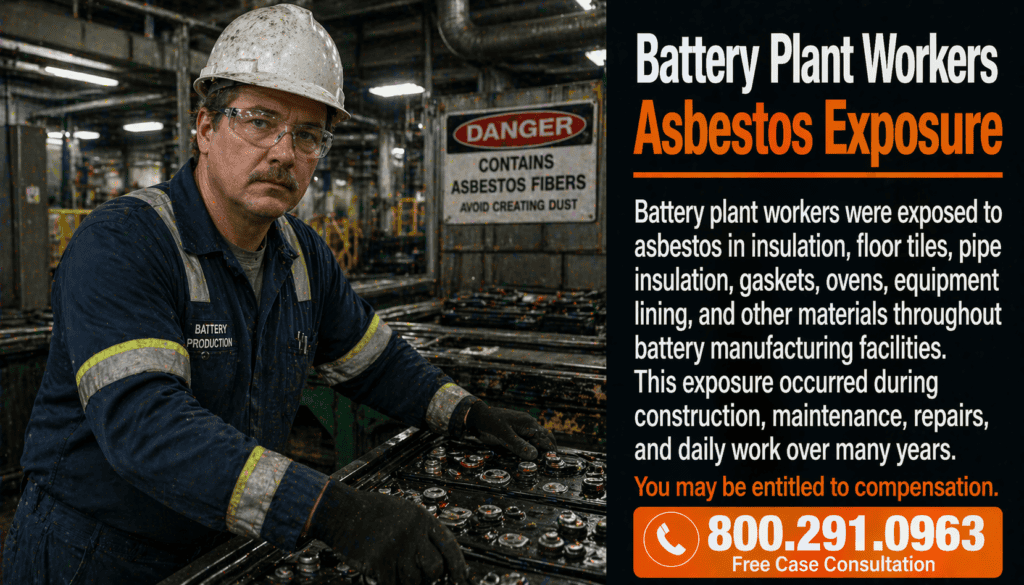
Battery Plant Workers Asbestos Exposure
Battery plant workers have manufactured, assembled, formed, inspected, maintained and recycled many types of batteries. Battery manufacturing should not automatically be described as asbestos work: NIOSH’s extensive evaluations of lead-acid battery plants focus primarily on hazards such as lead, arsenic, antimony and sulfuric acid. However, NIOSH also documented a specialized thermal-battery manufacturing process in which asbestos was deliberately mixed with zirconium and incorporated into battery components.
Potential asbestos exposure therefore depended heavily on the plant, battery technology, time period, raw materials and maintenance work performed. Workers may also have encountered separately documented asbestos-containing insulation or other legacy materials in older industrial facilities. A credible history should distinguish confirmed asbestos sources from the well-documented lead and chemical hazards of conventional battery manufacturing.
Battery Plant Workers and Occupational Asbestos Exposure
Battery manufacturing can include raw-material preparation, grid casting, plate pasting, assembly, welding, electrolyte filling, charging, inspection, maintenance and recycling. The hazards differ substantially by battery type and process.
NIOSH Health Hazard Evaluation 80-096-1359 documented direct asbestos use in a thermal-battery manufacturing operation. The report states that zirconium and asbestos were screeded and mixed with water to form a slurry, pressed into sheets and cut into donut-shaped pieces. Those zirconium/asbestos components were later combined with other materials inside a metal case to produce a thermal battery.
This is strong primary evidence that asbestos was used in at least one documented battery-manufacturing process. It should not be generalized to every battery factory or to ordinary lead-acid batteries.
NIOSH’s evaluations of conventional storage-battery manufacturing instead repeatedly identify lead as a dominant occupational hazard. A 2026 NIOSH overview specifically lists lead-acid battery recycling among workplaces where lead exposure remains important.
Related resources include automotive mechanics and heavy equipment workers asbestos exposure, industrial and manufacturing factory workers asbestos exposure, production workers asbestos exposure and factory workers asbestos exposure.
Where Asbestos Could Be Found in Battery Plants
Potential asbestos sources depended on the specific factory and process. Relevant sources can include:
- Specialized thermal-battery components: NIOSH documented asbestos deliberately mixed with zirconium in one thermal-battery manufacturing process
- Raw-material preparation: workers handling asbestos before or during preparation of a documented asbestos-containing battery component
- Process equipment: older industrial machinery or high-temperature systems where separate records confirm asbestos-containing insulation, gaskets or heat-resistant materials
- Steam and utility systems: older pipes, boilers or mechanical systems where asbestos-containing thermal insulation is documented
- Building materials: legacy asbestos-containing materials in older factories when disturbed during maintenance, renovation or demolition
Lead-acid battery materials should not be mislabeled as asbestos. NIOSH evaluations of storage-battery plants identify lead, arsenic, antimony, arsine, stibine, sulfuric acid and other process hazards. Those substances are separate from asbestos.
The strongest asbestos claim therefore identifies a specific asbestos-containing battery process or separately documented asbestos-containing plant material rather than relying on the words “battery plant” alone.
How Battery Plant Workers Could Encounter Asbestos
When asbestos was actually present, exposure could occur through direct handling or disturbance of asbestos-containing material.
- Raw-material handling: receiving, measuring or moving asbestos used in a documented manufacturing process
- Mixing: combining asbestos with other raw materials before wet processing
- Component production: pressing, cutting or handling asbestos-containing battery components
- Cleanup: disturbing residual asbestos-containing material or settled dust from a confirmed asbestos process
- Equipment maintenance: repairing older machinery, piping or thermal systems with documented asbestos-containing components
- Renovation: disturbing confirmed asbestos-containing factory building materials
- Nearby work: working close to operations where asbestos-containing materials were disturbed
NIOSH’s thermal-battery report provides direct process evidence because asbestos was intentionally combined with zirconium. The report also shows why each plant must be researched individually: the evaluated operation was a specialized thermal-battery process, not a generic description of battery manufacturing.
For conventional lead-acid plants, NIOSH’s primary-source evidence centers much more strongly on lead exposure. Keeping these hazards separate improves factual accuracy and helps identify the actual exposure pathway.
Battery Manufacturing, Assembly and Maintenance Areas
A credible occupational history identifies the employer, plant, battery type, department, dates, materials and work tasks.
Raw-Material Areas
NIOSH’s thermal-battery investigation documented asbestos and zirconium being prepared together in a raw-material area. Workers assigned to raw-material preparation can therefore be especially important when reconstructing exposure at a facility that used this process.
Battery Assembly Areas
Assembly workers can handle plates, cases and other battery components. Whether asbestos exposure occurred depends on whether the specific components handled contained asbestos. Conventional battery assembly should not be assumed to involve asbestos.
Lead-Acid Battery Plants
NIOSH has repeatedly evaluated storage-battery manufacturing for lead. One large NIOSH evaluation assessed inorganic lead, arsenic, antimony, arsine, stibine, sulfuric acid and related hazards across battery-plant job categories. These findings are important because lead exposure is distinct from asbestos exposure.
Battery Recycling Operations
NIOSH currently identifies lead-acid battery recycling as a common occupational lead-exposure setting. Recycling work does not by itself establish asbestos exposure; an asbestos source must be separately documented.
Maintenance and Utility Areas
Maintenance workers can encounter materials outside the battery-production process. In older industrial plants, asbestos exposure may be relevant if maintenance disturbed documented asbestos-containing insulation, gaskets, piping, boilers or building materials.
Older Industrial Buildings
Battery factories can occupy older industrial structures. Building age alone does not prove asbestos. Material surveys, abatement records, laboratory reports and maintenance records can help establish whether asbestos-containing materials were actually present and disturbed.
Related resources include industrial and manufacturing factory workers asbestos exposure, production workers asbestos exposure, factory workers asbestos exposure, maintenance workers asbestos exposure, maintenance mechanics asbestos exposure and high-risk jobs asbestos exposure.
Secondary or Household Exposure
NIOSH recognizes that workplace contaminants can be carried home on clothing and other items. For an asbestos household-exposure history, however, the original workplace asbestos source should first be established rather than inferred from battery-plant employment alone.
Need help now? Call 800.291.0963
Live chat available 24/7, 365 days a year.
Submit Your Case
Asbestos Health Risks and Other Battery Plant Hazards
Asbestos exposure is associated with serious diseases including mesothelioma, lung cancer and asbestosis. Those risks become relevant to a battery-plant worker when actual occupational asbestos exposure can be supported by process, material, job or facility evidence.
Battery workers may also face important hazards unrelated to asbestos. NIOSH identifies lead exposure as a major concern in manufacturing and specifically in lead-acid battery recycling. Historical battery-plant evaluations also examined arsenic, antimony, sulfuric acid and other substances.
These hazards should not be combined. Lead exposure does not establish asbestos exposure, and asbestos exposure does not establish lead poisoning. Each requires its own workplace and medical evidence.
Medical questions about asbestos, lead or other occupational exposures should be discussed with a qualified healthcare professional.
Documenting a Battery Plant Exposure History
A useful investigation identifies the employer, plant, battery technology, department, dates, materials and tasks associated with possible asbestos exposure.
- Employment evidence: plant, employer, department, payroll, W-2, union and Social Security earnings records
- Process evidence: thermal-battery, lead-acid, assembly, recycling or other manufacturing process
- Material evidence: raw-material specifications, formulas, safety data, purchase records and laboratory analyses
- Task evidence: mixing, pressing, cutting, assembly, cleanup, maintenance, insulation work or renovation
- Plant evidence: industrial-hygiene surveys, NIOSH evaluations, OSHA records, abatement reports and facility drawings
- Product evidence: battery specifications, technical manuals, production records and supplier documentation
- Witness evidence: production workers, maintenance employees, supervisors, industrial hygienists and coworkers
For specialized battery manufacturing, process descriptions can be especially valuable. NIOSH’s thermal-battery investigation, for example, documented where asbestos entered the production process and how the asbestos-containing component was made.
Questions That Can Strengthen an Exposure History
Which plant and years? What type of batteries were made? What department and job? Were raw materials mixed onsite? Was asbestos listed in formulas or specifications? Did the worker maintain insulated equipment or piping? Are purchasing records, industrial-hygiene reports, abatement records or coworker statements available? These details can help identify a specific asbestos pathway.
Asbestos Lawsuits, Trust Funds and Compensation
A battery plant worker diagnosed with mesothelioma or another asbestos-related disease may have potential legal or compensation options when evidence supports occupational asbestos exposure and applicable requirements are met. Possible avenues can include claims involving legally responsible companies and asbestos bankruptcy trusts.
Battery-plant employment alone does not establish asbestos exposure, liability or trust eligibility. Each claim has separate medical, exposure, company, product and filing requirements. Evidence connecting the worker to a documented asbestos-containing process, product or plant material may be necessary.
Potential evidence includes employment and Social Security records, union records, process specifications, purchase orders, safety data, production manuals, NIOSH or OSHA records, asbestos surveys, abatement records, photographs, coworker statements and medical documentation. Applicable law and filing deadlines should be reviewed individually.
Related Industrial and Maintenance Resources
Industrial work: Industrial & Manufacturing Factory Workers Asbestos Exposure · Factory Workers Asbestos Exposure
Production work: Production Workers Asbestos Exposure
Maintenance: Maintenance Workers Asbestos Exposure · Maintenance Mechanics Asbestos Exposure
Authoritative Sources
This page was researched using NIOSH government records. The strongest asbestos-specific evidence is a NIOSH Health Hazard Evaluation documenting asbestos as an intentional raw material in a specialized thermal-battery process. Other NIOSH battery-manufacturing records are used to distinguish asbestos from the much more broadly documented lead and chemical hazards of conventional storage-battery production.
- NIOSH — HHE 80-096-1359, Thermal Battery Manufacturing
- NIOSH — HHE 78-98-710, Battery Manufacturing Plant
- NIOSH — HHE 77-28-552, Storage Battery Manufacturing
- NIOSH — Occupational Lead Exposure HHEs, Including Battery Manufacturing
- NIOSH — Lead in the Workplace and Lead-Acid Battery Recycling
- NIOSH — Understanding Occupational Lead Exposure Risk
Battery Plant Workers Asbestos Exposure FAQ
Was asbestos ever used directly in battery manufacturing?
Yes, in at least some specialized processes. NIOSH documented a thermal-battery operation where asbestos was mixed with zirconium, pressed into sheets, cut into components and incorporated into batteries.
Did all battery plants use asbestos?
No. The documented thermal-battery process should not be generalized to every battery factory. Conventional lead-acid battery manufacturing is much more strongly associated in NIOSH records with lead and other chemical hazards.
Is lead in a battery the same as asbestos?
No. Lead and asbestos are different workplace hazards. Evidence of lead exposure does not prove asbestos exposure.
Could battery plant maintenance workers encounter asbestos?
Potentially, if they disturbed separately documented asbestos-containing insulation, gaskets, piping, boilers, machinery components or building materials in an older facility.
What evidence can show asbestos was used in a battery process?
Process specifications, raw-material records, safety data, purchase orders, technical manuals, industrial-hygiene reports and government investigations can help identify asbestos use.
Could battery plant workers have take-home exposure?
Potentially, if a worker was actually exposed to asbestos and contaminated clothing or belongings carried fibers away from the plant. The original asbestos source should first be established.
What other hazards are important in battery plants?
NIOSH has extensively documented lead exposure in battery manufacturing and recycling. Historical evaluations also examined arsenic, antimony, sulfuric acid and other process hazards.
Can battery plant workers qualify for asbestos trust fund claims?
Some may qualify if they meet a trust’s medical and exposure requirements and can connect their work to a covered asbestos product, company or qualifying exposure period. Battery-plant employment alone does not establish eligibility.
Get Help Reviewing a Battery Plant Exposure History
Call 800.291.0963
Live chat is available 24/7, 365 days a year.
Prior battery manufacturing, assembly, maintenance or recycling work does not automatically prove asbestos exposure, disease causation, liability, claim eligibility or compensation. Each situation depends on the plant, battery technology, dates, department, materials, tasks, asbestos-content evidence, medical evidence and applicable legal requirements. Compensation is not guaranteed.
⚕️ Legal & Medical Information Disclaimer
This page provides general educational information and is not medical or legal advice. The information does not establish asbestos exposure, diagnosis, causation, liability, claim eligibility or compensation. Medical concerns should be discussed with a qualified healthcare professional, and legal questions should be reviewed with a qualified attorney.