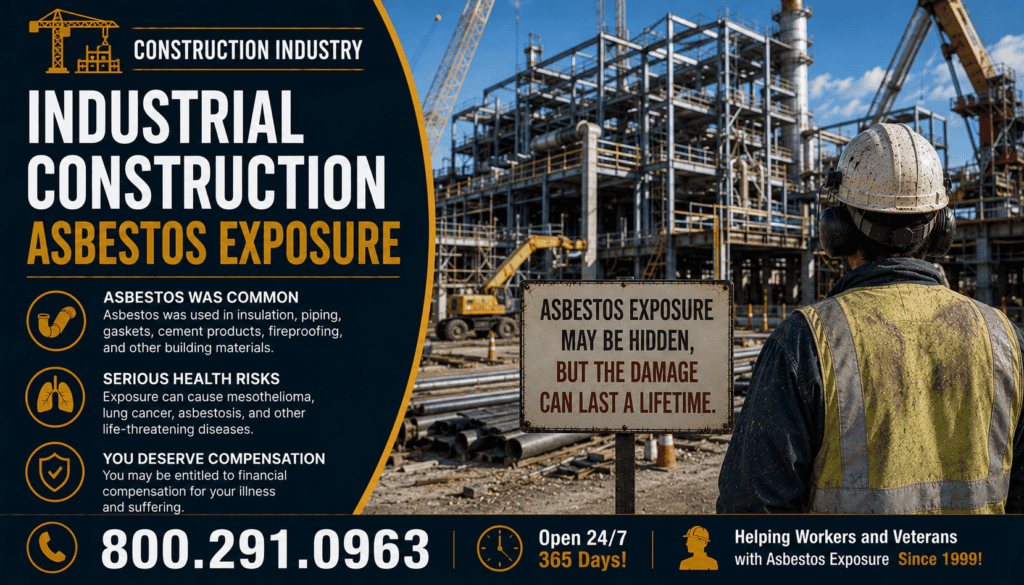
🏭 Industrial Construction Asbestos Exposure
Industrial construction exposed workers to extreme levels of asbestos through factories, power plants, refineries, mills, and heavy industrial facilities that relied on asbestos for heat resistance, fireproofing, and mechanical insulation.
Among all construction environments, industrial job sites produced some of the highest asbestos exposures ever recorded. From the 1930s through the late 1980s, asbestos was considered essential for industrial safety and efficiency. It lined boilers, furnaces, pipes, turbines, reactors, and structural steel—often in friable (easily crumbled) forms.
Workers involved in industrial construction frequently handled raw asbestos materials directly, cut or mixed asbestos products on site, and worked in enclosed, poorly ventilated environments—creating intense and repeated inhalation risks.
🧱 Why Asbestos Was Used in Industrial Construction
Industrial facilities faced hazards far beyond residential or commercial buildings.
Asbestos was chosen because it:
-
🔥 Withstood extreme heat and flame
-
⚙️ Insulated high-pressure systems
-
🧯 Provided fireproofing for steel structures
-
🧪 Resisted chemical corrosion
-
💪 Reinforced cement and refractory materials
-
💲 Reduced equipment replacement costs
Its use was systemic, not occasional.
🏗️ Common Industrial Construction Materials Containing Asbestos
Industrial construction incorporated asbestos into nearly every system.
🧰 High-risk asbestos materials included:
-
🔥 Boiler insulation and refractory linings
-
🌡️ Steam pipes and pressure vessels
-
⚙️ Turbines, pumps, and compressors
-
🧯 Spray-on fireproofing for steel beams
-
🧱 Cement panels, block, and refractory brick
-
⚡ Electrical panels, arc chutes, and cable insulation
-
🧱 Furnace doors, gaskets, and seals
-
🧱 Expansion joints and vibration dampeners
Many of these materials shed fibers continuously as they aged.
👷 How Industrial Construction Exposure Occurred
Exposure happened during routine tasks—not just accidents.
Common exposure scenarios:
-
🧰 Installing or removing insulation
-
🔥 Lining furnaces and kilns
-
🔧 Cutting or grinding asbestos cement
-
🧱 Spraying fireproofing onto steel
-
🛠️ Repairing boilers and turbines
-
🧹 Cleanup after construction phases
-
🏚️ Demolition of aging industrial structures
Dust levels were often thousands of times above safe limits.
🧑🏭 Workers Most at Risk in Industrial Construction
Industrial construction exposed a wide range of trades.
High-risk job roles include:
-
🧱 Insulators and fireproofers
-
🔧 Pipefitters and boilermakers
-
⚙️ Millwrights
-
🛠️ Maintenance mechanics
-
🔌 Industrial electricians
-
🧑🏭 Welders and metal workers
-
🧹 Laborers and cleanup crews
-
👷 Supervisors and foremen
Many workers rotated across multiple industrial sites, compounding exposure.
🏢 High-Risk Industrial Facility Types
Industrial asbestos exposure was especially severe at:
-
🏭 Power plants
-
🛢️ Oil refineries
-
🧪 Chemical plants
-
🏗️ Steel mills
-
🧻 Paper mills
-
🏭 Foundries and casting plants
-
🚢 Shipyards and dockside facilities
-
⚙️ Manufacturing complexes
These sites often operated 24/7, increasing airborne fiber circulation.
🫁 Diseases Linked to Industrial Construction Asbestos Exposure
Because exposure levels were often extreme, disease risk was high.
Common diagnoses include:
-
Mesothelioma (pleural and peritoneal)
-
Asbestos-related lung cancer
-
Asbestosis
-
Diffuse pleural thickening
Many industrial workers are diagnosed earlier and more aggressively than other exposure groups.
⚠️ Why Industrial Construction Exposure Was So Dangerous
Several factors intensified risk:
-
❌ Friable asbestos used extensively
-
❌ Enclosed spaces with poor ventilation
-
❌ Long shifts and overtime
-
❌ No respirators or warnings
-
❌ Multiple asbestos products used simultaneously
Workers often inhaled fibers daily for years.
⚖️ Legal Options for Industrial Construction Asbestos Victims
Victims may qualify for substantial compensation through:
-
⚖️ Asbestos personal injury lawsuits
-
🏦 Multiple asbestos trust fund claims
-
⚰️ Wrongful death lawsuits (for families)
-
🇺🇸 VA benefits (for veterans on industrial bases)
Claims are typically filed against manufacturers, not employers.
🧑⚖️ How a Lawyer Can Help With Industrial Construction Claims
An experienced asbestos lawyer can:
-
🔍 Identify asbestos products used at industrial sites
-
📂 Reconstruct work histories across decades
-
🏭 Match exposure to responsible manufacturers
-
🏦 File multiple trust fund claims simultaneously
-
⚖️ File lawsuits in favorable jurisdictions
-
⏱️ Protect statute of limitations deadlines
-
🤝 Manage complex, high-value claims
Industrial cases often qualify for some of the highest compensation levels.
❓ Frequently Asked Questions (FAQs)
❓ I worked industrial construction in the 1970s—can I still file?
Yes. Most deadlines start at diagnosis, not exposure.
❓ What if the plant is closed?
Claims are filed against product manufacturers, not facilities.
❓ Were industrial exposures worse than residential?
Often yes—due to friable materials and heat degradation.
❓ Can contractors file claims?
Yes. Employment status does not affect eligibility.
❓ Can families file after death?
Yes. Wrongful death and trust fund claims may still be available.
📞 Get Help for Industrial Construction Asbestos Exposure
If you worked in industrial construction and were later diagnosed with mesothelioma or another asbestos-related disease, significant compensation may still be available—even decades later.
📌 You May Qualify For:
-
High-value asbestos lawsuits
-
Multiple asbestos trust fund claims
-
Wrongful death compensation
-
VA benefits (if applicable)
📞 Call 800-291-0963 for a free, confidential industrial construction asbestos exposure review
⏱️ No upfront costs • Nationwide representation • Deadline-protected claims
Industrial asbestos exposure was widespread—your case deserves full accountability.