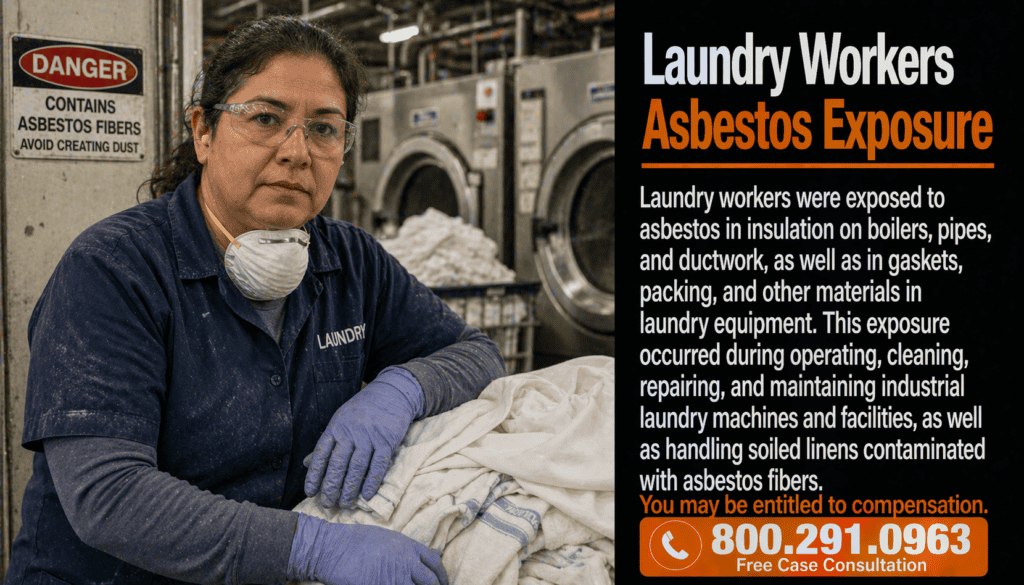
Laundry Workers Asbestos Exposure
Laundry workers can have a distinct occupational asbestos exposure pathway when they handle work clothing or protective garments contaminated at asbestos workplaces. OSHA specifically regulates the laundering of asbestos-contaminated clothing, requires employers to warn the person doing the laundering about asbestos hazards, and requires contaminated clothing to be transported in sealed, labeled containers.
This does not mean ordinary household, hotel, hospital or commercial laundry work involved asbestos. A credible history should identify where contaminated garments came from, which workers or industries generated them, how they were transported and sorted, and whether laundry employees handled them before effective containment or decontamination.
Laundry Workers and Occupational Asbestos Exposure
OSHA’s general-industry asbestos standard directly addresses employees and other persons who launder asbestos-contaminated protective clothing. Employers must ensure that laundering is performed so airborne asbestos fibers are not released above applicable exposure limits and must inform the person laundering the clothing of asbestos’s potentially harmful effects.
Historical NIOSH evidence also demonstrates that asbestos fibers could accumulate visibly on workers’ clothing and potentially expose people who later contacted those garments. This provides a direct occupational pathway for laundry employees when the clothing they received was genuinely asbestos-contaminated.
Potential exposure could involve laundry workers serving asbestos manufacturing plants, shipyards, construction or abatement contractors, industrial facilities, power plants or other workplaces where employees’ garments became contaminated with asbestos fibers.
The source must still be established. Handling ordinary dirty work clothes does not prove asbestos exposure.
Related resources include textile, apparel and consumer goods manufacturing workers asbestos exposure, industrial, manufacturing and factory workers asbestos exposure, shipyard workers asbestos exposure and construction workers asbestos exposure.
Asbestos-Contaminated Work Clothing
Asbestos fibers can be carried on contaminated work clothing. NIOSH identifies asbestos among substances that can be transported from work on clothing, shoes, skin or hair, potentially exposing other people.
OSHA requires asbestos-contaminated work clothing to be placed in closed containers that prevent asbestos dispersion. Clothing removed from the workplace for cleaning must be transported in sealed impermeable bags or other closed impermeable containers and properly labeled.
Garments and Items Worth Investigating
- Coveralls worn during documented asbestos work
- Work uniforms contaminated in asbestos manufacturing or processing
- Protective garments used during asbestos maintenance or abatement
- Clothing from shipyard or industrial asbestos work
- Reusable protective equipment sent to a laundry for cleaning
- Other garments documented as contaminated with asbestos fibers
The strongest evidence identifies both the asbestos-generating workplace and the laundry that received its garments. Contracts, invoices, customer lists, uniform-service records and testimony from workers can help make that connection.
Sorting, Handling and Laundering Tasks
Potential exposure can occur before garments are fully contained or cleaned. Laundry employees may unload bags, sort clothing, transfer garments between containers, load washers, remove cleaned items, maintain laundry equipment or clean work areas.
Tasks Worth Investigating
- Opening containers holding documented asbestos-contaminated clothing
- Sorting contaminated uniforms or protective garments by hand
- Shaking, moving or transferring contaminated clothing
- Loading garments into washers or other cleaning equipment
- Cleaning lint, dust or debris associated with contaminated garments
- Maintaining equipment used to process asbestos-contaminated clothing
- Handling contaminated reusable protective equipment
OSHA specifically prohibits removing asbestos from protective clothing and equipment by blowing or shaking. That rule is important because agitation can disperse fibers from contaminated garments.
Historical NIOSH recommendations likewise emphasized that contaminated work clothing should not be taken home and that family members could otherwise be exposed.
Need help now? Call 800.291.0963
Live chat available 24/7, 365 days a year.
Submit Your Case
Commercial and Industrial Laundry Exposure
Commercial or industrial laundries may process uniforms and protective clothing from multiple employers. Asbestos risk depends on whether a laundry actually accepted contaminated clothing from asbestos workplaces and whether appropriate containment, notification and cleaning controls were used.
OSHA’s asbestos standard anticipates this circumstance by requiring an employer who sends contaminated clothing to another person for laundering to inform that person about the need to prevent airborne fiber release and the potentially harmful effects of asbestos exposure.
Records Worth Reviewing
- Laundry customer and service contracts
- Uniform pickup and delivery records
- Invoices identifying industrial customers
- Records showing asbestos-contaminated garments were accepted
- Container and labeling procedures
- Laundry safety and asbestos training records
- Industrial-hygiene or air-monitoring reports
- Equipment-cleaning and maintenance records
A laundry serving an industrial customer is not enough by itself. Evidence should connect the customer to asbestos work and show that contaminated clothing or equipment was sent to the laundry.
NIOSH’s historical review of workplace-to-home contamination also found that normal cleaning and laundry methods can be inadequate for some hazardous contaminants, including asbestos, reinforcing the importance of preventing contamination from leaving the workplace in the first place.
OSHA Controls for Asbestos-Contaminated Clothing
OSHA’s general-industry asbestos standard contains specific protective-clothing and laundering requirements. These provisions provide strong primary-source evidence that laundering asbestos-contaminated clothing can create an occupational exposure concern if fibers are released.
Key OSHA Requirements
- Contaminated clothing must be stored to prevent asbestos dispersion
- Clothing removed for cleaning must be transported in sealed impermeable containers
- Containers must carry required asbestos hazard labels
- Employers must prevent blowing or shaking asbestos from protective clothing
- Laundering must prevent excessive airborne asbestos fiber release
- The person laundering contaminated clothing must be informed of the asbestos hazard
OSHA’s construction and shipyard asbestos standards contain similar laundering provisions for contaminated protective clothing. This is relevant because commercial laundry workers may have received garments from workers in construction or maritime asbestos operations.
These requirements do not establish that a particular laundry worker was exposed. They identify the hazard pathway and the controls that should be investigated in an individual work history.
Related resources include custodians and janitors asbestos exposure, maintenance workers asbestos exposure and production workers asbestos exposure.
Mesothelioma and Other Asbestos-Related Health Risks
NIOSH’s scientific review recognizes occupational asbestos exposure as a carcinogenic hazard. Diseases associated with asbestos exposure include malignant mesothelioma, lung cancer and asbestosis.
Laundry workers present an important distinction between primary and secondary occupational exposure. They may not have performed the original asbestos work, but they could have encountered fibers carried into the laundry on contaminated work clothing or protective equipment.
Asbestos-related disease can develop after long latency periods. Former laundry employees may therefore need decades-old customer, employment, uniform-service and industrial-hygiene records to reconstruct the source of contaminated garments.
Laundry employment alone does not establish asbestos exposure or disease causation. The contaminated clothing source, worker’s tasks, frequency and duration of handling, controls used, medical evidence and other relevant factors must be evaluated individually.
Medical questions concerning prior occupational asbestos exposure, symptoms, screening or diagnosis should be discussed with a qualified healthcare professional.
Documenting Laundry Worker Asbestos Exposure
A useful occupational history connects the laundry employee to clothing or equipment contaminated at a documented asbestos workplace.
- Employment: laundry company, facility, years, department and job title
- Customers: industrial plants, shipyards, contractors or other asbestos workplaces served
- Garments: uniforms, coveralls or protective clothing received for laundering
- Tasks: unloading, sorting, shaking, loading, cleaning and equipment maintenance
- Containment: bags, containers and labeling used for contaminated garments
- Controls: ventilation, respiratory protection, training and laundry procedures
- Records: contracts, invoices, customer lists, industrial-hygiene reports and safety files
- Witnesses: coworkers, drivers, supervisors, industrial customers and safety personnel
Questions That Can Strengthen an Exposure History
Which laundry and years? Which industrial customers sent uniforms? Did any customer perform documented asbestos work? Were contaminated garments bagged and labeled? Did workers sort or shake clothing by hand? Were respirators or special ventilation used? Are customer contracts, pickup records, invoices, safety records or coworkers available?
Household and Take-Home Exposure
NIOSH identifies asbestos as a take-home contaminant that can travel on clothing, skin, hair and shoes. Laundry workers themselves could potentially carry workplace contamination home if asbestos fibers reached their clothing and effective hygiene or changing procedures were not used.
Take-home exposure should not be assumed from dusty laundry work alone. The occupational asbestos source and a credible route of contamination should be established.
Lawsuits, Trust Funds and Compensation
A laundry worker diagnosed with mesothelioma or another asbestos-related disease may have potential legal or compensation options when evidence supports occupational asbestos exposure and applicable requirements are met.
Laundry employment alone does not establish exposure, causation, liability, trust eligibility or compensation. Depending on the evidence and jurisdiction, potential issues can involve asbestos-product manufacturers, industrial customers, contractors, premises-related parties, workers’ compensation systems or asbestos bankruptcy trusts.
Trust eligibility generally requires satisfying the individual trust’s medical and exposure criteria and connecting the claimant’s history to a covered company, product, facility or qualifying period. Compensation is not guaranteed.
Related Laundry and Occupational Exposure Resources
Consumer goods workers: Textile, Apparel & Consumer Goods Manufacturing Workers Asbestos Exposure
Industrial workers: Industrial, Manufacturing & Factory Workers Asbestos Exposure · Shipyard Workers Asbestos Exposure
Cleaning and maintenance: Custodians & Janitors Asbestos Exposure · Maintenance Workers Asbestos Exposure
Authoritative Sources
This page is supported by unusually direct OSHA and NIOSH evidence. OSHA specifically regulates people laundering asbestos-contaminated work clothing, while NIOSH documents asbestos on contaminated clothing and recognizes asbestos as a workplace contaminant that can be carried away from the original exposure site.
Laundry Workers Asbestos Exposure FAQ
Could laundry workers be exposed to asbestos from work clothing?
Yes. OSHA specifically regulates laundering of asbestos-contaminated protective clothing and requires controls to prevent airborne fiber release.
Were all laundry workers exposed to asbestos?
No. Laundry employment does not establish asbestos exposure. The clothing or equipment handled must be connected to a documented asbestos source.
Does OSHA require warnings for people laundering asbestos-contaminated clothing?
Yes. OSHA requires employers sending contaminated clothing for laundering to inform the person doing the laundering about the need to prevent fiber release and the harmful effects of asbestos exposure.
How should asbestos-contaminated clothing be transported?
OSHA requires contaminated clothing removed for cleaning to be transported in sealed impermeable bags or other closed impermeable containers with required labeling.
Why can shaking contaminated clothing be dangerous?
Agitating asbestos-contaminated garments can disperse fibers. OSHA prohibits removing asbestos from protective clothing and equipment by blowing or shaking.
Could commercial laundry workers receive asbestos-contaminated uniforms?
Potentially, if the laundry serviced employers whose workers performed documented asbestos work. Customer and uniform-service records can help establish that connection.
What records can help document a laundry worker’s asbestos exposure?
Employment files, customer contracts, pickup records, invoices, garment-handling procedures, industrial-hygiene reports, safety records and coworker statements can help reconstruct exposure.
Can laundry workers qualify for asbestos trust fund claims?
Some may qualify if they meet a trust’s medical and exposure requirements and connect their exposure to a covered asbestos company, product, facility or qualifying period. Laundry employment alone does not establish eligibility.
Get Help Reviewing Laundry Worker Asbestos Exposure
Call 800.291.0963
Live chat is available 24/7, 365 days a year.
Prior employment as a laundry worker does not automatically prove asbestos exposure, disease causation, liability, claim eligibility or compensation. Each situation depends on the laundry, industrial customers, contaminated garments, handling practices, exposure controls, employment dates, medical evidence and applicable legal requirements. Compensation is not guaranteed.
⚕️ Legal & Medical Information Disclaimer
This page provides general educational information and is not medical or legal advice. The information does not establish asbestos exposure, diagnosis, causation, liability, claim eligibility or compensation. Medical concerns should be discussed with a qualified healthcare professional, and legal questions should be reviewed with a qualified attorney.