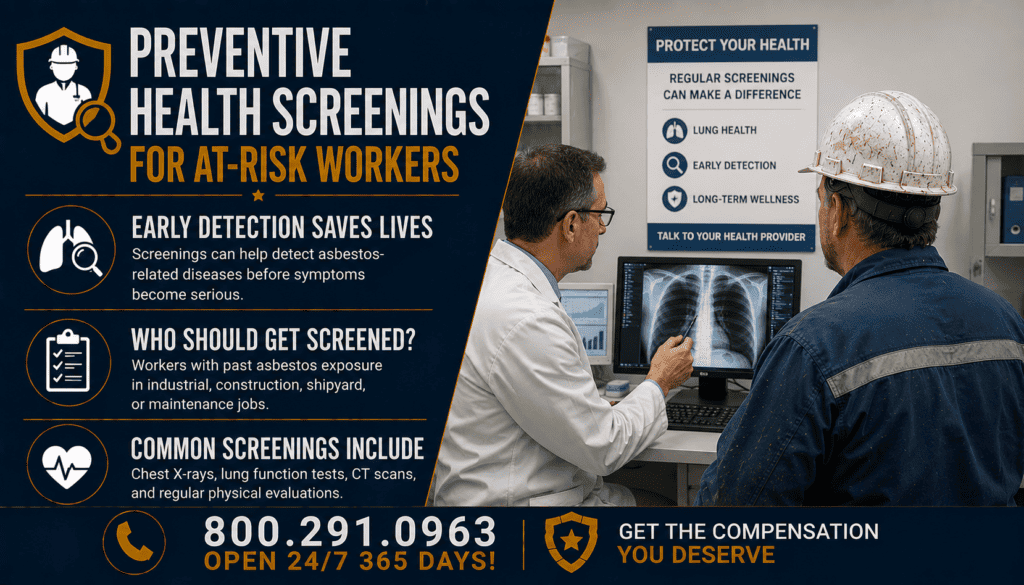
Preventive Health Screenings for At-Risk Workers
Workers with documented or suspected occupational asbestos exposure may have questions about medical surveillance, chest X-rays, pulmonary function testing and long-term health follow-up. OSHA requires medical surveillance for certain currently exposed workers covered by its asbestos standards, but the appropriate evaluation for a former worker should be determined individually by a qualified healthcare professional.
Screening and surveillance do not prove that asbestos exposure occurred, and OSHA cautions that adequate screening tests do not currently exist to determine whether an employee will later develop serious chronic asbestos-related cancer. Medical testing is most useful when combined with a detailed work and exposure history and interpreted by an appropriately qualified clinician.
Preventive Health Screenings for At-Risk Workers
Occupational health screening is intended to identify health changes that may warrant follow-up and, for active workers, can help identify situations where harmful exposure should be reduced or eliminated. Surveillance programs can also track health patterns among groups of workers with similar exposures.
For asbestos, the distinction between medical surveillance required by an occupational standard and elective clinical screening is important. OSHA’s general-industry asbestos standard requires a medical surveillance program for employees who are or will be exposed at or above specified airborne asbestos exposure limits.
Former workers who are no longer covered by an employer surveillance program should discuss their individual exposure history, age, smoking history, symptoms, other risk factors and appropriate medical follow-up with a qualified healthcare professional.
Related resources include worker safety, documentation and occupational resources, asbestos exposure in high-risk jobs and asbestos exposure in buildings.
OSHA Asbestos Medical Surveillance
Under OSHA’s general-industry asbestos standard, employers must institute medical surveillance for employees who are or will be exposed to airborne asbestos at or above the time-weighted-average or excursion limit. Required examinations and procedures must be performed by or under the supervision of a licensed physician, provided without cost to the employee and offered at a reasonable time and place.
Elements OSHA Requires in Covered General-Industry Examinations
- Medical and occupational work history
- Standardized respiratory-disease questionnaire
- Physical examination with specified areas of emphasis
- Chest radiography according to the standard’s requirements
- Pulmonary function testing, including FVC and FEV1
- Additional testing the examining physician considers appropriate
OSHA provides for pre-placement, periodic and termination examinations in covered general-industry circumstances. Periodic examinations are made available annually, while the frequency of required chest radiographs follows the age- and exposure-based schedule in the standard.
Construction and shipyard asbestos standards also contain medical-surveillance requirements, but coverage and details differ. Workers should not assume that one industry’s requirements automatically apply to another.
Medical and Occupational Work History
A detailed occupational history helps a healthcare professional understand whether asbestos exposure was plausible, when it may have occurred and what other respiratory hazards may have been present.
Information to Discuss With a Healthcare Professional
- Employers and approximate dates of employment
- Job titles, trades and daily duties
- Plants, shipyards, construction sites, military facilities or buildings
- Products, insulation, equipment and materials worked around
- Maintenance, repair, demolition or renovation activities
- Respiratory protection and other controls used
- Known air-monitoring or industrial-hygiene results
- Smoking history and other relevant respiratory exposures
OSHA’s medical-surveillance guidance emphasizes that physicians should understand the operating conditions in which occupational asbestos exposure is likely to occur. Work history is therefore not merely administrative information; it helps put medical findings into exposure context.
Workers reconstructing older employment can use personnel records, Social Security work history, union records when applicable, coworker statements, asbestos surveys and exposure-monitoring records. The related worker safety and occupational documentation resource explains these records in more detail.
Chest X-Rays and Occupational Surveillance
Chest radiography is one component of OSHA’s required medical-surveillance protocol for covered asbestos workers. The frequency is not simply “every year” for every worker; OSHA’s schedule varies according to age and years since first exposure.
NIOSH explains that chest radiographs are used in occupational respiratory surveillance and that specially trained B Readers classify chest images for pneumoconiosis using the International Labour Organization classification system.
Important Limitations
- A normal chest X-ray does not prove that asbestos exposure never occurred.
- A chest X-ray cannot predict with certainty whether cancer will develop later.
- Abnormal imaging requires medical interpretation and appropriate follow-up.
- Imaging findings do not by themselves identify the employer, product or jobsite responsible for exposure.
- The decision to obtain imaging outside a required surveillance program should be made with a qualified healthcare professional.
OSHA’s non-mandatory medical-surveillance appendix states that adequate screening tests to determine an employee’s potential for developing serious chronic diseases such as cancer from asbestos exposure do not presently exist. Chest X-rays can nevertheless provide information relevant to occupational respiratory health.
Need help now? Call 800.291.0963
Live chat available 24/7, 365 days a year.
Submit Your Case
Pulmonary Function and Spirometry Testing
Spirometry is a pulmonary function test that measures how well a person moves air into and out of the lungs. NIOSH explains that occupational spirometry can establish a baseline, track lung function over time and help evaluate workers with respiratory symptoms.
For covered workers under OSHA’s general-industry asbestos standard, required pulmonary function testing includes forced vital capacity (FVC) and forced expiratory volume in one second (FEV1).
What Spirometry Can Help Evaluate
- Baseline lung function before or during hazardous work
- Changes in lung function over time
- Breathing problems that may warrant further evaluation
- Fitness considerations related to respirator use when applicable
- Patterns among groups of workers in surveillance programs
Spirometry is not a test for mesothelioma and does not identify which workplace substance caused an abnormal result. NIOSH notes that a healthcare professional should analyze baseline and periodic results, explain them to the worker and determine when additional medical evaluation is appropriate.
Workers with new or worsening breathing symptoms should seek medical evaluation rather than relying on occupational screening information alone.
What Asbestos Screening Can and Cannot Show
Screening is sometimes misunderstood as a way to determine whether a healthy person will eventually develop mesothelioma or lung cancer. OSHA explicitly cautions that adequate screening tests to determine an employee’s potential for developing serious chronic disease such as cancer from asbestos exposure do not presently exist.
Screening May Help
- Document medical and occupational history
- Assess respiratory symptoms
- Measure lung function
- Identify some radiographic abnormalities
- Prompt further medical evaluation when appropriate
- Support efforts to prevent additional workplace exposure
Screening Does Not Automatically Establish
- That occupational asbestos exposure occurred
- The amount of asbestos a worker inhaled
- Which company, product or jobsite caused an exposure
- That a person will develop mesothelioma or lung cancer
- Legal causation or liability
- Eligibility for compensation
Medical surveillance and exposure documentation should therefore complement each other. A worker’s medical records address health; employment, product, industrial-hygiene and jobsite records address the circumstances of exposure.
Screening Records and Medical Follow-Up
Workers should keep copies of relevant occupational and medical records when available. Long latency between asbestos exposure and disease can make older records particularly important.
Records Worth Preserving
- Medical-surveillance examination results
- Chest-radiograph reports
- Pulmonary function and spirometry results
- Occupational and respiratory questionnaires
- Physician recommendations and follow-up instructions
- Exposure-monitoring results
- Employment and work-history records
- Asbestos surveys and industrial-hygiene reports
OSHA’s general-industry asbestos standard requires covered medical-surveillance records to be maintained for the duration of employment plus 30 years. Required asbestos exposure-monitoring records are maintained for at least 30 years.
Workers with abnormal findings, respiratory symptoms or significant exposure concerns should discuss next steps with a qualified healthcare professional. Testing should be individualized rather than selected solely from information on a website.
Occupational Documentation and Potential Claims
Medical screening records may become part of a broader occupational history, but they do not replace evidence identifying an asbestos source. A potential asbestos claim may also require employment records, product identification, jobsite evidence, exposure records and witness testimony.
Neither participation in screening nor an abnormal test result automatically establishes asbestos exposure, disease causation, liability, trust eligibility or compensation. Compensation is not guaranteed.
Related Worker Resources
Documentation: Worker Safety, Documentation & Occupational Resources
Occupational exposure: Asbestos Exposure in High-Risk Jobs
Selected occupations: Construction Workers Asbestos Exposure · Shipyard Workers Asbestos Exposure · Factory Workers Asbestos Exposure
Authoritative Sources
This page uses OSHA and NIOSH primary government guidance. OSHA’s asbestos standard defines medical-surveillance requirements for covered workers, while its medical-surveillance appendix explains both the value and limitations of chest radiography and pulmonary function testing. NIOSH provides occupational spirometry and chest-radiography resources.
- OSHA — Asbestos, 29 CFR 1910.1001
- OSHA — Medical Surveillance Guidelines for Asbestos, Appendix H
- OSHA — Medical Screening and Surveillance Requirements Guide
- NIOSH/OSHA — Protect Yourself: Spirometry Breathing Test
- NIOSH/OSHA — Spirometry Screening and Surveillance Resources
- NIOSH — B Reader Program and Occupational Chest Radiography
Asbestos Health Screening FAQ
Should every worker with possible past asbestos exposure get the same screening tests?
No. Appropriate evaluation depends on the person’s exposure history, current or former employment status, symptoms, age, other risk factors and clinical circumstances. A qualified healthcare professional should determine appropriate testing.
Does OSHA require medical surveillance for some asbestos-exposed workers?
Yes. OSHA’s asbestos standards require medical surveillance for certain covered workers who meet specified exposure or work criteria.
What is included in OSHA’s general-industry asbestos medical surveillance?
For covered workers, the standard includes medical and work history, a respiratory questionnaire, physical examination, chest radiography according to the required schedule, pulmonary function testing and additional tests the physician considers appropriate.
Can a chest X-ray predict whether a worker will develop mesothelioma?
No. OSHA states that adequate screening tests do not currently exist to determine an employee’s potential for developing serious chronic diseases such as cancer from asbestos exposure.
What does spirometry measure?
Spirometry measures lung function, including how much and how quickly a person can move air. It can help identify respiratory changes but does not diagnose mesothelioma or identify the source of an occupational exposure.
Are asbestos medical-surveillance examinations always annual?
Under OSHA’s general-industry standard, periodic medical examinations for covered employees are made available annually, but required chest-radiograph frequency follows a separate age- and exposure-based schedule.
How long are covered asbestos medical records retained?
OSHA’s general-industry asbestos standard requires covered medical-surveillance records to be retained for the duration of employment plus 30 years, while required exposure-monitoring records are kept for at least 30 years.
Does medical screening prove eligibility for an asbestos claim?
No. Medical information may be important, but a claim generally also requires evidence addressing occupational exposure, causation and the requirements of the applicable legal or trust process. Compensation is not guaranteed.
Get Help Reviewing Occupational Asbestos Exposure
Call 800.291.0963
Live chat is available 24/7, 365 days a year.
Prior work in an at-risk occupation, participation in medical surveillance or an abnormal screening result does not automatically prove asbestos exposure, disease causation, liability, claim eligibility or compensation. Each situation depends on the work history, exposure evidence, medical evidence and applicable legal requirements. Compensation is not guaranteed.
⚕️ Legal & Medical Information Disclaimer
This page provides general educational information and is not medical or legal advice. The information does not establish asbestos exposure, diagnosis, causation, liability, claim eligibility or compensation. Medical concerns should be discussed with a qualified healthcare professional, and legal questions should be reviewed with a qualified attorney.