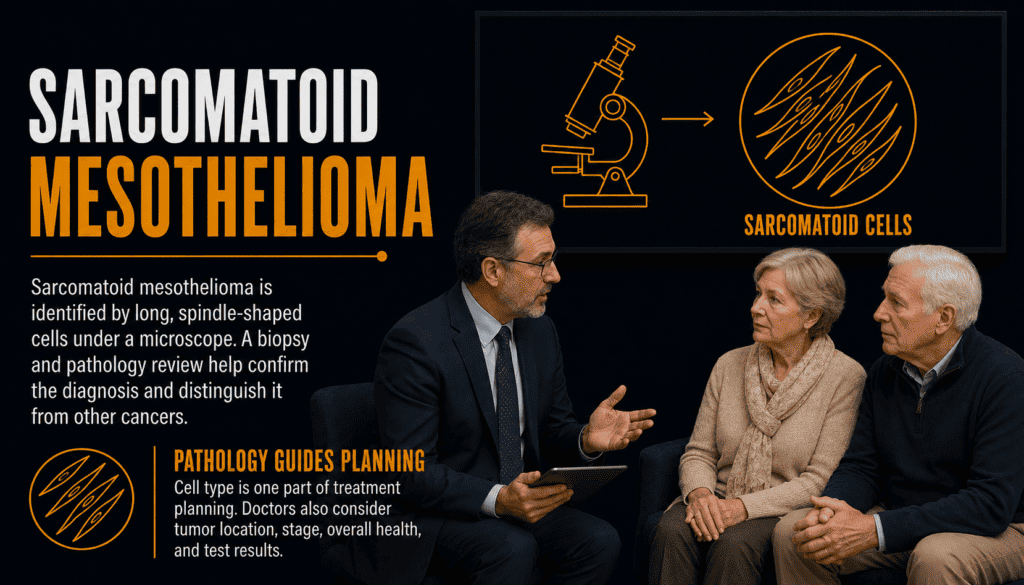
🧬 What Is Sarcomatoid Mesothelioma?
Understanding Sarcomatoid Mesothelioma: From Exposure to Legal Help
Sarcomatoid mesothelioma is a rare and aggressive form of mesothelioma, found in about 10–20% of all diagnosed cases. This subtype develops from spindle-shaped cells that are disorganized and scattered, making it more resistant to treatment and quicker to spread than other cell types. It can occur in the pleura, peritoneum, or other body linings.
Source: American Cancer Society
🛠️ How Do People Get Sarcomatoid Mesothelioma? (Causes & Progression)
The leading cause of sarcomatoid mesothelioma is asbestos exposure—commonly through direct occupational contact or secondary household exposure.
Here’s how exposure turns into disease:
Asbestos materials are disturbed
Construction, ship repair, and industrial maintenance release asbestos fibers from insulation, cement, or brake materials.
Fibers are inhaled or swallowed
Once airborne, these sharp fibers are breathed in or ingested—often without the person realizing it.
Fibers reach tissue linings
Fibers embed in pleural or abdominal linings and cannot be expelled, starting chronic inflammation and tissue scarring.
Dormant for decades
Over 20–50 years, the fibers trigger genetic mutations, eventually forming cancerous sarcomatoid cells.
Symptoms eventually develop
Pain and breathing issues worsen quickly as the cancer grows aggressively and spreads.
Mesothelioma is diagnosed
Biopsy and pathology confirm the sarcomatoid subtype through cell shape and behavior analysis.
🏗️ Common Sources of Exposure:
-
Shipyard and Navy vessel work
-
Industrial boiler rooms and power plants
-
Construction demolition and renovation
-
Auto repair shops (brake/clutch dust)
-
Family exposure from work clothing
Even limited asbestos contact may cause sarcomatoid mesothelioma decades later.
Source: OSHA – Occupational Safety and Health Administration
⚠️ Early Signs and Symptoms
Sarcomatoid mesothelioma progresses quickly and causes intense symptoms:
-
Persistent chest or abdominal pain
-
Difficulty breathing
-
Fatigue or weakness
-
Cough or hoarseness
-
Swelling and fluid buildup (effusion)
-
Weight loss and decreased appetite
Symptoms often appear late and may be confused with other illnesses, delaying diagnosis.
🧪 How Sarcomatoid Mesothelioma Diagnosed
This aggressive cell type is harder to diagnose and often requires expert pathology:
-
Imaging: CT, PET, or MRI scans show tumor size and spread
-
Fluid Analysis: Testing pleural or peritoneal fluid for cancer cells
-
Biopsy: Surgical or needle biopsy provides tissue for diagnosis
-
Histology & Immunohistochemistry: Identifies sarcomatoid spindle-shaped cells
Source: NIH Study
📊 Stages of Sarcomatoid Mesothelioma
Staging reflects tumor location and spread:
-
Stage 1: Rarely detected this early; tumors are small and localized
-
Stage 2: Cancer spreads to nearby tissues or organs; limited surgical success
-
Stage 3: Advanced local spread, often with lymph node involvement
-
Stage 4: Distant metastasis to organs like liver, bones, or brain—treatment is palliative
Sarcomatoid cells spread faster and are less responsive, reducing long-term survival.
💉 Treatment Options for Sarcomatoid Mesothelioma
This subtype is harder to treat than epithelioid:
Surgery:
Often not an option due to fast spread and poor surgical margins, but attempted in early-stage cases.
Chemotherapy:
Standard regimens like Pemetrexed + Cisplatin may help slow progression but are less effective in sarcomatoid cells.
Radiation Therapy:
May help relieve pain or reduce tumor mass in specific areas but is rarely curative.
Immunotherapy:
Drugs like Opdivo + Yervoy have shown some promise, especially in sarcomatoid pleural mesothelioma (CheckMate 743 Trial).
Palliative Care:
Used frequently to manage pain, breathing, and quality of life as tumors advance.
📈 Life Expectancy & Survival Rates for Sarcomatoid Mesothelioma
-
Average survival: 4–12 months
-
With treatment: Some live up to 18 months
-
Without treatment: Median survival often under 6 months
-
Most aggressive of the three main cell types
Source: American Cancer Society
💰 Cost of Treatment for Sarcomatoid Mesothelioma
Due to intensity of care, costs may exceed $250,000–$600,000:
-
Hospital stays and ICU care: $50K+
-
Chemotherapy & Immunotherapy: $100K–$200K+
-
Palliative support and oxygen therapy
-
End-of-life care, travel, and medication costs
Legal compensation may help offset high medical bills.
⚖️ Legal Help and Compensation
Despite its rarity, sarcomatoid patients may receive compensation:
-
Asbestos Trust Funds – Part of over $30 billion available
-
Lawsuits or Settlements – Average $1M–$2.5M for valid claims
-
VA Claims – For veterans exposed in military service
-
Wrongful Death Lawsuits – Available for surviving families
MesotheliomaHelp.org – Legal Guide
📚 Lawsuit Examples for Sarcomatoid Mesothelioma
Steel Mill Worker — $9.6 Million Verdict (2021)
Details: Developed sarcomatoid pleural mesothelioma after years in high-heat areas with asbestos.
Outcome: Jury awarded compensation for negligent exposure.
Source: Bloomberg Law
Shipyard Electrician — $8.4 Million Settlement (2019)
Details: Diagnosed after decades in enclosed ship compartments filled with asbestos-lined wiring.
Outcome: Resolved through civil trial and trust fund.
Source: Mealey’s Litigation Report
Navy Veteran — $7.8 Million Verdict (2020)
Details: Exposed to asbestos pipe insulation in ship boiler rooms.
Outcome: Found equipment manufacturer liable.
Source: HarrisMartin Publishing
Brake Mechanic — $6.3 Million Verdict (2018)
Details: Diagnosed with sarcomatoid mesothelioma after years of handling asbestos brake pads.
Outcome: Auto part distributor held responsible.
Source: VerdictSearch
Refinery Operator — $10 Million Verdict (2022)
Details: Long-term asbestos exposure in refinery pumps and gaskets.
Outcome: Multinational supplier found at fault.
Source: National Law Review
🔬 Research and Ongoing Studies
-
CheckMate 743: Shows immunotherapy helps sarcomatoid patients more than chemo
-
Targeted Drug Trials: Exploring new anti-tumor drugs specific to cell type
-
Histology Reviews: Improving subtype classification to avoid misdiagnosis
-
Genomic Studies: Searching for gene mutations that drive sarcomatoid growth
Explore trials at: ClinicalTrials.gov
📍 Final Prognosis
Sarcomatoid mesothelioma is the most aggressive and least treatable subtype. Survival is shorter, but some patients benefit from immunotherapy and palliative support.
Expert legal guidance can ease the financial burden and bring justice for exposure victims.
👨⚖️ How a Mesothelioma Lawyer Can Help
A skilled asbestos lawyer can:
-
Identify asbestos products or materials linked to your job
-
File trust claims or lawsuits for sarcomatoid victims
-
Assist families with wrongful death claims
-
Meet strict legal deadlines—no fee unless your case wins
-
Pursue maximum compensation for medical and legal recovery
📞 Free Legal Help for Sarcomatoid Mesothelioma Victims
If you or a loved one have been diagnosed with sarcomatoid mesothelioma, you may be entitled to major compensation—even decades after exposure.
Call Now: 800.291.0963
• No upfront fees
• No costs unless we win
• Exposure investigation included
• Help for laborers, veterans, families
Or request help online 24/7