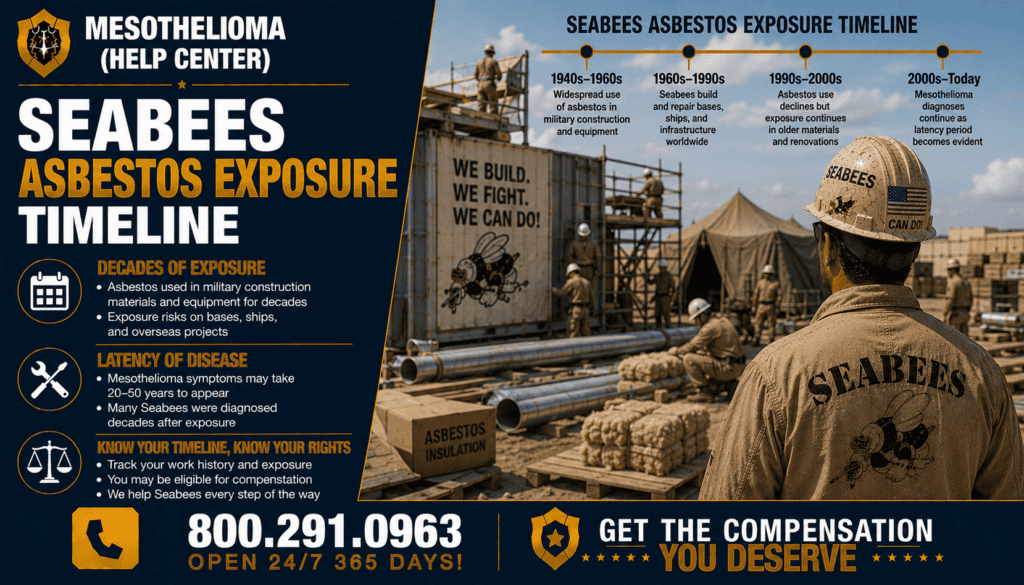
🗓️ Seabees Asbestos Exposure Timeline
Building a clear asbestos exposure timeline can help U.S. Navy Seabee veterans and families reconstruct where, when and how possible exposure may have occurred. Because mesothelioma and other asbestos-related diseases can develop decades after exposure, a timeline is often one of the most useful ways to organize military service, jobs, projects, materials, equipment, medical history and supporting evidence.
A useful Seabee timeline should connect dates, duty stations, battalions, ratings, construction projects, equipment, asbestos-containing products, maintenance work and later medical events. It should avoid assuming exposure based only on branch of service, rank or building age.
The goal is not simply to list every assignment. The strongest timeline identifies the periods where the veteran was most likely to have encountered disturbed asbestos-containing materials and links those periods to records that can be verified.
This page is part of the broader U.S. Navy Seabees Asbestos Exposure guide.
📌 Why a Seabee Asbestos Exposure Timeline Matters
An exposure timeline helps turn scattered memories and records into a structured history that can be reviewed for medical, VA and legal purposes.
- Shows when the veteran served in each battalion or unit.
- Links duty stations to specific construction projects.
- Identifies changes in rating, trade or responsibilities.
- Connects jobs to possible asbestos-containing products or equipment.
- Separates military exposure from later civilian exposure.
- Helps identify coworkers and supervisors from the same period.
- Clarifies whether renovation, demolition or maintenance occurred.
- Creates a framework for comparing service records with medical history.
A timeline does not prove exposure by itself, but it can reveal where the strongest evidence is likely to exist.
🎖️ How to Organize Seabee Service by Period
Start with the veteran’s service dates and divide the record into distinct periods based on battalion, assignment, location and duty changes.
1. Entry and Training
Record enlistment, initial training, technical school and the veteran’s first Seabee rating or assignment.
2. First Duty Assignment
Identify the battalion, base, construction site and daily duties during the veteran’s first operational assignment.
3. Deployments and Transfers
List each overseas deployment, temporary duty assignment, transfer and major project in chronological order.
4. Promotion or Job Changes
Note when the veteran moved into supervisory, technical or equipment-specific responsibilities that may have changed the type of exposure.
5. Final Military Assignments
Document the veteran’s last duty stations, separation date and any final maintenance, construction or demolition assignments.
6. Post-Service Work
Record civilian jobs after military service so military and nonmilitary exposure sources can be evaluated separately.
🔧 How Jobs, Products and Equipment Fit Into the Timeline
Each period of service should include the veteran’s daily work and the materials or equipment associated with that work.
| Work Type | Products or Components to Investigate | Related Page |
|---|---|---|
| Construction | Flooring, roofing, cement products, insulation, ceilings | Seabees Construction Workers Asbestos Exposure |
| Mechanical repair | Brakes, clutches, gaskets, packing, engine components | Seabees Mechanics Asbestos Exposure |
| Pipefitting | Pipe insulation, flange gaskets, valve packing | Seabees Pipefitters Asbestos Exposure |
| Electrical work | Panels, switchgear, insulation, heat-resistant components | Seabees Electricians Asbestos Exposure |
| Welding | Heat-resistant blankets, insulation, gaskets, packing | Seabees Welders Asbestos Exposure |
| Heavy equipment | Brakes, clutches, gaskets and machine components | Seabees Heavy Equipment Operators Asbestos Exposure |
For each job period, record the specific product, machine, manufacturer, model, building or mechanical system whenever possible.
📍 How Bases, Projects and Deployments Fit Into the Timeline
Location is important because asbestos exposure research often depends on the exact building, construction project, facility or equipment present during a specific period.
🏢 Military Bases
Document barracks, warehouses, housing, maintenance buildings, utility structures and administrative facilities. See Seabees Military Bases Asbestos Exposure.
✈️ Airfields
Include runway construction, hangars, maintenance buildings, power systems and support facilities. See Seabees Airfield Construction Asbestos Exposure.
⚓ Ports and Harbors
Include piers, docks, pump houses, warehouses, utilities and equipment areas. See Seabees Port & Harbor Construction Asbestos Exposure.
🌎 Overseas Construction
Record country, installation, deployment dates and exact project. See Seabees Overseas Construction Asbestos Exposure.
🪖 Wartime Construction
Document conflict, campaign area, damaged buildings, rapid repairs and demolition activity. See Seabees Wartime Construction Asbestos Exposure.
❄️ Cold-Weather Construction
Include heating systems, insulated piping, generators and maintenance in enclosed facilities. See Seabees Cold Weather Construction Asbestos Exposure.
⏳ How Asbestos Latency Affects the Timeline
Asbestos-related diseases often develop many years after exposure. This long latency means that a veteran diagnosed today may need to reconstruct work performed decades earlier.
- Exposure may have occurred many years before symptoms developed.
- The most important service period may be far earlier than diagnosis.
- Multiple exposure periods may exist.
- Military and civilian exposures should be listed separately.
- Repeated lower-level exposures may be relevant when documented.
- Diagnosis timing should be recorded separately from exposure timing.
Long latency is one reason detailed records and witness statements can be especially valuable.
🫁 Medical History and Diagnosis Timing
A complete timeline should also include the veteran’s medical history related to asbestos disease.
- Date symptoms first appeared.
- Date of first chest imaging or specialist evaluation.
- Date of biopsy or pathology testing.
- Date mesothelioma or another asbestos-related disease was diagnosed.
- Major treatment dates.
- Date disability or VA claims were filed.
- Date of death, if applicable.
Medical timing can be important when evaluating service connection, legal filing deadlines and wrongful death claims.
💬 Need Help Building a Seabee Exposure Timeline?
The strongest timeline connects service dates, duty stations, jobs, products, equipment, witnesses and medical history in one chronological record.
Call 800.291.0963, use live chat 24/7, 365 days a year, or Submit Your Case for a free, confidential review.
📂 Records Used to Build a Seabee Exposure Timeline
- DD214 and military personnel records.
- Battalion and unit histories.
- Duty-station and deployment records.
- Construction project files and work orders.
- Building plans and specifications.
- Equipment inventories and maintenance logs.
- Parts catalogs, manuals and procurement records.
- Photographs, maps and personal records.
- Coworker, supervisor and family statements.
- Medical, pathology and treatment records.
When exact records are missing, contemporaneous photographs, unit histories, equipment manuals and witness statements may help narrow the likely work conditions.
⚖️ How the Timeline Supports VA and Legal Claims
🎖️ VA Benefits
A timeline can help show the connection between military duties, asbestos exposure and a later asbestos-related diagnosis. See Seabees VA Benefits for Mesothelioma.
⚖️ Mesothelioma Lawsuits
A legal investigation can use the timeline to identify products, manufacturers, jobsites and potential defendants. See U.S. Seabees Mesothelioma Lawsuit.
🏦 Asbestos Trust Fund Claims
Trust claims may require evidence showing when and where the veteran encountered products connected to a particular company. See Seabees Asbestos Trust Fund Claims.
🕊️ Wrongful Death Claims
For families, a clear timeline can help preserve exposure evidence after the veteran’s death. See Seabees Wrongful Death Asbestos Lawsuit.
⏳ Filing Deadlines
Diagnosis and death dates should be included because they may affect civil filing deadlines. See Seabees Asbestos Statute of Limitations.
❓ Seabees Asbestos Exposure Timeline Questions
What is the first date to put on a Seabee asbestos timeline?
Start with enlistment and initial training, then add each battalion, duty station, deployment and major job change in chronological order.
Should the timeline include every military assignment?
Yes, but highlight periods involving construction, renovation, demolition, mechanical maintenance, equipment repair or other work where asbestos-containing materials may have been disturbed.
Should civilian jobs be included?
Yes. Civilian employment should be listed separately so military and nonmilitary exposure sources can be evaluated accurately.
How detailed should product information be?
As detailed as possible. Manufacturer, model, product name, part number, building, equipment type and work task can all strengthen the record.
What if exact dates are unknown?
Use the narrowest reliable range supported by records or memory and clearly label approximate dates rather than presenting them as exact.
Why include medical dates?
Diagnosis, treatment and death dates may affect VA evidence, legal strategy and filing deadlines.
Can family members help build the timeline?
Yes. Family members can help document household routines, take-home exposure, treatment history and records the veteran discussed or preserved.
Can a timeline prove asbestos exposure by itself?
No. It is an organizing tool. Exposure should still be supported with product, worksite, equipment, witness or other evidence whenever possible.
🚀 Turn a Seabee Service History Into a Clear Exposure Timeline
📞 Organize the Dates, Jobs, Locations, Products and Medical History
If you or a loved one served with the U.S. Navy Seabees and later developed mesothelioma or asbestos-related lung cancer, a detailed chronological timeline can help identify the strongest periods and sources of possible exposure.
- Service dates — enlistment, battalions, deployments and separation.
- Jobs and projects — construction, maintenance, equipment and repair work.
- Products and equipment — insulation, gaskets, packing, brakes, clutches, buildings and machinery.
- Medical history — symptoms, diagnosis, treatment, claims and death date when applicable.
Call 800.291.0963 now, use live chat 24/7/365, or Submit Your Case for a free, confidential case review.
⚕️ Legal & Medical Information Disclaimer
This page provides general educational information and is not legal or medical advice. A timeline can help organize evidence but does not by itself prove asbestos exposure or legal responsibility.