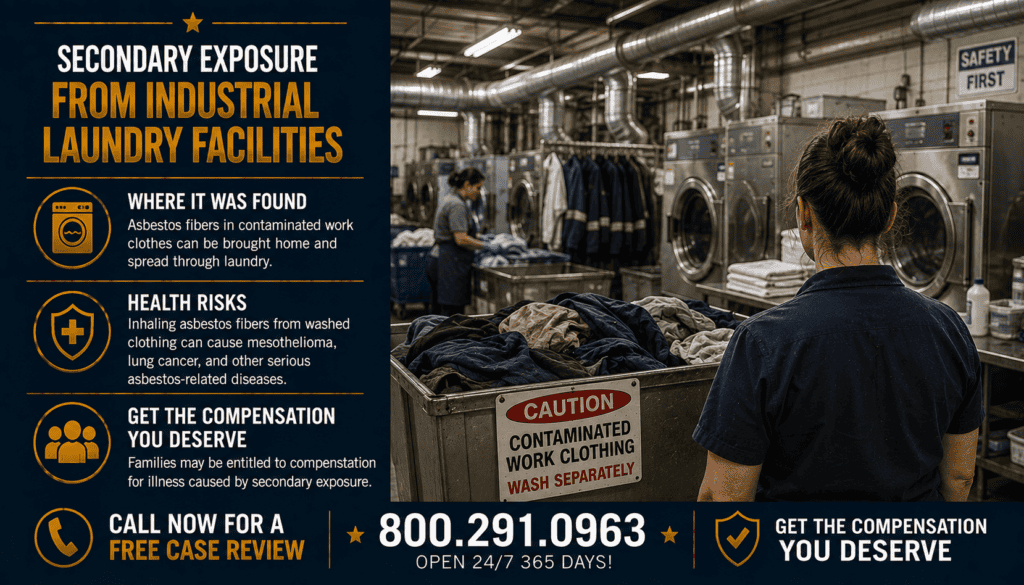
Secondary Asbestos Exposure From Industrial Laundry Facilities
Industrial laundry facilities can become part of an asbestos exposure history when they receive work clothing contaminated at another workplace. Historically, uniforms, coveralls and protective garments from factories, shipyards, construction operations, power plants, refineries and other industrial settings could be sent away for commercial laundering. Workers who sorted, handled or cleaned contaminated clothing could encounter dust even though they never worked at the original asbestos job site.
This pathway should be investigated carefully rather than assumed. The important questions are where the clothing came from, whether the source workplace involved asbestos, how garments were transported and handled, which laundry employees had contact with them, what controls existed, and whether a diagnosed person also had other occupational or household exposure.
🧺 How Industrial Laundry Exposure Could Occur
Industrial laundries may handle work clothing from multiple employers and industries. If clothing arrived contaminated with asbestos fibers, employees could potentially encounter fibers while unloading containers, sorting garments, transferring clothing between machines, cleaning equipment or performing housekeeping.
OSHA’s current general-industry asbestos standard specifically addresses laundering contaminated clothing. It requires laundering to be performed so that airborne asbestos is not released above the applicable permissible exposure limits and requires an employer sending contaminated clothing to another person for laundering to inform that person of the required controls and potential harmful effects.
For the broader legal and exposure framework, visit Secondhand, Family & Environmental Asbestos Lawsuits.
🏭 Where Contaminated Work Clothing Came From
The laundry facility is only one part of the exposure chain. A useful investigation begins with the industries and customers that supplied clothing. Potential historical sources could include shipyards, asbestos-product manufacturing, insulation work, construction, boiler and power-plant operations, refineries, foundries, railroads and other workplaces where asbestos-containing materials were disturbed.
A customer relationship alone does not prove that the clothing contained asbestos. Match the customer, work period, employee tasks and asbestos source as closely as possible.
👷 Industrial Laundry Workers at Risk
Potentially relevant jobs can include sorters, laundry operators, route or delivery workers, washroom employees, dryer operators, maintenance mechanics, cleaners and supervisors who regularly entered contaminated-clothing areas.
Job title alone is not enough. Record where the person worked inside the facility, what garments were handled, whether bags were opened, whether clothing was shaken or sorted, how often the work occurred and what ventilation or protective measures existed.
👕 Sorting and Handling Contaminated Clothing
Handling clothing before washing can be important because dust on garments may be disturbed during dumping, sorting, shaking, folding or transferring. Current OSHA rules prohibit removal of asbestos from protective clothing by blowing or shaking and require contaminated clothing to be handled and transported under specified controls.
Historical practices should be documented as remembered rather than reconstructed from today’s requirements. Current standards demonstrate recognized control methods but do not automatically prove what a particular laundry was legally required to do decades ago.
💨 How Fibers Could Become Airborne
Asbestos fibers deposited on clothing can be disturbed by movement. NIOSH has documented take-home contamination as a pathway by which workplace substances, including asbestos, can travel on clothing, shoes and other items.
For an industrial laundry claim, the question is whether asbestos-contaminated garments reached the facility and whether the diagnosed worker or family member experienced a meaningful pathway of contact. Visible dust alone cannot identify asbestos.
🌀 Washers, Dryers and Laundry Equipment
Historical exposure questions can extend beyond initial sorting. Investigators may examine washers, dryers, ventilation, lint collection, garment-transfer areas and equipment-cleaning practices. Maintenance workers may also have entered areas where dust accumulated.
A machine’s presence does not establish asbestos exposure. Facility records, customer accounts, industrial-hygiene data, housekeeping procedures and firsthand testimony can provide stronger context.
🏢 Shared Laundry Areas and Cross-Contamination
Industrial laundries may process clothing from multiple customers. If contaminated industrial garments were handled in the same building as other clothing, investigators may ask whether sorting areas, carts, work surfaces, ventilation or equipment allowed contamination to move beyond the original garments.
Cross-contamination should not be assumed merely because clothing shared a facility. Evidence should identify the layout, workflow, timing and actual handling practices.
🏠 Secondary and Take-Home Exposure From Laundry Work
A second exposure stage could occur if a laundry employee carried workplace contamination home on clothing, shoes, hair or personal items. CDC/NIOSH defines take-home exposure as workplace contamination entering homes or vehicles on a worker’s body, clothes, shoes or other items and specifically includes asbestos among recognized take-home hazards.
For a household history, document whether the laundry worker changed or showered before leaving work, whether work clothing entered the home, who washed it, where shoes were stored and whether the family shared a vehicle.
See Legal Options After Secondary Household Asbestos Exposure.
⚖️ OSHA Rules for Asbestos-Contaminated Clothing
Current OSHA general-industry rules contain detailed controls for contaminated protective clothing. Under 29 CFR 1910.1001, covered employers must prevent employees from taking contaminated work clothing out of required change rooms except for authorized laundering, maintenance or disposal. Contaminated clothing must be stored in closed containers that prevent dispersion.
OSHA further requires laundering to prevent airborne asbestos releases above the applicable permissible limits. An employer sending contaminated clothing to another person for laundering must inform that person of this requirement and of the potentially harmful effects of asbestos exposure.
These current provisions are useful safety context. Whether they applied to a historical exposure depends on the dates, industry, work and law then in effect.
📦 Bagging, Labeling and Transport
Current OSHA rules require contaminated clothing being transported for cleaning, maintenance or disposal to be placed in sealed impermeable bags or other closed impermeable containers and labeled as required by the standard.
For a historical investigation, route sheets, customer contracts, delivery manifests, laundry bags, labels, photographs and employee recollections may help show how industrial garments reached the facility.
🏭 Source Employer and Laundry Employer Questions
An industrial laundry exposure history can involve at least two workplaces: the source employer whose operations contaminated the clothing and the laundry employer whose employees handled it. The legal responsibilities of those entities can differ.
Workers’ compensation rules may affect claims involving a person’s own employer. Separate claims against third parties can raise product, premises, negligence or other theories depending on jurisdiction and facts. Do not assume that identifying one employer resolves the entire liability analysis.
🧩 Product Manufacturers and Other Third Parties
An investigation may also examine manufacturers or suppliers of asbestos-containing products used at the source workplace, contractors responsible for relevant work, premises owners and other entities. Each connection should be supported independently.
Evidence that a laundry received uniforms from a factory does not identify which asbestos product, if any, contaminated those garments. Product identification generally requires additional historical evidence.
📁 Evidence for an Industrial Laundry Exposure History
Build the history from both ends: identify the laundry worker’s job and identify the industrial customers whose clothing entered the facility. Then look for evidence connecting those customers to asbestos-containing work during the same period.
| Evidence | Potential use | Limitation |
|---|---|---|
| Payroll/personnel record | Confirms laundry employment and period | Does not prove contaminated clothing |
| Customer list/contract | Shows industrial customer relationship | Does not prove garments contained asbestos |
| Route sheet | Connects clothing pickup to customer | May not identify worker or contaminant |
| Industrial-hygiene report | Documents measured conditions | Must match location, task and period |
| Coworker testimony | Can describe actual handling practices | Limited to firsthand knowledge |
| Source-site records | Can identify asbestos materials/processes | Still must be connected to garments and time |
🧾 Records That May Help Reconstruct Exposure
- Industrial laundry payroll and personnel files
- Customer contracts and account lists
- Pickup and delivery route records
- Invoices and billing records
- Safety manuals and training documents
- Industrial-hygiene or air-monitoring records
- Ventilation and equipment-maintenance records
- Workers’ compensation or incident files
- Historical photographs of sorting and wash areas
- Source-employer asbestos and product records
- Union and pension records
- Former coworker contact information
👥 Coworker and Family Witnesses
Former laundry employees may remember which industrial customers supplied heavily soiled garments, how bags were opened, whether clothing was shaken or sorted, what protective equipment was used and how the building was cleaned.
Family witnesses may help document whether the laundry employee returned home in work clothing, where garments and shoes were stored and who handled household laundry. Preserve firsthand recollections without supplying details a witness does not independently remember.
🚪 If the Laundry Facility Closed
A closed laundry does not necessarily end the investigation. Records may survive with successor companies, former owners, insurers, unions, pension administrators, property owners, customers, government agencies or former employees.
Historical business directories, property records and corporate filings may also help identify the correct company name and operating years before more specific records are requested.
🚫 What Laundry Evidence Does Not Automatically Prove
- Working at an industrial laundry does not prove asbestos exposure.
- Receiving clothing from an industrial customer does not prove the garments contained asbestos.
- Visible dust cannot identify asbestos by appearance.
- A current OSHA requirement does not automatically establish the historical legal duty.
- A customer invoice does not prove a particular employee handled that customer’s clothing.
- A source workplace’s use of asbestos does not by itself prove fibers reached the laundry.
- A mesothelioma diagnosis does not identify the responsible source or company by itself.
🗓️ Building a Two-Stage Exposure Timeline
Industrial laundry cases can require two connected timelines. The first reconstructs how clothing became contaminated at the source workplace. The second reconstructs how the laundry employee—or a member of that employee’s household—encountered the clothing.
| Stage | Questions to document |
|---|---|
| Source workplace | Employer, industry, asbestos products, worker tasks, dates |
| Transport | Who collected garments, containers, route, frequency |
| Laundry facility | Sorting, washing, drying, cleaning, ventilation, employee location |
| Take-home pathway | Work clothes, shoes, vehicle, household laundry, family contact |
| Medical history | Diagnosis and other possible occupational/environmental exposures |
For general evidence reconstruction, see How to Document Your Asbestos Exposure History.
✅ Industrial Laundry Exposure Checklist
- Record the laundry’s exact name and address.
- Identify years of employment and job titles.
- Describe actual sorting, washing, drying and cleanup tasks.
- Identify industrial customers remembered from the relevant period.
- Record how contaminated clothing arrived and was stored.
- Document whether garments were shaken, sorted or brushed before washing.
- Identify ventilation, dust-control and protective practices.
- Search customer contracts, route sheets and invoices.
- Preserve industrial-hygiene and safety records.
- Locate former coworkers and supervisors.
- Investigate asbestos sources at customer workplaces separately.
- Document work clothing and take-home practices of laundry employees.
- Preserve family recollections of household laundry routines.
- Record other occupational, household and environmental exposures.
- Check legal filing deadlines promptly.
❓ Frequently Asked Questions
Can industrial laundry workers be exposed to asbestos?
Potentially, if they handled clothing contaminated with asbestos fibers. The source of contamination and the worker’s actual contact need to be established.
Does OSHA regulate laundering of asbestos-contaminated clothing?
Yes. Current OSHA general-industry rules require contaminated clothing to be laundered so airborne asbestos is not released above applicable permissible limits and require specified information to be provided to the person doing the laundering.
Can contaminated clothing be transported loose?
Current OSHA rules require contaminated clothing covered by the standard to be transported in sealed impermeable bags or other closed impermeable containers and appropriately labeled.
Does working at a commercial laundry prove asbestos exposure?
No. The investigation must connect the laundry to contaminated garments and connect the worker to handling or conditions capable of exposure.
Could a laundry worker bring asbestos home?
Take-home contamination is a recognized occupational pathway. CDC/NIOSH includes asbestos among substances that can be transported from work on clothing, shoes, the body or other items.
Who might have been exposed inside the laundry?
Depending on workflow, sorters, machine operators, route workers, maintenance employees, cleaners and others in contaminated-clothing areas may warrant investigation.
What if the laundry handled uniforms from many companies?
Identify customers and periods as specifically as possible. Contracts, route records, invoices and coworker testimony can help narrow the source.
Can a customer list prove asbestos contamination?
No. It establishes a business relationship. Additional evidence is needed to determine whether asbestos-contaminated garments were sent to the laundry.
What if the laundry closed decades ago?
Records may survive with successors, insurers, unions, pension plans, former customers, property owners or former employees.
Can family members of laundry workers have secondary exposure?
Potentially. A household history should document whether work clothing or shoes came home, who handled them and how often the contact occurred.
Do current OSHA rules prove a historical laundry violated the law?
No. Historical legal duties must be evaluated under the rules that applied to the relevant industry, place and time.
What evidence should a diagnosed person preserve?
Preserve employment records, customer information, coworker contacts, household exposure details, medical records and any documents identifying asbestos use at source workplaces.
📞 Request a Case Evaluation
If you or a family member has been diagnosed with mesothelioma after working at an industrial laundry—or after living with a laundry worker—gather the laundry name, employment dates, job duties, industrial customers, coworkers, clothing-handling practices and any household laundry history.
Call 800.291.0963 for a no-obligation case evaluation and to talk to a real person 24/7, 365 days a year. Many mesothelioma law firms handle qualifying cases on a contingency-fee basis; confirm the fee agreement and terms directly with the firm you retain. Submit your case here.
📝 Summary
Industrial laundry facilities can form an intermediate asbestos exposure pathway when contaminated work clothing travels from an asbestos workplace to a commercial laundry. A careful investigation connects the original industrial source to the garments, the garments to the laundry facility, and the laundry work to the person who experienced exposure. A second take-home pathway may also require investigation when a laundry employee carried contamination into a household. Customer records, route sheets, employment documents, industrial-hygiene records, witnesses and source-workplace evidence can help reconstruct this chain without assuming that all industrial laundry work involved asbestos.
🔗 Confirmed Sources
- OSHA — 29 CFR 1910.1001, Asbestos
- CDC/NIOSH — About Take-Home Exposures
- NIOSH — Protect Your Family: Reduce Contamination at Home
Disclaimer: General information only—not legal or medical advice. This website is not a law firm. Employment at an industrial laundry does not by itself establish asbestos exposure, disease causation or legal responsibility. Occupational standards, workers’ compensation rules, liability law and filing deadlines vary by jurisdiction and time period. No prior result guarantees a future outcome.